Mark Miller, Sam Holley (2023). Deficits in Cognitive Resilience of Commercial Pilots: The Case for Adding a Computer Information and Automation Tenet in Digital Flight Operations. In: Human-Centered Aerospace Systems and Sustainability Applications. AHFE Open Access, vol. 98, pp. 74–84. https://doi.org/10.54941/ahfe1003921
Enhanced proficiency for commercial pilots operating in advanced digital technology flight operations is needed to address potential deficits in cognitive resilience. Cognitive resilience is needed when cognitive flow is disrupted or when unanticipated situations occur resulting in cognitive overload or confusion. The researchers propose adding a Digital Flight Deck Management tenet to the current Crew Resource and Threat Error Management model that would focus on successful responses to disruptive effects from computer information and automation operations. The researchers analysed these effects via three approaches. First, a human factors analysis applied an upgraded SHELL model to identify issues that affect cognition, situational awareness, and decision making. Second, evaluating data extracted from NTSB accident reports and ASRS GPS databases, an aviation safety analysis showed the commercial flight industry has become safer, but incidents involving computer information and automation error have increased by as much as 72%. Third, recent trends were examined to assess potential threats in the form of cyber-attacks, digital interference and loss of digital systems that affect digital flight operations. Movement toward efficiency gains are driving forces for increased use of digital information and automation. When considering the evolution and transition of the human-machine collaboration on the digital flight deck, and development of single pilot operations or distributed crewing for commercial flight, the researchers propose augmenting the CRM/TEM model by incorporating a Digital Flight Deck Management tenet to address potential deficits in cognitive resilience, situational awareness, and decision making.
Reliance on computer-generated information and systems automation has generated increasing situations where pilots encounter mode confusion, unexplained flight control deviations, conflicting systems data, and simi- lar cognitive challenges. Other digital flight deck (DFD) concerns related to increased digital information and automation have resulted in cognitive over- load, compromised situational awareness, and reduced crew effectiveness
Deficits in Cognitive Resilience of Commercial Pilots 75
(Miller and Holley 2018). The ability and capacity for pilots to resolve technological conflicts or unanticipated DFD irregularities requires cogni- tive resilience. Cognitive resilience is ubiquitous in the literature as it relates to organizations, degenerative brain conditions, late adulthood, stroke, learning disabilities, mindfulness training, and various operating systems. Neurologi- cally, cognitive resilience is derived from the neural capacity for refraction (Forsberg et al., 2016), which might be only seconds to achieve stability (via the thalamus and basal ganglia). For this paper, the model of cognitive resi- lience developed by Parsons (2016) is fitting and describes the significance of cognitive mapping that serves to integrate information. Resilience indica- tes how effectively an individual recognizes and responds to adversity which often manifests as perceived discrepancies between a situation and the mental map of the individual. On the DFD, the time available for resolution is limi- ted and typically stressful. Given the differences in experience and response characteristics among multi-crewed operations, cognitive resilience is likely to vary markedly. To better understand the deficits confronting pilots on the DFD, the authors evaluated evidence for disruptive events affecting cogni- tive processes. A human factors analysis of digital flight deck operations and cognitive challenges was performed. Then, a safety data analysis was completed using recent data from accidents and self-reports. Last, a trend analysis to identify sources of unanticipated computer and automation dis- ruptions revealed several active threats. Based on the findings, a need for expanded Crew Resource Management (CRM) training was evident and an additional Management tenant is suggested for the Threat and Error mana- gement (TEM) Model which also considers the transition to more entwined human-machine relationships.
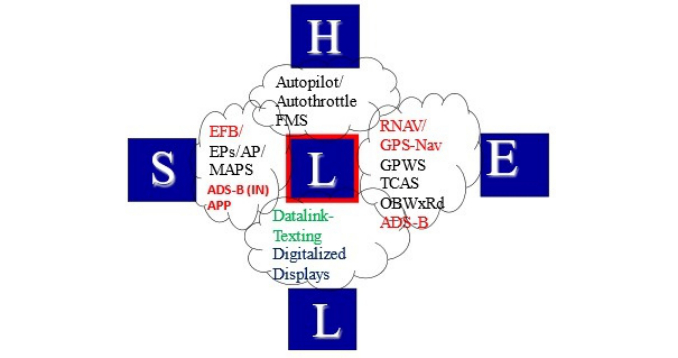
HUMAN FACTORS ANALYSIS OF THE DIGITAL FLIGHT DECK In analyzing the current state of digital information and automation, it is imperative to recognize how quickly changes can occur on a commercial DFD where efficiency and flight safety can change into a potential threat to flight operations which may induce human error. The current comme- rcial DFD has evolved from a primary human-machine interface that involved direct linkages among the SHELL (Software, Hardware, Environment, Live- ware) components to multiple influential interactive digitized layers (clouds depicted in Figure 1).
The human-machine evolution on the flight deck accelerated with flight management systems, auto-pilot and auto-throttle, and soon were followed by safety enhancements like ground proximity warning systems, traffic alert and collision avoidance systems, and on-board weather radar. During the same period digitized information was enhanced with LCD and combined screens. Electronic flight bags (EFB) with copious flight information were added. More than ever, these digitized computer enhancements have required pilots to become proficient managers of the human-machine interface (HMI). Currently the commercial DFD is in a digital upgrade by integrating the FAA’s NextGen air transportation system that requires all participating aircraft to use ADS-B (Out) to track aircraft positions via satellite digital signals. ADS-B
76 Miller and Holley
Figure 1: Updated SHELL 2017 with computer information and automation (Miller 2017).
(In), which is not mandatory, gives pilots updates through their EFB. This gives the pilot visual information on other aircraft, terrain and weather live on the EFB device. The information evolution in the commercial DFD has also added digitized communications like Datalink texting. The modern DFD has become more optical, as illustrated in Figure 1 and the SHELL linkages are more crowded with digital data. The clouds depicting the new linkages are overflowing into one another becoming concatenated and posing new challenges for pilot cognition.
Digital Flight Deck Challenges Affecting Pilot Cognition Three major areas of cognition affected by computer information and auto- mation on the commercial DFD are cognitive flow, load and processing. Cognitive flow is a state where the operator feels in control, is focused, and enjoys the experience. When active, cognitive flow results in near optimal performance with reduced mental resourcing and capability to process infor- mation very efficiently. While features of the DFD can promote flow, when disrupted there can be severe consequences. In the case of Asiana Flight 261 (NTSB 2014) that crashed in San Francisco during 2013, the pilots executed a non-precision approach to landing due to an inoperative glideslope system. Less practiced in flying manually, the autothrottle was disengaged and engi- nes brought to idle wherein the aircraft did not maintain sufficient speed to land safely. Previous reliance of the pilots regularly using automation to land induced a disruption in their cognitive flow and revealed a lack of resilie- nce as conditions deteriorated. Another threat to cognition on the DFD is with cognitive load which relates to how much information a pilot can cycle actively in working memory before the neural capacity or available resources are overwhelmed. Two recent examples of this occurred with the Boeing 737 Max 8 crashes in Indonesia (2018) and Ethiopia (2019). In these catastrophic accidents of Lion Air Flight 610 and Ethiopian Airlines Flight 302 (NTSB
Deficits in Cognitive Resilience of Commercial Pilots 77
2019), the principal causal factor was failure of the automated Maneuvering Characteristics Augmentation System (MCAS) system. In both accidents a faulty angle of attack sensor triggered the automated MCAS to push the nose of the aircraft down and in both cases the pilots were unable to correct for the malfunctioning system. The DFD in both accidents immediately activated multiple emergency warning systems which overwhelmed the pilots as they experienced cognitive overload. While cognitive load is managed and redu- ced substantially by computer information and automation, failures in DFD systems can quickly surpass the threshold for effective cognitive processing and, absent resilience, inhibit pilots from comprehending and responding to accumulating data from multiple digital sources. For domain specific infor- mation, the human brain has a processing capacity between 2 to 60 bits per second (bps) used for attention and decision-making, including perceptual and language processing, and can rapidly become overtaxed when experi- encing novel or confusing data (Fan 2014). As the DFD continues to add more digitized information and automation that requires close monitoring it is becoming an optical challenge that requires exceptional scanning tech- nique to process information without overload. The dangers of this higher visual optical processing load is evident in Air France Flight 447 (BEA 2012) that crashed in 2009. Icing obstructed the pitot tubes and the aircraft’s digital indicated airspeed was no longer accurate. This condition automatically dea- ctivated the autopilot causing the pilot flying to increase the angle of attack resulting in a stall while, simultaneously the nonflying pilot could not over- ride control inputs. The abundance of digital visual clues requiring cognitive processing, which included multiple different auditory and sensory warnings on the DFD at night with no visible horizon, was displaced by pilot confusion and absence of resilience.
Digital Flight Deck Cognitive Challenges and Situational Awareness In the accidents reviewed here, computer information and automation pla- yed a major role in affecting crew cognition. In all four cases the DFD and the humans were interacting safely until events affecting digital information and automation disrupted cognitive flow, load and processing. A different challenge is where automation influences situational awareness (SA), typi- cally in three different aspects: by decreasing vigilance, inducing a passive instead of an active role, and altering the form of feedback provided to the operator. In their seminal study, Endsley and Kiris (1995) researched threats to aviation by assessing out-of-the-loop performance with level of control in automation. They studied how regular use of automation could handicap operators when reverting to manual operations during automation failure. They attributed loss of skills and SA to lack of vigilance and complacency. At the time it was thought that automation increases in commercial DFD would lessen workload and the reduced interaction along the HMI would increase SA. However, Endsley and Kiris noted that different levels of human intera- ction with automation prompted varied reactions in the three levels of SA. For example, there was one level where human interaction with automation reduced workload and the operator maintained SA. Their study measured SA
78 Miller and Holley
among five levels of workload in relation to automation. Findings indicated that the higher the levels of automation used, requiring the least interaction and which reduced workload, resulted in the lowest levels of SA before a simulated automation failure. The more interaction with automation by the operator, the higher the SA. Partial human interaction with automation still produced relatively high levels of SA and maintained an equilibrium between automation workload reduction and substantial levels of SA. After 30 years, the same issues with digital automation still exist. Consequently, it suggests the need to establish balance in automation workload and SA on the DFD through improved ergonomic design and enhancing CRM/TEM to maintain safe levels of SA that promote resilience and do not invite cognitive disruption and overload.
In a highly automated flight environment, like the DFD, a sudden fai- lure is likely to provoke a startle response by the flight crew. This effect results in confusion and a delayed and sometimes insufficient or inappro- priate response before recovery action is taken. A surprise can also occur when a pilot observes information that is not aligned with or contradi- cts the shared mental model or cognitive maps of the operators and their expectations. These may be the result of undetected malfunctions or faulty operator inputs. Using HFACS, data from ASRS for 257 landing incidents involving seven different aircraft manufacturers and eleven types of inci- dents, Woods and Sarter (2000) revealed the highest frequency of decision errors was associated with inappropriate procedures and inadequate kno- wledge of systems (49.4% at Level 1) and failing to prioritize attention (47.5% at Level 2). Shortcomings in CRM were found in 60.7% of the inci- dents. These data strongly suggest that cognitive disruption is indicated as a precursor to decision errors and that resilience was absent to an effective degree.
SAFETY DATA ANALYSIS OF ERROR AND MALFUNCTIONS
Table 1 summarizes data from NTSB and ASRS identifying computer infor- mation and automation errors or malfunctions. From 2011 and 2021, there were a total of 197 Part 121 aircraft accidents in the United States. Among these, 12 were attributed to computer information and automation error as the primary cause per NTSB Final Accident Reports (NTSB 2022). This repre- sents 6% of all Part 121 accidents in the U.S. over the 10-year period. Of the seven fatal accidents, three were caused by computer information and automation error, equating to 43% of all Part 121 fatal accidents during the period which is evidence of human-machine error. Other aviation safety data
Table 1. NTSB and ASRS data on accidents and GPS malfunctions.
Table available in the original PDF paper.
NTSB (N = 197) 2011-2021 ASRS (N = 50 for March each year) 12 (6%) due to computer/automation error 2018: 9 (18%) GPS malfunction 3 of 7 fatal accidents due to computer/automation error
2022: 36 (72%) GPS jamming, interference, system loss
Deficits in Cognitive Resilience of Commercial Pilots 79
to support the potential threat from computer information and automation on the DFD is from ASRS data related to GPS Malfunctions (NASA 2022) that were reported anonymously. A batch of 50 ASRS GPS Malfunction inci- dents from March 2018 were analyzed and yielded 9 of 50 (18%) related to legitimate failures of the GPS system on commercial DFD that substantially affected flights, with little mention of jamming. Analysis of the same ASRS data category of GPS Malfunction incidents for March 2022 revealed 36 of 50 (72%) reports of related failures of the GPS system on commercial DFD affecting the flight. Of those, 24 (48%) were reported as jamming. Interfere- nce and system loss also were listed as reasons for the GPS failures. As noted in Table 1, GPS Malfunction reports by commercial pilots greatly increased between 2018 and 2022. Both the NTSB data and ASRS data analysis sup- port the serious potential aviation safety issue where computer information and automation malfunctions can become a threat to cognitive processing and resilience on the DFD.
TREND ANALYSIS FOR DIGITAL FLIGHT OPERATIONS While the human factors analysis and the aviation safety data analysis show that computer information and automation are becoming more of a poten- tial threat to the commercial DFD, current trends also support a similar threat for the future. One influential trend is that commercial aircraft ope- rating in U.S. airspace now require compliance with ADS-B (out) digital equipment which tracks each aircraft by using satellites instead of ground- based equipment and radar. The NextGen system provides pilots with digital information on their EFB displays. Unfortunately, the digital communicati- ons systems also invite potential for cyber-attacks, interference or jamming, and systems shutdowns. The current number of cyber-attacks on the mari- time shipping navigation systems increased 400% (Maritime Executive 2020) during 2020 for ships going into port globally, and 900% from 2017 to 2019, which should rightly alarm global aviation authorities. Likewise, the effect of 5G towers interfering with commercial aircraft GPWS in relation to ILS landing operations near 20 major airports in the Northeast U.S. in early 2022 also provides a warning for possible interference or jamming on the DFD. Concerned about compromised DFD, many airlines cancelled flights into 5G tower airports until the interference threat was mitigated (Gambrell and Koenig 2022). More recently, the FAA’s digital NOTAM system went offline on the night of 10 January 2023 and limited critical flight safety information of airports to pilots and airline dispatchers. This in turn cau- sed the FAA to ground 7000 flights until the system was fixed and operating safely the next day. Perhaps the biggest driving force affecting the DFD in the future is ergonomic design by manufacturers. Both of the world’s lar- gest aircraft manufacturers, Airbus and Boeing, are keen to continue adding new digital information and automation to the DFD, in part to move clo- ser to reducing the number of pilots on the flight deck. Airbus is promoting their new A350 model as a starting point for single pilot flight operations (SPO) and is supported by a computer-centered ergonomic design philoso- phy that envisions a SPO DFD in the future (Kaminski-Morrow 2021). The
80 Miller and Holley
last major trend is that CRM/TEM, in its current 6th generation, will be inte- grating more human-computer teamwork from the current human-human teamwork model while slowly trying to eliminate one more human from the commercial DFD to gain SPO. As the transition to upgrade computer information and automation on commercial DFD occurs, the CRM/TEM model will have to evolve. How it evolves could be meaningful to flight safety on the commercial DFD if an effective form of computer informa- tion and automation training is added. With the gradual transition of having more human-computer teamwork required, the authors propose that the next logical step in CRM/TEM design would be to integrate a much-needed DFD Management tenet to be fused with the current CRM tenets. An enhanced version of CRM/TEM could accommodate future influxes of digital infor- mation and automation and limit potential threats. A proficient CRM/TEM trained flight deck is one of the best strategies for commercial aviation to combat human error, and with the current trends supporting compu- ter information and automation it is now crucial to upgrade the current twenty-year-old model.
ENHANCING THE CRM/TEM MODEL TO PROMOTE SITUATIONAL AWARENESS AND COGNITIVE RESILIENCE Stemming from the disaster at Tenerife airport in 1977, and the 1978 United Airlines Flight 173 accident in Portland, NASA endorsed CRM training for U.S. airlines. The program began at United Airlines in 1981 and within 10 years had become a global standard. CRM is a systems-oriented approach that focuses on cognitive skills and interpersonal communications to enha- nce situational awareness, problem solving, decisions, and teamwork. As the industry evolved, so did CRM into its current 6th generation version including Threat and Error Management (Cusick et al., 2017).
The CRM/TEM model incorporates seven tenets, or characteristics, to reduce human error and is adopted by the U.S. Navy, U.S. Air Force, and most commercial operators. Tenets in the current model include: Situational Awareness, Decision Making, Assertiveness, Communications, Leadership, Team Management, Workload/Task Management, Stress Management and Mission Analysis. All are used to manage threats, although the tenets do not specifically address the cognitive disruption aspects or provide for cogni- tive resilience. The FAA has not promoted the addition of training for computer information and automation disruptions that result in cognitive processing delays or inability to respond and recover mentally. Conversely, in their current CRM advisory circular, which is almost 20 years old, the International Civil Aviation Organization has developed CRM training and management techniques that emphasize automation and advanced techno- logy flight decks (ICAO 2005). The European Aviation Safety Agency (EASA) has also placed great emphasis on improving CRM training in the areas of automation, monitoring and intervention, and related surprise or confusion effects (EASA 2017). Even so, aspects of techniques or training to achieve cognitive resilience are absent.
Deficits in Cognitive Resilience of Commercial Pilots 81 The addition of error management to the 5th generation of the CRM model, later expanded to include external threats in the 6th generation, cre- ated the current CRM/TEM version. In practice, the TEM tenets are used for pilots to identify known threats and determine strategies for preventing or resolving errors (Ma and Rankin 2012). Lacking in the current model are strategies to resolve computer information and automation threats that are less familiar, unlikely, or unknown. An added tenet could be useful for pilots to identify the error, determine if the cause is known, resource the problem resolution to avoid overload, and move toward cognitive resilience before being overcome in the situation. A new CRM/TEM tenet also would strengthen recovery from dangerous states of flight caused by trends identi- fied earlier such as jamming or interference. These situations then could be used in LOFT or LOSA training scenarios to develop cognitive resilience.
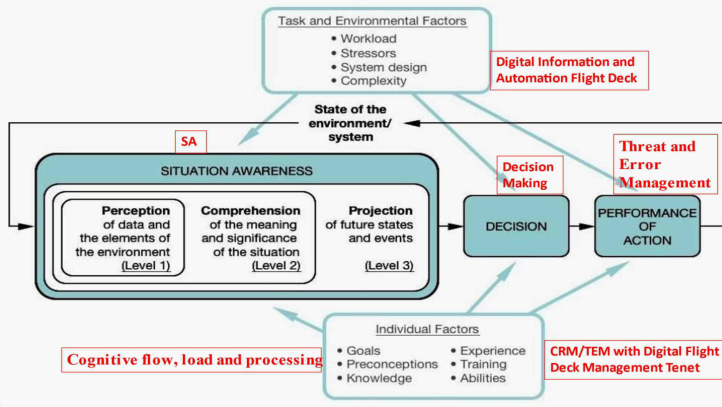
Considering the beneficial effects of an added tenet on DFD Management into the CRM/TEM, a further adjustment (shown in red) to Endsley’s model of SA Synthesis enhances that process and flow as illustrated in Figure 2.
Collectively, these adjustments could be expected to counter potential threats on the DFD regarding unexpected or sudden disruptions, promote resilience, and restore effective cognitive flow, load and processing. Perfor- mance actions (especially those related to the DFD) then would be based on much higher levels of SA and decision making (DM) along with TEM principles to manage threats.
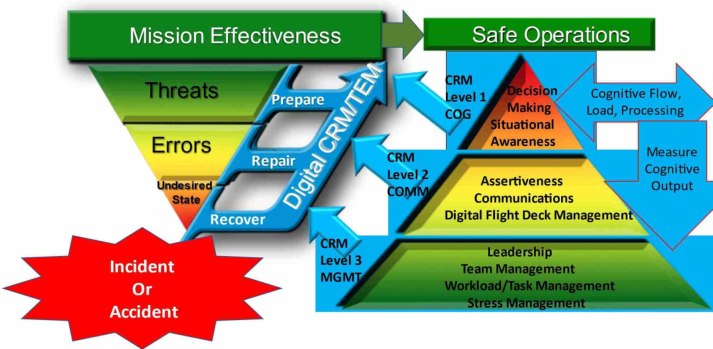
Enhanced Model of CRM/TEM for the Digital Flight Deck The enhanced DFD CRM/TEM model highlights and emphasizes the impor- tance of cognition as it relates to flight safety on a commercial DFD by placing the training tenets of CRM/TEM into a hierarchy with the cogni- tive skills (SA, DM, TEM) at the top, as these skills have a direct influence
Figure 2: Adapted from the Endsley (1995) model of SA with DFD CRM/TEM added.
82 Miller and Holley
Figure 3: Adapted from CRM/TEM skills model (Miller and Holley, 2021) with enhanced DFD CRM/TEM skill level hierarchy and DFD Management.
on flight safety. Accounting for the importance of the cognition-related CRM/TEM tenets would produce an enhanced model of DFD CRM/TEM as shown in blue in Figure 3. These cognitive skills now become prioritized and are grouped at the top of the CRM skill set as CRM Level 1 Cognition. Emphasis is placed on the importance of cognitive flow, load and proces- sing to facilitate and emphasize more attendant management. The new DFD Management tenet anchors the CRM level 2 Communications skill set which will place emphasis on improved Communications with the human and the computer on the DFD, along with the importance of Assertiveness. Just below the Communications skill set is the foundational skill set of CRM level 3 Management. This Management skill set is comprised of Leadership, Team Management, Workload/Task Management and Stress/Fatigue Management. All of the Management skill set tenets will be substantially influenced by the new DFD Management tenet.
CONCLUSION
The enhanced DFD CRM/TEM model poses an effective solution to address cognitive human factors analysis issues and threats that can arise during ope- rations related to the HMI on the commercial DFD. From a flight safety perspective, a DFD Management tenet is a way to optimize the use of TEM and could reduce incidents and accidents caused by pilots surrounded by computer information and automation competing for optically challenged cognitive space. The enhanced model incorporates adjustments to train to build resilience and successfully resolve disruptions or unanticipated challen- ges on the DFD that may lead to human or computer errors. The authors believe the proposed enhanced CRM/TEM model is flexible and constructed to adjust to ongoing and future trends that accompany the age of digital flight and growing collaboration of human-machine working relationships. The DFD would benefit from the enhanced DFD CRM/TEM and could
Deficits in Cognitive Resilience of Commercial Pilots 83
allow pilots a strategic edge by overcoming deficits in cognitive resilience and strengthening capabilities for resolving disruption and the related cognitive challenges to avoid HMI errors into the future.
REFERENCES
Bureau d’Entuetes et d’Analyses 2012. Final Report: Air France Flight 447 [online]. Available from: https://bea.aero/docspa/2009/f-cp090601.en/pdf/f-c p090601.en.pdf. Cusick, S., Cortes, A., Rodrigues, C. (2017). Commercial aviation safety. 6th ed.
New York: McGraw Hill. Endsley, M. (1995). Toward a theory of situational awareness in dynamic systems.
Human factors, 37(1), pp. 32–64. Endsley, M., Kiris, E. (1995). The out of the loop performance problem and level of control in automation. Human factors, 37(2), pp. 381–394. European Aviation Safety Agency 2017. CRM Training [online]. Available at: https://www.easa.europa.eu/en/document-library/general-publications/crm-tr aining-implementation/. Fan, J. (2014). An information theory account of cognitive control. Frontiers in
neuroscience, 8(680), pp. 1–16. Forsberg, H., Lindén, J., Hjorth, J., Månefjord, T. and Daneshtalab, (2020). Challenges in using neural networks in safety-critical applications. In: 2020 AIAA/IEEE 39th Digital Avionics Systems Conference (DASC), pp. 1–7. Gambrell J, Koenig, D. (2022). Airlines cancel some flights after reduced 5G rollout
in US [online], (19 January 2022). https://www.usnews.com/news/business/art icles/2022-01-19/airlines-worldwide-rush-to-change-flights-over-us-5g-dispute (accessed 01-29-2023). International Civil Aviation Organization 2005. Human Factors Training Manual (DOC 9683) [online]. Available at: https://store.icao.int/en/human-factors-traini ng-manual-doc9683ICAO. Kaminski-Morrow, D. (2021). A350F timeline in ‘right place’ for single-pilot ope-
ration: Faury [online], (15 November 2021). https://www.flightglobal.com/safet y/a350f-timeline-in-right-place-for-single-pilot-operations-faury/146419.article (accessed 29 January 2023). Ma, M., Rankin, W. (2012). Implementation Guideline for Maintenance Line Operations Safety Assessment (M-LOSA) and Ramp LOSA (R-LOSA) Programs [online]. Available at: https://www.faa.gov/about/initiatives/maintenance_hf/losa/ publications/media /losa implementation_guideline.pdf. Miller, M. (2017). Aviation human factors: The SHELL Model 2017 and compute-
r/human factors analysis, unpublished paper presented at: FAA Aviation Safety Conference. Honolulu, 23 June. Miller, M., Holley, S. (2018). SHELL revisited: Cognitive loading and effects of digitized flight deck automation. In: Baldwin, E., ed., Advances in Neuroergo- nomics and Cognitive Engineering. Cham, Switzerland: Springer International, pp. 95–107. Miller, M. Holley, S. (2021). Air traffic controller resource management: An appro-
ach for reducing cognitive loading and increasing situational awareness. In: Stan- ton, N., ed., Advances in Human Aspects of Transportation. Cham, Switzerland: Springer International, pp. 535–542. National Aeronautics and Space Administration 2022. ASRS Database Report Sets 2018 and 2022, Global Positioning System (GPS) [online]. Available at: https: //asrs.arc.nasa.gov.
84 Miller and Holley
National Transportation Safety Board 2014. Descent Below Visual Glidepath: Impact with Seawall Asiana Airlines Flight 214 [online]. Available from: https://www.ntsb.gov/investigations/AccidentReports/Pages/aviation.aspx. National Transportation Safety Board 2019. Assumptions Used in the Safety Asses-
sment Process and the Effects of Multiple Alerts and Indications on Pilot Perfor- mance [online]. Available from: https://www.ntsb.gov/investigations/accidentrepo rts/reports/ asr1901.pdf. National Transportation Safety Board 2022. NTSB Accident Database Accident Reports 2011-2021 [online]. Available at : https://www.ntsb.gov/Pages/Aviatio nQuery.aspx. Maritime Executive. (2020). Report: Maritime cyberattacks up by 400 Percent
[online], (29 June 2020). https:// maritime- executive.com/article/report-maritime- cyberattacks-up-by-400-percent (accessed 29 January 2023). Parsons, S., Kruijt, A., Fox, E. (2016). A cognitive model of psychological resilience.
Journal of experimental psychopathology, 7(3), pp. 296–310. Wichter, Z. (2023). What really caused the NOTAM system to go offline? FAA provides an update [online], (20 January 2023). https://www.usatoday.com/story/travel/airlin
e-news/2023/01/20/faa-update-notam-human-error/11088911002/ (accessed 29 January 2023). Woods, D., Sarter, N. (2000). Learning from automation surprises and “going sour” accidents. In: Sarter, N. and Amalberti, R., eds. Cognitive engineering in the aviation domain. Mahwah, NJ: Lawrence Erlbaum Associates, pp. 327–353.
LISTED IN THE AHFE DIGITAL BOOKSTORE CATALOGUE
Explore the complete digital volume
Human-Centered Aerospace Systems and Sustainability Applications
Read this individual research paper free through the original publisher, or explore the full digital proceedings book.
ISBN 978-1-958651-74-2
Explore this ISBN in the AHFE Bookstore ↗Listed in the July 2026 bookstore catalogue; search by ISBN to confirm current availability · Digital book purchase optional