Mark Miller, Michelle Hight (2024). Prospective Gains in Safety and Cost Management; Using the HFACS to Proactively Address Organization Influences that Cause Human Error. In: Safety Management and Human Factors. AHFE Open Access, vol. 151, pp. 147–157. https://doi.org/10.54941/ahfe1005311
Created from the original work of James Reason’s Swiss Cheese accident causation model featuring human error and latent organizational influences, the Human Factors Analysis and Classification System (HFACS) has become a proven model for analysing human error in aviation accidents. HFACS classifies human error into four levels of organizational influence that can set the stage for unsafe acts to occur. In modern terms of Safety Management Systems (SMS) proactivity, however, the HFACS is still utilized largely as a reactive accident investigation tool, focused on analysis of historical events to form ideas about system deficiencies and negative trends. This study emphasizes that human error on the bottom portion of the HFACS model often carries a substantial monetary and human cost to the organization, even when an aircraft is not involved in a classified accident. Here, the researchers sought a more proactive and systematic way of pre-identifying latent negative organizational influences causing the costliest human errors and finding mitigating solutions by tapping into front line perspectives. This project began with the development of a strategic aviation leadership course for a commercial aviation organization, “Airline X,” with the intent of gathering qualitative data to systematically address HFACS organizational influences that could lead to costly human error accidents and incidents. Researchers proposed top-down, proactive mitigations based on an extensive thematic analysis of front-line perspectives on various safety threats and other organizational deficiencies. After a year of collecting data from over 1,100 individuals during the leadership course through the Airline X pilot group, the qualitative data was compiled and analysed from the responses to two short surveys; one was given early in the course after guided discussions, and the other at the end of the course. The qualitative methodology enabled categorization of the pilots’ answers into common themes. Ten sub-themes were established, all related to organizational influences, then prioritized, and superimposed on the HFACS. During the study, sub-themes related to ramp safety literally manifested themselves in the form of two costly ramp incidents that resulted in revenue loss, as both aircraft were temporarily removed from service for repair. In a display of prescient, timely feedback from the pilot group and supporting accident data showing the direct cost of a potentially failed ramp policy (organizational influences) as evidence, the researchers recommended a continuous cycle of ‘Bottom up (reactive), Top down (proactive)’ Human Factors Safety Management Systems (HFSMS) feedback to senior and middle management to enhance the company’s existing SMS.
Commercial aviation safety has been evolving from a once reactive way of implementing safety measures in decades past, to a more proactive Safety Management System (SMS) model in this decade. The biggest challenge to modern commercial aviation safety remains latent, unanticipated human error which consistently accounts for upward of 80% of the industry’s accidents (Marais & Robichaud, 2012). In most cases, a forensic accident investigation methodology is still used to determine the cause of accidents. It is usually during this investigation that some form of human error is either determined to be the main cause or is closely linked to the main cause of the accident. James Reason (1990) proposed that human error was heavily influenced by various organizational deficiencies that set up all the precondi- tions necessary for the unsafe act to occur. In other words, the human errors most closely related to the accident were often linked strongly to seemingly innocuous, yet insensitive decisions made at the top of the organization by senior management. In the 1990s, military researchers analysed thousands of military, commercial, and General Aviation (GA) accidents after they had occurred, systematically classifying the most common human errors at all levels of the organization (Shappell & Wiegmann, 2001; 2003). This effort resulted in the creation of a tiered model they called the Human Factors Analysis and Classification System (HFACS), which helped them operational- ize Reason’s (1990) Swiss Cheese Model. The goal of HFACS was to move away from the ineffectual paradigm of attributing blame directly to the perpetrator of an accident, towards a more scientific approach to the com- plexity of human error causation in organizations. The HFACS is widely used in accident investigation across many industries to identify the array of organizational influences that can trigger error.
THE COST OF HUMAN ERROR Addressing the problem of human error in the airline industry is as rel- evant as ever but has substantially shifted in form since the 1970s when human factors research and understanding of accident causation was still in its infancy. After dozens of catastrophic human-caused fatal accidents, new regulations proposing training solutions emerged in the early 1980s. One such remedy was Cockpit Resource Management (CRM), which evolved into more advanced forms of Crew Resource Management (CRM) that are still trained and practiced today. Threat and Error Management (TEM) concepts emerged in the late 1990s, and along with other improvements in flight deck technologies and powerplant reliability, TEM transformed commercial avia- tion into the safest mode of transportation (Helmreich et al., 1999). Today, despite these improvements in human factors training for pilots, the threat of human error still looms large. Latent, sometimes hidden organizational deficiencies often prove quite costly, especially outside the flight environment where these costs are incurred most often (Reason, 1990; Britton, 2024). The International Air Transport Association (IATA),a trade association represent- ing the global airline industry, recently reported that airline profit margins will remain extremely thin for the foreseeable future, at a projected 2.7% in
Prospective Gains in Safety and Cost Management; Using the HFACS to Proactively 149
2023–2024; that amounts to approximately $5.45 profit on average for every revenue passenger flown (Ros, 2023). In an efficient and successful airline business today, human error is no longer just about inflight safety practices. Now, success must involve proactive error prevention at every level of the company (Helmreich et al., 1999; Britton, 2024). Many human error costs can be attributed to poor communication of strategic decisions at the higher levels of the organization, eventually leading to poor supervisory decisions at lower levels, which can increase the risk of front-line unsafe acts. Though far less publicized, human error occurs in dispatch, maintenance, ramp, load- ing, operations, and support roles—not just on the flight deck. Human error incidents and accidents occur consistently at all commercial air carriers and manifest as a cost burden, even if they do not end in a catastrophic, news- worthy event. If a tug bumps an aircraft on the ramp, the cost comes in the form of temporary removal from revenue service. A maintenance technician might miss one item, but the aircraft must be brought back in for an addi- tional inspection if the procedure was done incorrectly. An untrained, poorly supervised baggage handler can injure themselves lifting luggage improperly and require paid leave or even long-term disability. A weight and balance system can be mis-programmed, causing a flight efficiency issue, and thou- sands of extra pounds of fuel to be burned unnecessarily. At worst, an event like this could cause a tail strike upon take-off or a dangerous landing. Close calls and mistakes often go unreported or covered up for fear of punishment, and the underlying systemic causes of the error are never addressed. In many cases, companies have policy for after-the-fact safety management reactions, but many still do not have adequate tools to correct negatively impactful high-level strategic management decisions or poorly implemented supervi- sory practices before the resultant human factors incidents occur on the front line. In a new age of increasingly proactive SMS, it would be advantageous for top leaders in high-risk industries to focus more efforts on identifying and fixing latent, negative organizational influences before events occur, in the process enhancing safety and reducing costs (Britton, 2024).
MAKING HFACS MORE PROACTIVE Although the HFACS as an accident investigation tool is helpful for classi- fying and identifying organizational influences tied to the human error, and has been influential in enhancing aviation safety, its most common usage has been reactive–in the aftermath of an incident or accident. In today’s commer- cial airline industry, proactive efforts include Flight Data Monitoring (FDM) innovations such Flight Operations Quality Assurance (FOQA), anonymous incident reporting and Line Operations Safety Audits (LOSA), which provide observational data about threats faced by air crews, and any resultant human error. The present study suggests continuation of all such efforts in addition to a modified usage of the HFACS. The facilitated, small-group discussion techniques outlined here can be used to uncover latent threats and errors in cross-sectional or in cohort studies, measuring organizational cultural change over time. This methodology relies heavily upon a foundation of instructor- student and peer-to-peer trust and can be applied to diverse working groups
150 Miller and Hight
at all organizational levels, from ramp agents to C-suite executives. Process improvement solutions based on qualitative data like this can enhance safety and efficiency, help to meet regulatory requirements, and satisfy stakeholders who are heavily invested in the airline’s profitable revenue service.
LEADERSHIP TRAINING DESIGN AT AIRLINE X On February 25, 2020, the Federal Aviation Administration (FAA) issued a Pilot Professional Development Final Rule, directing airlines to imple- ment leadership and command training for pilots in command (FAA, 2020). The goal of the leadership course at Airline X was threefold: Satisfying the FAA’s ruling, enhancing leadership, followership, and mentoring skills for all pilots, and collecting qualitative organizational influence data to enhance the existing SMS.
The training development team understood the criticality of breaking down psychological barriers common in the highly unionized, often polar- ized airline industry. Previously at Airline X, there was a general distrust between employee labour groups and management. Honest, transparent and usable qualitative data gathering from employee labour groups at Airline X or any other similar unionized airline might have been impossible if not accom- plished through the methodology of trust-building facilitated discussion modules, and simple rapport building by listening. The core course devel- opers were experts with collective decades of experience in aviation human factors, organizational leadership, and clinical psychology. Importantly, the lead developer was also a professional pilot with front-line, relatable expe- riences in military and civil flying. This shared piloting and life experience balancing challenging priorities of job and family proved to be of paramount importance when gaining buy-in and trust, diffusing the “us-against-them” management versus union tension almost immediately.
Human factors training like this relies heavily upon human connection, and therefore the introductory module of the training was called “V + 10%” in which the present definition and etymological roots of the term “vul- nerability” were described and discussed, after a “fun fact about yourself” icebreaker. V + 10% is a concept coined by the developers of this course, asserting that wherever pilots are professionally and personally, they could likely use a 10% boost in their outwardly expressed vulnerability levels (E. Olson, personal communication, February 6, 2022). A growing body of business research and social science supports the fact that without openness, commitment to clarity of communication, and an authentic and appropriate level of vulnerability, leaders have a harder time establishing and maintain- ing trust on teams (Brown, 2015). In the Airline X leadership course, the instructor built rapport with participants by pitching and facilitating small group discussions on three key topics over the course of several hours, but the pivotal initiation of trust building relied upon the skillful execution of the introductory V + 10% topic. After the initial icebreaker and V + 10% introduction, the first discussion topic was ‘current events in the aviation industry.’ Participants were asked to pair up, identify and discuss their
Prospective Gains in Safety and Cost Management; Using the HFACS to Proactively 151
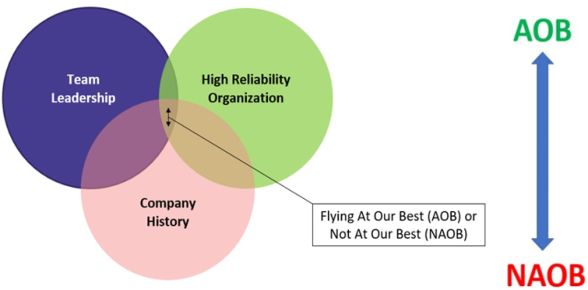
thoughts on various social and technological changes ranging from demo- graphics to automation to post-pandemic politics, and the implications of these sociocultural shifts for pilot-leaders. This current events module did not require introduction of new concepts or any complex lecture. It was simply used as a ‘warm-up’ exercise to initiate the group to facilitated dis- cussion techniques and pacing. Afterwards, instructional modules included three main topics, displayed graphically with a simple Venn diagram: Team leadership as described by Lencioni (2005), High Reliability Organizational (HRO) concepts for the aviation context, as described by Teske & Adjekum (2022), and finally, a discussion of positive and negative events throughout the company’s history. Each course module corresponding to a segment of the Venn diagram included another small group facilitated discussion based on a sliding scale between the “At Our Best” (AOB) and “Not At Our Best” (NAOB) extremes plotted on the scale (E. Olson, personal communication, February 6, 2022). Trainees were asked to discuss amongst themselves in groups of two or three what they thought were key concepts of the module, then record their thoughts on separate sticky notes, collaboratively. Finally, one group member walked to the front of the room to post their group’s notes on the board along the continuum between AOB and NAOB (see Figure 1). After the final module on company history, the discussion turned from sim- ple historical knowledge of the company to a holistic assessment of how their own senior management was currently performing. These perspectives were now weighed using their recent assimilation of knowledge about HRO pil- lars, team building concepts, and a greater depth of understanding of shared company history. The intersection between these three interrelated leader- ship constructs in the Venn diagram represented an ideal intellectual and professional balance for a flight crew leader to inhabit. Instructors termed this the ‘balance of leadership theory and practice’ that should be layered upon already existing technical expertise as a qualified airline pilot. This set of leadership skills, as a goal, was projected upon not only the pilots attend- ing the leadership course, but also implicitly imposed upon their managerial superiors. Discontents among the unionized pilot group emerged during the training; many pilots began to outwardly voice their concerns about senior leadership strategy and communication and were encouraged to channel those concerns into the data collection tool during the facilitated discussions. In this way, the discussions were kept professional and civil, and partici- pants understood the importance of their candid responses. The facilitator explained how the data would be compiled and reported anonymously to senior leadership in the company prior to delivering the surveys. Surveys are usually taken independently and impersonally, and pilots are often distrust- ing of this methodology, fearing retribution as IP addresses can be traced, and identities revealed. During Airline X’s leadership course, surveys were taken together in the same small groups they had formed during discussion mod- ules. The short three-question survey simply asked what the company should start doing, stop doing and continue doing to achieve continued success, as measured by these three previously discussed organizational leadership mod- ules. Pilots were asked to compile their perspectives collectively, then one person inputted the group’s agreed-upon answers to the survey questionnaire.
152 Miller and Hight
In this way, every participant was assured anonymity. This also stimulated lively group debate and discussion after the previous modules’ rapport and trust building, resulting in much richer consensus and arguably more valid qualitative results than if each participant had submitted their answers inde- pendently. Trainees in the course almost universally took the time to discuss and learn from one another’s perspectives in a very outward display of trust and listening skill, after just a few hours of training. The buy-in achieved by doing these peer-to-peer discussions manifested itself in the results. The effort and time taken in giving inputs to the questionnaire was quite profound.
Figure 1: Organizational leadership discussion modules presented on a scale from “AOB” to “NAOB” (E. Olson, EMO Advisors, February 2022).
DATA COLLECTION AND ANALYSIS This study involved five stages of data collection and analysis from Airline X, culminating with a compilation of recommendations based on results:
1) A six-hour leadership workshop for pilots, sponsored by the Airline X training department with two short surveys given at strategic points throughout the day of training. 2) Analysis of the qualitative survey data into themes and sub-themes, with resultant breakdown of theme percentages based on response frequencies. 3) Links created from qualitative themes to organizational influences in the HFACS, where appropriate. Additional safety data research for related human errors (accidents and incidents) on the bottom level of HFACS at Airline X, connected to the qualitative themes that emerged. 4) After the prioritization of themes, any serious safety or efficiency defi- ciencies and the linked organization influences would be revealed to departmental project management team(s) for further analysis of prob- lems and possible solutions. Even positive feedback using these methods can be informative and important for continued business success. 5) Once informed of latent issues, leaders must respond with deliber- ate transparency to solve identified problems and to keep lines of communication open across all organizational levels to reinforce trust.
Prospective Gains in Safety and Cost Management; Using the HFACS to Proactively 153
6) Over time, this methodology could replace traditional climate assess- ment surveys that companies deliver via email without personal connec- tion or trust. When highly incentivized, these surveys can produce usable but often incomplete data, usually with minimal participation rates.
After a full year of teaching the course to the pilot group, the qualita- tive survey data were analysed and three major themes emerged: Safety and Operations (SO), Human Resources (HR), and Strategic Management and Leadership (SL). Under the SO Theme, four sub-themes emerged related to pilot training: Increasing the use of technology to meet industry standards, flying efficiently, safely and on time, and maintaining safety standards. Under the HR theme, three sub-themes emerged: Improving employee relations with other employee groups and management, investing in employees’ future (pay and benefits), and the need to stop mixing staff and line service duties on the ramp. Under the SL Theme, three sub-themes emerged related to maintaining the authentic company customer service experience: Listen, be transparent, innovate, and diversify route structure.
After qualitative themes and sub-themes emerged, quantitative percent- ages of each theme and sub-theme were calculated to reflect frequency of its appearance. The SO theme accounted for 27.3% of the answers. The HR theme accounted for 19.5% of the answers. The SL theme accounted for 53.2% of the answers. Even though the SO and HR themes were well addressed by the pilot group, the SL theme emerged as the focal point of the pilot group’s attention, appearing in over half of their responses. Under the SO theme, additional sub-themes were identified, with pilot training at 7.9%, increasing the use of technology at 7.4%, flying efficiently safe and on time at 5.7% and maintaining safety standards at 6.3%. Under the HR theme, the sub-themes were focused on improving employee relations with other employee groups and management at 5.3%, investing in employees (pay and benefits) for the future at 5.7%, and the need to stop mixing staffing and line service duties on the ramp at 8.5%. Under the SL theme, sub-themes were: Maintaining the authentic company customer service experience 12.6%, lis- tening more and becoming more transparent and innovative 16.8%, and diversifying route structure at 23.7% (see Table 1).
Table 1. Qualitative survey data extracted from airline X leadership course for pilots.
Table available in the original PDF paper.
Qualitative Sub-themes with linked HFACS Organizational Influences % Improve Pilot training-Organizational Processes 7.9 Improve technology to industry level-Resource Acquisition Mgmt. 7.4 Flying efficiently safe and on time-Organizational Processes 5.7 Maintaining safety standards-Organizational Processes 6.3 Improve employee relations-Resource/Acquisition Mgmt. 5.3 Invest in employees (pay and benefits)-Resource Acquisition Mgmt. 5.7 Stop mixing duties on ramp-Resource Acquisition Mgmt. 8.5 Maintaining authentic customer service-Organizational Climate 12.6 Listen, be more transparent and innovative-Organizational Climate 16.8 Diversify route strategy-Organizational Climate 23.7
154 Miller and Hight
IDENTIFICATION OF SUB-THEMES TO HFACS AND PRIORITIZED
1) Pilot Training-Organizational Processes, Organization Training Issues 2) Increasing the use of technology-Resource Acquisition Management, Operator Support 3) Flying efficiently safe and on time-Organizational Processes, Ops Tempo, and Workload 4) Maintaining safety standards-Organizational Processes, Safety Program Policy 5) Improving employee relations with other employee groups and management-Resource/Acquisition Management, Operation Support 6) Investing in employees (pay and benefits) for the future-Resource / Acquisition Management, Financial 7) Mixing staffing and line service duties on ramp-Resource / Acquisition Management, Operations Support 8) Maintaining company customer service experience-Organizational Cli- mate, Organizational Values and Culture 9) Listen more and be more transparent and innovative—Organizational Climate, Organization Values and Culture 10) Diversify flight routing—Organizational Climate, Mission.
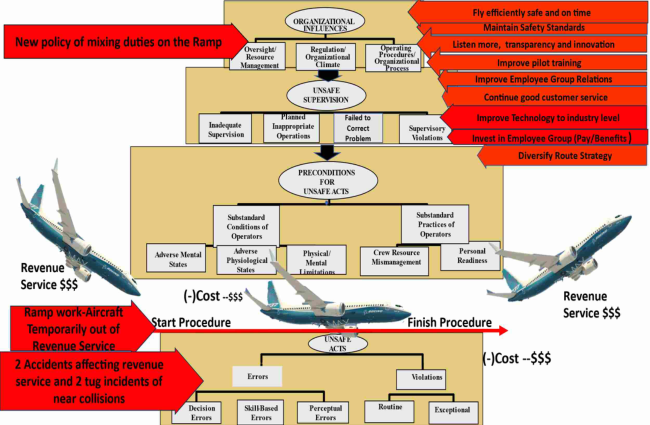
Sub-themes linked to HFACS organizational influences were prioritized (ranked) according to the frequency of survey responses. The company’s financial situation at the time contributed to the ranking with sub-themes linked to the highest priority being outside the sphere of company finances. The highest theme appears on the left of Figure 2 (in red) while those on the right (in red) were ranked lower, yet still represented significant latent organizational influences: 3, 4, 9,1, 5, 7, 2, 8, 6, 10.
Figure 2: Bottom up / top down HFSMS ramp issues analysis, adapted from (Shappell & Wiegmann, 2003, p. 71).
Prospective Gains in Safety and Cost Management; Using the HFACS to Proactively 155
CORRELATING HFACS THEMES WITH INCIDENT & ACCIDENT DATA During this yearlong study, two separate incidents involving ramp operations occurred. After the initial data analysis from surveys was complete, newly updated safety data obtained through the SMS reporting process were applied to certain sub-themes, and rankings readjusted where evidence of serious threats to safety or economic efficiency emerged. While the pilot group men- tioned the sub-theme “mixing staffing and line service duties on ramp” 8.5% of the time in their responses, studying the problem more revealed that Air- line X had previously employed a group of highly trained ramp agents that had been tasked specifically with aircraft pushback procedures. Recently, due to high-level leadership strategy far removed from the front line, their jobs had been expanded and diversified to all ramp duties, presumably for man- ning efficiency purposes. Any ramp employee could now quickly qualify to perform pushback procedures. Training for these procedures was haphazard amid poor company communications about the entirely new written pol- icy. Many of the pilots in the leadership course noted a rapid deterioration in quality and safety of ramp control—especially during pushback proce- dures. Many survey comments noted this as an insensitive act of senior level organizational influence. During the leadership course, a series unsafe acts occurred on the ramp that pilots attributed to policy change. An aircraft sustained damage to the undercarriage during pushback, requiring it to be removed from service to repair and inspect the damage. Later, a cargo box was launched into the nose of a passing aircraft, again forcing removal from service. Two close calls of tug drivers nearly hitting wings were also reported. Learning of the costly incidents and close calls on the ramp warranted that the sub-theme, “mixing staffing and line service duties on ramp” be moved up in ranking. See Figure 2 (Bottom up / Top down HFSMS ramp issues analysis) of Airline X.
RECOMMENDATIONS FOR SYSTEM IMPROVEMENT With the sub-themes linked to organizational influences on the HFACS and prioritized, the question remained: How does this airline manage high priority organizational influence threats efficiently and effectively? The researchers suggest appointing process improvement team(s) within the com- pany to collaborate and make recommendations to top strategy and policy owners. This presupposes a top leadership group that is open and recep- tive to both negative and positive feedback, willing to innovate and change, and through the process, communicate with vulnerability and transparency. This process improvement team would engage employees as co-authors of solutions to identified sub-themes (problems). Makeup of such a team would be critical to a successful outcome. Grouping safety-minded man- agers, front line agents, and airline union members would reduce the potential for bias. A representative from the Airline X Emergency Response Commit- tee trained in human factors and accident investigation could help ensure that theory is adequately understood and applied to the broader team rec- ommendations. The committee should also analyse incidents by type of error: Decision errors, skill-based errors, perceptual errors, and violations
156 Miller and Hight
(Shappell & Wiegmann, 2003). During this analysis, the group could use the scientific method to hypothesize, test, then work to implement practi- cal solutions. How, for example, is a new ramp policy carried out on in training and supervisory (reinforcement) levels? Potentially flawed policy would also be analysed, and improvements made systematically and proac- tively. Finally, they would be tasked with determining preconditions for future errors including, for example, practices and tasks, technology in use, physical environment, and supervision (Shappell & Wiegmann). Using a Bottom- up and Top-down methodology, they could seek the metaphorical holes in Reason’s (1990) Swiss cheese with a modified, more proactive use of the HFACS model, here termed the ‘HFSMS’ overlay model.
CONCLUSION AND IMPLICATIONS FOR FUTURE STUDY In this study, the ramp safety example illustrates how qualitative, perspective- seeking feedback can provide almost prescient insights into latent threats. This data becomes even more powerful as a safety and efficiency catalyst when coupled with an established SMS program. The importance of rap- port and trust building cannot be understated—trust and buy-in are vehicles for gaining valuable qualitative data from diverse employee groups. Future studies using the Bottom up Top Down HFSMS overlay, alongside training techniques empowering employees to contribute their unique insights will continue to renew and reinforce existing human factors theory, helping to create ever more practical, proactive, revenue-supportive SMS for airlines. Indeed, implications of this study reach beyond the airline industry. When truly quantified, the cost of undiscovered ‘latent’ organization influences (especially in a high-risk, low profit margin environment) outweighs the cost of these process improvement efforts.
REFERENCES
Brown, B. (2015). Daring greatly: How the courage to be vulnerable transforms the way we live, love, parent, and lead. Penguin books, ISBN 978-1592408412. Britton, T., (2024). 5 Components of Safety Culture in Aviation SMS - with Examples
and Resources, SMS Pro Aviation Safety Software Blog for Airlines and Air- ports. https://aviationsafetyblog.asms-pro.com/blog/5-components-of-safety-cul ture-in-aviation-sms. Federal Aviation Administration (2020, March 3). Advisory Circular 120-42: Leadership and Command Training for Pilots in Command. https://www.faa.gov/docu mentLibrary/media/Advisory_Circular/AC_121-42.pdf Helmreich, R. L., Klinect, J. R. & Wilhelm, J. A. (1999). Models of threat, error, and
CRM in flight operations. Proceedings of the Tenth International Symposium on Aviation Psychology (pp. 677–682). Columbus, OH: The Ohio State University. Retrieved January 27, 2024 from Models of Threat, Error, and CRM in Flight Operations (flightsafety.org). Marais, K. B., Robichaud, M. R. (2012). Analysis of trends in aviation maintenance risk: An empirical approach. Reliable Engineering System Safety. 106, pp. 104–118. https://doi.org/10.1016/j.ress.2012.06.003\ Reason, J. (1990). Human Error. New York: Cambridge University Press.
Prospective Gains in Safety and Cost Management; Using the HFACS to Proactively 157
Ros, M. (2023) IATA presents 2024 outlook: Rising profits but thin margins for airlines. Retrieved January 30, 2024 from https://www.aerotime.aero/articles/iat a-presents-2024-outlook-rising-profits-but-thin-margins-for-airlines. Shappell, S. A., Wiegmann, D. A. (2001). Applying Reason: The Human Factors
and Classification System HFACS). Human Factors and Aerospace Safety, 1(1), pp. 59–86. https://psycnet.apa.org/record/2003-02913-002 Shappell, S. A., Wiegmann, D. A. (2003). A Human Error Approach to Aviation Accident Analysis: The Human Factors Analysis and Classification System, Chapters 2, 3, pp. 21–71. https://doi.org/10.4324/9781315263878 Teske, B. E. & Adjekum, D. K. (2022). Understanding the relationship between High
Reliability Theory (HRT) of mindful organizing and Safety Management Systems (SMS) within the aerospace industry: A cross-sectional quantitative assessment, 3(2), pp. 105–114. https://doi.org/10.1016/j.jnlssr.2022.01.002
LISTED IN THE AHFE DIGITAL BOOKSTORE CATALOGUE
Explore the complete digital volume
Safety Management and Human Factors
Read this individual research paper free through the original publisher, or explore the full digital proceedings book.
ISBN 978-1-964867-27-4
Explore this ISBN in the AHFE Bookstore ↗Listed in the July 2026 bookstore catalogue; search by ISBN to confirm current availability · Digital book purchase optional