Vasilios Andrikopoulos, Marina Bitsaki, Antonio Bucchiarone, Santiago Gómez Sáez, Dimka Karastoyanova, Frank Leymann, Christos Nikolaou, Marco Pistore (2019). A Game Theoretic Approach for Managing Multi-Modal Urban Mobility Systems. In: Advances in The Human Side of Service Engineering. AHFE Open Access, vol. 8. https://doi.org/10.54941/ahfe100298
Collective adaptive systems provide secure and robust collaboration between heterogeneous entities such as humans and computer systems. Such entities have potentially conflicting goals that attempt to satisfy by interacting with each other. Understanding and analyzing their behavior and evolution requires technical, social and economic aspects of modeling. In this paper, we develop a new design principle to describe an integrated and multimodal urban mobility system and model the interactions of various entities by means of game theoretic techniques.
Emerging large-scale collective adaptive systems (CASs) such as urban transportation systems, national electric power markets and grids, ad hoc communication and computing systems, public health and others provide secure and robust collaboration between heterogeneous entities such as humans and computer systems (Kernbach, Schmickl, Timmis, 2011). As each entity is autonomous and preserves individuality, it still forms collectives for collaboration to accomplish collective tasks. Dynamic changes in the environment in which a CAS evolves, affect its operation and have to be properly handled by adapting system configuration and entities’ behavior. Understanding and analyzing this behavior requires technical, social and economic aspects of modeling. Concepts that characterize and describe CASs have been studied in various domains like, for example, Swarm Intelligence (Levi, Kernbach, 2010), autonomic computing (Lewis, Platzner, Yao, 2012), or service-based systems (Marconi, Pistore, Traverso, 2008). Little research, however, addresses the problem of predicting the evolution of such systems.
In this paper, we use a new design principle based on cells and ensembles (Andrikopoulos et al., 2014) to develop an economic model that describes the strategic interactions in an integrated and multimodal urban mobility system. According to this approach, a CAS comprises of multiple entities that are physical or virtual organizational units. Each entity has a context (a set of properties) and a set of goals that it attempts to fulfill. Each entity aggregates a set of cells and participates in one or more ensembles. Cells represent concrete functionalities of the system that need to be executed in order to satisfy a goal or interact with other cells (of the same or different entity) through pre-defined protocols. Ensembles are collections of cells provided by different entities that collaborate with each other to accomplish a certain goal. In this context, entities have a set of preferences that affect its perceived utility derived by participating in an ensemble. The concept of ensembles challenges current research on developing methodologies for the evolution of cells and ensembles to meet entity goals and improve the utility of the system under changing conditions. This work was carried out as part of the EU funded project “ALLOW ENSEMBLES1”.
We consider an urban mobility system that includes various means of transport such as regular buses, flexible buses and car pooling (Andrikopoulos et al., 2013). The FlexiBus is a special bus that operates a flexible route set by passenger needs. The FlexiBus company is represented by a FlexiBus system, which is responsible for optimally creating different routes in the area of interest and guarantees that each route satisfies passengers’ preferences. This new mode of transportation promises a decrease in travel cost but probably an increase in travel time. A passenger has to decide whether to process a request to one of the predefined destinations, while the FlexiBus system has to make a choice to accept or not a new request that arrives after the beginning of the bus, checking for availability and time constraints.
In this paper, we model the decisions of different kinds of entities in the above scenario as a dynamic non- cooperative game of complete information. At the lifecycle of a FlexiBus route, arrivals of new request trigger a new game comprising of a set of players (potential passengers, FlexiBus system, bus driver, payment manager) that negotiate for achieving an optimal travel time. The outcome of each game adjusts the decisions taken by the various entities of the system so that a passenger maximizes his utility (minimizing his desired travel time) and the FlexiBus system maximizes the probability of fulfilling each commuter’s time constraint within promised boundaries.
LITERATURE REVIEW
An efficient transportation system utilizes mass transit alternatives to the automobile in order to reduce congestion and support ecological solutions. Travelers make decisions based on timing, cost, comfort, safety and mode of trips, while planners face policy questions such as frequency of routes, itineraries, size, cost and so on. Several studies have been conducted for modeling commuting time and analyzing congestion management strategies including travelers’ departure time choice, route choice, or mode choice.
In (Lam, Small, 2001), a method to value travel time and its reliability is proposed. The method is based on collecting data on travel behavior. People had to choose between two parallel routes, one free but congested and the other with time-varying tolls by maximizing a utility function (a function of travel time, variability in travel time, cost, characteristics such as time-of-day and car occupancy, and a random component). Then, the value of time for a traveler is defined to be the rate of change in utility with respect to travel time over the rate of change in utility with respect to cost. Similarly, the value of reliability for a traveler is defined to be the rate of change in utility with respect to variability in travel time over the rate of change in utility with respect to cost. Estimates of value of time and reliability have been compared under various versions of the model (taking into account route only or, route and time of day, route and mode, route and transponder).
In (Johansson et al., 2003), the labor market commuter behavior is analyzed taking into account the observation that the willingness of an individual to commute is different for short, medium and long time distances. The paper introduces a utility function of wage level and commuting time in which time-sensitivity parameters for local, regional and interregional interactions are included. The paper examines the hypothesis that time sensitivity is lower for intra-municipal compared to intra-regional commuting. In addition, jobs inside the municipality are preferred to jobs in the rest of the region.
In (Li, Huang, 2005), the reliability of morning commuting in congested and uncertain transport networks is investigated. A model for studying commuting behavior in a stochastic and time-dependent network is proposed. The commuters make their choices on departure time and route in terms of the minimal perceived travel disutility.
1 ALLOW Ensembles: http://www.allow-ensembles.eu Human Side of Service Engineering (2019)
The route travel disutility, expresses the travel cost for a specific trip and is defined as a function of travel time, value of time, schedule delay cost of early or late arrival and a lateness penalty. The perceived disutility is the expected travel disutility added by a component that represents the random error of perceiving the expected travel disutility.
Other studies analyze the interactions that take part between commuters and planners or transport managers and examine how commuters choose their optimal routes and trip modes using non-cooperative games. In (Sun, Gao, 2007), a non-cooperative, perfect information, static game is formulated to describe how travelers adjust their route choices and trip modes. This paper analyzes the game between travelers and discusses the equilibrium of transit market. Every traveler’s strategy set is the combination of all routes that link his origin and destination and all the trip modes provided by different operators. The utility function of each traveler is defined as his satisfaction degree which is a function of travel time, travel cost, environment, comfort and safety. The model of operators is examined independently of that of the travelers. It formulates the decisions taken by operators as a profit maximizing problem. The solution to this problem is the number of travelers attracted by the operator given a price vector.
In (Anas, Berliant, 2010), the authors consider a commuting network consisting of a finite set of nodes at which the commuters live or to which they commute or through which they commute and a finite set of transport links between the nodes (there exists only one mode of transportation). A non-cooperative game is formulated consisting of a set of commuters who compete for routes. The route choice is modeled using two different models. In the static model, the commuter chooses a route (this is his strategy) in order to minimize the time cost (pay-off). There is no choice of time of departure or arrival (it is not part of his strategy). If a link of the selected route operates below capacity then the time cost is constant, otherwise the time cost increases in proportion to the excess of commuters above capacity. It is proved that there is a Nash equilibrium in pure strategies. It is also proved that an optimum exists (social welfare is maximized) which is generally different from the Nash equilibrium. The dynamic model considers that departure time is part of the strategy of a commuter (in addition to the route). It is proved that Nash equilibria in the dynamic model are completely different from those of the static model.
In this paper, we investigate a dual problem facing both the commuters and the transportation authority; the commuters choose their trip mode, while at the same time the transportation company that provides a bus for example, makes decisions on accepting or not travel requests dynamically.
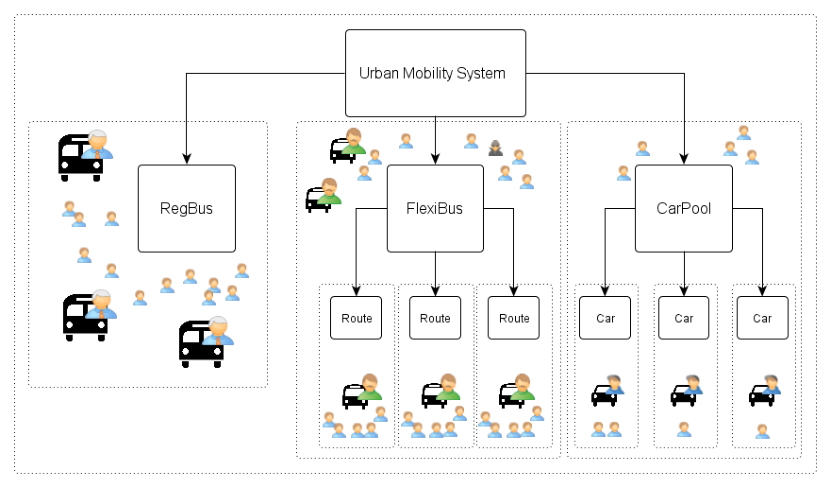
AN URBAN MOBILITY SYSTEM Supporting citizens’ mobility within the urban environment is a priority for municipalities worldwide. Although a network of multi-modal transport systems (e.g., buses, trains, metro), services (e.g., car sharing, bike sharing, car pooling), and smart technologies (e.g., sensors for parking availability, smart traffic lights, integrated transport pass) are necessary to better manage mobility, they are not sufficient. Citizens must be offered accurate travel information and ability to exploit related services on the go (e.g., ticket purchase, car pooling reservation, etc.). In order to deliver ``smart services" to citizens, available systems should be interconnected in a synergic manner constituting a system of systems. In the context of the motivating scenario for this paper, we consider an Urban Mobility System (UMS) that integrates three means of transport: regular bus (RegBus), flexible bus (FlexiBus) and car pooling (CarPool) (Andrikopoulos et al., 2013) (see Figure 1).
Regular bus is a conventional system of predefined routes and timetables that is supported by a number of buses.
FlexiBus is a modern transportation service that combines the features of taxi and regular bus service. A FlexiBus system defines a network of pickup points and provides to passengers transportation between any of these points on demand. In other words, a passenger can request transportation between any two points at given time. Trips are served by small buses and each bus can serve more than one request at a time. The cornerstone idea of the service is to organize bus routes in such a way that all requests are served with minimal number of buses/routes. As a result, passengers are provided with a ``trip on demand'' service that is more convenient than regular buses but less expensive than taxi.
Car Pooling provides integration between independent drivers and passengers. Each driver can submit her itinerary with timetable, and other passengers can apply for a lift by this driver, once their origin and destination fit the itinerary.
Figure 1. The Hierarchy of the Urban Mobility System
The goal of the urban mobility system is to provide seamless integration of the above services to the passengers. Within the current scenario we can distinguish the following set of entities:
Passenger: this entity has the goal to reach its destination at certain time and with certain preferences (e.g., payment by cash, trip with a luggage, trip with a wheelchair);
RegBus Driver: this entity has the goal to perform a predefined route and respect the timetable. It communicates to the RegBus system and may report bus delay, bus damage, traffic difficulties as well as receive updates (e.g., about the traffic situation);
FlexiBus Driver: this entity has the goal to perform routes and respect passenger's needs (e.g., timing, preferences). It needs to keep in touch both with the FlexiBus system (to get route updates) and passengers it serves (e.g., in case of delay);
CarPool Driver: this entity submits trip details into a system and has to reply to passenger applications by either accepting or rejecting them. The CarPool driver may also need to communicate with the passengers (e.g., in case of delay);
RegBus System: provides passengers with the trip planning service and notifications about route status (delays, cancellations). It may also circulate information about traffic jams or road accidents to bus drivers;
FlexiBus System: has the goal to organize optimal routes (e.g., a route serves more passenger requests at lower expenses). It guarantees that each route satisfies preferences of its passengers (e.g., origin and destination, temporal aspects, special requirements etc.), and other utility functions (reduction of the number of routes, optimal traffic planning, CO2 emissions, congestion, etc.). To find the set of possible routes it may communicate with the other services to get additional information (e.g., traffic, closed roads etc.), available resources (i.e., available buses), and generate alternative routes;
CarPool System: aggregates propositions from drivers and supplies them to passengers on demand. It may also provide some kind of communication and notification system.
Urban Mobility System (UMS): supervises the three means of transportation and provides their integration. In particular, it provides the passengers with a universal tool for planning complex trips involving more than one means. It also creates integrated notification and support system (e.g., where car accident information reported by a regular bus driver can be propagated to FlexiBus and CarPool drivers, or where a damage of a regular bus can be addressed using minibuses of the FlexiBus system). Finally, UMS can provide single payment for a complex trip;
Ticket Manager is the entity that processes trip payments.
The way urban mobility is organized in real life reflects all the challenges of a collective adaptive system. Indeed, within the urban mobility domain we have multiple entities (passengers, buses, transportation systems, ticket machine, cars and others) that are autonomous in their goals and operation but need collaborate with other entities around them thus bringing up the concept of collectiveness. For example, in order to travel to a destination with a FlexiBus, the passenger must interact with the FlexiBus system, the Ticket Manager and maybe with the bus driver (in case of cancellation or delay). Inter-entity interaction/collaboration may be more complex and include more than one participant. Such group of participants with related intentions can be considered as a temporary collective of entities operating in coordination with each other. One example of such a complex collective is a particular FlexiBus route that groups the bus driver operating the route and the passengers served by this route. A more complex collective might be the whole FlexiBus system that includes all passengers, bus drivers and routes. Although the participants of such collective are not always explicitly connected, such connections might emerge spontaneously (e.g., a passenger may ``switch'' from one route to another).
It is quite clear that entities in our scenario have to operate in a dynamic environment. For example, for a given passenger, the surrounding world evolves autonomously: the buses keep on moving, the management system keeps on accepting new requests, the other passengers keep on conducting their trips and so on. Moreover, external factors may cause unpredictable situations: the road may get closed and the bus may get damaged. All this forms a dynamic context that, even though not fully controlled by the passenger, may affect the way he operates. Another important aspect is dynamic partners. The set of entities with whom the given entity can interact is dynamic. This is determined by the openness of the system (entities can enter and exit the scenario) and by the fact that some partners are only reachable/useful in certain point in time and space. For example, FlexiBus system may temporarily cease to operate due to technical problems (i.e., become temporarily unavailable to passengers).
Entity operation is closely connected to the environment (e.g., the passenger may change her travel plans if the bus is going to be late). It means that actors must properly react to critical environmental changes and adapt their behavior to such changes. As we mentioned, collective adaptation may be way more complex and imply changes to the behavior of multiple participants. For example, if a FlexiBus route is treated as a collective of a bus and passengers, in case of bus damage, the bus driver might need to contact the repair service and trigger reimbursement to the passenger. As an option, alternative solutions could be proposed to the passengers (alternatively, the FlexiBus system might negotiate with the passengers and, upon agreement, request urgent bus replacement). This is an example of collective adaptation.
Finally, the scenario demonstrates the hierarchical organization of entities into collectives. For example, 1) a FlexiBus route is a collective of a bus and passengers, 2) a FlexiBus system is a collective of routes (and maybe unassigned passengers and buses), 3) the Urban Mobility System is a collective of RegBus, FlexiBus, CarPool systems etc.
The Allow Ensembles Model The urban mobility system previously described is modeled as a complex service system enabling an evolving interaction of multiple actors towards achieving their individual goals in a certain context. As previously presented in (Andrikopoulos et al., 2013), such actors are modeled as entities, which aggregate a set of different functionalities offered or required by an entity as reusable cells. Collaborative interactions between entities arise from the interaction of their cells in the scope of an ensemble, which is dynamically created in order to fulfill specific goals initiated by the entities. Focusing on the previously presented scenario, the FlexiBus system of UMS aggregates a set of cells, e.g. the trip booking cell and the route assignment cell. The trip booking cell interacts with the passenger’s cell towards guiding the passenger through the ticket booking process, while the route assignment cell Human Side of Service Engineering (2019) assigns a specific route to a bus driver.
The existence of entities having individual selfish interests leads to the existence of conflicting goals that entities aim to satisfy by establishing collaborations among them. For example, the FlexiBus system aims to maximize the overlapping routes in the city towards reducing the CO2 emission. However, passengers’ preferences, e.g. arrival time, are distinct, and in occasions can be adverse to FlexiBus system’s goals. Therefore, entities cooperate towards increasing their individual and collective satisfaction, which can be expressed in utility terms. Consequently, in the scope of our work we aim to model the economic perspective of systems of ensembles, and consider that entities participate in games according to multiple criteria towards achieving a set of objectives. Non-cooperative games can be considered when focusing on the achievement of individual objectives when potential interests exists within a system (Osborne and Rubinstein, 1994), while the interaction of entities towards achieving a common task and objective can be modeled as a cooperative game (Wiese, 2010).
In order to incorporate the means to analyze and evaluate properties and desired goals of the entities, we investigate the economic models that assign utility to individual entities, and therefore provide a measured value of their satisfaction. The usage of a utility function as a mean to quantify utility allows the assignment of numerical values to every choice and its ordering based on the entity’s preference (Andrikopoulos et al., 2014). Cells interact in the scope of an ensemble towards achieving an entity’s objective and contributing to improve its utility. Therefore, each entity takes into consideration the criterion of utility maximization when selecting an ensemble to participate in, while also considering the behavior and actions of the other entities. When an ensemble is being executed, the utility values from each entity participating in such ensemble are aggregated to a collective utility.
The modeling of the economic behavior in the proposed system is approached by defining the concept of meta- cells (Andrikopoulos et al., 2014). Meta-cells represent the economic characteristics of functional cells. More specifically, by collecting and measuring data, these cells measure the utility of every entity and ensemble, and communicate with other cells in order to compute strategies and make decisions. In addition, meta-cells facilitate the ensemble performance improvement by running optimization algorithms. Simultaneously to the creation of ensembles due to the interaction of entities’ functional cells, strategic utility-based interactions of different entities’ meta-cells trigger the creation of the strategic ensemble (see Figure 2). The strategic ensemble is constituted by the interaction of one or more meta-cells and handles the decision making at the level of interactions between entities. The capabilities provided by the strategic ensemble are related to: 1) reducing the entities’ choices by imposing constraints derived from the entities’ goals, 2) the evaluation from the point of view of an entity for participating in one ensemble, and 3) the assignment of utility to each entity in an ensemble in order to manage the negotiation between entities.
The strategic ensemble execution and life-cycle is closely related to the execution ensemble. More specifically, the strategic ensemble is created previous to the execution ensemble. Decision-making interactions between the meta-cells concerning the selection of the most beneficial execution ensemble trigger the creation of the strategic ensemble. During the execution phase of the execution ensemble, the strategic ensemble runs in parallel, as the operations of the execution ensemble are directly affected by the ones executed in the strategic ensemble.
Figure 2. A strategic Ensemble in the FlexiBus Scenario
Figure available in the original PDF paper.
A GAME THEORETIC APPROACH TO MODEL ENTITY INTERACTIONS We introduce a simplification of the urban mobility system described previously and apply our ideas to formulate the economic model that describes the actors, their actions and the problems they need to solve when they participate to set up and use a single FlexiBus route. We investigate a dual problem facing both the passengers and the transportation authority; the passengers choose their trip mode, while at the same time the FlexiBus system makes decisions on accepting or not travel requests dynamically.
Scenario We consider the ensemble described by a scheduled route operated by a FlexiBus company and a set of passengers that have already booked for using this route for a common destination. We consider the urban mobility system consisting of the passengers, the FlexiBus system, the ticket manager and the FlexiBus driver. The route consists of M pickup points that are executed according to passenger requests. Passengers are able to pre-book for a pickup point. The route is postponed if the number of pre-booking requests is less than a pre-defined threshold. A passenger may send a request after the departure of the FlexiBus for a subsequent pickup point.
Let T A be the time that pre-booking for the route is initiated. If the number of requests does not reach the threshold n0 by time T B (T A<T B) the route is postponed. The requests that arrive before T B are conditionally accepted by the system provided that the route will finally be executed. Once the route is being executed we consider time slotst 1,…,t M. At t 1 the bus departs from the starting point. At time t 2the bus arrives at the second pickup point (the bus will not stop if no request for this pickup point is active) and so on.
The entities of our urban mobility system make decisions according to their own utilities. We consider that each new passenger chooses between two modes of transportation according to his money and time constraints: taking the regular bus or taking the FlexiBus. Given that the route is being executed, the FlexiBus system has to make a choice to accept or reject a new request that arrives before or after the departure of the bus, checking for availability and time constraints. We consider that the passengers that have already chosen to use the specific route do not alter their decisions (taken in a previous time instant), that is, no negotiation between them and the FlexiBus system takes place for the new conditions of the route (increased number of pickup points resulting in longer travel time). The FlexiBus system has to take into account that any violation of its past commitments will affect negatively its utility.
When a new request enters the system, at time t , a negotiation phase between the passenger and the system has to take place. A passenger request R is defined as a vector R=(tr ,m) where tr is the desired travel time and m is the pickup point. A new request arrives either in the pre-booking phase or the execution phase of the route. We describe the negotiation phase as follows: upon a new request R, the FlexiBus system processes the request and replies sending a message to the passenger defined as MES=(status,t) where status is 0 (if not accepted) or 1 (if accepted) and t is the remaining expected travel time. The estimate of the remaining travel time depends on the number of current passengers of the route, the number of future accepted requests till the termination of the route and a stochastic component related to congestion.
The passenger then decides to enter the route (ensemble) if the expected utility he accrues by choosing the FlexiBus is higher than the expected utility obtained using the regular bus. The utility of a passenger reflects his benefit from travelling and is a function of the travel cost and travel time. The utility of the FlexiBus system denotes the revenues it gets from one execution of the route. Thus, it is to its own benefit to tempt (a good estimation of travel time is necessary) as many passengers as possible to take the bus. Note that the above utilities cannot be calculated before the execution of the route, since travel time and the total number of passengers of the route are not known beforehand (stochastic component). Instead we can estimate those variables during the route and provide expected utilities.
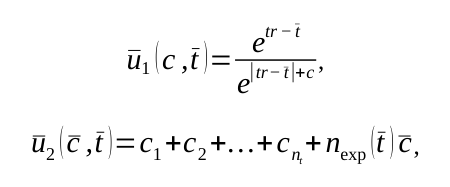
Utility functions The utility u1of a passenger for participating in the specific ensemble (route) reflects his benefit from travelling and is a function of the travel cost cand the actual travel timeT. An example of a utility of this kind is given as follows:
Equation reproduced from the original PDF.
If tr −T>0 the bus has arrived earlier than desired is constant with respect to T. If tr −T<0 the bus arrived late and passenger’s utility decreases as T increases.
The utility u2of the FlexiBus system for initiating and executing the specific ensemble denotes the revenues it gets from one execution of the route: u2 (c )=c1+c2+…+cn
Equation reproduced from the original PDF.
At decision time t ,(during the negotiation), T and n are random variables, thus entities calculate expected utilities u1andu2. Examples of these utilities are given below:
Equation reproduced from the original PDF.
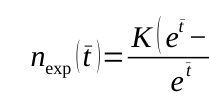
where nt is the number of passengers (already using or having booked for the route) at time t, c is the mean cost for future passengers and nexp is the expected number of future passengers as a function of t. The function nexp is increasing in t and takes a maximum value equal to the remaining seats of the bus, say K. An example is given by:
t−1)
Equation reproduced from the original PDF.
t .
e
Game Formulation We model the above scenario as a non-cooperative dynamic game where decisions are to be taken each time a new request arrives at the system. At each such time instant the game consists of two players (the new passenger and Human Side of Service Engineering (2019) the FlexiBus system) who compete for the desired travel time. The passenger’s strategy is to ask for as short as possible trip while the system’s strategy is to promise as long as possible trip. The outcome of the game is a pair of travel times; a desired and a promised one. If the passenger reveals the real desired travel time, he increases the probability of being accepted to the cost of increasing the probability of being late if the actual travel time is significantly larger than the expected travel time. On the other hand, the FlexiBus system has to balance the benefit it accrues from accepting a new request and the potential benefit of future requests. The objective is to find the optimal outcome such that the players have no incentive to deviate from.
We consider a game of complete information, since:
The FlexiBus system provides private information of current passengers to the new passenger.
The utility functions of all entities are common knowledge.
We also consider a dynamic mechanism in which the decision points are request arrivals. New strategies have to be derived each time a new request arrives (thus a new game is formulated). All these games across the route have to be synchronized in order to derive optimal profits for the FlexiBus company and the passengers. We also consider that each such game is sequential:
Step 1: The new passenger makes a request.
Step 2: The FlexiBus system calculates its strategy (accept or reject) based on the request.
Step 3: The new passenger calculates his strategy based on system’s strategy.
Let a new request arrive at time t . The game consists of two players; the new passenger and the FlexiBus system. The strategy profile of the players is given by s=(tr ,t) where tr is the desired travel time of the passenger and t is the expected travel time specified by the FlexiBus system. The payoff p1of the new passenger is given by: p1 (s)={ G,tr<t u1(c,t )−f (tr),tr ≥t
where G is the payoff gained by the passenger’s alternative solution and f is a function that incorporates the risk of adding future passengers. Accordingly, the payoff p2of the FlexiBus system is given by: p2 (s)=u2 (c ,t )−g (t)
where g is a function that incorporates the risk of losing future passengers.
We consider that decisions of the passengers or the system at time tare taken according to the following rules:
A new passenger decides to enter the route at time t i, if the expected utility he accrues by choosing the FlexiBus (u1=(c,t )) is higher than the expected utility obtained using the regular bus )).
The FlexiBus system decides to accept a passenger request, if there are available seats and the current expected travel time is less than the promised travel time to the current passengers (t <t old.
The above game describes the interactions of entities and reveals some rather interesting aspects of the decision making process inside an ensemble:
Even though the various entities have similar goals (reaching a destination), their strategies are rather conflicting (estimated travel time changes to the benefit of some passengers and at the same time at a cost for others).
In equilibrium, entities that participate in the ensemble collaborate with each other and share the payoff created by the execution of the ensemble.
The evolution of the ensemble is based on the synchronization of entities’ decisions during the execution of the ensemble.
CONCLUSIONS
Various utility models have been considered in predicting the behaviour of passengers as parts of transportation systems. Travel time is an important factor that affects the satisfaction of passengers and thus their utility. Models for estimating the value of travel time have also been defined. Non-cooperative games have been proposed to model passengers’ decisions in terms of mode choice, route choice and time-of-day travel choice.
In this paper, we aim to develop a methodology using games and utility functions in order to exploit two aspects of transportation systems that have not yet been considered. First, the passengers interact with each other but also with the trip operators/managers/planners in order to take decisions. We consider thus an urban mobility system in which every member has his own selfish goals that are better achieved through a mobility management system. Non-cooperative games are appropriate models for modelling such situations. Second, entities have a utility that expresses their benefits from using the services of the urban mobility system (in the traditional way) but new performance metrics (analogous to utility) have to be defined in order to evaluate the operation of cells and ensembles seen as components of a complex system.
Derivation of equilibrium strategies in the game described in this paper as well as extensions of the scenario to include different destinations for various passengers, perform repeated negotiations between UMS and current passengers, consider flexible routes that add or remove pickup points upon requests, are directions for future work.
REFERENCES
Anas, A., Berliant, M. (2010), “The Commuting Game”. Andrikopoulos, V., Bitsaki, M., Gómez Sáez, S., Karastoyanova, D., Nikolau, C., Psycharaki, A., “Utility-based Decision Making in Collective Adaptive Systems”, in: Proceedings of the Fourth International Conference on Cloud Computing and Service Science (CLOSER’14), 2014. (to appear) Andrikopoulos, V., Bucchiarone, A., Gómez Sáez, S., Karastoyanova, D., Mezzina, C. A., “Towards Modeling and
Execution of Collective Adaptive Systems”, in: Proceedings of the Ninth International Workshop on Engineering Service-Oriented Applications (WESOA’13), 2013. Johansson, B., Klaesson, J., Olsson M. (2003), “Commuters? non-linear response to time distances”, in: Journal of Geographical Systems, vol. 5, no. 3, pp. 315–329. Kernbach, S., Schmickl, T., Timmis J. (2011), “Collective Adaptive Systems: Challenges beyond Evolvability”, in:
ACM Computing Research Repository (CoRR). Lam, T. C., Small, K. A. (2001), “The value of time and reliability: measurement from a value pricing experiment”, in: Transportation Research Part E: Logistics and Transportation Review, vol. 37, no. 2–3, pp. 231–251. Levi, P., Kernbach, S. (2010), “Symbiotic Multi-Robot Organisms: Reliability, Adaptability, Evolution”, in:
Springer Verlag, vol. 7. Lewis, P., Platzner, M., Yao, X. (2012), “An outlook for self-awareness in computing systems”, in: Awareness Magazine. Li, Z., Huang, H. (2005) “Fixed-Point Model and Schedule Reliability of Morning Commuting”, in: Stochastic and
Time-Dependent Transport Networks, pp. 777–787. Marconi, A., Pistore, M., Traverso, P. (2008), “Automated composition of web services: the astro approach”, in: IEEE Data Eng. Bull.,vol. 31, no. 3, pp. 23-26. Osborne, M. J. and Rubinstein, A, “A Course in Game Theory”, in: MIT Press, 1994. Sun, L., J., Gao, Z., Y. (2007), “An equilibrium model for urban transit assignment based on game theory”, in:
European Journal of Operational Research, vol. 181, no. 1, pp. 305–314. Wiese, H., “Applied cooperative game theory”, 2010. URL: http://www.uni-leipzig.de/˜micro.
LISTED IN THE AHFE DIGITAL BOOKSTORE CATALOGUE
Explore the complete digital volume
Advances in The Human Side of Service Engineering
Read this individual research paper free through the original publisher, or explore the full digital proceedings book.
ISBN 978-1-4951-2091-6
Explore this ISBN in the AHFE Bookstore ↗Listed in the July 2026 bookstore catalogue; search by ISBN to confirm current availability · Digital book purchase optional