Sangjic Lee, Kohei Nishiyama, Nariaki Nishino (2023). Game Theoretic Modeling of User Innovation and Venture M&A Processes. In: The Human Side of Service Engineering. AHFE Open Access, vol. 108, pp. 393–399. https://doi.org/10.54941/ahfe1003142
User innovation and venture M&A mechanisms enable value co-creation that utilizes knowledge and skill of individuals through the interaction between stakeholders. Given that the applicable methods for external innovation continue to diversify and economic efficiency becomes a relevant criterion of innovation process performance, they need to fit to the market environment and business model in order to be effective in value creation. But there is not enough analysis that takes the factors such as product characteristics and degree of consumer value diversity into account, and implication regarding the correspondence relationship between them and the adequate form of value creation process is scarce. This study proposes a game theoretic model that investigates the fitness of external R&D methods to the environmental factors. The model is analyzed by a numerical simulation, and how the environmental parameters such as product price, quality and innovation cost affect the relative social surplus of the proposed models is systematically examined. The condition of parameters in which each mechanism induces a relatively superior performance in terms of production quantity and social surplus is computed.
In today’s competitive economy, many methods for organizations to procure useful knowledge and capabilities from outside entities have been suggested and found to be an effective complement of internal R&D. Since its first conceptualization in the work by von Hippel (von Hippel, 1976), user inno- vation has been recognized as one of the effective methods firms utilize to acquire valuable ideas for new product development (NPD) purposes. Other seminal concepts include co-creation (Prahalad and Ramaswamy, 2004), open innovation (Chesbrough, 2003), and innovation contest (Terwiesch and Wu, 2008). In addition to these representative forms of external innovation activities, companies carry out many others that base on communicating information over the organizational boundaries. For example, merger and acquisition (M&A) (Dezi et al., 2018) and mass customization (Stoetzel, 2012) are also understood as a form of intaking external skills and compete- nces. Another important issue is that the emerging methods of external R&D are frequently coordinated via internet-based communication systems such as user communities and innovation platforms that lower the cost of exploring
potential contributors of innovation and enhancing the quality of transmitted information (Chu, 2013). These commonalities between the various forms of open R&D suggest that companies may be situated in an environment where multiple innovation activities are applicable and the best way for generating innovation should be strategically chosen. The cases of adopting multiple open innovation methods for NPD (Antorini and Muniz, 2013) appear, but there is a shortage of implication for identifying which of them are effective under specific environmental conditions in the existing literature. This study aims to investigate the corresponding relationship from the firm environment to the suitable innovation sourcing methods.
DECISION MODELS OF EXTERNAL INNOVATION Studies of innovation contest is one of the fields where the microeconomic modeling approach is vigorously used. The representative models such as Moldovanu and Sela (2001) and Terwiesch and Xu (2008) assume that the host of the contest prepares fixed amounts of prize money that will be given to the innovators who offer the preferable outcomes. The participants select optimal amount of effort that they will exert to solve the problem suggested by the host, given that the quality of solution and the effort cost is both proportionate to the effort. Therefore, increasing the effort amount will lead to a larger possibility of acquiring the prize, but the cost will be larger at the same time. Also, the payoff of each innovator depends on the effort amount of other participants.
In the user innovation field, the innovator stakeholder is conceptualized in a similar manner. Gambardella et al. (2017) provides an elaborated model in which the interaction between the users and the manufacturer firm is for- mally described by game theory. The users invest their time as the effort for innovation and receive the benefit that is proportionate to the sum of effort of all users. And the manufacturer can reduce the users’ innovation cost by providing support to the user innovation activity, in exchange of support cost.
Lee et al. (2021) suggested a game theoretical framework in which the stakeholders’ rational choices and social performances of two external R&D methods can be compared under specific levels of environment variables such as the product price and innovation cost. The models of user innovation and venture M&A basing on the identical framework are proposed and analyzed in this study.
In the suggested game models, a product is developed and produced as a result of the decision of the players. It has two attributes, product quality x and price p, that are exogenously determined. The case of horizontal diffe- rentiation is assumed, which means that each consumer has a specific value of quality that it prefers for the most, and the preferredness of the other pro- duct alternatives depends on the distance from the ideal quality. The set of possible values of x and p is denoted as X and P respectively. The consumer demand for a product profile is the aggregation of the purchase decision of each consumer. The number of buyers is counted by adding up the consumer mass distribution F for the area where the consumer’s utility is positive under the endowed characteristic values and the product attributes. Then, the sales
Game Theoretic Modeling of User Innovation and Venture M&A Processes 395
quantity ratio is calculated by dividing the number of buyers by the number of all consumers.
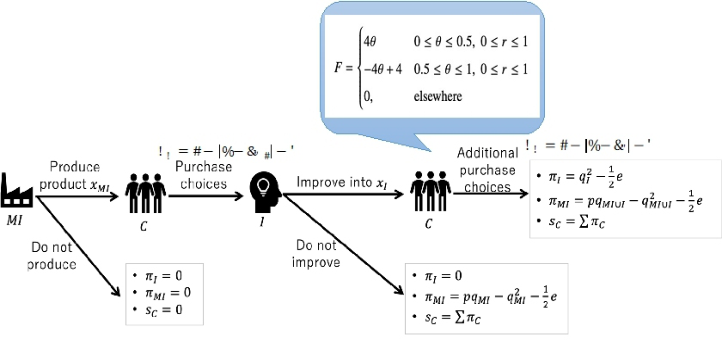
THE USER INNOVATION MODEL The game tree in Figure 1 illustrates the players, decision nodes and the profit structure of the user innovation mechanism. There are one manufacturer- innovator MI, one innovator I and multiple number of consumers Cθ,r. The variables θ and r express the characteristic of a consumer, and a specific com- bination of them may be assigned to more than one consumer. The first move is made by the manufacturer-innovator player type. The decision is to deve- lop and produce a product with its own capability. Its strategy is denoted as tM ∈TM = {PD, NP}. If the profit from production is estimated to be negative, the producer chooses not to produce, i.e., tM = NP and the game finishes, raising a zero profit for all players πMI = πI = πCθ,r = 0. When tM = PD is taken, the player must disburse the innovation effort e/2 to con- duct the R&D activity and the production cost q2
MI. The expenditure needs to be reimbursed by the sales revenue pqMI of the devised offering xMI. The sales quantity ratio qMI may increase into qMI∪I due to the decision-making of innovator type player. The manufacturer-innovator is able to assess the strategy of I and qMI∪I before selecting its own strategy. In the case that a product is released by MI, the consumers face it and make the purchase decision. The buyer ratio qMI is computed by dividing the summation of the consumer distribution function F of the buyers by the total population N.
The decision turn of innovator I comes after the customers have bought the product. It is an user of the manufacturer’s product and is concer- ned about voluntarily modify the feature of it. The strategy options are tI ∈TI = {IN, NI}. In the case the player carries out the task, the pro- duct quality is changed into a new position xI in return for the mental effort e/2. The innovator observes the number of consumers for whom the revi- sed offering is acceptable, i.e., yields a positive utility, and gains the intrinsic
Figure 1: The game model of user innovation.
motivation q2
I . It is possible that a part of qI is the new customers who had not purchased the original product xMI. If these consumers exist, they switch to buy it from the manufacturer and adopt the innovator’s modification, and the sales quantity ratio is increased to qMI∪I. If the innovator decides not to engage in user innovation, its utility is πI = 0.
Integrating the information described above, the utility functions of the players are defined as shown in Figure 1.
THE VENTURE M&A MODEL
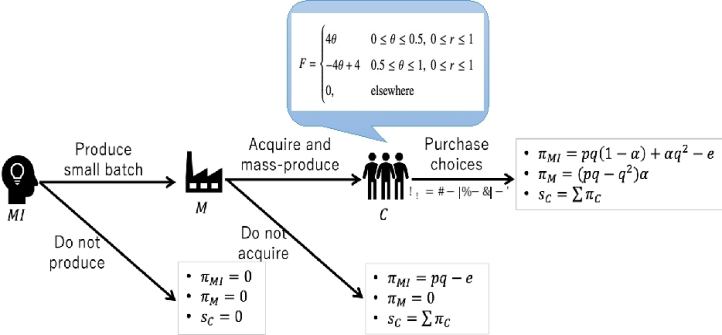
Figure 2 displays the players of venture M&A model and the structure of their decision-making. There are one manufacturer-innovator MI, one manufactu- rer M and multiple number of consumers Cθ,r. MI is the entrepreneur who thinks of commercializing the knowledge by itself. It needs to decide whether or not to establish the venture company. The strategy option is defined as tMI ∈TMI = {IN, NI}. If tMI = IN is chosen, the player invests the effort e and the offering with quality x is prepared for production. And then the innovator conducts a market research and discovers the potential demand q for its product. The acceptance of innovation causes satisfaction q2
I . If the manufacturer-innovator decides not to engage in the mechanism, the game ends and all players receive an utility of zero.
The incumbent manufacturer M reacts after observing the foundation of the firm by MI. At this moment, M considers taking over the business from MI. The strategy choice is tM ∈TM = {PD, NP}. If it picks tM = PD, the takeover contract is signed. Then M produces the innovator’s design x, sells it to the consumers, and embraces the sales revenue pq and the production cost q2. It also gives a part of its earnings pq−q2(1−α) to MI as the takeover payment. If the takeover does not seem to be profitable, the producer chooses tM = NP. The manufacturer-innovator produces by itself in this case and keeps all of the revenue pq −q2 to itself. The manufacturer-innovator is able to forecast which case of utility function will materialize due to the choice
Figure 2: The game model of venture M&A.
Game Theoretic Modeling of User Innovation and Venture M&A Processes 397
of M. Regardless of by whom the product is released, the consumers face the same purchase situation. The demand q is computed in the same manner as user innovation case. The utility functions of the players as the consequences of the rational choices are described in Figure 2.
COMPARATIVE ANALYSIS The extensive-form game theoretic decision models are analyzed by a com- puter simulation. It is assumed that each of the exogenous variables e, p, α, xMI and xI take a discrete value from its corresponding set of possible values E = {0, 0.05, · · · , 0.2, 0.25}, P = {0, 0.1, 0.2, · · · , 0.9, 1}, A = {0.1, 0.2, · · · , 0.8, 0.9} and XMI = XI = {0, 0.1, 0.2, · · · , 0.9, 1}. The sets are consisted of values that cover the interval [0, 1] and are distri- buted at identical intervals. The effect of the exogenous variables on the choices of the players and the utility outcomes is investigated by computing the Nash equilibrium of the game tree shown in Figure 1 and 2 for each of the combination of exogenous variables. For the distribution F of consumer characteristics, a linear function of ideal quality taste θ is assumed. The con- sumer distribution is symmetric about θ = 0.5. The number of consumers is identical for all values of r when θ is fixed, and the total population of consumers is 110.
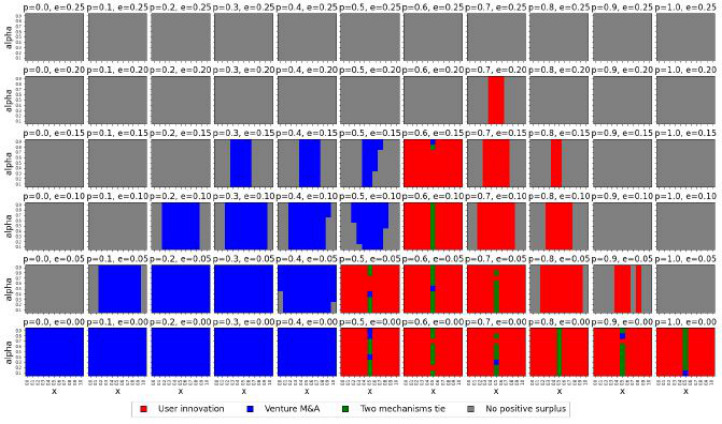
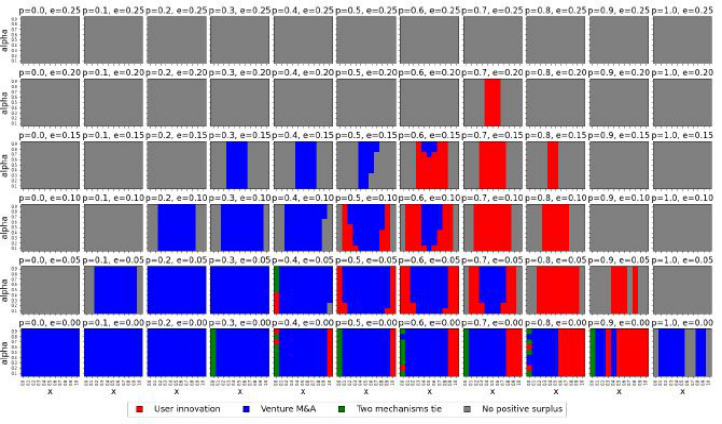
In Figure 3 and 4, the social surplus of the user innovation and the venture M&A models are compared. Social surplus is defined as the sum of all players existing in the game. In each figure, the input variables change over the axes and the remaining xI differs between the figures. The two figures represent the cases of xI = 0.5 and xI = 0. They are two extreme values of the product quality at the opposing direction, in terms of the number of potential buyers.
Parameters p and e consist the horizontal and vertical axes of each of the figures. The smaller rectangular subfigure inside the figure represents a spe- cific combination (p, e) that is marked on the upper side of it. The subfigure
Figure 3: Comparison of social surplus when xI = 0.5.Figure 4: Comparison of social surplus when xI = 0.
on the lower left end displays the situation p = 0, e = 0 and the subfigures are placed in the ascending order of p to the right and in the ascending order of e to upwards. In each subfigure, the horizontal axis marks the value of product quality xMI of the manufacturer-innovator player, and the vertical axis denotes the manufacturer-innovator profit sharing ratio α.
The result shows the trend that the user innovation model derives a lar- ger social surplus when the product price p takes a relatively larger value among the possible settings, and the venture M&A mechanism performs bet- ter when p is lower. If the price is low, the costs of production and other types of the manufacturer type player exceed the profit from producing the innovation, leading to a non-participation decision. In the user innovation model, this results in the zero profit for all players, while the venture com- pany player chooses to produce by itself under some cases in the venture M&A model. The differently colored zones in the figures can be explained by this logic. Other than the price, the innovation cost e always negatively affect the social surplus of both models. The second quality variable xI, which exists only in the user innovation model, contributes to the production deci- sion of manufacturer when it is set to a value that provokes a large consumer demand.
REFERENCES
Antorini, Y. M. and Muniz, A. M. (2013) The Benefits and Challenges of Collaborating with User Communities, Research-Technology Management, Volume 56. Chesbrough, H. W. (2003) The era of open innovation, MIT Sloan Management
Review, Volume 44 No. 3. Chu, K. M. (2013) Motives for participation in Internet innovation intermediary platforms, Information Processing and Management, Volume 49 No. 4.
Game Theoretic Modeling of User Innovation and Venture M&A Processes 399
Dezi, L., Battisti, E., Ferraris, A. and Papa, A. (2018) The link between mergers and acquisitions and innovation: A systematic literature review, Management Research Review, Volume 41. Gambardella, A., Raasch, C. and von Hippel, E. (2017) The User Innovation
Paradigm: Impacts on Markets and Welfare, Management Science, Volume 63. Lee, S., Nishiyama, K., Kimita, K. and Nishino, N. (2021) Co-creation and Personalization as Incentive Mechanisms of Utilizing External Innovation Sources: Which Performs Better? Asian Journal of Innovation and Policy, Volume 10 No. 3. Moldovanu, B. and Sela, A. (2001) The Optimal Allocation of Prizes in Contests,
American Economic Review, Volume 91. Prahalad, C. K. and Ramaswamy V. (2004) Co-creation experiences: The next practice in value creation, Journal of Interactive Marketing, Volume 18 No. 3. Stoetzel, M. (2012) Engaging Mass Customization Customers beyond Product Con-
figuration: Opportunities from the Open Innovation Field, International Journal of Industrial Engineering and Management, Volume 3. Terwiesch C. and Xu, Y. (2008) Innovation contests, open innovation, and multiagent problem solving, Management Science, Volume 54 No. 9. von Hippel, E. (1976) The dominant role of users in the scientific instrument
innovation process, Research Policy, Volume 5.
LISTED IN THE AHFE DIGITAL BOOKSTORE CATALOGUE
Explore the complete digital volume
The Human Side of Service Engineering
Read this individual research paper free through the original publisher, or explore the full digital proceedings book.
ISBN 978-1-958651-84-1
Explore this ISBN in the AHFE Bookstore ↗Listed in the July 2026 bookstore catalogue; search by ISBN to confirm current availability · Digital book purchase optional