Hisashi Masuda, Yoshinori Hara (2019). A Dynamic Model based on Customer Learning Speed. In: Advances in The Human Side of Service Engineering. AHFE Open Access, vol. 8. https://doi.org/10.54941/ahfe100281
The heterogeneity of customers is dependent not only variety of customers but also the time change. How do we treat the variety of customers based on time is issue for the service research. We construct a model for representing the customer learning speed interpreted by customer expectation based on novelty. The results are to show the customer learning rate in relation to the novelty of each service sector (Restaurant, Hotel and Mobile-phone users), and effects of the customer learning assistant promotion by numerical simulation. We can manage the dynamic aspects of customers' variety adding the static aspects of them.
The servicizing economy is prevalent all over the world. We are required not only to provide services but also to treat in accordance with the variety of customers. We are focusing on the customer learning speed based on the customer expectation, typically based on novelty. We construct a microeconomic model for representing the customer learning speed and show the parameter based on an empirical research.
Background
Servicizing is wide spread in economy all over the world. From competition, manufacturing businesses are required to treating the services. Within the current situation, service dominant logic is remarkable (Vargo and Lusch, 2004).
We face to the variety of customers in the servicizing economy. The criteria of service evaluation are not uniquely fixed. The characteristics of the criteria depended on the culture, religion, gender and so on.
It is difficult to treat the variety in relation to the change of time. On the other hands, the static aspects are scrutinized by a lot of researches. The reason is difficult to make closed models for the dynamic aspects of customers.
However, we cannot understand the mechanism by adding the statistical aspects. We interpret the behavior by using any dynamic models. Therefore, we need to make the theory for the criteria of the service evaluation.
Research Question and Purpose How to connect the variety of customers based on the time and a modeling. We need to represent the change of the criteria of service evaluation. In addition, it is important that where we focus as the dynamic factors.
To develop this approach, we can manage businesses considering the dynamic aspects of customers. For example, from perspective of ergodicity, the understanding to static aspects for customers deepens with the long-term analysis of them. Thus, companies can treat two varieties of customers, varieties depended the static and dynamic aspects.
Approach In this paper, we construct the connection of customer learning speed and customer expectation based on our previous works (Masuda and Hara, 2011, 2012). First one, we constructed a model for representing the customer dynamic aspects by focusing on the novelty and familiarity within customer expectation. Second one, we proposed a model for representing the customer heterogeneity by using the customer learning rate.
After that, we fit the parameter by questionnaire data (Masuda and Hara, 2011). We collected the customer satisfaction and expectation data from users of the restaurant, hotel and mobile-phone users in Japan, 2009. Typically, we focus on the gap of expectation, that is, if customers have no knowledge for the services, the gap is the biggest one.
As the results, the customers learning rates are the following; Restaurant: 68%(t=1), 66%(t=2), 92%(t=3); Hotel: 70.8%(t=1), 50%(t=2), 50%(t=3); Mobile-phone users: 93.6%(t=1), 100%(t=2), 97.1%(t=3). In the case of restaurant and hotel, t=1 is receiving the service first time, t=2 is receiving the service from second to forth, t=3 is receiving the service more than five times. In the mobile-phone case, t=1 is ensemble of purchase point of customer, t=2 is ensemble of duration from purchase time to 1 year, t=3 is ensemble of duration more than 1 year. In addition, we see the behavior of these parameters by numerical simulation (Masuda and Hara, 2012).
From this approach, we can manage the variety of customers dependent the dynamic aspects based on time. Typically, it is important to understand the customer statements of customer learning. The difference of the customer learning rate lead the decision making how to choice the strategies.
The following section, we explain the detail. Section 2 is the related works. Section 3 is to make the connection with customer learning speed and the change of the customer expectation. Section 4 is to find parameter based on questionnaire data from a survey research. Section 5 is implication from our work. Section 6 is conclusion.
RELATED WORKS Our work is positioned in the integrated area of microeconomics and service marketing. How to evaluate the dynamic aspect is a big problem for the researched in relation to service. We need to have a dynamic model for representing the aspects. Here, we aim to apply the microeconomic model to the service research.
We show the existing economic model for representing the dynamic aspects. The Hotelling model is the basic model for customer choice in microeconomics (Hotelling, 1929). Fudenberg extended the hotelling model for customer poaching (Fudenberg and Tirole, 2000). There is an extended work to "behavior-based personalization"(Zhang, 2011).
Next, we show the approached from service marketing. Customer satisfaction research was started by Oliver (Oliver, 1997). Disconfirmation model is the basic approach in the customer satisfaction. Another basic service evaluation model is the SERVQUAL model by Parasuraman (Parasuraman, Zeithmal and Berry, 1998). Regarding the dynamic aspects of the expectation and satisfaction researches for customer, Bolton analyzed customer of mobile-phone by a dynamic model by showing first experienced satisfaction is related after the evaluation by the customer (Bolton, 1998).
CONNECTING THE CUSTOMER LEARNING SPEED AND CUSTOMER EXPECTATION We represent the customer learning speed based on the customer expectation. We set the start rate is 0%, there are no person understanding their preference for the services, and the end rate is 100%, there are all person understanding their preferences. We interpret the rate by the gap of expectation and modified expectation receiving after the services.
Concept of Customer Learning Speed How to represent the heterogeneity of customers is the issue for the service researches. There are a lot of directions representing the heterogeneity of customers. And the directions are not uniquely fixed each person within a long- term period.
We constructed a model focusing on the novelty and familiarity expectation perspective (Masuda, 2011). We interpreted novelty and familiarity by using the gap of expectation and modified expectation. And we showed the change of the novelty and familiarity by each frequency of receiving the services.
On the other hand, we constructed a model for representing the dynamic aspects using by customer learning perspective (Masuda, 2012). We represented the heterogeneity of customers by using two type classifications; one is unknown customers for their preferences, other is known customers. And we showed the change of the weight of two types against all customers for representing the dynamic aspects.
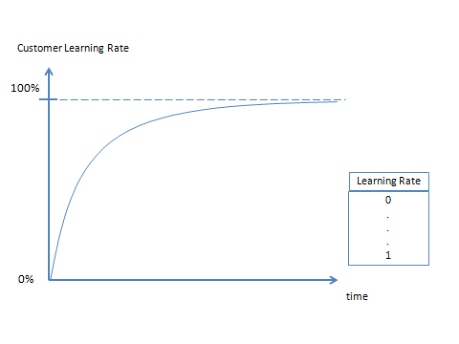
Specification to combine the Customer Learning and Novelty Expectation Our approach is how to connect the customer learning speed and the novelty expectation perspective. We connect customer novelty expectation rate and customer learning rate (see Figure 1). For modeling, we hypothesis from 0 to 1 of customer learning rate is equal to from 1 to 0 of customer novelty rate.
Figure 1: Overview of customer learning speed and novelty expectation perspectives Here, we hypothesize that the progress of customer learning/novelty expectation rate is a linear equation, that is,
. (1) Parameter r is a weight of customers understanding their preferences against the overall customers. Variable t is representing of discrete time (natural number). Parameter is the velocity of customer learning. Parameter is initial condition for the weight of customers understanding their preferences.
Naturally, we believe that the change of customer learning/novelty rate is non-linear one. Here, we constructed the simplest form. In the future, we need to develop and validate the one.
Make a Dynamic Model for representing the Customer Learning Speed We constructed the duopoly model for customer choice. Here, we use the same logic (see Masuda, 2012 for the detailed).
There are two firms, A and B. first-period is same as Hotelling model (see Hotelling, 1924). Second-period, firm B carry out a well-known service assistant strategy with additional cost C. Firm A is same action in the first period. Each firm knows strategies of each form. A well-known service assistant promotion strategy is meant that firm B's customer provide service b but competitor's customers provide special service b'. Customers have a learning rate of their preferences. Here, it is y in [0, 1]. Learning of customer preferences happen equally in the distribution.
In the case of customer learning rate y = 1 (perfect learning), a well-known service assistant strategy is the most effective, (2)
. (3) In the case of customer learning rate y = 0 (imperfect learning), a well-known service assistant strategy is ineffective perfectly,
(4) . (5)
Regarding the total profits, we equate total profit with discount factor delta,
(6) (7)
(8) In this case, y is static over time. For extending the n period, we hypothesize learning of customer preference progress by same rule. For example, in second period, y and (1-y), in third period, y+(1-y)y and 1 - (y+(1-y)y) and so on.
AN EMPERICAL RESEARCH FOR PROPOSED MODEL In this section, we got the customer learning rate from questionnaire data. We represent the microeconomic model based on the customer expectation. Finally we show the output from the formula for numerical simulation.
We got the novelty expectation rate from questionnaire (see Table 1). Point of our questionnaire is to ask 'a number of times of receiving the service', 'expectation before receiving(5-scales)', 'gap of expectation after receiving(3- scales)', 'customer satisfaction after receiving(5-scales)'. We got the data in 2009 December. Mobile phone and restaurant research is to construct web questionnaire. Japanese hotel, Ryokan, research is to distribute sheets of the questionnaire. In the Table 1, n is a number of people and t is label of subset of questionnaire data. In the mobile- phone case, t=1 is ensemble of purchase point of customer, t=2 is ensemble of duration from purchase time to 1 year, t=3 is ensemble of duration more than 1 year. In the case of restaurant and hotel, t=1 is receiving the service first time, t=2 is receiving the service from second to forth, t=3 is receiving the service more than five times.
Table 1: Questionnaire Survey: Customer Expectation and Satisfaction (2009)
Table available in the original PDF paper.
We got the customer learning rate from this questionnaire (see Table 2).
Table 2: Customer Learning Speed from Questionnaire Survey
Table available in the original PDF paper.
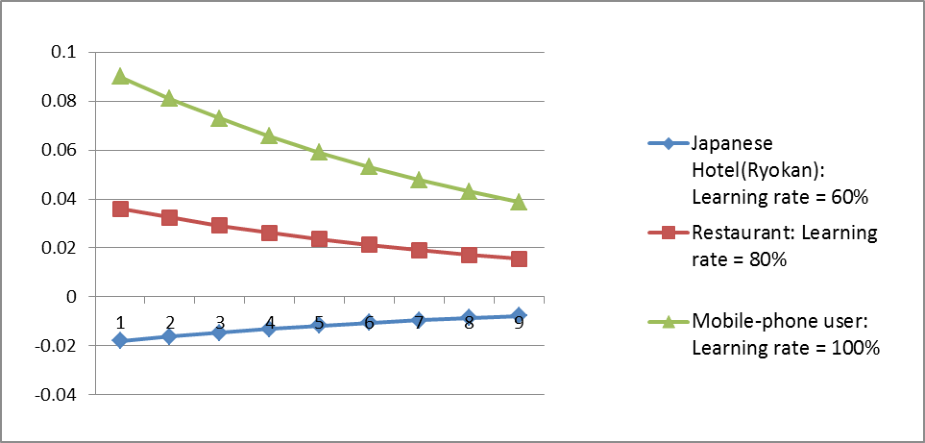
We input the parameters to the proposed extended hotelling model (see Figure 2). This is show the effect of the promotion for the well-known service. That is the effect increases by the completed learning customers.
Figure 2: Well-known service assistant promotion strategy
IMPLICATION This is one approach for treating the variety of customers from dynamic aspects. We can combine a microeconomic model and service marketing by using customer choice model like the hotelling model. In business side, this approach is useful how to treat the variety of customers for their differentiation.
CONCLUSION
We showed the customer learning speed. From questionnaire survey, the specific customer learning rates are; Restaurant: 68\%(t=1), 66\%(t=2), 92\%(t=3); Hotel: 70.8\%(t=1), 50\%(t=2), 50\%(t=3); Mobile-phone users: 93.6\%(t=1), 100\%(t=2), 97.1\%(t=3), t is representing the time period. And we showed the effect of well-known service assistant promotion by using customer choice model extended the Hotelling model that is one of microeconomic models.
There are theoretical and practical limitations. The novelty/familiarity perspective is one of them for the criteria of service evaluation. We believe that it is insufficient to treat the perspective only. Another issue is how to collect the data. We believe that it is important for understanding and applying the customer variety that to develop meta- perspectives, e.g., meta-questionnaire, meta-business process modeling and so on.
The direction of further research is two ways. First way is to develop other qualitative factors like novelty/familiarity perspective and discuss the customer learning speed. Another way is to develop the method how to collect the data like meta-modeling approaches.
ACKNOWLEDGEMENT
The authors thank Sung-sook Kang for her support for our survey research. I'll appreciate to the participants for the questionnaire. And this work is supported by JST-RISTEX.
REFERENCES
Bolton, R. N. (1998), "A Dynamic Model of the Duration of the Customer's Relationship with a Continuous Service Provider: The Role of Satisfaction," Marketing Science, vol. 17, No. 1. pp. 45-65 Boulding, W., Kalar,A., Staelin, R., Zeithmal, V. A. (1993), "A Dynamic Process Model of Service Quality: From Expectations
to Behavioral Intentions," Journal of Marketing Research, 7-27, February. Fudenberg, D., Tirole, J. (2000), "Customer Poaching and Brand Switching." The RAND Journal of Economics, 31(4). pp. 634- 657 Hotelling, H. (1929), "Stability in Competition." The Economic Journal, 39(153). pp. 41-57 Kopalle, P. K., Lehmann, D. R. (2006), "Setting Quality Expectations When Entering a Market: What Should the Promise Be?,"
Marketing Science, vol. 25, No. 1. pp. 8-24 Masuda, H., Hara, Y. (2011), "A Dynamic Evaluation Model based on Customer Expectation and Satisfaction." Paper presented at SRII2011 International Conference, San Jose, California. Oliver, R. L. (1997), "The Expectancy Disconfirmation Model of Satisfaction," in R. L. Oliver, ed., Satisfaction: A Behavioral
Perspective on the Consumer, New York, NY: McGraw Hill. pp. 98-131 Parasuraman, A., Zeithmal, V. A., Berry, L. L. (1998), "SERVQUAL; A Multiple-Item Scale for Measuring \& Consumer Perceptions of Service Quality," Journal of Retailing, Vol. 64, No. 1. Vargo, Stephen L. and Lusch, Robert F. (2004), "Evolving to a new dominant logic for marketing." Journal of Marketing, 68. pp.
1-17 Zeithmal, V. A. (1981), "How Consumer Evaluation Processes Differ Between Goods and Services," Marketing of Service. pp.
186-190 Zhang, J. (2011), "The Perils of Behavior-Based Personalization." Marketing Science, 30(1). pp. 170-186
LISTED IN THE AHFE DIGITAL BOOKSTORE CATALOGUE
Explore the complete digital volume
Advances in The Human Side of Service Engineering
Read this individual research paper free through the original publisher, or explore the full digital proceedings book.
ISBN 978-1-4951-2091-6
Explore this ISBN in the AHFE Bookstore ↗Listed in the July 2026 bookstore catalogue; search by ISBN to confirm current availability · Digital book purchase optional