Kengo Matsumura, Hisashi Masuda (2023). Influence of Pre-Video Explanation through an Acquaintance on Perception and Purchase Intention in Japanese Sake Tasting. In: The Human Side of Service Engineering. AHFE Open Access, vol. 108, pp. 400–404. https://doi.org/10.54941/ahfe1003143
In social media marketing, the impact of the relationship between the information provider and the receiver on marketing effectiveness has recently been the focus of much attention. However, in the field of tasting marketing for alcoholic beverages and other products, such differences in the relationship have not been adequately examined. This study examined how factors related to the degree of relationship to the characters in the video affect purchase intentions for the sake tasting experience, comparing the case where tasting participants know the informant in the video with the case where they do not know. The results showed a statistically significant positive relationship from cognitive perception to purchase intention for both knowing and not knowing the character in the video. Furthermore, there was a statistically significant positive relationship from sensory perceptions such as aroma to purchase intention only when the character was known. This research will contribute to the development of tasting marketing that takes into account the nature of the relationship between the information provider and the receiver.
With the proliferation of social media, social media marketing is attracting attention across all industries. In this context, there is a movement to utilize social media influencers, who are becoming increasingly influential on social media (e.g., Masuda et al., 2022). Compared to traditional influencers such as celebrities, these social media influencers have a more specific domain- based influence on the consumer side, and are often perceived as user-initiated information providers.
With respect to alcohol-related marketing, various characteristics and perceptions and their applications have been examined. Consumer variables (demographic, psychographic/behavioral, and genetic variables), product variables (in-product and extra-product attributes), and context and purch- ase process (customer journey, atmosphere) have been identified as factors related to consumers’ beer choice (Betancur et al. 2020). Tasting events in
Influence of Pre-Video Explanation Through an Acquaintance on Perception 401
beer have also been analyzed to determine the impact on consumers when tasting different types of beer (e.g., mass-produced vs. craft beers) (Jaeger et al. 2020). In the tourism sector, wine tourism, which offers wine tastings in wine-producing regions, is a typical example of tourism that utilizes alcoh- olic beverages (Dawson et al. 2011). Japanese sake tourism is another tourism experience service that is being actively implemented in Japan based on the appeal of its historical and cultural aspects (Sato and Kohsaka, 2017).
An exploratory analysis of the prior information given to tasting partici- pants in the alcoholic beverage tasting experience is underway (Masuda and Matsumura, 2022). However, it has not been fully demonstrated how the relationship between the imformation provider and the receiver affects their perceptions of the tasting experience and its marketing effectiveness. With the growing influence of social media influencers, consideration of the relation- ship between the information provider and receiver becomes an important perspective in the provision of tasting services as well.
This study focuses on Japanese sake as an alcoholic beverage and aims to determine how the relationship between the imformation provider and receiver influences the evaluation of the tasting experience when it comes to the provision of advance information given to participants. Specifically, we will test whether participants at a sake tasting event will be acquaintance with the character in the video when they watch a video of a person explaining the sake they are tasting before the tasting, and what effect this will have on their evaluation of the experience. This study provides theory-building that enables the evaluation of the impact of relationships on the prior provision of information to customers of tasting services in tasting marketing, as well as insights for practitioners who utilize tasting services to design more effective tasting marketing.
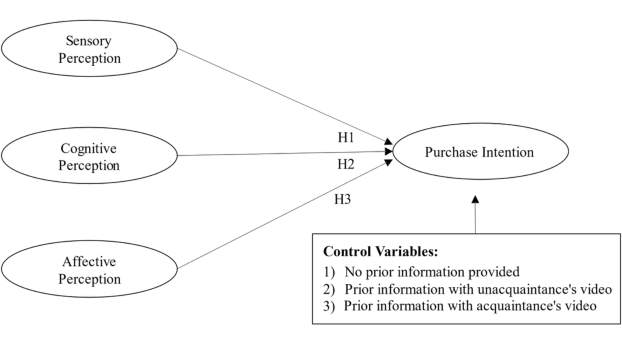
RESEARCH MODEL Based on the purpose of this study, hypotheses were developed and the rese- arch model was set up as shown in Figure 1. Product purchase intention was
Figure 1: Proposed research model.
402 Matsumura and Masuda
set as outcome of tasting marketing, and based on previous studies (Betancur et al. 2020; Jaeger et al. 2020; Ares and Jaeger, 2015; Jaeger et al. 2017), tasting sensory perceptions, cognitive perceptions, and affective perceptions with respect to the evaluation of the tasting experience itself. For the con- trol variables, in terms of differences in the prior information given to tasting event participants, we set 1) no prior information provided prior to tasting, 2) prior information with unacquaintance’s video, and 3) prior information with acquaintance’s video.
METHOD
To test the proposed research model, a tasting experiment with brand-new Japanese sake was conducted with customers of a Japanese restaurant in California, USA. In this study, prior to participating in the tasting experi- ment, participants are controlled to be provided with prior information about the new product by different means. Specifically, participants were randomly divided into two groups, as either with no prior information provided or with prior information provided prior to tasting. With regard to whether or not they knew the character in the video, the survey item asked about the level of aquaintance on a 5-point Likert scale. Regardless of the degree of acquain- tance, the information given used the same description of the new product. Participants in the group for which no advance information is provided will participate in the tasting experience without prior information about the new product. As the product used here, we set up one of the new sake products from a certain sake manufacturer. This new product is very different in fla- vor from conventional sake. The study was conducted based on the same research and experimental design as a previous study (Masuda and Matsu- mura, 2022), which was approved for research ethics review by the Graduate School of Management, Kyoto University.
An experimental question items was developed to gather feedback from participants on their tasting experience based on the proposed research model. The main question items were components of the research model, measuring the degree of agreement in the tasting experience on a 5-point Likert scal. Sensory perceptions consisted of aroma, sweetness, dryness, aci- dity, hardness, roundness, complexity, freshness, juicy (fruity), watery/light, aftertaste, and white wine taste. Cognitive perceptions consisted of arti- san, balanced, cheap, easy drinking, refined, friendly, casual, new, light/full bodied, mass produced, masculine, simple, smooth, strong, unique, craft brew, authentic. Emotional perceptions consisted of memorable, stimulating, pleasant, enjoyable, adventurous, relaxing, and exciting. Product purchase intent was used as the marketing outcome. In addition, the frequency of each participant’s previous experiences with alcoholic beverages and demographic demographics were collected.
Data were collected at two Japanese restaurants in California, USA, on June 20-23, 2022 and June 27-30, 2022. Participants were randomly assi- gned to one of the two pre-information acquisition types after agreeing to the purpose and procedures of the experiment. Each group was then given a tasting of a new sake product in the pre-information type of each group.
Influence of Pre-Video Explanation Through an Acquaintance on Perception 403
After tasting, participants completed a web-based questionnaire based on this survey design using a mobile device. The number of valid responses was 170 (Restaurant A: 95, Restaurant B: 75).
The hypothesis testing method is PLS-SEM (Partial Least-squares-based Structural Equation Modeling) (Hair et al. 2022). PLS-SEM is more robust with smaller sample sizes than covariance-based structural equation mode- ling (CB-SEM) and is suitable for small sample sizes such as in this study.
RESULTS
The results of this study showed a statistically significant positive relationship from cognitive perception to purchase intention for both knowing and not knowing the character in the video (Table 1). On the other hand, there was a statistically significant positive relationship from sensory perceptions such as aroma to purchase intention only when the characters were known.
Table 1. Results of hypothesis testing (H1-H3).
Table available in the original PDF paper.
Prior with information No prior information unacquaintance
This study demonstrates the influence of the relationship between the chara- cters in the explanatory video and the tasting participants on their evaluation of the tasting experience, which has not been adequately tested in traditional alcohol beverage tasting research. With the widespread use of social media, various information providers may be created, and the nature of the relati- onship between information providers and their recipients will also diversify. The findings of this study will contribute to the promotion of tasting marke- ting that takes into account the construction of the social relationship aspects of information transmission through people. In the future, we will conduct detailed analysis of customer demographics, conduct empirical experiments that take into account the difference in the impact of information transmis- sion from the corporate side or from the consumer side, and develop a theory on the impact of providing advance information in tasting-type services, and work on building a theory on the impact of providing prior information on tasting-type services.
404 Matsumura and Masuda
ACKNOWLEDGMENT
This work was supported by Gekkeikan Sake (USA), INC. Joint Research Project 2022.
REFERENCES
Ares, G., & Jaeger, S. R. (2015). 11 - Check-all-that-apply (CATA) questions with consumers in practice: experimental considerations and impact on outcome. In J. Delarue, J. B. Lawlor, & M. Rogeaux (Eds.), Rapid Sensory Profiling Techniques (pp. 227–245): Woodhead Publishing. Betancur, M. I., Motoki, K., Spence, C., & Velasco, C. (2020). Factors influencing the
choice of beer: A review. Food Research International, 137, 109367. doi: https: //doi.org/10.1016/j.foodres.2020.109367. Brown, G., & Getz, D. (2005). Linking wine preferences to the choice of wine tourism destinations. Journal of Travel Research, 43(3), 266–276. Dawson, H., Holmes, M., Jacobs, H., & Wade, R. I. (2011). Wine tourism: Winery
visitation in the wine appellations of Ontario. Journal of Vacation Marketing, 17(3), 237–246. Gómez, M., Pratt, M. A., & Molina, A. (2019). Wine tourism research: a systematic review of 20 vintages from 1995 to 2014. Current Issues in Tourism, 22(18), 2211–2249. doi: 10.1080/13683500.2018.1441267. Hair, J. F., Hult, G. T. M., Ringle, C. M., & Sarstedt, M. (2022) A Primer on Par-
tial Least Squares Structural Equation Modeling (PLS-SEM) Third Edition, SAGE Publications. Jaeger, S. R., Worch, T., Phelps, T., Jin, D., & Cardello, A. V. (2020). Preference segments among declared craft beer drinkers: Perceptual, attitudinal and behavi- oral responses underlying craft-style vs. traditional-style flavor preferences. Food quality and preference, 82, 103884. doi: https://doi.org/10.1016/j.foodqual.2020. 103884. Masuda, H., Han, S. H., & Lee, J. (2022). Impacts of influencer attributes on
purchase intentions in social media influencer marketing: Mediating roles of cha- racterizations. Technological Forecasting and Social Change, 174, 121246. doi: https://doi.org/10.1016/j.techfore.2021.121246. Masuda, H., & Matsumura, K. (2022). An Empirical Study on the Impact of Prior Information Provision Methods on Participants’ Perceptions in Tasting Marketing. Paper presented at the ENTER22 e-Tourism Conference. Sato, J., & Kohsaka, R. (2017). Japanese sake and evolution of technology: A com-
parative view with wine and its implications for regional branding and tourism. Journal of Ethnic Foods, 4(2), 88–93.
LISTED IN THE AHFE DIGITAL BOOKSTORE CATALOGUE
Explore the complete digital volume
The Human Side of Service Engineering
Read this individual research paper free through the original publisher, or explore the full digital proceedings book.
ISBN 978-1-958651-84-1
Explore this ISBN in the AHFE Bookstore ↗Listed in the July 2026 bookstore catalogue; search by ISBN to confirm current availability · Digital book purchase optional