Hisashi Masuda, Kanae Kochigami, Yin Jou Huang (2024). Use of a robot and the personalization of information provision in tourism marketing promotions. In: The Human Side of Service Engineering. AHFE Open Access, vol. 143, pp. 150–159. https://doi.org/10.54941/ahfe1005093
Although a framework for artificial empathy exists in marketing research, the marketing effects of artificial empathy when using robots and generative artificial intelligence (AI) have not been sufficiently verified. This study shows that in the promotion of tourism services, artificial empathy can be achieved through the use of robots and personalization of the way information is conveyed. We established and verified a research model based on the hypothesis that influences visit intention. When using personalized explanations with generative AI, artificial empathy had a statistically significant positive impact on visit intention through helpfulness and perceived connectedness. Merely using robots cannot influence the outcomes (visit intentions). However, even without changing the main promotional content, we can influence the outcomes by personalizing the presentation to match audience preferences.
In marketing, research on the effectiveness of advertising recommendations made by social media influencers is progressing. Media influencers build careers by accumulating expertise in specific domains. Social media influ- encers’ information dissemination based on their own experiences may be trusted more by consumers than traditional celebrity endorsement adver- tisements. Information senders’ credibility has been reported to positively impact marketing effectiveness, such as repurchase intention (Sokolova and Kefi, 2020; Schouten, Janssen, and Verspaget, 2020; Masuda, Han, and Lee, 2022). However, with the recent development of robots and artificial intelligence (AI), research on the use of automation technology in marketing has begun to be reported (Hoyer et al., 2020). The use of robots in services, called ser- vice robots and chatbots, which are based on programming and interacting with customers, is increasing. Thus, the impact of AI technology on robots in service is significant for advancing automation through marketing.
Use of a Robot and the Personalization of Information Provision 151
Research has progressed from the perspective of artificial empathy through the use of robots and AI. Artificial empathy is a concept that describes human cognitive and emotional empathy in the design and implementa- tion of AI agents; it measures how customers empathize with AI agents in response to automated technology and customer marketing communica- tions (Liu-Thompkins, Okazaki, and Li, 2022). AI-enabled customer service agents can provide emotional and social customer interactions comparable to human agents (Liu-Thompkins, Okazaki, and Li, 2022).
Although a framework exists for artificial empathy in marketing research, the marketing effects of artificial empathy when using robots and generative AI have not been sufficiently verified. Many previous studies have analyzed the marketing effects of technology utilization based on descriptive scenarios, without using actual robots. In the context of using actual robots and owing to the variety of implementation methods, it is necessary to demonstrate the influence of the type of robot that provides information and the method of conveying that information on its marketing effectiveness.
In this study, we analyzed the influence of using robots and personal- ized information delivery methods on visitors’ intention to promote tourism attraction. Specifically, we utilize Softbank Robotics’ humanoid service robot Pepper (Pandey and Gelin, 2018), and personalize the way information is conveyed based on two dimensions: rational/emotional and casual/formal. We set up a research model based on the hypothesis that artificial empathy influences visit intentions through helpfulness and perceived connectedness. This model was verified based on the data collected in the experiment. This research will support more effective decision-making when formulat- ing tourism/service promotions that utilize automation technology to clarify trends in visit intentions based on differences in the use of robots and the personalization of explanations by generative AI.
PRIOR RESEARCH AND HYPOTHESIS CONSTRUCTION Research on the concept of artificial empathy is underway as a perspective for evaluating the use of technology in the marketing field (Liu-Thompkins, Okazaki, and Li, 2022). Artificial Empathy measures how customers empathize with AI agents in response to automated technology and customer marketing communications, and Artificial empathy is mainly composed of three concepts: Perspective-taking, Empathic concern, and Emotional contagion (Liu-Thompkins, Okazaki, and Li, 2022).
The roots of artificial empathy lie in interpersonal fields, such as clinical psychology, social psychology, and ethics (Yalcin and DiPaola, 2018). Empa- thy refers to the ability to sense, understand, and share others’ thoughts and emotions (Wieseke et al., 2012). Empathy has been investigated in many marketing research contexts (Weißhaar and Huber, 2016; Wieseke et al., 2012). Research on the effects of social relationships on influencer marketing is ongoing. In particular, research is being conducted on parasocial relationships (PSR), which are pseudo-human relationships formed between influencers and followers, even though there is no direct interaction. Various studies have
reported that PSR has a positive impact on marketing outcomes such as repur- chase intention in endorsement advertisements on social media (Masuda, Han, and Lee, 2022).
In this study, we developed hypotheses regarding visit intention as a pro- motion of tourism attractions based on the extant literature on artificial empathy, the helpfulness of AI agents, and social relationships/connectedness. Social relationships, such as the PSR formed by product buyers, influence future purchase intentions (Masuda, Han, and Lee, 2022). Therefore, we pro- pose the following hypothesis. H1: Perceived connectedness with an AI agent positively influences the intention to visit a tourist attraction. Regarding helpfulness, it has been verified that the helpfulness of AI agents influences perceived connectedness (Okazaki, Nguyen, and Celiktutan, 2023). There- fore, we propose the following hypothesis. H2: Helpfulness of an AI agent is positively related to its perceived connectedness with the AI agent. Arti- ficial empathy affects the helpfulness of AI agents (Okazaki, Nguyen, and Celiktutan, 2023). Therefore, we propose the following hypothesis. H3: Arti- ficial empathy is positively related to the helpfulness of AI agents. These hypotheses are summarized in the research model shown in Figure 1.
Figure 1: Proposed research model.
Figure available in the original PDF paper.
Methodology
In this study, we examined the influence of robot utilization and person- alization of explanation phrases using generative AI on tourism promotion based on a proposed research model. To measure marketing effectiveness, we conducted controlled experiments using the following information pro- vision methods: 1) neutral and standardized information with video and artificial narration as an AI agent (no-appearance); 2) personalized phrase of the explanation (main contents are same) with video and artificial narration as an AI agent (no-appearance); 3) neutral and standardized information with video and a robot as an AI agent; 4) personalized phrase of the explanation (main contents are same) with video and a robot as an AI agent.
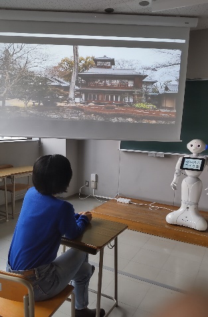
Pepper (Pandey and Gelin, 2018) from SoftBank Robotics, was used. Pep- per is a humanoid robot with a height of 120 cm that is capable of speech and gestures. As various reports have been made on the marketing effects of using pepper (Tuomi, Tussyadiah, and Hanna, 2021), we used pepper in this experiment based on its relationship with previous studies. In video-only explanations, audio files are incorporated into the videos. In the explanation using the robot, no audio was incorporated into the video and the robot spoke the same sentences. The audio in the video and the robot’s audio were of the same type, and the timing of the audio explanations was aligned. To ensure that the robot naturally promoted the video, the robot spoke while facing for- ward. At the end of the sentence, the robot looked toward the screen where
Use of a Robot and the Personalization of Information Provision 153
the video was playing (see Figure 2). On the robot’s tablet, the information presentation was unified by presenting the robot’s name tag “the explainer Laika.”
The large language model (LLM) GPT-4 was used for personalization. In our study, we personalized PR texts along two dimensions, casual/formal and rational/emotional, resulting in four distinct PR styles: casual-rational, casual-emotional, formal-rational, and formal-emotional. To identify each participant’s preferred PR style, we administered a pre-experiment question- naire consisting of five questions. Each question contains four one-line PR texts representing different PR styles for the participants to choose from. Here, we prompted GPT-4 to generate one-line PR texts on predefined PR targets (products or services) for each PR style. Similarly, we used GPT-4 to generate personalized PR texts for each participant based on their pre- ferred PR type (most chosen in the questionnaire). Here, GPT-4 is prompted to rewrite the original PR text into each of the four PR styles while ensuring the semantic invariance of the content. Finally, the automatically generated PR texts were checked by a native Japanese speaker to ensure their quality.
Figure 2: An experiment scene.
In this study, measurement items for each construct of the research model were adopted from extant literature and modified to suit the context of this study. Table 1 lists the measurement items used in the survey. All items were measured using a 5-point Likert scale ranging from “strongly disagree” to “strongly agree.” In the experimental scenario, participants watched a one- minute promotional video of a tourist attraction in Kyoto, Japan, and then answered a questionnaire designed based on the research model. Artificial empathy was measured using six items (Davis, 1983; McBane, 1995). The helpfulness of the AI agent was measured using four items extracted from Okazaki, Nguyen, and Celiktutan (2023). Perceived connectedness was mea- sured using five items (Okazaki, Nguyen, and Celiktutan, 2023). As an outcome of marketing effectiveness, visit intention was measured using two items from Tosun et al. (2015).
We constructed a web questionnaire based on the proposed research model and recruited participants for an experiment at a university in Kyoto, Japan. The experiment was conducted in December 2023, and 116 valid responses were received (Table 2).
We used structural equation modeling (PLS-SEM) based on partial least squares (PLS) to test our hypotheses. There are two types of structural equa- tion modeling (SEM): covariance-based (CB) and PLS-SEM (Hair et al., 2019). PLS-SEM requires no assumptions about the distribution of the measured variables because its iterative algorithm is based on a series of least- squares fits, and allows robust estimation even with small sample sizes. Here, we use the PLS-SEM approach, which is more flexible with respect to the dis- tribution of measured data and provides robust estimation results even when the sample size is limited.
Table 1. Questionnaire.
Table available in the original PDF paper.
Construct Item Measure Artificial empathy (Perspective- taking and Empathic concern) PT1 The instructor (Laika) tried to understand the customer more deeply by imagining how things would look from the customer’s perspective. PT2 The instructor (Laika) tried to “put himself in the customer’s shoes” PT3 The instructor (Laika) tried to imagine how he would feel if he were in the customer’s shoes. EC1 The instructor (Laika) sensed the customer’s feelings. EC2 The instructor (Laika) showed concern about the customer’s experience. EC3 The instructor (Laika) tried to make the customer feel better. Helpfulness Help1 The instructor (Laika) met my needs through its features. Help2 The instructor (Laika) provided good guidance (as needed) throughout the feature. Help3 The instructor (Laika) provided all the support I needed. Help4 The instructor (Laika) provided very wise and effective advice when needed. Perceived connectedness
PC1 I felt a connection with the instructor (Laika) PC2 The explanations given by the instructor (Laika) deepened our bond. PC3 Connected with the instructor (Laika) PC4 The instructor (Laika) shared my interests and ideas. PC5 I felt a connection with the instructor (Laika) Visit Intention VI1 I would like to actually visit this tourist facility VI2 I will visit this tourist facility soon
Use of a Robot and the Personalization of Information Provision 155
Table 2. Respondent demography.
Table available in the original PDF paper.
Characteristics Frequency (n) Percentage (%) Gender Female 73 62.93 Male 43 37.07 Age group (years) <20 30 25.86 20-24 81 69.83 25-29 4 3.45 Unknown 1 0.86 Promotion category No robot + standard narration 26 22.41 No robot + personalized narration 31 26.72 With robot + standard narration 25 21.55 With robot + personalized narration 34 29.31
RESULT
As a step in the analysis, we performed structural equation analysis using PLS- SEM. In the first half of PLS-SEM, we evaluated the measurement model for constructs and question items. In the second half, we tested our hypotheses based on the proposed research model. Third, we compared the differences based on the results of each experimental group.
The measurement models in this model are reflective constructs (con- structs that influence the measurement scale as latent variables). To evaluate the results of the reflective measurement model using all data (n = 116), outer loading, composite reliability, Cronbach’s alpha, convergence using average variance extraction (AVE) (Table 3), and discriminant validity were performed (Hair et al., 2016). All the external loads on the components exceeded a threshold of 0.70, indicating that the index had a sufficient level of reliability. The composite reliability value was > 0.70, indicating a sufficient level of reliability. Furthermore, Cronbach’s alpha was greater than 0.70, indicating that there was no problem in terms of reliability. The AVE exceeds the required threshold of 0.50 and has a high level of convergent validity. Regarding discriminant validity, all values were less than 0.9 according to the HTMT criteria, and discriminant validity was established.
To evaluate the proposed research model, we evaluated the VIF, the sig- nificance of the path coefficient, the level of R2 value, and the degree of predictive association Q2 (Table 4). First, all VIF values related to the con- structs are clearly below the threshold, and there is no problem of collinearity. Second, we checked the R2 value of the endogenous latent variable. Third, when evaluating the significance of the coefficients, all paths were significant at the 0.001% level.
Use of a Robot and the Personalization of Information Provision 157
Table 5 shows the results of the path coefficients (H1-H3) for hypoth- esis verification. As a result of the analysis, all hypothesized paths were statistically significant.
Table 5. Hypothesis testing (H1 to H3) results (all data).
Table available in the original PDF paper.
Result
Hypothesis/ Structural Path
B p-Value 95% Confidence Interval 0.460 0.000 [0.397, 0.728] Accepted
H1 Perceived connectedness → Visit intention
0.441 0.000 [0.205, 0.639] Accepted
H2 Helpfulness → Perceived connectedness
0.567 0.000 [0.311, 0.603] Accepted
H3 Artificial empathy → Helpfulness
Each hypothesis was verified using a research model for the data from each experimental group. The results are summarized in Table 6. Regarding the groups, Group 1 pertains to neutral and standardized information with video and artificial narration as an AI agent (no-appearance); Group 2 refers to personalized phrases of the explanation (main contents are the same) with video and artificial narration as an AI agent (no-appearance); Group 3 per- tains to neutral and standardized information with video and a robot as an AI agent; Group 4 refers to personalized phrases of the explanation (main contents is same) with video and a robot as an AI agent. For Groups 1 and 3, H2 became non-significant compared to the results of the overall data. In Groups 2 and 4, all paths were statistically significant for the overall data.
Table 6. Hypothesis testing (H1 to H3) results (data for each group).
Table available in the original PDF paper.
Group 1 Group 2 Group 3 Group 4 Hypothesis B Result B Result B Result B Result
0.696*** A 0.618*** A 0.283 R 0.347* A
H1: Perceived connectedness →Visit intention
0.290 R 0.565*** A 0.665*** A 0.51*** A
H2: Helpfulness → Perceived connectedness
0.597* A 0.584** A 0.547** A 0.635*** A
H3: Artificial empathy →Helpfulness Note1: Group 1 is neutral and standardized information with video and artificial narration as an AI agent (no-appearance); Group 2 is personalized phrase of the explanation (main contents is same) with video and artificial narration as an AI agent (no-appearance); Group 3 is neutral and standardized information with video and a robot as an AI agent; Group 4 is personalized phrase of the explanation (main contents is same) with video and a robot as an AI agent.; Two Tailed Test; *** Significance Level = 0.1%; ** Significance Level = 1%; * Significance Level = 5%; A=Accepted; R=Rejected
DISCUSSION
The main finding of this study was that in the group that used personalized explanations by generative AI, artificial empathy had a statistically significant positive impact on visit intention through helpfulness and perceived connect- edness. Second, in the group that used neutral, standardized information, artificial empathy did not have a statistically significant positive effect on visit intention through helpfulness or perceived connectedness. In particular, in the standardized information provision group 1, which did not use the robot, the path from helpfulness to perceived connectedness was not statisti- cally significant, whereas in group 3, the path from perceived connectedness to visit intention was not statistically significant.
The novelty of this research is that, in the case of standardized information provision, it is not possible to influence the outcome (visit intention) simply by using videos with artificial narration or a robot with artificial narration. We showed that by personalizing the explanation provision phrase to match the audience’s preferences (e.g., rational/formal and casual/emotional), arti- ficial empathy can also affect outcomes when using artificial narration or robots.
The theoretical implication of this study is that it provides a perspective for extending the theory of artificial empathy to the point where market- ing outcomes can be obtained by combining artificial voices, robots, and explanations of personalized phrases against audiences.
Regarding the limitation, this time data were obtained on the respondents’ general openness to interacting with technology and/or robots, but this was not reflected in the results of the analysis. The differences may arise from the degree of technology preference. Another limitation is that it was not possi- ble to explicitly analyze the marketing effects of robots. Further research is required to analyze the effects of interactions with robots and personalization using generative AI. This will enable the construction of theories and verifi- cations that will contribute to effective promotional decision-making using service robots and generative AI.
ACKNOWLEDGMENT
This study was supported by JSPS KAKENHI Grant Number 20H01532. We would like to thank Editage (www.editage.jp) for English language editing.
REFERENCES
Davis, M. H. (1983). Measuring individual differences in empathy: Evidence for a multidimensional approach. Journal of Personality and Social Psychology, 44(1), 113–126. doi: 10.1037/0022-3514.44.1.113. Hair, J. F., Hult, G. T. M., Ringle, C., Sarstedt, M. (2016). A Primer on Partial Least
Squares Structural Equation Modeling (PLS-SEM). Sage Publications. Hair, J. F., Risher, J. J., Sarstedt, M., Ringle, C. M. (2019). When to use and how to report the results of PLS-SEM. European Business Review. Hoyer, W. D., Kroschke, M., Schmitt, B., Kraume, K., Shankar, V. (2020). Trans-
forming the customer experience through new technologies. Journal of Interactive Marketing, 51, 57–71. doi: https://doi.org/10.1016/j.intmar.2020.04.001.
Use of a Robot and the Personalization of Information Provision 159
Liu-Thompkins, Y., Okazaki, S., Li, H. (2022). Artificial empathy in marketing interactions: Bridging the human-AI gap in affective and social customer expe- rience. Journal of the Academy of Marketing Science, 50(6), 1198–1218. doi: 10.1007/s11747-022-00892-5. Masuda, H., Han, S. H., Lee, J. (2022). Impacts of influencer attributes on purchase
intentions in social media influencer marketing: Mediating roles of characteri- zations. Technological Forecasting and Social Change, 174, 121246. doi: https: //doi.org/10.1016/j.techfore.2021.121246. McBane, D. A. (1995). Empathy and the salesperson: A multidimensional perspective. Psychology & Marketing, 12(4), 349–370. doi: https://doi.org/10.1002/mar. 4220120409. Mende, M., Scott, M. L., van Doorn, J., Grewal, D., Shanks, I. (2019). Service
robots rising: how humanoid robots influence service experiences and elicit com- pensatory consumer responses. Journal of Marketing Research, 56(4), 535–556. doi: 10.1177/0022243718822827. Okazaki, S., Nguyen, T. V. T., Celiktutan, O. (2023). Do gestures make robots more empathetic? Exploring artificial empathy, helpfulness, and social connectedness. Paper presented at the 8th International Conference on Serviceology. Pandey, A. K., Gelin, R. (2018). A mass-produced sociable humanoid robot: Pepper:
The first machine of its kind. IEEE Robotics & Automation Magazine, 25(3), 40–48. doi: 10.1109/MRA.2018.2833157. Schouten, A. P., Janssen, L., Verspaget, M. (2020). Celebrity vs. Influ- encer endorsements in advertising: the role of identification, credibility, and Product-Endorser fit. International Journal of Advertising, 39(2), 258–281. doi: 10.1080/02650487.2019.1634898. Sokolova, K., Kefi, H. (2020). Instagram and YouTube bloggers promote it, why should I buy? How credibility and parasocial interaction influence purchase inten- tions. Journal of Retailing and Consumer Services, 53. doi: https://doi.org/10. 1016/j.jretconser.2019.01.011. Song, C. S., Kim, Y.-K. (2022). The role of the human-robot interaction in consumers’
acceptance of humanoid retail service robots. Journal of Business Research, 146, 489–503. doi: https://doi.org/10.1016/j.jbusres.2022.03.087. Tosun, C., Dedeo˘glu, B. B., Fyall, A. (2015). Destination service quality, affective image and revisit intention: The moderating role of past experience. Journal of Destination Marketing & Management, 4(4), 222–234. Tuomi, A., Tussyadiah, I. P., Hanna, P. (2021). Spicing up hospitality service encoun-
ters: the case of Pepper™. International Journal of Contemporary Hospitality Management, 33(11), 3906–3925. doi: 10.1108/IJCHM-07-2020-0739. Weißhaar, I., Huber, F. (2016). Empathic relationships in professional services and the moderating role of relationship age. Psychology & Marketing, 33(7), 525–541. doi: https://doi.org/10.1002/mar.20895. Wieseke, J., Geigenmüller, A., Kraus, F. (2012). On the role of empathy in
customer-employee interactions. Journal of Service Research, 15(3), 316–331. doi: 10.1177/1094670512439743. Yalcin, Ö. N., DiPaola, S. (2018). A computational model of empathy for interactive agents. Biologically Inspired Cognitive Architectures, 26, 20–25. doi: https://doi. org/10.1016/j.bica.2018.07.010.
LISTED IN THE AHFE DIGITAL BOOKSTORE CATALOGUE
Explore the complete digital volume
The Human Side of Service Engineering
Read this individual research paper free through the original publisher, or explore the full digital proceedings book.
ISBN 978-1-964867-19-9
Explore this ISBN in the AHFE Bookstore ↗Listed in the July 2026 bookstore catalogue; search by ISBN to confirm current availability · Digital book purchase optional