Leena Tamminen-Peter, Virpi Fagerström (2021). Did the Finnish Ergonomic Patient Handling Passport® evoke changes in vocational education and work places?. In: Advances in Human Aspects of Healthcare. AHFE Open Access, vol. 13. https://doi.org/10.54941/ahfe100480
The Finnish Ergonomic Patient Handling Passport® (EPHP®) was developed in consensus with Finnish experts, and has been standardized and registered in Finland since 2009. The EPHP® scheme defines the competencies, skill, and knowledge levels needed to perform patient transfers safely; ensures compliance with legislative requirements; and enhances patient safety and the quality of care. In Finland to date, over 2 800 people have passed the EPHP® exam and 275 have undergone the instructor training, of whom one third are teachers from different levels of vocational education. The result of a small questionnaire to 80 instructors reveals that about half of the schools have an instructor training the EPHP® scheme in some form or other. In the practical nurses’ education, EPHP® training is most commonly optional (n =12) or supplementary (n=14), and in three collages compulsory. For the registered nurses and physiotherapists, EPHP® training is available in two organizations as compulsory, in two as optional, and in four as supplementary. In the workplaces, the progress has been faster and the benefits of EPHP® training in both the quality of care and well-being of staff are evident. The EPHP® training appears to achieve the aims set forth by work places.
Work-related musculoskeletal disorders (MSDs) in nursing persist as the leading and most costly occupational health problem in Europe and the USA (Nelson et al. 2009). The cumulative effect of repeated manual patient handling activities and static awkward postures in care work are the main cause of MSDs. In spite of many efforts, very little progress has been achieved. (Hignett et al. 2003). Videman et al (1989; 2005) have shown that back symptoms are a common problem among student nurses. Low back pain rates among young and healthy nursing students have been estimated via prospective studies to be between 12 to 13% with a cumulative incidence of over 22% throughout a two-year period (Baldasseroni et al. 1998). These rates are particularly alarming since they are far greater than would be expected for a young, healthy cohort. There are many reasons for this but an important one is insufficiently taught safe patient handling in vocational education. In the USA already in 2005 a safe patient curriculum module has been piloted (Iakovou 2008; Waters et al. 2009). Nursing schools in most European countries remain deficient in their ergonomic instruction in patient handling competencies.
There are circa 140 nursing schools in Finland with approximately 20 000 students. In 2010, 210 200 registered and practical nurses worked in Finnish Social and health care (Official Statistics of Finland 2013). The future demographic changes in the population will cause a shortage in the labour force, requiring a system approach with ergonomic solutions to promote caregivers’ health and safety (Tamminen-Peter et al. 2011, ISO/TR 12296. 2012).
A survey in Finland on the patient handling training of nurses revealed wide variations in instruction among schools. Physically strenuous and unsafe patient handling methods were commonly taught in the last decade. (Rantsi 2005). The legal requirement to ensure that qualified students are competent to perform their tasks safely was not fulfilled. Nationwide guidelines of quantity and quality instruction in patient handling would enable schools and teachers to design suitable curriculums. Extended instruction time and the implementation of training in different studying cycles help students to master the required skills. To improve the quality of education, teachers need both to update their knowledge of ergonomics and more instruction time. In addition, better co-operation between schools and trainee placements is crucial. (Tamminen-Peter 2007).
Although the project “Development of evidence-based ergonomic teaching in patient handling at health care polytechnics and colleges” (Tamminen-Peter 2007) did not create a change in curriculums, it constituted a base and provided material for the Ergonomic Patient Handling Passport® (EPHP®) which was developed in 2007-2009 by Tamminen-Peter and Fagerström (2011) in cooperation with national experts for the Finnish Institute of Occupational Health (FIOH) supported by the Ministry of Social Affairs and Health.
The EPHP® training has been standardized and registered in Finland since 2009. It is intended for all social and health care professionals, students in the social and health care sectors, as well as all who assist others in moving. While a passport instructor is entitled to train for EPHP®, only FIOH provides training for both instructors and EPHP®. (Tamminen-Peter & Fagerström 2012). To date, over 2 800 people have passed the EPHP® exam and 275 have undergone the instructor training, of whom one third are teachers from different levels of vocational education.
CONTENT OF THE PASSPORT Human Systems Integration
The aim of the Ergonomic Patient Handling Passport® scheme is to define the competencies, skill, and knowledge levels needed to be able to perform patient transfers safely; to ensure compliance with legislative requirements; and to improve both patient safety and the quality of care. By means of the scheme's exam, nurses can prove their competence. Safe Patient Handling improves caregivers’ ability to assess and avoid risks and thus enhances both caregiver and patient safety, by lowering the physical load and decreasing work-related musculoskeletal injuries.
During a two-year pilot phase, 200 specialists from the Interactive Communication Network of Ergonomics participated in the development work. The content was tested in two stages, first by three pilot courses, in an old people’s home, a university hospital and a nursing college. Teachers, occupational physiotherapists, nurses and administrative staff were invited to join a focus group to discuss the evaluation results. According to their suggestions, a new improved scheme with an e-learning frame was created with the help of a pedagogical e-learning advisor. The new scheme was piloted through three courses for the experienced teachers and physiotherapists – altogether over 60 participants – in order to receive their comments on the content. Two pilot courses for the passport instructor were held.
The Ergonomic Patient Handling Passport® scheme consists of the following four parts: 1) E-learning 2) Practical training of evidence-based principals 3) Application of evidence-based practice at the workplace, and 4) Repetition and exam (Figure 1). The passport is valid for five years; to keep it valid a one-day refresher training session is required.
E-learning The online platform comprises the theoretical fundamentals needed for online study: exercises, tests and a discussion forum. Four tasks must be completed in two months, involving:
1) Reading about the epidemiology of nurses' back problems and studying different lifting techniques to understand potential risk factors in patient handling activities and the causes of musculoskeletal disorders. Further study involves the ergonomics of the work environment, the basics of biomechanics, and the analysis of some pictures. 2) Exercises for four weeks to improve body awareness, and keeping a diary about one’s own body experiences to become more aware of one’s tactile senses. 3) Studying basic biomechanics, becoming acquainted with assistive devices and hoists, and analysing the biomechanical principles to apply them in patient handling. 4) Reading the acts related to patient handling and discussing cases with fellow students in order to become familiar with occupational safety responsibilities and obligations.
Practical training The practical training lasts 16 hours, and can be organized as follows: 2 x 8 hours, 3 x 5.3 hours, or 4 x 4 hours. It consists of the following: 1) Assessment of patient's functional capacity, patient’s dependency level, weight, weight- bearing ability, cognitive status, and willingness to co-operate. 2) Principles of normal human movement in order to move optimally when involved in patient handling, and to promote the favourable movement patterns and optimal independence of the patient. 3) Assessment and activation of the patient’s own resources and moving ability. The students practise verbal and tactile interaction to optimise the patient's own resources and to encourage their independence. 4) Knowledge and skills to apply safe, ergonomic handling principles i.e. stable base, spine in line, and loads close to the body. Students practise how these assisting principles can be applied in various handling situations such as: getting up from a lying or sitting position, turning and moving in bed, in hygiene care, getting up from the floor. 5) The use of assistive products and patient lifts is practised in different assistive situations. 6) Documentation of patient's functional capacity, chosen method to assist a patient and required aids. 7) Learning to deal with unpredictable occurrences such as patient falls. The training concentrates on developing problem-solving skills.
Application phase After practical training, students return to their workplace to deepen their skills by applying the learned methods to their own patients. Teachers and occupational physiotherapists also practise their skills in a care institution for at least a few days. In this way the transfer effect of learned methods can be enhanced into everyday practice. It is recommended that the application phase lasts for one month.
Exam Before the exam, students have the opportunity to rehearse for a few hours. During the exam, two transfers are performed, one manually and one with the aid of a hoist. The activities are filmed and two qualified passport instructors evaluate the transfers according to the criteria.
AIM The aim of the Finnish Institute of Occupational Health is to improve health care workers’ health and skill in safe patient handling and incorporate the content of the passport into the compulsory studies of physiotherapy and nursing students. What changes have taken place in vocational nursing training and in work places since EPHP®’s introduction? Have teachers been able to integrate the content of the passport into the studies of physiotherapy and nursing students?
METHODS
A questionnaire by Digium Enterprise was sent to all teachers (n=80) with EPHP® instructor qualifications. The study sample consisted of teachers who worked in the vocational education institutions and responded to the questionnaire during January 2014. The contacts were collected from FIOH’s register of Patient Handling Passport® instructors. Responding time was one week after which the questionnaire was resent to those teachers who had not yet responded. The response rate was 37.5 %. The baseline information on respondents and social and health care educational institutions in Finland are presented in Table 1.
Table 1: Baseline information on respondents Variables All Vocational colleges Polytechnics n=30
Table available in the original PDF paper.
Equation reproduced from the original PDF.
Gender
29
23
6
- female, n
1
1
0
- male, n Education
28
22
6
- higher education, n
2
2
0
- lower education, n Basic education of teachers
4
3
1
- practical nurse, n
8
6
2
- registed nurse, n
21
18
3
- physiotherapist, n Social and health care education providing institutions
140
119
21
- in Finland, n
28
22
6
- correspondents, n
The questionnaire contained the following questions: How is the Ergonomic Patient Handling Passport® training organized at the college? Is it in the curriculum as compulsory, optional or supplementary studies? To which of the following student groups is the EPHP® scheme available (practical nurse, registered nurse, paramedic or physiotherapist)? How many credits does a student get from the EPHP® scheme and which factors are promoting or preventing the EPHP® scheme from being added to the curriculum? The data was both quantitative and qualitative.
The questionnaire’s quantitative data were analysed with the key ratio and the quantitative data were sorted into vocational college or polytechnics groups. The qualitative data were analysed with the content analysis. First, the researcher divided the analysed units into the main themes. Second, when necessary, the main theme was recoded into the sub-theme. Finally, the propositions were organized into the main or sub-themes and the propositions were quantified by counting percentages from the number of propositions. The propositions were divided into 52 promoting and 46 preventing factors.
RESULTS
Changes in the Vocational Training In the vocational collages, where practical nurses are educated, EPHP® training is most commonly available either as optional (n =12) or supplementary (n=14) studies. The EPHP® scheme is available both optionally and supplementary in eight organizations and compulsory in three colleges. (Table 2). In the college education students typically get 3 credits (range 0.5-3.5), if they pass the EPHP® studies.
Table 2. Ergonomic Patient Handling Passport® training for students of practical and registered nursing.
Table available in the original PDF paper.
Vocational colleges
Equation reproduced from the original PDF.
Compulsory 3 2 Optional 12 2
Supplementary 14 4
In two polytechnics, where registered nurses and physiotherapist are educated, EPHP® training is a compulsory module in the curriculum. In two colleges it is optional, and in four colleges supplementary (Table 2). In polytechnics, students also typically get 3 credits (range 3-5 credits) for the EPHP® qualification.
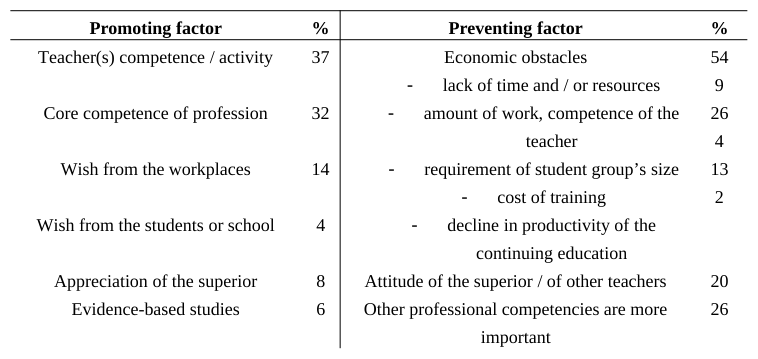
Of the respondents, 37% considered that the teacher’s activity and competence is a factor that promotes the integration of EPHP® training into the curriculum (Table 3). Understanding that ergonomics is an important core competency of nursing and the manager's appreciation were helping factors. Also workplaces’ and students’ wishes assisted in incorporating EPHP® training into the curriculum. Over half of the respondents saw different economic obstacles as preventing the inclusion of ergonomic training into the curriculum.
Table 3. Promoting and preventing factors in incorporating EPHP® training into the curriculum according to the content analyses of respondents’ answers (n=30).
Changes in the work-places The changes in the workplaces are gathered from several small studies. Henriksson (2011), in her master thesis, interviewed six nurses who had mastered EPHP®. While their units implemented safer work techniques, they used their body in a more ergonomic way, encouraged patients to move more, adapted their assistance to patient’s functional capacity, and used adequate equipment such as hoists when needed, all these factors having a positive impact on both risk assessment and work safety.
Saarinko -Weideman (2010) studied with the SOPMAS method, how the EPHP® training influenced the transferring of skills by observing eight nurses performing transfers in three situations. Their competence improved from the lowest level to the second highest, the 4th level on a scale of 1-5.
The long-term care unit in the Rovaniemi municipality with 36 patients needing physically demanding assistance started the EPHP® training in 2009. Now in 2014 the unit has ten EPHP® trained nurses and one EPHP® instructor. Their four-year statistics, 2009 – 2012, revealed a 600 days’ sick-leave reduction. This resulted in the unit being awarded the Wellbeing Prize in 2012.
With the aim to train all its health care workers (n=230), Kallio basic health care service started in 2010 training three of their own EPHP® instructors who then in turn set out to train the Kallio staff. By the beginning of 2014 they had trained 90% of the staff. All who have undergone the EPHP® training experienced their work as lighter, and 75% feel an improvement in their musculoskeletal health. Also the number of sick-leave days is reported to have decreased.
Fagerström’s (2013) doctoral thesis showed that multilevel ergonomic intervention, involving the practical EPHP® training component, reduced nurses’ neck disorders by 72%. Practical training improved nurses’ assisting skills from fair to moderate; 18 % of this improvement was due to active participation in training programmes and positive attitudes to learning. The intervention reduced the risk exposure level of patient handling in units from medium to negligible. In addition, the intervention improved the organization’s patient handling policies, procedures and working practices. The study indicated that evidence-based practical training is an important part of ergonomic intervention (Fagerström 2013.)
Although, as in Fagerström’s intervention study, many workplaces in Finland implement into their organisation’s policy only the EPHP® scheme’s practical training in order to decrease physical stress in nursing work, their positive feedback, which is starting to pour in, is encouraging.
DISCUSSION AND CONCLUSIONS Finland has circa 140 nursing schools, where physiotherapists and nurses are educated. In five years 80 teachers qualified as EPHP® instructors. As some schools have more than one EPHP®-qualified instructor only about half of the schools have an instructor, who trains the EPHP® scheme in some form or other. Many instructors have trained the other nursing teachers at their school in EPHP®, in order to enable them to teach safe handling skills to their students.
The response rate of the questionnaire was low and covers only every fourth college. Regardless of the poor response it can be concluded that progress has been made considering that at least the EPHP®-trained teachers offer some ergonomic training in safe patient handling. The amount of ergonomic training in safe patient handling has increased in Finnish nursing schools from the situation of ten years ago when only one collage in Finland allocated a sufficient amount of training, and most schools only 3-4 hours or none (Rantsi 2005). The change is slow and still only a fraction of schools teach the EPHP® scheme is as a compulsory part of the curriculum.
In the workplaces, the progress has been faster and the benefits of EPHP® training can be clearly seen in the quality of care and the well-being of staff. The EPHP® training seems to achieve the aims set forth by work places. The working practices are safer and assistive devices are used where and when needed. Patients’ functional capacities are well supported, work is experienced as lighter than earlier and musculoskeletal symptoms and sick leave days have decreased. However, workplaces are burdened with costs for training nurses in safe patient handling.
REFERENCES
Baldasseroni, A., et al., 1998. Frequency of lumbago in a cohort of nursing students. La Medicina del lavoro, 89 (3), 242–253. Fagerström, V. 2013. Developing Patient Handling Ergonomics in Nursing – Multilevel controlled intervention study in elderly care. University of Turku. Henriksson, A. 2011. Potilassiirtojen Ergonomiakortti® -koulutuksen vaikutukset potilaan siirtymisen avustamiseen hoitajien
associate degree nursing program. Teaching and Learning in Nursing 3, 48-52. ISO/TR 12296. 2012. Technical Report Ergonomics - Manual handling of patients in the healthcare sector. Geneva, Switzerland: ISO Copyright Office. Nelson, A. & Baptiste, A. 2004. Evidence-based practices for safe patient handling and movement. Online Journal of Issues in
the Nursing School. Spine 30 (20), 2334-2341.
LISTED IN THE AHFE DIGITAL BOOKSTORE CATALOGUE
Explore the complete digital volume
Advances in Human Aspects of Healthcare
Read this individual research paper free through the original publisher, or explore the full digital proceedings book.
ISBN 978-1-4951-2093-0
Explore this ISBN in the AHFE Bookstore ↗Listed in the July 2026 bookstore catalogue; search by ISBN to confirm current availability · Digital book purchase optional