John A. Sokolowski, Catherine M. Banks (2019). Developing An Agent-based Architecture to Model Population Displacement. In: Advances in Cross-Cultural Decision Making. AHFE Open Access, vol. 6. https://doi.org/10.54941/ahfe100201
United Nations High Commissioner for Refugees data reports the dislocation of millions from their native or accustomed environments. Statistical models authenticate the numbers exiting and ascertain proximate reasons for decisions to leave. These models employ static data and thus provide static outputs. This is problematic because when a decision to exit is concluded factors driving that decision can change or additional variables can present. A more efficient model is needed to envisage a broader range of outputs proffering why, when, and where migration will occur. Additionally, possessing the means to assess what-if scenarios allows for anticipating a range of expected/unexpected outcomes. This paper presents a unique architecture to state (environment) and population (agent) representation for agent-based modeling (ABM) as a means to analyze the decision-making process of individuals threatened with population displacement. This architecture facilitates agent-based modeling that can represent both fluid conditions in the environment and fluctuations in the decision-making process by people under duress. The predominant population displacement modeling application has been statistical, exclusive of dynamic inputs. The conclusions and recommendations within the literature validate implementing a new architecture for this research, which can model root, proximate, and triggering variables associated with this multi-layered, human-factors laden phenomenon.
The global environment is experiencing a grand-scale complex dilemma in the form of the dislocation of millions of individuals from their native or accustomed environments. The data from the United Nations High Commissioner for Refugees speaks to the severity of the problem (Year of Crisis, 2011):
* 12 million stateless individuals * 7.1 million people in a protracted situation * 4.3 million displaced individuals due to conflict or persecution * 3.5 million internally displaced individuals * 2.7 million refugees spread throughout 70 states * 876,000 individuals applied for asylum or refugee status * 800,000 individuals deemed refugees The various above designations are assigned individuals premised on why one leaves and where one goes (e.g., refugee, or internally displaced person). For purposes of this research we have taken an inclusive approach to these designations by assigning the term population displacement to this phenomenon.
Edited by T. Ahram, W. Karwowski and T. Marek The literature readily supports that individuals within a threatened population consider all factors known to them and then choose the best option based on assessment of the particular circumstances, perceived risks, costs, and benefits. Statistical models are developed along these lines to authenticate the numbers of those exiting and to ascertain the proximate reasons for that decision. This type of model holds to static data and thus provides a static output. This is problematic because even when a decision to exit is concluded, factors driving that decision can change during the course of the journey, or additional variables can come into the situation. A more complex model- ing capability is required for these scenarios to envisage broader potential outputs that include why, when, and where migration will occur. Additionally, possessing the means to assess what-if scenarios allows for anticipating a broader range and/or unexpected outcomes. As such, this paper presents a unique methodology to environment and agent development for engaging agent-based modeling to analyze the decision-making process of individuals in the threatening situation of population displacement.
The paper flows as follows: Part 2 reviews the current literature on both assessing and modeling popula- tion displacement; Part 3 presents two models developed by prominent social scientists in the field of refugee movement. These models serve as a baseline for crafting a more detailed matrix that can used for representing “en- vironment” for an agent-based model; Part 4 previews the two matrices developed by the authors as a methodology for environment representation and agent characterization to be used for an agent-based model; and Part 5 summa- rizes the approach, proffers suggested uses for the methodology; and tenders concluding comments.
LITERATURE REVIEW ON MODELING POPULATION DISPLACE- MENT There is an earnest discussion on how to assess population displacement within the sphere of interested scholars from across the social science disciplines (political science, sociology, legal studies, anthropology, economics, etc.). To shape the course of our approach to population displacement analysis, we did a cursory review of the theoretical approaches to this research: the criticisms, challenges, and options put before intersecting scholars in this field. We reviewed a number of papers to get better idea of how the topic was being researched. This review was necessary to better understand the crisis-like problem of population displacement, how the phenomena is being researched, how it is being assessed (modeled), and where do we as modelers from the engineering world fit in. In sum, we found that the research approaches are driven by discipline and the intent of the research and that the modeling was overwhelmingly statistically based.
Existent Theoretical Approaches Evaluating Population Displacement A lesson in the exclusivity of population designations, i.e., refugee or internally displaced, came from Forced Migration Studies: Can We Just Agree to Date, in which Hathaway questions the soundness of integrating refugee studies into the widely accepted forced migration studies (Hathaway, 2007). His rationale: this approach to assessing the problem might result in failure to consider the specificity of the refugee’s circumstances as the result of becoming better focused on the phenomena instead of the personal predicament. This finding alerted us to ensuring that we represented population, entities, and environment with equal significance. Another deficiency in the empirical research is the notion of constraining population representation by disaggregating, standardizing, and categorizing groups (Bakewell 2008).
This finding shaped our research approach as one that should present a comprehensive characterization of displaced populations, causal relationships, representations of the environment, or state of the state as we address it, and the human factors that are indisputably difficult to capture but integral to understanding events and outcomes. In Refugee Studies and the International Refugee Regime, Scallettaris (2007) notes that a wider migration approach has often proved more appropriate and profitable in studying refugee related situations.
Our review of this aspect of the empirical data led us to conclude that these differing theoretical approaches adapted either a people perspective or phenomena perspective and as such they are unable to present a comprehen- sive depiction that conveys the totality of a an imminent or crisis situation. Repeatedly, however, this literature rec- ommends the need to blur the lines or allow for overlap of mixed populations and mixed environments (situations on the ground) as these entities evolve over time.
Edited by T. Ahram, W. Karwowski and T. Marek
Existent Modeling Approaches to Assessing Population Displacement The modeling approach for assessing population displacement consists primarily of statistical applications. We found a single game theory treatment and a simplified modeling and simulation technique, both of which we viewed as creative. Almost in its entirety the problem of population displacement has been analyzed from a statistical standpoint. Of the 10 relevant papers we investigated, 8 make clear this is the approach many social scientists em- ploy. Overall, these models presented a static look at population displacement primarily the result of model con- straints associated with statistical applications. Still, we aimed to evaluate the literature with the simple goal of in- vestigating what was done, what are the strengths and deficiencies of these models, what can we adopt from these efforts.
Prominent among these research efforts is the statistical modeling of Moore and Shellman, whose numer- ous iterations focused on expanding the both model and the hypothesis. Moore and Shellman (2004) have deter- mined the leading cause of forced migration as violent behavior from the state and as such they focused on push fac- tor emanating from the state. They propose that people monitor the violent behavior of the government as well as dissidents and assess the threat it poses on them. Their statistical model goes beyond the modeling the structural characteristics of the state (Schmeidel 1997, 1998, 2000) which, in their estimation fails to connect the human factor and renders a binary assessment in the form of inputs – violence, and outputs – population displacement. The pur- pose of this model was to examine the exiting decision-making process of a threatened population.
Based on probability developed along the lines of a lottery (each person is eventually going to be a victim), the Moore and Shellman model characterized the state or habitual residence as experiencing four sources of threat: government forces, dissident forces, the interaction of these two forces, and foreign forces. The dependent variable was the decision to leave. The model was limited to forced migrants produced by a state with the flow measure cali- brated from 0 to 1 million. There were two government variables for threat: genocide / politicide (using data from the Harff 2003 study) and human rights violations (with data from Gibney and Dalton 1996). Two models were ex- ecuted for the periods 1952-1995 and 1976-1995. The models included data from 175 states with dependent vari- able being forced migrant flow specific to people responding to a single-information set such as behavior of state or dissidents. Thus, people’s decisions are linked via a common set of information accessible to all; their decisions are not independent. Descriptive statistics included these additional variables: genocide, dissident violence, civil war, international war, government terror, democracy, transition, gross national product, and forced migration. There was a data matrix of 7000 observations, but many of the countries were missing data or variables in the 2 time peri- ods. With the outputs from their model of co-variates of forced migration, Moore and Shellman unabashedly note state that their model results "tell us precious little about the specific impact of co-variates in any given forced mi- gration event."
Another Moore and Shellman model investigated push and pull factors of states (Moore and Shellman 2006). This model is designed to represent an individual's decision hinging on two things: victimization (to go or not) and socio-politico-economic opportunities (where to go). Characterization of the state held to the push factors such as sources of threat and institutions that provide freedom and rule of law. The pull factors of neighboring state included its political institutions, wage opportunities, cultural opportunities. The results from the statistical runs in- dicated as dissident and state violence increases, migrants likely to remain as IDPs than cross borders because dis- sidents have a history of providing pockets of safety. Thus, it is the state that is likely to target the civilian popula - tion. Moore and Shellman findings were quite stark: refugee production vice IDP production is a function of state targeted terror and civil wars produce more IDPs while genocides produce more refugees. This Moore and Shell- man model makes clear the need to represent within the model both the state and region at-large. Although on the right track in appreciating the need to represent the decision-making process of the population, the model does not provide satisfactory outputs that capture trigger points forcing a decision and a move. Addressing this deficiency would result in a useful predictive model that could be used to gauge how long a population will remain and where they will go once they have decided to leave.
The research surrounding push/pull factors is significant because it goes straight to the question of why people migrate. A study of 129 states (spanning 1964-1989) engaged a thesis that the state creates a threatening en- vironment, either actively or passively (Davenport 2003). Davenport et.al compared other studies that attempt this thesis only to find some suffered from selection bias because their models assessed only states that produced refugees or reviewed the data at a global rather than national level (Hakorirta 1986, Apodaca 1998, Gibney 1996). These studies fail to represent a major sector of the population, internally displaced peoples, and they address only bi-variate relationships leaving the models wanting in adequate consideration of push / pull factors. The Davenport
Edited by T. Ahram, W. Karwowski and T. Marek model was successful in developing a model beyond bi-variate relationships. This enabled an assessment of push/ pull elements by using statistical analyses using fixed effects least squares on a pooled cross sectional time series data set as mentioned above. The findings supported a somewhat common-sense conclusion that threats to personal integrity are of primary importance in the decision to abandon a locale. Moreover, measures of state threats to per- sonal integrity, dissident threats to personal integrity, and joint- state-dissident threats have a statistically significant effect on migrant production. Using net migration as the dependent variable the model included a number of inde- pendent, widely recognized variables such as nature of threat, structure of polity, interaction of state and dissidents.
Perhaps the most profound finding in the Davenport model, and worthy of representation in model develop- ment, is that states moving toward democracy tend to have a greater number of forced migrants. Notably, this counter-intuitive conclusion was drawn when less weighty variables were considered: environmental cues implying threat; economic security; and social networks. This unanticipated, significant result speaks volumes of the need to develop comprehensive models that can find correct values for all factors affecting the decision-making process.
At the time of this writing we found only one game theoretical model (Azam 2002) that analyzes motives of violence against civilians during internal wars. The model addresses two theses: soldiers terrorize because they need to loot as a means to augment resources; and, looting is simply a function of conflict. From the state's perspec- tive, displacement of large factions of the population reduces fighting efficiency of the enemy as they cannot hide or obtain supplies. Both hypotheses are investigated in game theory format with presenting the government and rebels simultaneously deciding on the level of forces engaged in violence against civilians (Stage 1) before these opposing forces decide the level of forces they will engage in fighting in each other (Stage 2).
Azam's analysis and conclusions, drawn from excellent empirical research, bring much to the subject and modeling approach of population displacement. Introducing more counter-intuitive findings, the game theoretical model allows for deriving clearly the different implications to the presence of looting in civil conflicts. As a func - tion of conspicuous atrocity, the Azam model suggests that violence against civilians is a military tactic not just a by-product of war. The outputs form this model suggest numerous factors that merit representation that have not been evaluated in any other models; most significant perhaps is the notion that there will be more refugees if a state government gets more resources and this is the result of the type of conspicuous atrocity – war against civilians.
Lastly, Bruzzone (2011) presents a conceptual model of a use-case to investigate the impact of migrant sea- sonal workers on communities. He characterizes the two populations, local and migrant, in an effort to measure the effects of conflict and disorder in the community and the response of local law enforcement. The model is concep- tual in design and as such is not an executable model with simulation runs and outputs. What is model does provide is a perspective on situational population displacement due to the economic pull of another state. Bruzzone conveys a comprehensive representation of the effects of population movement typically deemed acceptable, as with migra- tory workers. He suggests that under difficult economic periods more workers come, bringing higher competition for work, overall and escalating social unrest takes place, and crime increases. These factors merit attention within the more traditional view of population displacement as a result of conflict and/or persecution as they highlight what un- welcoming conditions could exist in locales serving as destinations for displaced populations.
Probably most prolific in the field of assessing and measuring factors that affect population movement is the work of Susanne Schmeidel. Her research (1997) assesses the role of generalized structural factors in the forma- tion of forced migration. Her models support the predominating thesis that political violence is the most important cause of migration; more specifically the level and type of violence determine likelihood and size of refugee dis- placement. A unique addition to the qualitative analysis on the subject of population displacement is Schmeidel’s adaptation of the Early Warning of Refugee Flows model by Clark (1989) in which Schmeidl emphasizes the signifi- cance of intervening factors or intervening conditions, such as refugees meeting with various unexpected obstruc- tions to their flight or humanitarian facilities being held hostage. Schmeidel expands the Clark model by delineating root causes, proximate causes, and intervening causes all of which are necessary in the development of a theoretical model designed to explain an entire situation or behavior with the idea that the assessment and model would eventu- ally be able to predict behavior. But the mapping of qualitative data to a quantitative analysis poses some deficien- cies as these statistical studies cannot conclusively determine the role of significant variables. Nor is statistical mod- eling able to clarify the degree of impact of certain variables. Simply, statistical modeling cannot represent interven- ing factors in a meaningful way so as to yield insightful predictive power.
Our literature review indicated that the predominant modeling application to assessing population displacement has been a static approach excluding dynamic inputs. The conclusions and recommendations presented in the literature validate our decision to implement the methodology selected for this research which can model causal, correlative, and corresponding factors associated with the multi-layered, human-factors laden phenomena of population displacement.
Edited by T. Ahram, W. Karwowski and T. Marek Population displacement is a complex network of relationships that must be modeled as more than just a linear link between agents or entities. As such qualitative analysis, intangibles and subjective data affecting human behavior, must be represented. Not to be excluded is the incorporation of what is most commonly used, quantitative data, to allow for an examination of population displacement through numerical representation. The mixed-methods data mining from the social science contribution to this model will provide a summarization of large bodies of sub- jective data as well as a generalization based on quantitative projections (objective data) as a means of representing the totality of the issues surrounding population displacement (Sokolowski and Banks, 2009).
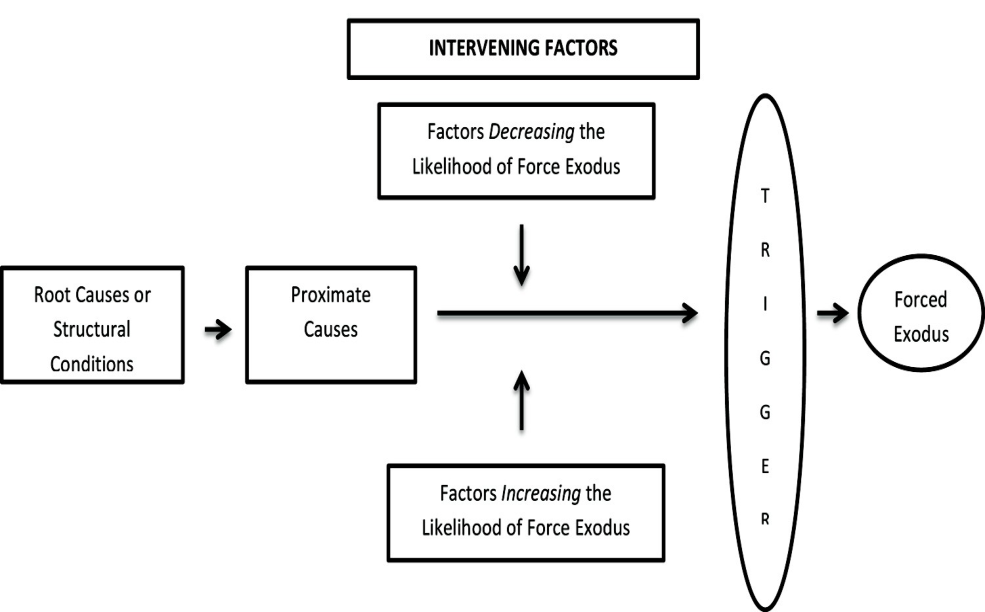
TWO SIGNIFICANT SOCIAL SCIENCE MODELING APPROACHES Probably most prolific in the field of assessing and measuring factors that affect population movement is the work of Susanne Schmeidl. As a social scientist, her research assesses the role of generalized structural factors in the forma- tion of forced migration (Schmeidl, 1997). Her models support the predominating thesis that political violence is the most important cause of migration; more specifically, she posits that the level and type of violence determines likeli- hood and size of refugee displacement. A unique addition to the qualitative analysis on the subject of population displacement is Schmeidl’s adaptation of the Early Warning of Refugee Flows model by Lance Clark (see Figure 1) in which Schmeidl emphasizes the significance of intervening factors or intervening conditions, such as refugees meeting with various unexpected obstructions to their flight or humanitarian facilities being held hostage (Clark, 1989).
Figure 1. Early Warning Model of Forced Migration - Clark Model
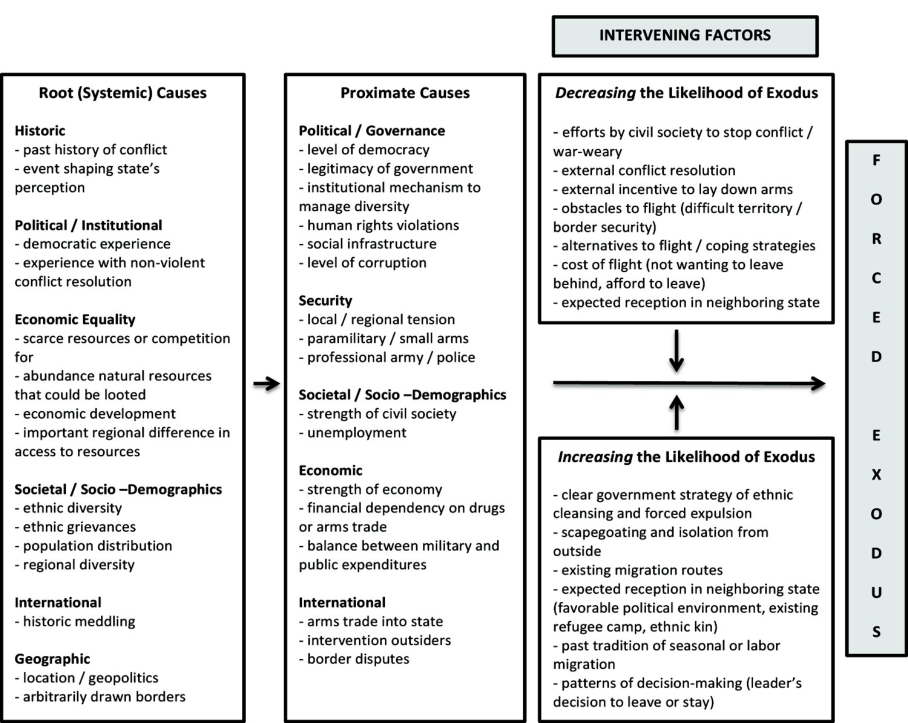
Schmeidl expands the Clark model by delineating root causes, proximate causes, and intervening causes to population displacement all of which are necessary in the development of a theoretical (conceptual) model designed
Edited by T. Ahram, W. Karwowski and T. Marek to explain an entire situation or behavior with the idea that the assessment and model would eventually be able to predict behavior (see Figure 2).
Figure 2. Indicators for the Early Warning Model of Forced Migration - Schmeidl Model
The challenge with the Schmeidl model is the mapping of qualitative data to quantitative values that could be used for simulations. Again the deficiency of this study is that it cannot conclusively determine the role or signif- icance of specific variables. Nor is Schmeidl’s statistical modeling able to clarify the degree of impact of certain variables.
We have concluded from the literature review and the assessment of the social science models (statistical and theoretical modeling respectively) cannot represent intervening factors in a meaningful way so as to yield in- sightful anticipatory or prognostic analysis. The theoretical models do, however, allow for a comprehensive charac- terization of the data as well as a means to represent triggering events which can serve as a template for assimilating population displacement data.
METHODOLOGY FOR REPRESENTING THE STATE (ENVIRONMENT) AND CHARACTERIZING THE PEOPLE (AGENT)
Edited by T. Ahram, W. Karwowski and T. Marek The authors of this research gleaned much from the literature review, especially the Clark and Schmeidl models, in constructing a methodology to represent the environment and to characterize the agent(s) for an agent-based model. We conclude this is the most effective modeling paradigm for assessing and analyzing the data that all of the model- ers discussed in the Literature Review deemed significant to understanding the phenomena of population displace- ment.
Agent-based Modeling To effectively understand the influence of one’s environment in a distressed population one must begin by studying, then representing the factors that control the environment both from the threatened population’s perspective and from the perspective of those causing the threat. Specific to the Syrian case study is the existence of two competing forces, the rebels and the government, that are each vying for control of the state and arguably the hearts and minds of the people. The relative importance of each of these groups and the methods they use directly dictate how the threatened population behaves.
Modeling and simulation, specifically the agent-based paradigm, has become a recognized tool for explor- ing real world systems, especially those that cannot be readily manipulated for experimentation purposes, such as human and social systems (National Science Foundation, 2013). The challenge is to develop a computational repre- sentation of these systems in an efficient and accurate manner.
Some definitions are in order to clarify the above steps: a model is a representation of an event or system at some level of abstraction; a simulation is the operation of the model over a period of time. The concept of abstrac- tion is important because it is unlikely that the model will be an exact replica of the system it is intended to repre- sent. The modeler must decide what level of abstraction is sufficient to meet the purpose of building the model in the first place.
Agent-based modeling, on the other hand is a bottom up approach to representing a system usually at the micro level. They are dynamic models that imitate the actions and interactions among the units of analysis. Agent- based modeling focuses on these units of analysis, or Agents, and the sequence of actions and interactions of the Agents over a period of time. Agents may represent people, organizations, countries—any type of social actor. These actors may act in parallel, may be heterogeneous, and may learn from their actions. Each Agent responds to the prior action of one or more of the other Agents or the environment in the model (or system). This, in turn, pro- duces an extended and often emergent sequence of behaviors which can be analyzed for different things. The action of the Agent can be regarded as a variable; inaction of the Agent is also a variable and it can be considered hostile, neutral, or information seeking. This modeling paradigm was chosen for this case study because we needed to ob- serve the individual changes in the population regarding their treatment by the government and the core group of rebels.
To conduct agent-based modeling one begins by defining the basic behavior of an Agent. This behavior may be captured is many ways. The most often used method is through a series of simple rules that the Agent must follow. These rules help describe the fundamental goals that the Agent is trying to achieve. Probably the best known example of an agent-based model is Craig Reynolds’ Boids which simulates the flocking behavior, emergence, of birds (Reynolds, 1987). This idea of emergence is central to agent-based models. Because of the Agent’s autono- mous, goal-seeking behavior, complex behaviors emerge that are not pre-programmed. This methodology is an ef- fective way to simulate complex social behaviors through the application of relatively simple rules that each Agent follows.
Thus, one can see that agent-based modeling is intrinsically social in that the actions and characteristics of the Agents are influenced by the actions and characteristics of the other Agents in the social system. An agent- based model consists of autonomous software entities that interact with the other entities in the simulation to achieve their own set of goals. Agent-based models are a viable means to explore complex adaptive systems such as the in- surgency in the Delta (Axelrod, 1997).
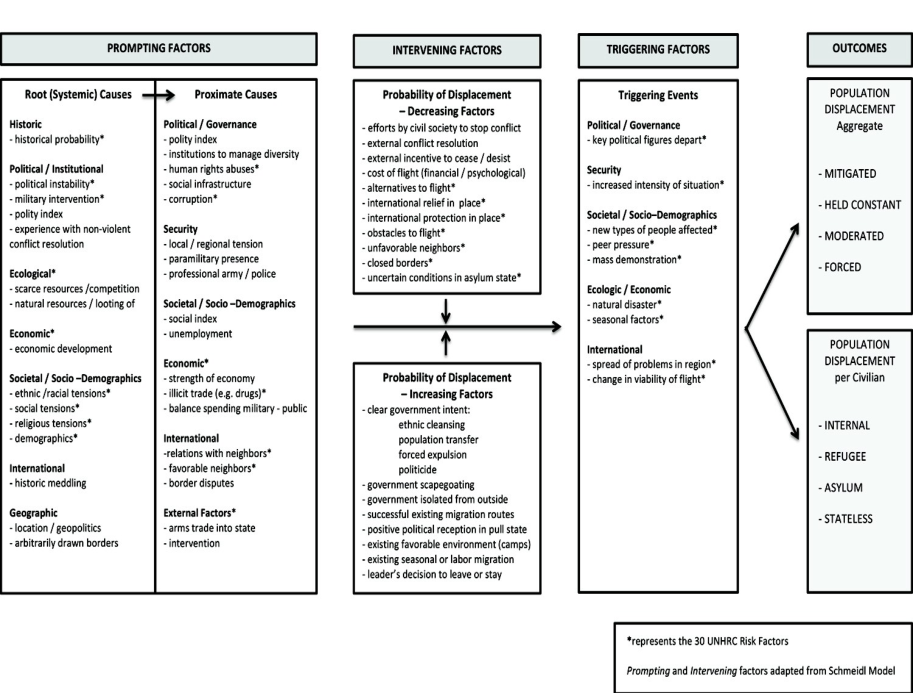
For our ongoing study of the Syrian Civil War, the environment will be developed based upon the Environ- ment Matrix shown in Figure 3. The agents are drawn from groups of people and entities listed in the ABM Agent Matrix in Table 1 below. The simulation will present these agents while moving about their region, encountering other agents or entities, and interacting with the agents and entities in some manner depending on their state of be - ing. Crafting Matrices for Environment and Agents
Edited by T. Ahram, W. Karwowski and T. Marek We begin by crafting an ABM Environment Matrix that mirror-images the specific factors outlined by the United Nations Human Rights Council (UNHRC, 1996). These variables are divided among Prompting Departure, Inter- vening Factors, and Triggering Events. Here is a sampling from the UNHRC:
Prompting Departure
ethnic and racial tensions
social tensions
religious tensions
human rights abuses
political instability Intervening Factors
alternatives to international flight
international relief in place of origin
international protection force in place of origin obstacles to flight Triggering Events
new types of people affected
spread of problems in region
increase intensity of situation
changes in viability of flight To be sure, population displacement is a complex network of relationships that must be modeled as more than just a linear link between agents or entities. As such qualitative analysis, intangibles and subjective data affect- ing human behavior, must be represented. Not to be excluded is the incorporation of what is most commonly used by the vast majority of modelers of population displacement, quantitative data, to allow for an examination of popu- lation displacement through numerical representation.
The authors have a history of engaging multi-disciplinary, mixed-methods research such as drawn from the social science contributions to provide a narration and summarization of large bodies of subjective data as well as a generalization based on quantitative projections (objective data) as a means of representing a holistic view of the facts and concerns surrounding population displacement . With this in hand, the authors have developed an ABM Environment Matrix that can be individually mapped per case study to ensure adequate and correct representation of the model environment reflecting the specific factors delineated by the UNHRC. We also included an OUTCOMES section into which the outputs of the simulation will be categorized (see Figure 3).
Edited by T. Ahram, W. Karwowski and T. Marek
Figure 3. ABM Environment Matrix - Sokolowski-Banks Model
Both the Clark and Schmeidl models provided little in the way of developing the agent portion of our methodology. The inability to characterize the key component to analyzing population displacement – the person aka agent – is a critical shortfall in statistical modeling we reviewed in the literature. Integral to assessing popula- tion displacement is the need to monitor motivation for migration as reflected in the agent. Our aim at this juncture is to craft a detailed agent characterization matrix to observe how an agent performs to achieve a goal such as sur- vival (civilian: decision to stay or move) or to accomplish a task (regime: effort to retain political control).
For purposes of this paper (and as an introduction to a future use of this methodology to analyze the Syrian civil war), the agents populating the Agent Matrix will reflect the current actors and segments of Syrian society – participants – involved with or affected by the current conflict (Office UNHCR, 2013; US Department of State, 2013; US Agency on International Development, 2013). The matrix in Table 1 assigns location (state internal or ex- ternal) and the actors’ intent or goal (sustain power, over-throw government, or survive the conflict).
Table 1. ABM Agent Matrix of the Sokolowski-Banks Model
Table available in the original PDF paper.
Edited by T. Ahram, W. Karwowski and T. Marek PARTICIPANTS LOCATION INTENT / GOAL FACTORS
This matrix cites participants at-large and allows for additional segments of the population and/or a more granular look at these populations. For example, under the Location variable a population can be assigned both an internal and external representation; or, under the Intent / Goal variable a population might include Religion as a motivator (intent) and goal (e.g., overthrow a secular government).
CONCLUSIONS
Agent-based modeling is an important tool for investigating human and social phenomena. This type of modeling has a number of advantages over traditional statistical modeling used to investigate the phenomenon of population displacement. First, subjective data that can be represented in the model plays a role: these computer agents can mirror-image real people given the correct inputs from the research. Second, these models can closely represents how an agent (human) interacts with its surroundings and the other agents (persons) in it. Third, agent-based models can dynamically coordinate communication and activity (Sokolowski and Banks, 2009). The authors acknowledge the strengths to this type of analysis and as such have developed the first step in agent-based modeling of population displacement to reflect an integration of previous modeling efforts. This methodology deliberately incorporates cri- teria set out by the UNHRC in representing specific factors to population displacement respecting the UNHRC as the authority on the subject.
The purpose of this effort was to develop a comprehensive representation of population displacement using ABM as the means to characterize accurately individuals, entities, and environment via the integration of qualitative (fuzzy or soft) data as well as quantitative values. Our methodology provides both a different approach and a differ- ent perspective to researching and understanding population displacement. As such, when populated and executed using our methodology, an agent-based model can proffer insight on how to prevent, hold constant, or moderate es- calating effects of threats to populations whose rights to citizenship, and all that it encompasses, are in jeopardy.
Edited by T. Ahram, W. Karwowski and T. Marek Our next effort will be to develop an agent-based model that fully represents events in Syria 2011-2012. We intend to execute and engage the model as a predictive or anticipatory tool to provide computationally sound conclusions as to where the crisis is heading over the stipulated time-steps, observing the effects of degenerating conditions and trigger points that could lead to external involvement (foreign military intervention) or collapse of the state.
REFERENCES
A Year of Crisis: Global Trends 2011. (2012), UNHRC. Geneva: Media Relations UNHRC. UNHRC Website: www.unhrc.org/statistics/populationdatabase Apodaca, C. (1998), "Human Rights Abuses: Precursor to Refugee Flight?", Journal of Refugee Studies 11(1): 80-93. Azam, J.P., Hoeffler, A. (2002), "Violence Against Civilians in Civil Wars: Looting or Terror?", Journal of Peace Research,
39: 461. doi: 10.1177/0022343302039004006 Bruzzone, A.G. (2011), "Modelling and Stablisation, Normalisation and Reconstruction Activities and their Impact over Internally Displaced Persons, Refugees, and Immigrants", NATO-CAX presentation. Conference Website: https://transnet.act.nato.int/WISE/COE/Individual/MS/Events/Archive/6thNATOCAX/Presentati/Container 5/ModellingS/file/_WFS/Modelling%20Stabilisation%20Normalisation%20%26%20Reconstruction%20A ctivi ties%20over%20IDPs.pdf Clark, L. (1989), "Early Warning of Refugee Flows", Washington, DC: Refugee Policy Group. Davenport, C., Moore, W.H., Poe, S.C. (2003), "Sometimes You Just Have to Leave: Domestic Threats and Forced Migra tion, 1964-1989", International Interactions, 29:27-55. doi: 10.1080/03050620390182966 Gibney, M., Dalton, M. (1996), "The Political Scale", Policy Studies and Developing Nations 4:73-84. Hakorirta, H. (1986), "Third World Conflicts and Refugeeism: Dimensions, Dynamics, and Trends of the World Refugee Problem", Helsinki: Finnish Society of Sciences and Letters. Harff, B. (2003), "No Lessons Learned from the Holocaust? Assessing Risks of Genocides and Politicides Mass Murder
since 1955", American Political Science Review 41:1079-103. Moore, W.H., Shellman, S.M. (2004), "Fear of Persecution: Forced Migration 1952-1995", Journal of Conflict Resolu tion Vol.
40, No. 5. doi: 10.1177/0022002704267767 Moore, W.H., Shellman, S.M. (2006), "Refugee or Internally Displaced Person: To Where Should We Flee?", Comparative Polit ical Studies Vol. 39, No. 59. doi: 10.1177/0010414005276457 National Science Foundation. Simulation-Based Engineering Science: Revolutionizing Engineering Science Through Simula
tion, Report of the National Science Foundation Blue Ribbon Panel on Simulation-Based Engineering Science. May 2006. Website: http://www.nsf.gov/pubs/reports/sbes_final_report.pdf Office of the United Nations High Commissioner for Refugees Website: http://www.unhcr.org Reynolds, C.W. (1987), "Flocks, Herds, and Schools: A Distributed Behavior Model", Computer Graphics; 21(4):25 – 34. Schmeidel, S. (1997), "Exploring the Causes of Forced Migration: A pooled time-series analysis, 1971-1990", Social Science Quarterly 78 (2): 284-308. Schmeidel, S., Jenkins, J.C. (1998), "Early Warning of Humanitarian Disasters: Problems in Building an Early Warning System", International Migration Review 32(2): 471-486. Schmeidel, S. (2000). "The Quest for Accuracy in the Estimation of Forced Migration", in Stephen C. Lubkemann, Larry Minear, and Thomas G. Weiss (Eds.), Humanitarian Action: Social Science Connections. (Occasional Paper No.3, pp. 127-157). Providence, RI: Thomas Watson Jr. Institute for International Studies. Sokolowski, J.A., Banks, C.M. (2009), Modeling and Simulation for Analyzing Global Events." Hoboken: John Wiley & Sons,
Inc. UNHCR (1996), "Contingency planning guidelines: A practical guide for field staff. Division of Operation Support, Geneva." Website: http://www.the-ecentre.net/resources/e-library/doc/2-CNTPLN US Department of State Website: http://www.state.gov/ US Agency for International Development Website: http://www.usaid.gov/
LISTED IN THE AHFE DIGITAL BOOKSTORE CATALOGUE
Explore the complete digital volume
Advances in Cross-Cultural Decision Making
Read this individual research paper free through the original publisher, or explore the full digital proceedings book.
ISBN 978-1-4951-2095-4
Explore this ISBN in the AHFE Bookstore ↗Listed in the July 2026 bookstore catalogue; search by ISBN to confirm current availability · Digital book purchase optional