Laurie Fenstermacher, Lawrence Kuznar, Mariah Yager, Steve Shellman (2019). Meaning Making Regarding Threat Narrative Based on Discourse Analysis. In: Advances in Cross-Cultural Decision Making. AHFE Open Access, vol. 6. https://doi.org/10.54941/ahfe100189
Often after an act of violence, a forensic analysis of what the responsible individual(s) or group(s) said or wrote would reveal “signals” that would have foreshadowed the event. Although these signals frequently occur well in advance; they are often nuanced, requiring a different lens to find and interpret discursive patterns and practices related to social identity, affect, integrative cognitive complexity, trustworthiness, and worldview. Threat narrative is the behavioral (actions/words) manifestation of subjective reality regarding threat. These lenses help an analyst reason about how an individual or group sees themselves and others, their perception of threat and propensity to negotiate, cooperate or engage in violence. The result is a tomographic view, albeit imperfect one, of the threat narrative.The Air Force Research Laboratory (AFRL) has been engaged in research aimed at enabling meaning making from discourse regarding threat narratives for several years. Previous research developed multi-lingual methodologies (Arabic and Pashto), documented in primers transitioned to operational customers, including the National Air and Space Intelligence Center (NASIIC), which enable the detection and interpretation of discourse related to social identity (in-group/out-group) (Fenstermacher et. al. 2012). This paper will focus on two projects designed to enable meaning making from the analysis of discourse, one employing a systematic approach to creating codebooks for automated analysis, and another employing taxonomies for automated analysis of identity and intent.A grounded theory approach, using human coders, was used to identify relevant discursive practices and patterns (themes and rhetorical devices), including intensifiers used to express trust, trustworthiness or distrust in Farsi. Key themes were identified such as Islam, positive virtues, and advanced age and/or experience. Association with a trusted individual, expert citation, language related to intimacy and poetry were typically associated with trust. Conversely, distrust was conveyed in themes related to negative virtues and government agendas and by use of figurative language such as metaphors and allusions.An automated approach focused on understanding the link between affect and behaviors using quantitative models of the effects of emotions (eight classes coded: trust, fear, surprise, sadness, disgust, anger, anticipation and joy) on behaviors of competing actors in Syria, Egypt and the Philippines (e.g., a dissident group, government and population). This approach highlights similarities and differences in resulting behaviors. For example, in both Egypt and the Philippines, societal fear, anger and disgust toward dissidents resulted in increases in dissident hostility. Conversely, in Egypt, government hostility increased in response to societal disgust whereas in Philippines it decreased.This research effort identified several apparently independent features: idea density and vocabulary diversity (proxies for integrative cognitive complexity) and affect expressed regarding in-group and out-group. Preliminary results indicate that the combination of these features would enable accurate forecasting of Naxalite bombings (.92 in sample, .8 out of sample correlation between model and actual bombings). These results are promising but preliminary; the generalization and robustness of these factors relative to different groups and languages will be assessed in a newly started research effort.The coding methodologies and the text analytic algorithms are a significant step forward in assisting analysts to systematically interpret threat narrative related language, characterize sources and reason about future behaviors and influence as well as helping to mitigate information overload by cueing analyst attention to potentially relevant documents and important events.
When an act of violence occurs, forensic analyses invariably identify precursor “signals”. These signals are in a vari- ety of forms, including physical and discursive behaviors. Each event, seen in hindsight, was preceded by a pattern of other events or behaviors. These behaviors have been described and studied in previous research. Bandura (1990) outlined a number of mechanisms used to disengage the moral sanctions to violence, including dehumanization (e.g., the Nazi cartoons depicting Jewish people as rats during the lead up to the Second World War). Numerous studies on the relationship between Integrative Complexity (IC) and subsequent behaviors demonstrated a link between a drop in IC and subsequent hostility/violence (Suedfeld, 1977, 2010). Social identity (in-group/out-group) has been identified as a factor in motivating violence. As threats from out-groups increase, in-group identification increases and, as in-group identification increases, out-group derogation increases, as does the likelihood of violence against that group (Pyszczynski, 2013). Previous work developed methodologies to identify discursive patterns related to social identity in order to forecast hostility (Toman et al., 2010).
New research led by the Air Force Research Laboratory seeks to leverage previous research on discourse analysis and threat behaviors in order to develop methodologies and algorithms to enable analysts to make meaning about threat and threat narratives. Threat narrative is the externalized behavioral “storyline” in which knowledge and sub- jective reality regarding threat is expressed (Moon, 2009). It includes the answer to questions as perceived by the object of study: Is there a threat? What’s motivating the threat? What’s the intent? What are the capabilities of the threat? How can the threat be deterred or defended? Where did the threat come from? Why does it exist? What are the “right” actions regarding the threat? What are preferred future outcomes? The focus on threat narrative implicitly requires an understanding of not only the “what”, “who” and “how” related to threats, but also enables the develop- ment of an understanding of “why” – providing key clues regarding potential nonkinetic courses of action.
DEVELOPING DISCOURSE ANALYSIS METHODOLOGIES TO ENABLE MEANING MAKING ABOUT THREAT Previous AFRL discourse analysis research resulted in methodologies that enabled analysts to have a “lens” to iden- tify and interpret the language associated with social identity in Arabic (Toman, et. al. 2010) and Pashto (Kuznar and Yager, 2012). This proved to be useful not only for forecasting future hostility but also for discerning the differ- ence in rhetorical strategies and language used by the mujahedeen in Afghanistan (Soviet era) and the Taliban (cur- rent era). A new research effort was initiated to use the same approach to identify the language associated with trust and trustworthiness in Farsi. The goal was to be able to improve source characterization (e.g., is the source represen- tative, trustworthy, etc.), an important step in analysis.
The primary objectives of this study included:
Identifying themes and rhetorical devices associated with trust in the Persian language,
Determining valence, or positive/negative connotation, of rhetorical devices,
Providing diachronic analysis of narrative theme and linguistic device stability,
Exploring the effects of genre, author’s profession, and purpose of communication,
Generating a codebook of these dimensions, and
Creating a structured database for reuse by analysts and researchers.
Methods
In consultation with native speaking Persian scholars, a corpus of 71 Iranian Persian (Farsi) texts that in some man- ner concerned trust was compiled, including works from Medieval sources, Classical Persian literature, contempo- rary literature and political discourse. They came from news articles (47%), prose literature (24%), websites/blogs (19%), Opinion Editorials (7%) and poetry (3%).
Focus groups of Persian-speakers with experience in language analysis provided an initial assessment of key rhetori- cal devices and themes used to identify trust and distrust in Persian. The information from these focus groups was used to produce an initial codebook of trust themes and rhetorical devices.
In order to sample the range of interpretations and reactions an audience may exhibit, a larger group of Persian- speakers read and then answered questions about a set of Persian documents. Readers rated the importance of trust in each document and provided their commentary on what uses of language expressed trust or distrust. It is impor- tant to note that the readers in this study were well-educated, urban ex-patriot Iranians, and so probably best repre- sent how well educated, urban Iranians would react to rhetoric surrounding trust issues.
Feedback from readers and focus groups was coded using a typology of 122 themes and rhetorical devices, along with measures of how important readers claimed the themes were for expressing trust or distrust and how strongly these sentiments were expressed. NSI researchers then created a structured database that contained each instance of each type of theme and rhetorical device. The database (both in Excel and SPSS format) is searchable, and provides for further analysis to answer questions about the stability of themes and rhetorical devices across multiple variables.
Key Findings – Mot Common Themes Associated with Trust/Distrust In parallel with trust definitions developed by social psychologists studying Western populations (Mayer, Davis, and Schoorman, 1995), the key to trust expressed by our Persian consultants is the ability to be vulnerable and not have others take advantage of one’s vulnerability. Native Persian speakers also reported that the ability to believe what one is told, or for it to necessarily be true, were secondary aspects to defining trust.
Many of the themes associated with trust could easily be categorized according to the Western Aristotelian Pillars of Persuasive argumentation: ethos (credibility of a source), pathos (emotional appeals), and logos (appeals to logic and evidence) (Hovland, Janis, and Kelley, 1953; McCrosky and Teven, 1999). Each of these aspects of persuasive argu- ment was important to the Persian participants, and in roughly equal measure.
The most common themes associated with trust/distrust include:
Religion (Islam) generally establishes trust.
Suspicion that there is a hidden government agenda generates suspicion and distrust.
Perceived positive virtues establish trust, perceived vices undermine it.
Advanced age and experience of a messenger establishes trust.
Being perceived as an enemy or foreigner (farangi) creates distrust.
Common themes that undermine trust include anger, lying, fear, conspiracy, secrecy, betrayal, and violence.
Rhetorical devices are ways of using language. The following rhetorical devices that most commonly establish or undermine trust include:
Grouping, which is the association of one party with another that is trusted or distrusted, therefore convey- ing the same quality to that party.
Citing experts helps to establish trust.
Citing relevant examples helps to establish trust.
Establishing social closeness, or intimacy, increases trust; creating social distance undermines trust.
The use of poetry is generally associated with establishing trust.
Figurative language (allusions, metaphors) and symbols are often used to either establish trust or distrust, depending on the comparison being made.
Intensifiers are rhetorical devices that do not in themselves make references to anything, but either increase or de- crease the effect of another theme or rhetorical device.
The only common intensifier is the use of hyperbolic, or extreme, language, which strongly discredits a statement and creates distrust.
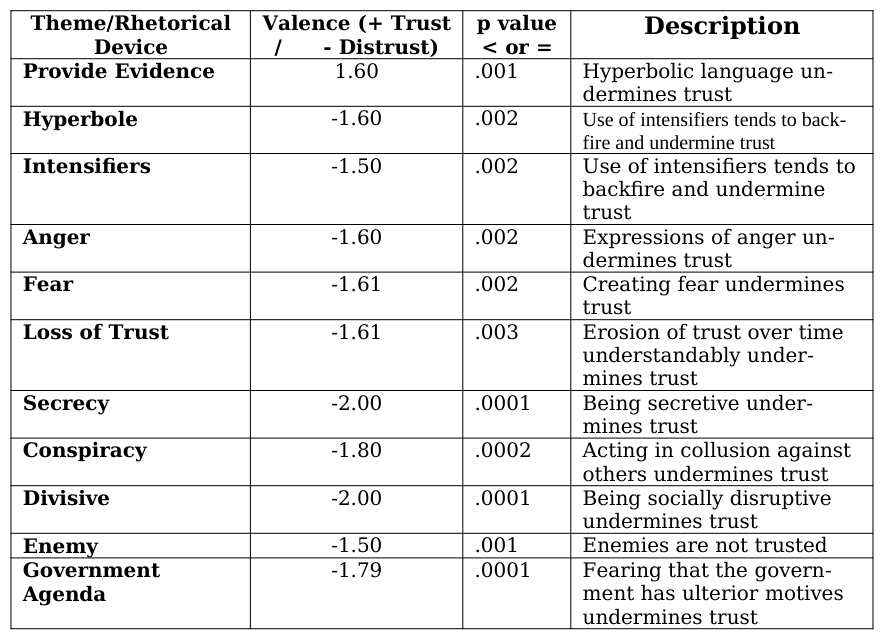
Key Findings – Valence of Themes / Rhetorical Devices Not all themes and rhetorical devices convey the same degree of trust or distrust. A trust valence metric, which varies from -2 (extreme distrust) to 2 (extreme trust), measures how strongly a theme or rhetorical device conveys trust or distrust. The themes and rhetorical devices whose valences were statistically significantly different from zero (no valence) demonstrate the strongest degrees of trust or distrust.
Only one theme conveyed trust in a strong way that is statistically significant: provide evidence. Authors who pro- vide evidence for their arguments are more likely to be trusted. Themes that convey distrust were more frequently identified. They include: emotive themes such as hyperbole, intensifiers, anger, fear, loss of trust, secrecy, con- spiracy, divisiveness, enemy, threat, virtue, betrayal, and lying ( ).
Table 1. Valence of Statistically Significant Themes Related to Trust Theme/Rhetorical Valence (+ Trust p value Description
Effects of Genre and Purpose Several independent variables were hypothesized to vary with trust themes and rhetorical devices including: Time Period, Genre, Author’s Profession, and Purpose of a document. Differential use of themes is measured by examin- ing the percentage of text segments in the corpus associated with a particular category within these variables (e.g. percentage of times Clerics used a theme versus other professions). The strength of these following relationships were measured with Cramer’s V and were found to be statistically significant at the p < .05 level.
Figurative language (Allusions, Symbols, Metaphors) is more often used on websites (5.5%, Cramer’s V = .136, p = .031).
Clerics (16.3% Cramer’s V =.191, p = .004) and documents sympathetic to the Green Movement (42.9% Cramer’s V = .328, p < .0001) made most use of expert citation.
Documents sympathetic to the Green Movement (21.4% Cramer’s V =.224, p , .0001) rely more on pro- viding evidence.
Clerics use poetry about as much a literary writers (8% and 9.9% respectively, Cramer’s V =.218, p < .0001), and poetry is also common in pro-democracy (8%) and anti-regime (5.6%) writing (Cramer’s V =.205, p= .001).
Equation reproduced from the original PDF.
Students (18.2% Cramer’s V = .183, p = .008) and documents sympathetic to the Green Movement (14.3% Cramer’s V = .166, p = .015) are most likely to invoke the personal characteristics of the messen- ger to establish trust or distrust.
Students (18.2% Cramer’s V = .219, p < .0001) and pro-democracy (8% Cramer’s V = .151, p = .043) writing are more likely to invoke fear, which undermines trust.
Concern over a government agenda peaks in 2009 (33.3% Cramer’s V = .197, p = .035), and is most com- mon among pro-democracy advocates (19% Cramer’s V = .159, p = .024) and students (83.3% Cramer’s V = .316, p < .0001).
Students are more likely to cite violence (18.2% Cramer’s V = .174, p = .015), betrayal (18.2% Cramer’s V = .175, p = .014), conspiracy (36.4% Cramer’s V = .307, p < .0001) and loss of trust (18.2% Cramer’s V = .175, p = .014) as reasons to distrust.
Secrecy is cited to establish distrust on websites (4% Cramer’s V = .144, p = .019), by a cleric-politicians (16% Cramer’s V = .231, p < .0001), and in pro-democracy writings (16% Cramer’s V = .233, p < .0001).
Religion, in particular appeals to Islam, are most common on websites (25.7% Cramer’s V = .262, p < .0001), most commonly used by politicians (60% Cramer’s V = .381, p < .0001), and to some extent by clerics and scholars, and are prominent in both pro- (22.6%) and anti-regime writings (22.6%)(Cramer’s V = .240, p < .0001).
Pro-regime writings are most likely to invoke the specter of enemies to establish distrust (7.6% Cramer’s V = .152, p = .039).
Pro-regime writings are also the ones that invoked the specter of invading or interfering foreigners (5.7% Cramer’s V = .157, p = .028), although all of these are very recent (2013).
Concern over threat is most common on websites (5.5% Cramer’s V = .133, p = .037) and in pro-democ- racy writings (16% Cramer’s V = .215, p < .0001), and used by politicians (22.7% Cramer’s V = .227, p < .0001).
DISCOURSE ANALYSIS ALGORITHMS FOR FORECASTING Affect and Behaviors
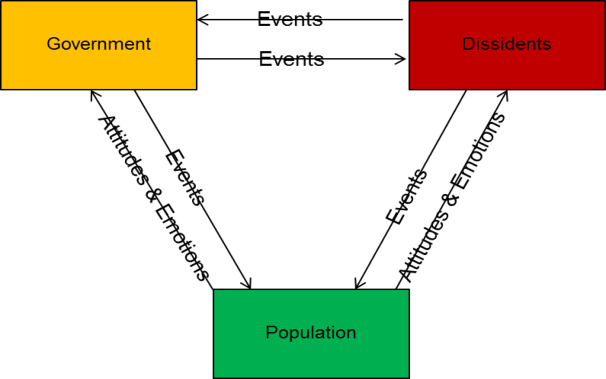
Many standard approaches to forecast behaviors have focused largely on static factors (e.g., poverty, grievances) at the expense of dynamic factors (e.g., who is doing what to whom, attitudes and/or sentiment of key actors/groups). Recent research explored the impact of affect on forecasting behaviors, focusing on the dynamics between the gov- ernment, dissidents (a non-state actor who uses non-traditional means (protest, violence) to meet their political needs, goals) and population (Shellman 2006a, b, 2008). The population is considered a key actor because both dis- sidents and (most) governments vie for their support. Text analytic algorithms extracted events as well as affect from data gathered on the Philippines and Egypt from 2001 to 1012. Emotions data were derived from extracted sen- timent expressions by mapping the expressions to an affect category; for example anger or fear (Plutchik, 1980). For example, “The Swiss government lauded Suu Kyi for her courage” would be coded as “positive” sentiment and under the “joy” affect class; whereas, for “The King is appalled” the sentiment would be coded as “negative” and the affect class as “disgust”. The relationship models of the government, dissidents and population were estimated using Auto Regressive Conditional Heteroskedasticity (ARCH) due to the non-constant variance in the time series data. The focus was on understanding the relationship both the impact of societal emotions on dissident and govern- ment behaviors as well as the impact of government and dissident behaviors on societal emotions.
Figure 1: Conceptualization of Conflict as Strategic Interactions
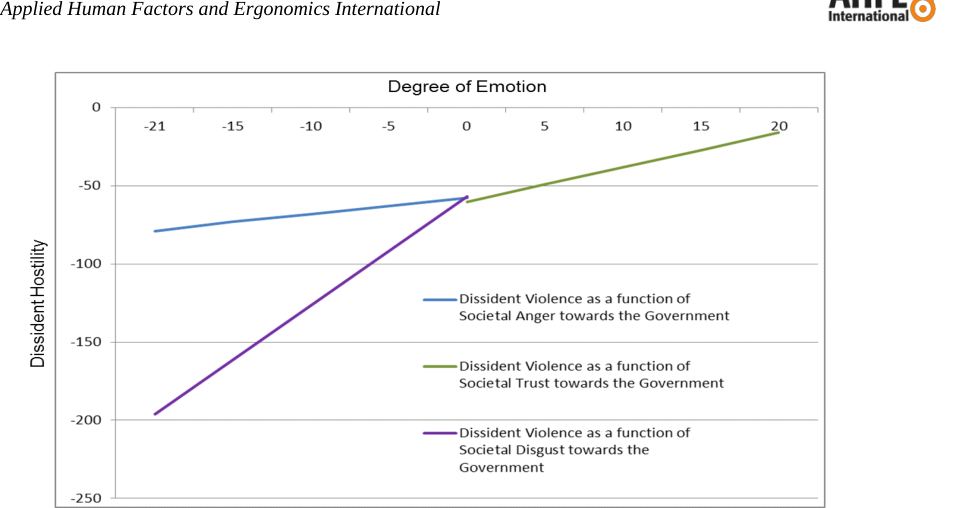
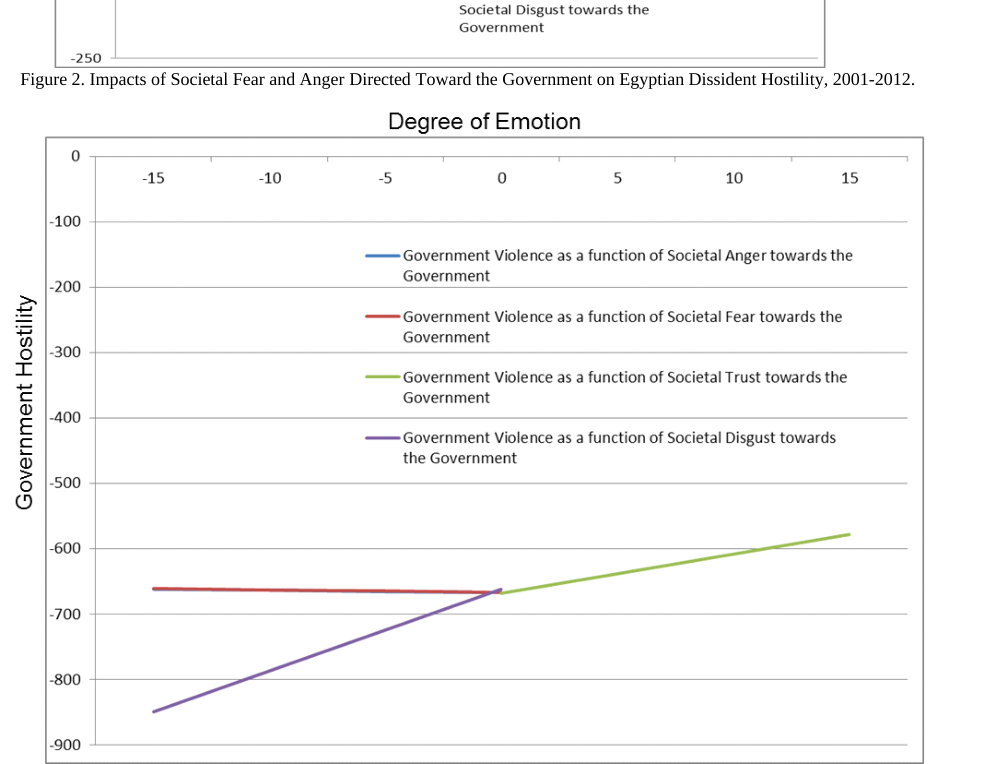
Across the two cases considered, Egypt and the Philippines, there were several similarities in relationships between the dissidents and government and population, but also several differences. For example, in Egypt and in the Philip- pines, intense societal fear of dissidents and societal disgust toward the government was associated with increases in dissident hostility (See Figure 2) and, conversely, societal anger towards dissidents was associated with a reduction in dissident hostility. However, differences arose in response to disgust expressed by the population toward the gov- ernment. In the democratic Philippines, government appeared to view negative social attitudes toward dissidents, principally anger, as a pretext to justify cracking down on dissidents through escalation of repressive behaviors; however, these behaviors eased in cases where society began to fear the government or display disgust toward it. This change in behavior makes sense to the extent that democratic leaders require the support of the people to attain or retain political office. Alternatively, the authoritarian Egyptian government reacted to similar forms of disgust by intensifying repression (see Figure 3). In time-series analysis of the emotions variables, only societal anger could be explained by our government and dissident behavior indicators across both cases. Dissident hostility tended to re- duce societal anger while government hostility tended to inflame it.
Figure 2. Impacts of Societal Fear and Anger Directed Toward the Government on Egyptian Dissident Hostility, 2001-2012.Figure 3. Impacts of Societal Emotions Directed Toward Government on Egyptian Government Hostility, 2001-2012.
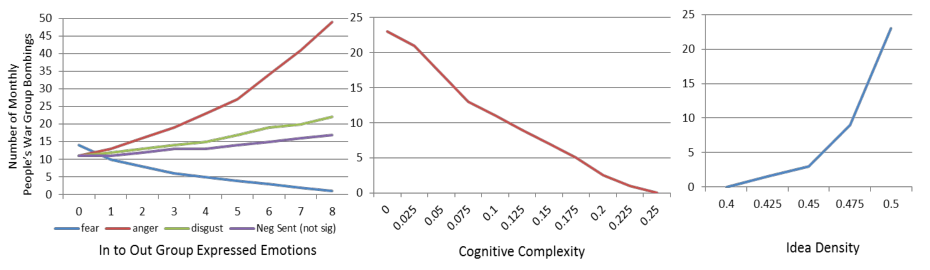
Forecasting Group Intent Research was initiated to investigate ways to automate the processing of discourse in order to extract discourse fea- tures in order to identify intent and/or forecast behaviors. One of the resulting efforts focused on extracting, measur- ing, and modeling five discourse features: cognitive complexity, sentiment expressed by in-group toward out groups (social identity), idea density, vocabulary diversity and keyness. Cognitive complexity is the extent to which a per- son is open to new ideas/ perspectives and is able to integrate them), idea density is the amount of information con- tained in a certain number of words, vocabulary diversity is the range of vocabulary used in a text, and keyness is the frequency of the use of certain words in a text relative to comparative texts (a way to track the salience of topics over time). The notion was that either or both idea density and vocabulary diversity would be good proxies for cog- nitive complexity. Cognitive complexity is a measure intended to approximate the one used by Baker-Brown et. al. (n.d.) in which the sum of the density of high (>2) cognitive complexity (language) indicators is divided by the num- ber of words in the document (and then multiplied by 100 for easier visualization). The sentiment of the in-group (Naxalites) toward various out-groups (Muslim dissident organizations, pro-democracy groups, the government, po- lice, military and other state officials) was measured by extracting language related to anger, fear and disgust (nega- tive sentiment). The expectation was that expression of anger or especially disgust toward an out-group would be as- sociated with increased violence (Matsumoto et al., 2012) and expression of fear would be associated with decreased violence. These features were extracted from 35-50 page newsletters produced regularly by the People’s War Group (PWG) from 1998 to the present. The PWG is a violent organization associated with the Naxalite communist move- ment in India and the newsletter serves to justify opinions, euphemize the group and derogate their opponents, among other objectives.
It is no surprise that there was clear statistical evidence showing that a significant decline in cognitive complexity on the part of the Naxalites was associated with increased levels of violence, consistent with previous findings (Toman et al., 2010, Satterfield, 1998). Idea density and vocabulary diversity also correlated with Naxalite violence, and may serve as orthogonal measures of cognitive complexity (see Figure 4). Keyness is similar to topic tracking, useful for tracking the use of discourse over time and potentially useful for identifying early indicators of violence including certain uses of imagery and propaganda.
Figure 5 below shows the power of using these discourse markers together to predict violence in the case of the PWG. The blue line shows a monthly frequency count of PWG bombings throughout India. The red line shows the predicted level of bombings using only measures of vocabulary diversity, idea density, cognitive complexity, and in- to out-group displays of fear, anger, and disgust. Each variable is statistically significant and there is a 91% correla- tion between the model-fitted values and the actual number of monthly bombings.
Figure 4: Effects of Various Discourse Indicators on PWG Bombings in India
0 20 40 60
0 10 20 30 40 time
bombings predicted number of events
Figure 5: Actual v. Predicted PWG Bombings as a Function of Several Autogenerated Discourse Variables (6 month lagged IVs; No lagged DV, no event or repression variables – all discourse indicators) The model only included automated discourse indicators (cognitive complexity, sentiment/affect toward out-group, idea density and vocabulary diversity). There were no lagged dependent variables, structural indicators, event based or repression based measures included in the model. And yet, discourse markers alone yielded an incredibly, perhaps surprisingly, powerful model of group-level violence.
Figure available in the original PDF paper.
PIECING TOGETHER THE THREAT NARRATIVE Advanced methodologies for extracting meaning and algorithms for automated text analytics are described in this paper. Ultimately, neither result in a complete description or understanding of the threat narrative. This understand- ing must be built by an analyst based on cues and clues from these tools. Existing methodologies (Fenstermacher, 2012) focused on the language of social identity and the methodology described previously can provide clues about how a group sees their capability, how group members see each other (e.g., are they trustworthy?) and the capability of the threat and support forecasting. The automated algorithms described in this paper, once matured, can provide important clues to an analyst about the existence and intent of the threat. New methodologies and algorithms will have to be developed to support the analyst’s understanding about what is motivating the threat, what the “right” ac- tions regarding the threat are and what the preferred outcomes are. These are part of their worldview and are explic- itly and implicitly woven into and manifest in discourse and physical behaviors.
CONCLUSIONS
The AFRL discourse analysis research program and other related research programs have developed methodologies and automated algorithms to cue an analyst’s attention and to help them identify the language characteristic of the threat narrative. There is no existing silver bullet available to do this. Ultimately to enable an analyst to make mean- ing about threat narrative, it will take the integration of existing (deployed) methodologies and algorithms in addi- tion to the maturation and transition of new methodologies and algorithms to foster a truly nuanced understanding of adversaries and their “emic” perspective of threat. This integration must be done in a way to enable the piecing to - gether and inferential reasoning about the threat narrative, providing appropriate cues about impending action, clues into worldview and potentially information about vulnerabilities and potential courses of action to shape or influence behaviors.
REFERENCES
Baker-Brown, G., Ballard, E. J., Bluck, S., Vries, B. D., Suedfeld, P., & Tetlock, P. E. (2004). Coding manual for conceptual/integrative complexity. Retrieved from http://www2.psych.ubc.ca/~psuedfeld/MANUAL.pdf Bandura, A. (1990), “Mechanisms of moral disengagement”, in: Origins of terrorism: Psychologies, ideologies, theologies, states
of mind, W. Reich (Ed.). Cambridge: Cambridge University Press. Covington, M.A. (2007), CPIDR 3 User Manual. CASPR Research Report 2007-03 (http://www.ai.uga.edu/caspr), Artificial Intelligence Center, The University of Georgia. Fenstermacher, L., Kuznar, L., Yager, M. (2012), “Analysis of Discourse for Indications and Warnings,” in: Proceedings 2nd International Conference on Cross-Cultural Decision Making, San Francisco, CA, 21-25 July 2012, 7307-7316. Hovland, C. I., Janis, I. L., & Kelley, H. H. (1953), Communication and persuasion: Psychological studies of opinion change.
New Haven, CT: Yale University Press. Kuznar, L. A., & Yager, M. C. (2012), Analysis of Pashtun narratives: Report on results. What cues do Pashto speakers use in understanding how to draw in- and out-group distinctions? Unpublished manuscript, Report prepared for Air Force Re- search Lab (AFRL), Contract FA8650-10-C-6106, Wright-Patterson Air force Base, Dayton, OH Matsumoto, D., Hwang, H.C., Frank, M.G. (2012), “Emotions expressed in speeches by leaders of ideologically motivated
groups predict aggression”, Behavioral Sciences of Terrorism and Political Aggression, DOI: 10.1080/19434472.2012.716449 Mayer, R. G., Davis, J. H., & Schoorman, F. D. (1995), “An integrative model of organizational trust”, Academy of Management Review, 20(3), 709-734. McCroskey, J. C., & Teven, J. J. (1999), “Goodwill: A reexamination of the construct and its measurement”, Communication
Monographs, 66, 90-103. Moon, W. (2009). “Worldview – Subjective Reality – Threat Narrative: The Macro View”. Working paper. Plutchik, R. (1980), Emotion: Theory, research, and experience: Vol. 1. Theories of emotion 1, New York: Academic Press. Pyszczynski, T. (2013), “Appendix B: Group Identity, Intergroup Conflict and Support for Violent Political Action” in: Mixed Initiative Discourse Analysis System (Ed. Patten, T., Romero, V., Koelle, D., et. al.), AFRL-RH-WP-TR-2013-0029. Satterfield, J. M. (1998), “Cognitive-Affective States Predict Military and Political Aggression and Risk Taking: A Content Anal-
ysis of Churchill, Hitler, Roosevelt, and Stalin.” Journal of Conflict Resolution 42 (6): 667-690. Shellman, S. M. (2006a), “Leaders & their motivations: Explaining Government-Dissident Conflict-Cooperation Processes”, Conflict Management & Peace Science 23(1):73–90. Shellman, S. M. (2006b), “Process Matters: Conflict & Cooperation in Sequential Government-Dissident Interactions”, Security
Studies 15(4):563–99. Shellman, S. M. (2008). "Coding Disaggregated Intrastate Conflict: Machine Processing the Behavior of Substate Actors Over Time and Space", Political Analysis 16(4): 464-77. Suedfeld, P., Tetlock, P.. (1977), “Integrative Complexity of Communications in International Crises”, The Journal of Conflict
Resolution , 21 (1): 169-184. Suedfeld, P. (2010), “The Scoring of Integrative Complexity as a Tool for Forecasting Adversary Intentions”, DRDC Report DRDC Toronto CR 2010-039. Toman, P., Kuznar, L., Baker, T., et. al. (2010), “Analysis of Discursive Accent and Discursive Practices I&W”, AFRL-RH-WP-
TR-2010-0128.
LISTED IN THE AHFE DIGITAL BOOKSTORE CATALOGUE
Explore the complete digital volume
Advances in Cross-Cultural Decision Making
Read this individual research paper free through the original publisher, or explore the full digital proceedings book.
ISBN 978-1-4951-2095-4
Explore this ISBN in the AHFE Bookstore ↗Listed in the July 2026 bookstore catalogue; search by ISBN to confirm current availability · Digital book purchase optional