Alexander Mertens, Amy Callahan, Kevin Doherty, Sarah-Jane Gerber (2018). Integration of Information and Communication Technology in Behaviour Therapy for Children with Attention Deficit Hyperactivity Disorder (ADHD). In: Advances in Human Factors, Software, and Systems Engineering. AHFE Open Access, vol. 4. https://doi.org/10.54941/ahfe100132
Attention Deficit Hyperactivity Disorder (ADHD) is the most common psychiatric disorder in childhood. Several studies demonstrate that the optimal approach to tackling it is a multimodal treatment including a cognitive behavioural approach. A key role for young ADHD pupils is played by monitoring carried out by teachers, parents and relatives. This paper presents the methods applied and lessons learned during the system engineering process within the WHAAM project, which aims to deliver efficacious means for the therapy through integration of Information and Communication Technology (ICT) into the treatment process. The applied methods include structured interviews with parents, teachers and health professionals, the iterative development of paper/software prototypes and demonstration to the prospective users as well as Wizard of Oz studies to identify usability problems. In addition to the concrete results relating to the design of the user interface and interaction process this paper describes the effective procedure model applied that has proven to be able to consider the manifold requirements of the different stakeholders involved in the integration of ICT in healthcare scenarios
Motivation Behavioural disorders have a strong impact on the lifelong learning (LLL) process for pupils and young adults. The Attention Deficit Hyperactivity Disorder (ADHD) is among the factors correlated with low scholastic achievements and the rates of early withdrawal. The ADHD, together with the frequent comorbidity with conduct, anxious disorders and learning disabilities, make students more likely to be suspended and expelled, and to have a high probability of drop-out (Rapport et al., 1999; Fletcher and Wolfe, 2008). For these reasons, ADHD and the associated diseases, have been the object of many studies involving researchers, clinicians and educators. The diagnosis and treatment services for ADHD are not uniformly distributed in the different European countries. As a consequence, many children who do not receive the correct diagnosis and appropriate treatment may manifest disorders related to substance abuse, mood disorders, social and relational problems during adolescence.
Objective In order to address this issue, the WHAAM project1 is designed to set out specific actions aimed at improving teacher and parent skills in the observation of ADHD subjects (aged 7-18), and to design a multifunctional tool to recognize trigger events and/or the consequences that are reinforcing and maintaining the undesirable behaviours, according to cognitive-behavioural strategies. By means of these actions, the project may contribute to tackling many relevant problems in this area, such as scholastic achievement and social inclusion. The choice to focus on parent and teacher training arose from an analysis of many studies on ADHD that have highlighted the need to move school and family from helpless victim mode to observer mode. However, currently there is an evident mismatch between certain educational practices, directed towards the typical “student with ADHD”, and the need for a pedagogical action, using ICT and innovative educational environments, which takes into account the diversity between subjects. The need for more professional development for teachers in relation to special educational needs and inclusive education (Rose and Tilstone, 2004; Idol, 2006) is internationally accepted, as is the need to provide school staff with appropriate training in meeting the challenges of teaching with ADHD pupils (Barkley, 1998; Alimo-Metcalfe and Alban-Metcalfe, 2001). So, the lifelong learning and training of teachers, parents and caregivers is another focus of the WHAAM project.
Approach Attention Deficit Hyperactivity Disorder (ADHD) is the most common psychiatric disorder in childhood. Several studies demonstrate that the optimal approach to tackling it is the multimodal treatment of ADHD (MTA), including behaviour therapy, medications, and a combination of the two. A key role in the cognitive-behavioural (CB) approach for young ADHD pupils is played by monitoring carried out by teachers, parents and relatives of the pupil with ADHD. It is useful to disclose the purpose or function that a particular behaviour serves. As a consequence, it has a key role in planning effective interventions aimed at modifying antecedents or triggering behaviours and/or the consequences that are reinforcing and maintaining the undesirable behaviours. This type of system is called behaviour management or modification and it has been found to work well with children and many adults with ADHD. Traditionally, the behavioural monitoring is performed using specific monitoring charts. Although frequent monitoring is really helpful, educators and parents are often reluctant to drawing up charts. In fact, it could be felt as a long and complicated procedure. Ideally, to be effective, MTA should involve patients, teachers, family and peers and provide them with psycho- educational contents such as information about symptoms and impairment, the prevalence of the disorder in children and adults, the most frequent comorbidities, the heritability, the brain dysfunctions involved, as well as the treatment options. The involvement of the patient’s social network has proved to be an invaluable element in the treatment process. Unfortunately, creating a link between the most important people around patients and promote dialogue and sharing is a very difficult task. The lack of a network support could be crucial for treatment results. In fact, literature highlights a strong need to further develop structured psycho-education programs with specific attention to monitoring techniques and to home-school collaboration for promoting behaviours that lead to scholastic and social success. Starting from these considerations, the WHAAM project aims to support the delivery of MTA through information and communication technology (ICT). In particular, a web application (accessible through both personal computers and mobile devices) will provide teachers and parents with features to easily monitor young pupils’ behaviours in a specific, measurable, attainable, realistic and timely way. Using the data gathered through the monitoring, the application will allow health personnel, parents and teachers to share observations, define together the best intervention plan for pupils and learn the most suitable strategies for the management of ADHD learning and behavioural difficulties.
To illustrate the status quo in treating children with ADHD and which improvements can be reached by integration of ICT in the treatment process, application scenarios for uninitiated persons were elaborated. The application scenario including a parent´s perspective is shown below: Oliver is a 7 year old boy attending National School. His mom Jeanette has always noticed a difference between him and his older brother (Finbar, 9 years old). Oliver is always on the go, and seems to lose interest in tasks quite quickly. He becomes very frustrated and can be quite teary and downhearted at times. Oliver is very bright but can struggle at school because he can’t seem to concentrate and gets into trouble with the teachers often for shouting out, getting out of his chair or disrupting other children. Oliver enjoys activities, like sport, but can find team tasks hard. He can struggle to get along with his peers at times as he finds it difficult to follow social norms. Jeanette became concerned with his behaviour and sought a private consultation with an educational psychologist. After initial assessment tools were completed and Oliver met with the psychologist, Jeanette was told that he displayed symptoms consistent with ADHD. As Jeanette had researched a bit herself, this was her initial suspicion. She continued to research ADHD online, and through public workshops offered in the local community. Oliver’s psychologist referred Oliver to an occupational therapist and offered some recommendations that could help Oliver at home and at school. Oliver was encouraged to play ‘brain training’ games on the ipad to increase concentration, engage in structured activities such as athletics/gymnastics/music, and for Jeanette to attend parent training groups to learn how to best deal with Oliver’s behaviour. Jeanette would like to be able to have easily accessible, reliable information about ADHD without having to spend hours researching online or in the library. She would like information that is clear and informative and understandable. Jeanette would like to be able to map the behaviour of her child with behaviours described in the ADHD information section of the app so that she may get a better understanding of typical behaviours and ones that are of more concern. Jeanette would like to be able to use the app to access information about Oliver’s behaviour at school and monitor his behaviour patterns at home. She would like to be able to use this information at meetings with teachers and clinicians to ensure that everyone has a comprehensive overview of her son’s behaviour. She would also like to follow techniques that have been recommended by the teachers and clinicians at home, with reminders and notifications to prompt her to use certain techniques, such as praise, ignore etc. She would like to get Oliver involved in the recording and monitoring of his behaviour as she feels that he should not be excluded from any discussions about his feelings, thoughts or actions. She would like to be able to show Oliver the app output and possibly help him to realise times when his behaviour changes, such as on the playground, dinner time etc. Ultimately she would like to use the app, in collaboration with her son, to gain knowledge about ADHD and to track Oliver’s behaviour over time in an effort to ensure that all interventions that she uses with him are meaningful and productive.
How a parent would to use the WHAAM application: Oliver’s clinician has registered Oliver on the WHAAM application. In their intake meeting she has input the personal data for Jeanette and Oliver into the app. She recommends that Jeanette use the application at gain more detailed information about ADHD and to complete observations of Oliver’s behaviour over the upcoming 4 weeks. The clinician show Jeanette how to use the application and refers her to the ‘how to video’ on the application website. Jeannette opens the WHAAM website at home and clicks on the ‘What is ADHD?’ tab. She reads through the information and scrolls down to specific heading and information of interest to her. She clicks back to the home page of the website and clicks on the log in button which brings her to the log in page of the WHAAM application. She enters her login details which brings her to the app home page. She clicks on her son’s icon which brings her to the homepage where she can navigate through the app. She receives a blinking notification symbol indicating that she has received a new notification. She clicks on the notification tab which brings her to the notification page. All notifications are ordered by date and author. She clicks on the highlighted notification read the details. A pop up window appears with the author of the notification and the notification details. She closes the pop up window when she has read the notification and presses the home button to return to Oliver’s home page. The notification has reminded her to complete a frequency observation today with Oliver during homework time she logs off and closes the app. At homework time, Jeanette returns to the app, logs in and clicks on Oliver’s homepage. She clicks on the general observation button, and chooses frequency observation. She input from the scroll down menu the duration of the observation, the setting and others present. She inputs the target behaviours that she wishes to observe. She presses the start button which starts the timer. Jeanette taps on the target behaviour button each time she witnesses the behaviour. After the allotted number of durations and observations, Jeanette closes the observation page and returns to the home page. She can open the observation logs page and view the details of the observation she completed by clicking on the date of the observation and the observation type. Jeanette can add post hoc notes to this observation in the notes section if she wishes. She closes the page, returns to the home page and logs out of the app. Jeanette remembers to bring her laptop with her to the next teacher parent meeting and clinician review meeting. She opens the app, logs in and clicks on Oliver’s icon. She opens the observation log tab and shares the observation details during the meetings.
METHODOLOGY
The methodical approach within this project consists of five sequential phases that each are based on the results of earlier work packages concerning the target group specific requirements: (1) Definition of system architecture and boundaries including entities/rolls interacting with the system
(2) Creation of user stories to define what functions the users need (“who”, “what” and “why”) (3) Design of low fidelity paper prototypes for incremental retrieval of user feedback
(3a) Iterative adaption of prototypes to comply with the requirements of the users (4) Development of Wizard of Oz software mockup for conducting user studies
(4a) Iterative adaption of prototypes to comply with the requirements of the users (5) Realization/Implementation of final system according to the functional and nonfunctional requirements
The project team uses a user-centered advance to identify the factors which might influence the success of the application, and address these issues within the application design. Until now phases (1) to (4) have been completed.
MODELLING THE SYSTEM System context and user rolls
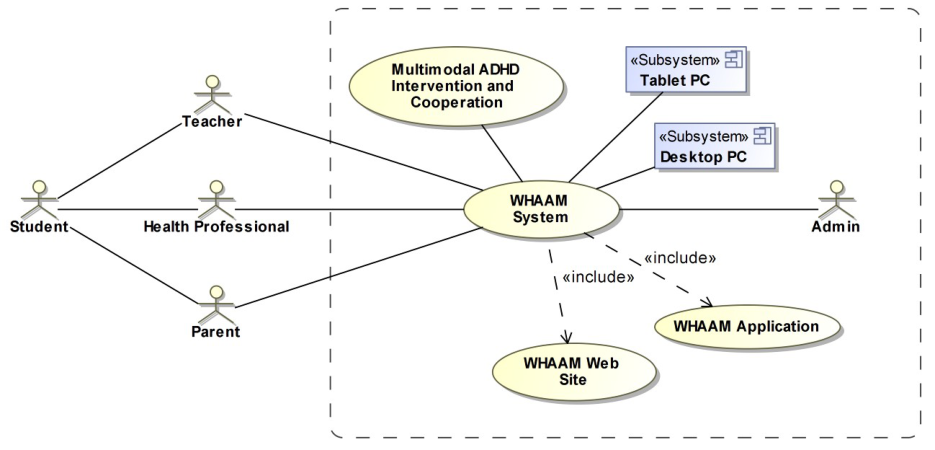
The system context including the boundaries of the system can be seen in Figure 1.
Figure 1. System context including boundaries and entities interacting with the WHAAM system
The entities that interact with it were categorized according to their expert knowledge, their relationship to the students and the location of interaction. The students themselves were also modelled as entities within the information flow, although they do not directly interact with the system.
Parents Parents of ADHD children access all intake and assessment information and they work collaboratively with Health Professionals in all aspects of the assessment, formalization, intervention and review process. They monitor the assessment and intervention processes and update information as necessary. They can record behaviours patterns at home.
Teachers Teachers of ADHD children are involved in the assessment, the identification of target behaviours and functions, and intervention plan definition. They will record observations in class and they will constantly collaborate with parents and health professionals. They have access to the efficacy evaluation of the intervention done in classroom.
Health professionals They have access to a complete overview of intake, family history, medical history, behavioural history, referral data, current concerns, school performance and behavior and assessment, interventions/treatments and medication history relating to the child. They can ask questions and provide feedback to parents and teachers and they make informed decisions about interventions based on accurate knowledge. They evaluate the efficacy of interventions through graphical representation of data.
Admins Admins approve Health Professionals registrations and manage users, roles and privileges.
Students Students provide health professionals, parents and teachers with their point of view on assessment, functional analysis and intervention data. They can ask also parents, teachers and health professionals questions about their condition.
User Stories – Usecases The user stories compiled are intended to reflect the possible features and domains for the WHAAM project for teachers, mental health professionals and parents of children presenting with ADHD. Because of the limited length of this contribution only two exemplarily user stories can be presented in Table 1.
The résumé of the proposed features and domains for the application, as conclusion of the more than 60 user stories elaborated, reveals the following core requirements:
Features to record the client’s personal data, including medical history relating to ADHD (for instance birth history, general health history, and family medical history), behaviour patterns at home and at school, school performance, and previous treatments, interventions or medications. This feature should also include details of referral (date of referral, name of referrer and agency, detailed reason for referral) and whether a formal diagnosis has been reached, or whether or not assessment is on-going (this feature should be updated once diagnosis has been reached and through-out each assessment stage). All details of measures used to assess the child both at school and within a mental health services/assessment of needs services should be included in this feature.
Feature to preform systematic direct observations at home and at school to facilitate in the assessment process, formalisation process and intervention implementation and review.
Feature to identify the function of the observation of behaviour at home or at school, i.e. to assist with assessment, to formalise a treatment plan, to implement interventions and to review intervention outcomes and individual education/behaviour plans.
Features to plan, support implementation and review interventions at home or at school.
Features to summarise all gathered data.
Table 1: Exemplarily user stories for the parent and teacher roll
Table available in the original PDF paper.
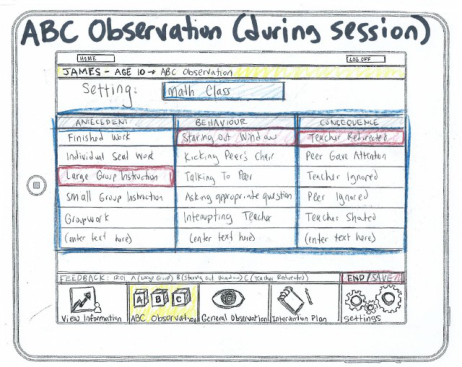
LOW FIDELITY PAPER PROTOTYPING Based on the above mentioned functional and non-functional requirements of the different stakeholders, low fidelity paper prototypes were developed to retrieve direct user feedback (see Figure 2). The overall feedback of the teachers, parents and health professionals interviewed was that they were positive about the potential of the app for helping plan for and support students with ADHD. However, many of the teachers and parents felt that the app may be better suited to health care professionals and many of the health care professionals thought it would be most useful to teachers and parents. All stakeholders pointed out difficulties with time constraints; for example, teachers said they would not have scope for monitoring behaviour while they were teaching and health care professionals point out they would rarely work directly with a student already diagnosed with ADHD. The teachers felt that a lot of the information that they would input, ABC observations for instance, would have to be input retrospectively given teacher-child ratios in primary school classrooms. This would add to their workload and would not necessarily be indicative of real time behaviour for the child in question. However, one of the teachers thought the information could be useful in creating individual education plans (IEPs) in schools and helping support children’s behavior. The teachers and health professionals questioned the amount of personal information that they would have to provide, both on themselves and on the children involved. One teacher suggested using a teacher registration number and another suggested a similar format for students. The parents asserted that they are looking for immediate practical advice with regards to behaviours that they are facing on a daily basis, and that an application that offered some practical tips with little navigation would be more useful to them. The healthcare professionals felt that if the application would be used by others (e.g. teachers, parents, special needs assistants), then they could help interpret the information and in that context it would be useful. However, they pointed out they themselves would rarely observe a child more than once; as such, the application would gather very little relevant information. One healthcare professional mentioned she would like to see an option for suggestions of functions on the ABC, some way of recording the duration behaviour and pointed out the need to consider the language used in the app. Each of the stakeholders brought up concerns about including the student’s personal information in a computer or tablet based web application. In particular, they were concerned about how the information was stored, whom it was accessible by, and whether the information could be seen by others (e.g. students, school staff).
Figure 2. Exemplarily paper prototypes for different steps of the interaction process with the WHAAM application
SOFTWARE PROTOTYPING On the basis of the results from the iterative adaption of the paper prototypes and the affiliated user feedback a Wizard of Oz software mockup was developed with help of the balsamiq® framework2 and common web
2 http://balsamiq.com/ technologies. The focus was on the concrete design of the user interface and the arrangement of the control elements, the information representation and navigation as well as the interaction process itself. Because of the concerns of the different stakeholder relating to privacy protection and data access it was decided to fork the system into a public component not containing any personal data (WHAAM website) and a private component with appropriate authentication and authorization mechanisms to guarantee data protection (WHAAM application).
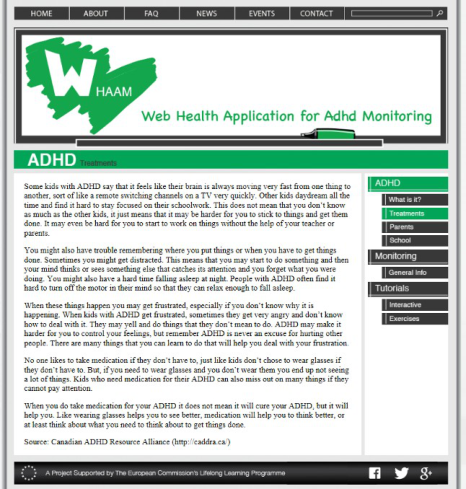
WHAAM web site The websites gives target-group-specific (students, parents, teachers and health professionals) information to set out specific actions aimed at improving skills in the observation of ADHD (see Figure 3). Moreover, the WHAAM website seeks to improve the home-school collaboration in the field of ADHD, promote a stronger awareness of the importance of creating a skilled social network around ADHD pupils and diffuse the use of behavioural monitoring as the best way to collect data and to plan effective and shared interventions.
Figure 3. Exemplarily pages of the WHAAM web site
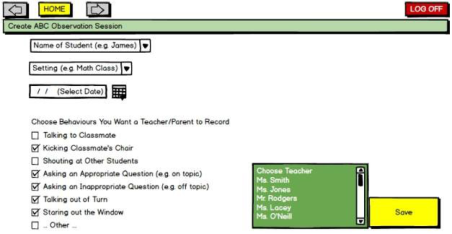
WHAAM application The WHAAM application is a platform independent framework for ICT-based interventions for students with ADHD which is accessible through both personal computers and mobile devices. Its aim is to support the ICT-based multimodal ADHD intervention of teachers and parents and to share observations with all actors involved in the treatment process. Therefore different monitoring instruments have been implemented and versatile functions for data analysis and interpretation as well as the semi-automatic creation of reports (see Figure 4).
CONCLUSIONS
The development of applications for use in the healthcare domain has to face many challenges e.g. by regulatory factors, the versatile requirements of the stakeholders involved and the need for a high grade of efficiency and effectiveness in existing processes. The systems engineering process for multifunctional tools to support behavioral monitoring of students with ADHD has shown that a human centered approach is necessary to succeed, while technology-based approaches promise no sustainable success, because the individual needs of the users would not be considered adequate. It showed that the ergonomic design of the human-computer interaction is less determining than expected and instead the direct usefulness for the individual methodology is essential. In addition, it can be stated that a general affinity for technology, as is often the case in the entertainment and automotive sector, does not exist for the focused medical context. Instead an unemotional assessment of the added value through the integration of technology is performed which outcome is crucial for the sustainable acceptance.
Figure 4. Exemplarily GUIs of the mockup for the WHAAM application
ACKNOWLEDGEMENT
The WHAAM project (Web Health Application for ADHD Monitoring) has been funded with support from the European Commission in the context of the Lifelong Learning Programme Key Activity 3 Multilateral Projects (reference project number: 531244-LLP-2012-IT-KA3MP). The research visit of the main author at Trinity College Dublin and the associated possibility to collaborate within this project was funded by the German Academic Exchange Service (DAAD). The author was granted a free copy of the balsamiq® Desktop App by the Balsamiq Studios and an academic license of MagicDraw® by No Magic.
REFERENCES
Alimo Metcalfe, B., Alban Metcalfe, R.J. (2001), “The development of a new transformational leadership questionnaire”, in: Journal of occupational and organizational psychology Volume 74 No. 1. pp. 1-27. Barkley, R.A. (1998), “Attention-deficit/hyperactivity disorder”, Guilford Press. Fletcher, J., Wolfe, B. (2008), “Child mental health and human capital accumulation: the case of ADHD revisited”, in: Journal
of Health Economics Volume 27 No. 3. pp. 794-800. Idol, L. (2006), “Toward inclusion of special education students in general education a program evaluation of eight schools”, in: Remedial and Special Education Volume 27 No. 2. pp. 77-94. Rapport, M.D., Scanlan, S.W., Denney, C.B. (1999), “Attention deficit/hyperactivity disorder and scholastic achievement: A
model of dual developmental pathways”, in: Journal of Child Psychology and Psychiatry Volume 40 No. 8. pp. 1169-1183. Rose, R., Tilstone, C. (Eds.) (2004), “Strategies to promote inclusive practice”, Routledge.
LISTED IN THE AHFE DIGITAL BOOKSTORE CATALOGUE
Explore the complete digital volume
Advances in Human Factors, Software, and Systems Engineering
Read this individual research paper free through the original publisher, or explore the full digital proceedings book.
ISBN 978-1-4951-2096-1
Explore this ISBN in the AHFE Bookstore ↗Listed in the July 2026 bookstore catalogue; search by ISBN to confirm current availability · Digital book purchase optional