Kathrin Maiera, Jürgen Hellbrücka, Heike Sacherb (2022). A Visuohaptic Collision Warning Approach for High-Priority Braking Scenarios. In: Advances in Human Aspects of Transportation: Part III. AHFE Open Access, vol. 17. https://doi.org/10.54941/ahfe100751
Referring to the great importance of an intuitive HMI for Advanced Driver Assistance Systems, a driving study was conducted to test innovative warning concepts for high-priority, imminent braking scenarios. Based on previous findings, a peripheral visual illumination stripe warning was expected to show important brake reaction time benefits compared to an auditory alarm, especially in multimodal presentation mode along with a haptic brake pulse warning. Based on previous findings recommending multimodal instead of unimodal warnings to minimize brake reaction times, the optimal timing of multimodal warning components was additionally evaluated. Using the EVITA test system, almost rear-end collision scenarios were provoked to test the different warning concepts. The results indicate a visuohaptic warning approach based on a synchronous presentation of multimodal warning components to communicate imminent braking advices. Further implications for warning concept design will be discussed.
Aiming to support the driver in more and more aspects of his driving task, a rapid increase of Advanced Driver Assistance Systems (ADAS) can be registered over the last years. Yet driver support and accident prevention are just as efficient, as ADAS-display and -warning concepts are intuitive and informative for the driver to maximally reduce the necessary time frame for signal interpretation and action selection (Cacciabue and Martinetto, 2006; Rosario, Louredo, Díaz, Soler, Gil, Solaz and Jornet, 2009; Winner, Hakuli and Wolf, 2009; Spence and Ho, 2008a). Considering the ongoing increase of ADAS, the development of an intuitive human-machine-interface (HMI) is facing new challenges. Until today warning strategies are based on a system-specific account, meaning that each single ADAS comprises a specific, characteristic warning sequence. In consequence, this traditional warning design will soon result in a huge variety and complexity of different in-car warning signals. Considering our limited cognitive information processing capacities (Ho and Spence, 2008; Driver, 2001; Styles, 2006; Motter, 2001; Weerd, 2003; van Zomeren and Brouwer, 1994), the driver’s task of correct signal interpretation and reaction decision-making can lead to heavy consequences in highly-critical driving conditions (Green, 2006; Ho, Cummings, Wang, Tijerina and Kochhar, 2006; Tretten and Gärling, 2011; Cummings, Kilgore, Wang, Tijerina and Kochhar, 2007). Thus, a paradigmatic change in the HMI-design of ADAS towards a system-comprising display- and warning-philosophy will be established. This new warning philosophy should provide immediate action Human Aspects of Transportation III (2022) recommendations without any reference to a specific ADAS. In this way, the number of warning signals can be reduced to two central warning-threads – a criticality-based classification for braking-advices and for steering- advices, in which all information and warnings can be logically and consistently integrated. Considering the prominent role of braking reactions in the context of accident-critical scenarios, the development process to realize this new paradigm first concentrated on the design and evaluation of a system-comprising warning concept for high- priority braking events.
Based on the question, how best to design driver warnings, literature is primarily recommending auditory and haptic warning devices (see for example Scott and Gray, 2008; Janssen and Nilsson, 2004; Belz, Robinson and Casali, 1999; Adell, Várhelyi, Fontana and Bruel, 2008; Liu, 2001; Rosario et al., 2009; Stanley, 2006; Brown, 2005; Fitch, Kiefer, Hankey and Kleiner, 2007; Ho and Spence, 2005; Ho, Tan and Spence, 2006; Mohebbi, Gray and Tan, 2009; Suzuki and Jansson, 2003; Ho, Reed and Spence, 2006; Rosario et al., 2009; Spence and Ho, 2008b; Graham, 1999; Wiese and Lee, 2004). This is due to the already existing visually information overload of the driving task (Scott and Gray, 2008; Ho, Reed and Spence, 2007; Rosario et al., 2009; Spence and Ho, 2008a), the low signal detection probability of visual icon-warnings displayed in the instrument cluster (Campbell, Richard, Brown and McCallum, 2007; Ho and Spence, 2008; Chan and Chan, 2006; Kiefer, LeBlanc, Palmer, Salinger, Deering, and Shulman, 1999) and the required attention shift towards the icon-warning for signal interpretation (Yeh, Merlo, Wickens and Brandenburg, 2003; Tretten and Gärling, 2011; Lamble, Laakso and Summala, 1999; Belz et al., 1999).
Yet visual warnings not only rely on icon (or text)-warnings that need to be directly focused for correct signal interpretation. In fact they can also be provided by means of luminance change, color contrasts or bursts of motion (Wickens and McCarley, 2010). Due to its unspecific nature this kind of visual warnings does not need to be foveally focused neither for signal detection nor for signal interpretation, but can rather be peripherally perceived. In consequence these warnings do not imply any attentional shifts or gaze distraction from the primary driving task (Mahlke, Rösler, Seifert, Krems and Thüring, 2007; Kienast, Lindner, Weigel, Henning, Krems, Wanielik and Spanner-Ulmer, 2008). In addition, displayed in the peripheral field of view these signals are extremely effective to provoke reflexive (bottom-up triggered) attention shifts without reducing cognitive information processing capacities for other tasks (Posner, 1980; Spence, McDonald and Driver, 2004; Hillstrom and Yantis, 1994; Wickens and McCarley, 2010). The few existing studies relying on peripheral visual warnings in the field of driving and aviation assistance fully support the promising potential of this new class of visual warnings in terms of signal detection, attention orientation and reaction times. This accounts for intramodal comparisons with classical visual warnings (Mahlke et al., 2007; Henning, Kienast, Lindner, Weigel, Krems and Spanner-Ulmer, 2008; Nikolic and Sarter, 2001; Hameed, Ferris, Jayaraman and Sarter, 2009; Maier, Sacher and Hellbrück, 2010; Maier, Sacher, Hellbrück, Meurle and Widmann, 2011) as well as for contrasting peripheral visual warnings with non-visual warnings (Ho and Spence, 2009; Hameed et al., 2009; Maier et al., 2010; Maier et al., 2011).
Considering different display options of warning signals, multimodal warnings are recommended. Neuronal activity underlying multimodal information processing indicate a significant stronger neuronal response when displaying two or more stimuli of different modalities together compared to the sum of neuronal activation when presenting the same stimuli separately (Santangelo, Lubbe, Olivetti Belardinelli and Postma, 2008; Meredith, 2002). This superadditive neuronal activation effect is relying on multisensory integration processes in the superior colliculus amongst others (see for example Teder-Sälejärvi, McDonald, Di Russo and Hillyard, 2002; Talsma and Woldorff, 2005). This enlarged neuronal response is reflected in significantly reduced reaction times compared to unimodal presented warnings (van Erp and van Veen, 2004; Chang, Hwang and Ji, 2011; Ho et al., 2007; Selcon, Taylor and McKenna, 1995; Lee and Spence, 2008; Brown, 2005). Yet multisensory integration strongly relies on a close spatial proximity between the multimodal attributes. In this way, the signal components are transmitted in the same receptive fields of multisensory neurons and are thus processed as being associated (Santangelo et al., 2008; Holmes and Spence, 2005; Colonius and Diederich, 2004; Stein and Meredith, 1993). Another central requirement is a close temporal coincidence in the arrival of the warning attributes in the relevant brain area (Wallace, Roberson, Hairston, Stein, Vaughan and Schirillo, 2004; Holmes and Spence, 2005). Different transmission and processing times of stimuli deriving from different modalities can be a problem in this context (Stein and Meredith, 1993; Colonius and Diederich, 2004). Therefore a small temporal window for multisensory integration exists, that may last between 100ms to 250ms (Stein and Meredith, 1993; Colonius and Diederich, 2004). Based on these findings, some effort was undertaken to balance transmission latencies of multimodal stimuli by slightly asynchronous signal presentation. Yet the few existing results in this context are heterogeneous. While some studies revealed significant reaction time benefits for synchronous stimulus presentation compared to asynchronous presentation of 200ms and 500ms in the context of an audiovisual signal (Chan and Chan, 2006), others are indicating advantages of a slight stimulus-onset-asynchrony (SOA) of 300ms to the point of even 600ms (Liu, Jin, Wang and Gong, 2011; Santangelo, Lubbe, Olivetti Belardinelli and Postma, 2006; Santangelo et al., 2008; Calvert and Thesen, 2004).
Concerning the design of multimodal warnings, traditionally mainly audiovisual signals were used (Chan and Chan, 2006; Selcon et al., 1995; Lee, McGehee, Brown and Reyes, 2002). Yet relying on the high stimulus salience, alarming potential and intuitive stimulus-response-compatibility of haptic warnings due to their presentation in peripersonal space, significant reaction time advantages of multimodal warnings with haptic signal components are to be expected (see Spence and Ho, 2008a). In consequence, research on visuohaptic (van Erp and van Veen, 2004; Lee and Spence, 2008) and audiohaptic warnings (Ho et al., 2007; Fitch et al., 2007; Brown, 2005; Lee and Spence, 2008) is increasing over the last years.
Aiming to develop a new system-comprising warning strategy for high-priority braking events, the present study was testing innovative and intuitive warning concepts for imminent braking advices. Beside an auditory alarm and a haptic brake pulse warning device, a peripheral visual warning was evaluated. Facing imminent almost rear-end collision scenarios, all warnings were both unimodally displayed as well as multimodally, realized as bimodal combinations of the three different warning components. Hypothesis 1: Based on the innovative potential of peripheral visual warnings, significant brake reaction time benefits compared to auditory warnings were expected both in unimodal and multimodal presentation modes. While auditory warnings can be perceived omnidirectional, peripheral visual warnings should be similar efficient in terms of signal detection and signal interpretation. Yet as auditory alarms are very much engaged in the driving task not only for hazard warnings in the driving context, but also and mainly for in-car advices like low fuel warning or low windshield washer fluid warning, driver information systems or even entertainment features, an auditory alarm cannot be automatically understood as a high-priority hazard warning (Fitch et al., 2007; Mohebbi et al., 2009, Scott and Gray, 2008; Kiefer et al., 1999; Perry, Stevens and Howell, 2006). In contrast, peripheral visual warning signals until today exclusively attribute to road hazards and should thus support driving decision making and reaction times. Hypothesis 2: On the other hand, haptic warnings should imply shortest brake reaction times in unimodal as well as multimodal presentation modes due to the exceptional alarming potential and intuitivity of peripersonal warning signals. Hypothesis 3: Furthermore, due to multisensory integration processes significant brake reaction time benefits of multimodal compared to unimodal warnings were expected. Aiming to maximize these benefits by optimizing the parameter settings in terms of transmission latencies of multimodal stimuli, the timing of the multimodal components was experimentally manipulated by realizing different stimulus onset asynchronies (SOA).
METHOD
Participants 80 participants – 70 men (87.5%) and 10 women (12.5%) took part in the study. Their mean age was 35.78 years (SD = 15.2 years), ranging between 19 and 68 years. The participant’s mean driving experience was 17.9 years (SD = 14.9 years). The recruitment of the participants took place by means of newspaper advertisement.
Test Environment To evaluate different warning strategies for high-priority braking events in real driving conditions but yet avoid dangerous or potentially harmful driving situations, the test environment EVITA (Experimental Vehicle for Unexpected Target Approach; Hoffmann, 2008; Hoffmann and Winner, 2007) was used to simulate critical rear-end collision scenarios. This system includes a towing vehicle to which a dummy-trailer is connected by cable. The dummy-trailer has the rear-view of a real car and is closely followed by the experimental vehicle, driven by the participant. To provoke unexpected braking events, the distance between dummy-trailer and experimental vehicle has to range between 15 and 25 meters. On that condition, the brakes of the trailer can be released, leading to a sudden and hard delay of the trailer (maximal 9 m/s2). While the trailer is slowing down rapidly, the towing vehicle keeps going with initial speed by unwinding the cable from the cable winch. During this, collision warnings in the experimental vehicle are supporting the driver’s braking reaction. Right before a collision (time-to-collision of 1s), the trailer is accelerated by the towing vehicle to initial speed.
Warnings To realize the peripheral visual warning, an illumination stripe was located in the windshield root in front of the driver place, which flashed in bright red color (RGB = 135; 0; 0) to indicate hazardous driving situations. The stripe was realized using indirect visible illumination segments. The illumination brightness was matched to the surrounding brightness on the test ground by means of expert ratings. To ensure maximal driver support, the visual warning was consistently presented from the beginning of the warning event until the moment of the potential collision. The auditory warning was a 1.800 Hz tone with a sound level of 55 dB, lasting for 0.95 seconds. The haptic warning was realized as a brake pulse, lasting for 300ms with a peak deceleration of 0.3g.
Experimental Design The whole setup included five test series, including one pretest and four experimental groups. Each group was confronted with three almost rear-end collision scenarios, based on different warning concepts. The presented data at hand only refer to the four experimental groups. In the first experimental group only unimodal warnings were presented. Realized as a within-subjects factor, each participant in this group experienced three different warnings, comprising of one visual illumination stripe warning, one auditory warning and one brake pulse warning. The three remaining experimental groups all experienced multimodal warnings. Their evaluation was based on a 3 x 3 mixed factor design. The within-subjects factor ‘warning modality’ included one visuohaptic warning (illumination stripe + brake pulse), one audiohaptic warning (auditory alarm + brake pulse) and one audiovisual warning (auditory alarm + illumination stripe). The between-subjects factor ‘time frame’ manipulated the stimulus-onset-asynchrony (SOA) between the multimodal attributes. While the first multimodal group experienced both warning components synchronously (SOA = 0ms), there was an SOA of 300ms between the first and second warning component in the second multimodal group and an SOA of 600ms in the third multimodal group. Due to modality-specific transmission latencies, the peripheral visual warning was presented first in visuohaptic and audiovisual warnings, while the alarm tone was presented first in audiohaptic warnings.
Concerning driving data, brake reaction time was the main dependent variable of interest, defined as time period between the release of the unimodal warning respectively the first component of the multimodal warning and the application of the brakes. Furthermore subjective ratings were assessed on a 6-point Likert scale to also evaluate the experienced warnings from the driver’s point of view.
Setup To ensure standardized almost collision scenarios, participants were driving in a constant speed of 60km/h and were requested to keep a fixed distance of 20 meters (± 5 meters) to the dummy-trailer driving ahead. This for, they constantly received feedback about their current distance by means of a three-stage control light placed at the bottom of the center console, indicating an appropriate vehicle-to-trailer distance in green light and an either too short or too long distance in red lights.
Once the control light indicated the appropriate vehicle-to-trailer distance, rear-end collision scenarios could be provoked. The sudden deceleration of the trailer was accomplished via a wireless command realized by the experimenter in the experimental car. As soon as the time to collision (TTC) was reduced to only 2 seconds, the different warnings were released. To prevent reaction-time biases concerning the sudden braking events, the participants had to accomplish a visual distraction task, implying intervals of entire gaze distractions from the driving task. To ensure a high commitment for the distraction task, the participants were fully unaware of the study’s real intention but were told to test implications of heavy driver distraction on driving performance.
Procedure Before starting the experimental session, the participants were informed about the pretended aim of the study by means of a standardized cover story. Also they were told about the set speed and vehicle-to-trailer distance. Based on this, a training session followed to practice the strict observance of the required vehicle-to-trailer distance. Also the visual distraction task was introduced. As soon as the participants were able to keep the required vehicle-to- trailer distance for a few seconds while accomplishing the distraction task, the experimental session started. All in all around 40 distraction task trials were run per person, with three sudden rear-end collision scenarios amongst Human Aspects of Transportation III (2022) them. To nevertheless ensure an unsuspicious commitment of the participants concerning the visual distraction task, the unexpected almost collision scenarios were excused by the experimenter as technical problems.
RESULTS
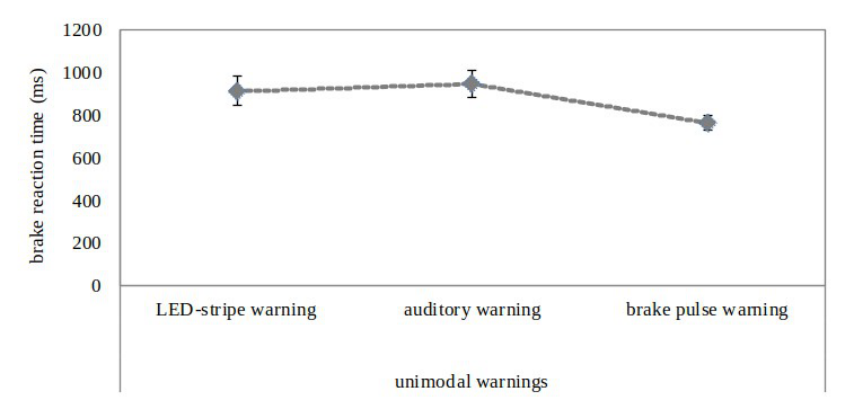
Results presented in this paper concentrate on brake reaction times. Figure 1 shows mean brake reaction times for unimodal warnings.
Figure 1: Mean brake reaction times for unimodal warnings (in bar graph: means and standard errors) As expected, one-way repeated measures ANOVA revealed a statistical significant effect that also proved to be of highly practical relevance (F(2, 32) = 4.25, p < .05, η2 p = .210, f = 0,52). A priori comparisons (alpha level adjusted) of the unimodal warning strategies showed significant brake reaction time advantages of the haptic brake pulse warning (M = 764ms) both over the visual illumination stripe warning (M = 912ms; t(32) = 2.23, p < .05, 1-sided, d = .66) and the auditory alarm (M = 946ms; t(32) = 2.74, p < .05, 1-sided, d = .83), while no reaction time benefits of peripheral visual warnings over auditory alarms could be revealed (t(32) = .30, p > .05, 1-sided, d = .12).
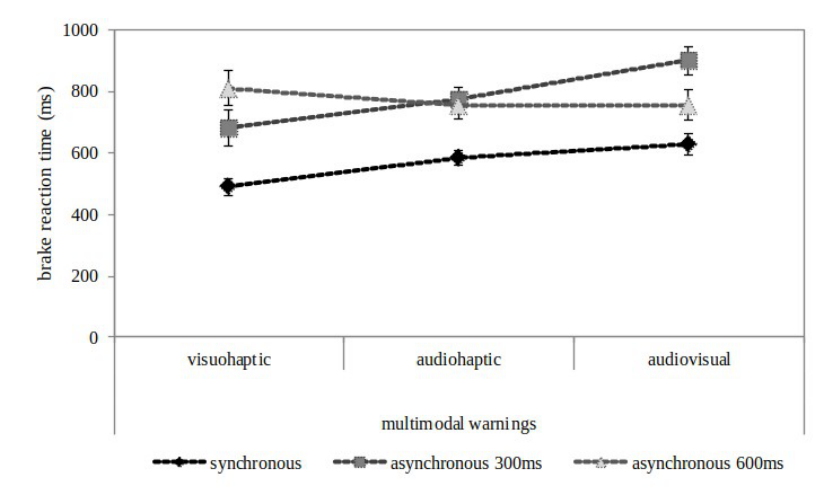
The descriptive statistics of multimodal warnings depending on warning modality and time frame are shown in Figure 2.
Figure 2: Mean brake reaction times for multimodal warnings depending on warning modality and time frame (in bar graph: means and standard errors)
A two-way ANOVA with ‘warning modality’ as three-staged repeated factor and ‘time frame’ as three-staged between-subjects factor was run. The analysis showed a statistical and practical significant main effect for multimodal warning strategies (F(2, 90) = 4.42, p < .05, η2
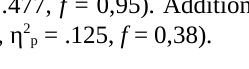
p = .089, f = 0,31). Also the between-subjects factor which manipulated the SOA between the multimodal warning components, revealed to be very significant both in statistical and practical ways (F(2, 45) = 20.50, p < .01, η2
p = .477, f = 0,95). Additionally, there was a significant interaction effect between both factors (F(4, 90) = 3.20, p < .05, η2
Equation reproduced from the original PDF.
Alpha level adjusted post-hoc comparisons indicated consistent brake reaction time benefits in the context of synchronous presented warning components compared to an asynchronous presentation of 300ms (visuohaptic: t(90) = -3.04, p < .01, 1-sided, d = 1.17; audiohaptic: t(90) = -3.02, p < .01, 1- sided, d = 1.66; audiovisual: t(90) = -4.31, p < .01, 1- sided, d = 1.79) as well as 600ms (visuohaptic: t(90) = -5.43, p < .01, 1- sided, d = 1.74; audiohaptic: t(90) = -2.83, p < .01, 1- sided, d = 1.12; audiovisual: t(90) = -2.12, p < .05, 1- sided, d = .70).
Based on these results, further analysis on multimodal warnings exclusively focused on synchronously presented warning components. In this context, a priori comparisons between the different synchronously presented multimodal warning strategies revealed significant reaction time benefits for visuohaptic (M = 490ms) compared to audiohaptic warnings (M = 586ms; t(90) = 1.66, p = .051, 1-sided, d = .95), as expected. Visuohaptic warnings also led to shorter brake reaction times compared to audiovisual warnings (M = 629ms; t(90) = 2.39, p < .01, 1-sided, d = 1.16), while no corresponding difference could be revealed for audiohaptic and audiovisual warnings (t(90) = .73, p > .05, 1-sided, d = .36).
Referring to the expected advantages of multimodal over unimodal warnings, an independent samples t-test was run, comparing mean brake reaction times of the brake pulse warning as most effective unimodal warning (M = 764ms) and the audiovisual warning as least effective multimodal warning (M = 629ms). Thus the very significant reaction time benefits of the audiovisual warning (t(31) = 2.76, p < .01, 1-sided, d = .96) respectively applies for any other comparisons among uni- and multimodal warnings.
DISCUSSION
With reference to the ongoing increase of different ADAS, an innovative, system-comprising display- and warning philosophy should be established to summarize the large number of warnings to only two action-based key messages: a warnings strategy for braking events and a warning strategy for steering advices. Referring to this project, the present study was concentrating on the question, how best to warn the driver in light of high-priority braking events. Former studies in this multi-step research project already indicated a promising potential of peripheral visual warnings combined with a haptic brake pulse warning to efficiently communicate imminent braking advices to the driver (Maier et al., 2010; see also Maier et al., 2011). The present study sought to validate these findings and also to specify the parameter settings. For this purpose, a real driving study using the EVITA test system was conducted to simulate almost rear-end collision braking scenarios.
Based on previous findings, the peripheral visual illumination stripe warning was expected to provoke significant shorter brake reaction times compared to an auditory alarm that is variously used in car and thus cannot be straight and intuitively identified as a hazard warning signal (Kiefer et al., 1999; Perry et al., 2006). The special potential of the peripheral illumination stripe warning in contrast is based on its high signal intuitivity and unambiguous hazard communication. Yet no reaction time advantages of the visual warning signal could be shown. It can be assumed, that the potential of the illumination stripe warning could not be fully exploit due to the heavy visual driver distraction. The distraction task not only involved a typical gaze movement away from the primary visual driving task, yet also implied a complete head movement to the passenger’s seat. Thus the driver indeed still perceived the red flashing of the illumination stripe warning, which finally led him to a braking reaction, yet similar to the interpretation difficulties in the context of an auditory alarm the driver might not have been longer able to straightly identify the red signal as an imminent hazard warning. As a consequence, no reaction time benefits of the illumination stripe warning could be revealed. Only in the multimodal presentation mode combined with a brake pulse (synchronously presented), the red flashing was unambiguously and right away identified as a warning signal and could thus exploit its full potential. In this case, the red flashing of the peripheral illumination stripe warning instantly reminds of the brake lights of vehicles in front and thus intuitively encourages braking reactions. In this way, both components of the visuohaptic warning refer intuitively to a braking reaction and could thus significantly enhance braking reaction times. Combined with a brake pulse warning, also the auditory alarm can be instantly identified as a hazard warning by the driver, yet only the brake pulse itself clearly communicates a braking advice, while the auditory alarm remains unspecific in its warning advice. This clear matching between signal and signal reason in the context of visuohaptic warnings finally lead to significant reaction time benefits over audiohaptic warnings, as expected (Hypothesis 1; see also Fitch et al., 2007; Kiefer et al., 1999; Perry et al., 2006; Lee, Hoffman and Hayes, 2004).
According to previous findings (Chang et al., 2011; Fitch et al., 2007; Lee et al., 2004; Scott and Gray, 2008; Mohebbi et al., 2009; Rosario et al., 2009; Straughn, Gray and Tan, 2009), significant brake reaction time advantages among the unimodal warnings could be shown for the haptic brake pulse compared to both the illumination stripe warning and the auditory alarm (Hypothesis 2). For multimodal warnings however (synchronously presented), only the visuohaptic warning proved very significant reaction time advantages over the audiovisual warning, while no such differences could be revealed for the audiohaptic signal. These findings further underline the particular warning potential of the peripheral illumination stripe warning.
Furthermore and in line with former results, consistent reaction time benefits of multimodal warnings compared to unimodal warnings could be found (Hypothesis 3; Selcon et al., 1995; Lee and Spence, 2008; Brown, 2005). Considering in this context the requirement of a close temporal proximity of multimodal attributes to arrive in the relevant brain areas for multisensory integration processes the question was raised, whether modality-specific transmission latencies of multimodal attributes should be experimentally balanced by means of slightly asynchronous signal presentations. While some studies revealed in fact reaction time benefits for asynchronously presented warnings (Santangelo et al., 2006; Santangelo et al., 2008; Liu et al., 2011), the present results consistently indicate (very) significant brake reaction time advantages for synchronous stimulus presentations for all bimodal warnings (see also Chan and Chan, 2006). Neurophysiological findings concerning modality-specific transduction latencies also give reason to expect advantages of an asynchronous presentation of multimodal warning components to enhance temporal coincidence in the arrival of the different attributes in the relevant brain areas (Colonius and Diederich, 2004; Vroomen and Keetels, 2010; Pöppel, Schill and Steinbüchel, 1990; Barnett-Cowan and Harris, 2009). Yet at the same time, a strong neuronal plasticity must be assumed to ever enable multisensory integration effects to happen (Holmes and Spence, 2005; Sugita and Suzuki, 2003; Morein-Zamir, Soto-Faraco and Kingstone, 2003). In this line of argument, temporal asynchronies in the arrival of multimodal attributes seem to be basically counterbalanced by the brain itself. This reasoning might be able to explain the heterogeneous findings so far. It might be that minor asynchronies in the stimulus arrival times could be completely and more precisely counterbalanced by the brain itself, which would suggest advantages of synchronous stimulus presentations, while conversely asynchronous stimulus presentations might be advantageous in case of greater transduction time differences.
All in all, the results of the present study support an innovative visuohaptic warning strategy – consisting of a peripheral visual illumination stripe warning and a haptic brake pulse – as an interesting and promising alternative to audiohaptic concepts in the context of highly imminent braking scenarios. Further research needs to be undertaken for a more comprehensive validation of peripheral visual warnings. The same applies to the so far heterogeneous results concerning the optimal timing of warning components in multimodal settings.
REFERENCES
Adell, E., Várhelyi, A., Fontana, M. D., Bruel, L. (2008), “Test of HMI alternatives for driver support to keep safe speed and safe distance - a simulator study”, The Open Transportation Journal Volume 2. Barnett-Cowan, M., Harris, L. R. (2009), “Perceived timing of vestibular stimulation relative to touch, light and sound”,
Experimental Brain Research Volume 198 No. 2-3. Belz, S. M., Robinson, G. S., Casali, J. G. (1999), “A new class of auditory warning signals for complex systems: Auditory Icons”, Human Factors Volume 41 No. 4. Brown, S. B. (2005), “Effects of haptic and auditory warnings on driver intersection behaviour and perception”. Unpublished
Master´s thesis. Virginia Tech. Cacciabue, P. C., Martinetto, M. (2006), “A user-centred approach for designing driving support systems: the case of collision avoidance”, Cognition, Technology and Work Volume 8 No. 3. Calvert, G. A., Thesen, T. (2004), “Multisensory integration: methodological approaches and emerging principles in the human
brain”, Journal of Physiology Volume 98 No. 1-3. Campbell, J. L., Richard, C. M., Brown, J. L., McCallum, M. (2007), “Crash warning system interfaces: human factors insights and lessons learned”, No. HS819 697. Washington DC: National Highway Traffic Safety Administration. Chan, A. H. S., Chan, K. W. L. (2006), “Synchronous and asynchronous presentation of auditory and visual signals:
Implications for control console design”, Applied Ergonomics Volume 37 No. 2. Chang, W., Hwang, W., Ji, Y. G. (2011), “Haptic seat interfaces for driver information and warning systems”, International Journal of Human-Computer Interaction Volume 27 No. 12. Colonius, H., Diederich, A. (2004), “Multisensory interaction in saccadic reaction time: a time-window-of-integration model”,
Journal of Conitive Neuroscience Volume 16. Cummings, M. L., Kilgore, R. M., Wang, E., Tijerina, L., Kochhar, D. S. (2007), “Effects of Single Versus Multiple Warnings on Driver Performance”, Human Factors: The Journal of the Human Factors and Ergonomics Society Volume 49 No. 6. Driver, J. (2001), “A selective review of selective attention research from the past century”, British Journal of Psychology
Volume 92 No. 1. Fitch, G. M., Kiefer, R. J., Hankey, J. M., Kleiner, B. M. (2007), “Toward developing an approach for alerting drivers to the direction of a crash threat”, Human Factors: The Journal of the Human Factors and Ergonomics Society Volume 49 No. 4. Graham, R. (1999), “Use of auditory icons as emergency warnings: evaluation within a vehicle collision avoidance application”,
Ergonomics Volume 42 No. 9. Green, P. (2006), “Driver status and implications for crash safety”. SAE Convergence Paper No. 2006-21-0028. Warrendale, Pennsylvania: Society of Automotive Engineers. Hameed, S., Ferris, T., Jayaraman, S., Sarter, N. (2009), “Using Informative Peripheral Visual and Tactile Cues to Support Task
and Interruption Management”, Human Factors: The Journal of the Human Factors and Ergonomics Society Volume 51 No. 2. Henning, M. J., Kienast, H., Lindner, P., Weigel, H., Krems, J. F., Spanner-Ulmer, B. (2008), “Multifunktionale Mensch- Maschine-Schnittstelle”, in: 5. Workshop Fahrerassistenzsysteme FAS 2008, Maurer, M., Stiller, C. (Eds.). pp. 151–158 Hillstrom, A. P., Yantis, S. (1994), “Visual motion and attentional capture”, Perception and Psychophysics Volume 55. Ho, A. W. L., Cummings, M. L., Wang, E., Tijerina, L., Kochhar, D. S. (2006), “Integrating intelligent driver warning systems:
effects of multiple alarms and distraction on driver performance”. Transportation Research Board 85th Annual Meeting CD-Rom. Ho, C., Spence, C. (2005), “Assessing the effectiveness of various auditory cues in capturing a driver's visual attention”, Journal of Experimental Psychology: Applied Volume 11 No. 3.
Ho, C., Spence, C. (2008), “The multisensory driver”. Aldershot: Ashgate. Ho, C., Spence, C. (2009), “Using peripersonal warning signals to orient a driver's gaze”, Human Factors: The Journal of the Human Factors and Ergonomics Society Volume 51 No. 4. Ho, C., Reed, N., Spence, C. (2006), “Assessing the effectiveness of “intuitive” vibrotactile warning signals in preventing front-
to-rear-end collisions in a driving simulator”, Accident Analysis & Prevention Volume 38 No. 5. Ho, C., Reed, N., Spence, C. (2007), “Multisensory in-car warning signals for collision avoidance”, Human Factors: The Journal of the Human Factors and Ergonomics Society Volume 49 No. 6. Ho, C., Tan, H. Z., Spence, C. (2006), “The differential effect of vibrotactile and auditory cues on visual spatial attention”,
Ergonomics Volume 49 No. 7. Hoffmann, J. (2008), “Das Darmstädter Verfahren (EVITA) zum Testen und Bewerten von Frontalkollisionsgegenmaßnahmen”.
Fachgebiet Fahrzeugtechnik der TU Darmstadt. Hoffmann, J., Winner, H. (2007), “Das Darmstädter Dummy Target EVITA. Ein Werkzeug zur Beurteilung von Antikollisionssystemen”, in: Erprobung und Simulation in der Fahrzeugentwicklung. Mess- und Versuchstechnik, VDI- Gesellschaft Fahrzeug- und Verkehrstechnik (Ed.). Holmes, N. P., Spence, C. (2005), “Multisensory Integration: Space, Time and Superadditivity”, Current Biology Volume 15 No.
18. Janssen, W., Nilsson, L. (2004), “Behavioural effects of driver support”, in: Driving future vehicles, Parkes, A. M. , Franzen, S.
(Eds.). pp. 137–145 Kiefer, R. J., LeBlanc, D., Palmer, M., Salinger, J., Deering, R., Shulman, M. (1999), “Development and validation of functional definitions and evaluation procedures for collision warning/ avolidance systems”, Report No. DOT HS 808 964. Washington, DC: National Highway Traffic Safety Administration. Kienast, H., Lindner, P., Weigel, H., Henning, M. J., Krems, J. F., Wanielik, G., Spanner-Ulmer, B. (2008),
“Aufmerksamkeitssteuerung durch räumlich gerichtete Anzeigen in Fahrerassistenzsystemen”, in: Integrierte Sicherheit und Fahrerassistenzsysteme, VDI Wissensforum (Ed.). pp. 413–423 Lamble, D., Laakso, M., Summala, H. (1999), “Detection thresholds in car following situations and peripheral vision: implications for positioning of visually demanding in-car displays”, Ergonomics Volume 42 No. 6. Lee, J. D., Hoffman, J. D., Hayes, E. (2004), “Collision warning design to mitigate driver distraction”, Proceedings of the
SIGCHI Conference on Human Factors in Computing Systems Volume 6. Lee, J. D., McGehee, D. V., Brown, T. L., Reyes, M. L. (2002), “Collision warning timing, driver distraction, and driver response to imminent rear-end collisions in a high-fidelity driving simulator”, Human Factors Volume 44 No. 2. Lee, J.-H., Spence, C. (2008), “Assessing the benefits of multimodal feedback on dual-task performance under demanding
conditions”, in: BCS-HCI ´08 Proceedings of the 22nd British HCI Group Annual Conference on People and Computers: culture, creativity, interaction - volume 1, England, D., Beale, R., Abuelmaatti, O. (Eds.). pp. 185–192 Liu, B., Jin, Z., Wang, Z., Gong, C. (2011), “The influence of temporal asynchrony on multisensory integration in the processing of asynchronous audio-visual stimuli of real-world events: an event-related potential study”, Neuroscience Volume 176 Liu, Y.-C. (2001), “Comparative study of the effects of auditory, visual and multimodality displays on drivers´ performance in
advanced traveller information systems”, Ergonomics Volume 44 No. 4. Mahlke, S., Rösler, D., Seifert, K., Krems, J. F., Thüring, M. (2007), “Evaluation of six night vision enhancement systems: qualitative and quantitative support for intelligent image processing”, Human Factors: The Journal of the Human Factors and Ergonomics Society Volume 49 No. 3. Maier, K., Sacher, H., Hellbrück, J. (2010), “A first step towards an integrated warning approach”, in: Advances in ergonomics
modeling and usability evaluation, Khalid, H. M., Hedge, A., Ahram, T. Z. (Eds.). pp. 259–268 Maier, K., Sacher, H., Hellbrück, J., Meurle, J., Widmann, U. (2011), “‘Multimodaler Warnbaukasten’. Eine neue Warnphilosophie für Fahrerassistenzsysteme”, in: Der Fahrer im 21. Jahrhundert. VDI-Bericht Nr. 2134, VDI-Gesellschaft Fahrzeug- und Verkehrstechnik (Ed.). pp. 75–91 Meredith, M. A. (2002), “On the neuronal basis for multisensory convergence: a brief overview”, Cognitive Brain Research,
Volume 14 No. 1. Mohebbi, R., Gray, R., Tan, H. Z. (2009), “Driver reaction time to tactile and auditory rear-end collision warnings while talking on a cell phone”, Human Factors: The Journal of the Human Factors and Ergonomics Society Volume 51 No. 1. Morein-Zamir, S., Soto-Faraco, S., Kingstone, A. (2003), “Auditory capture of vision: examining temporal ventriloquism”, Brain
research Volume 17 No. 1. Motter, B. (2001), “Attention in the animal brain”, in: The MIT encyclopedia of the cognitive sciences, Wilson, R. A., Keil, F. C.
(Eds.). pp. 41–43 Nikolic, M. I., Sarter, N. B. (2001), “Peripheral visual feedback: a powerful means of supporting effective attention allocation in event-driven, data-rich environments”, Human Factors Volume 43 No. 1. Perry, N., Stevens, C., Howell, C. (2006), “Warning signal design: the effect of modality and iconicity on recognition speed and
accuracy”, Proceedings of the 7th International Australian Aviation Psychology Symposium. Pöppel, E., Schill, K., Steinbüchel, N. v. (1990), “Sensory integration within temporally neutral systems states: a hypothesis”, Naturwissenschaften Volume 77. Posner, M. I. (1980), “Orienting of attention”, The Quarterly Journal of Experimental Psychology Volume 32. Rosario, H. d., Louredo, M., Díaz, I., Soler, A., Gil, J. J., Solaz, J. S., Jornet, J. (2009), “Efficacy and feeling of a vibrotactile
Frontal Collision Warning implemented in a haptic pedal”, Transportation Research Part F: Traffic Psychology and Behaviour Volume 13 No. 2.
Santangelo, V., Lubbe, R. H. J., Olivetti Belardinelli, M., Postma, A. (2008), “Multisensory integration affects ERP components elicited by exogenous cues”, Experimental Brain Research Volume 185 No. 2. Santangelo, V., van der Lubbe, R. H. J., Olivetti Belardinelli, M., Postma, A. (2006), “Spatial attention triggered by unimodal,
crossmodal, and bimodal exogenous cues: a comparison of reflexive orienting mechanisms”, Experimental Brain Research Volume 173 No. 1. Scott, J. J., Gray, R. (2008), “A comparison of tactile, visual, and auditory warnings for rear-end collision prevention in simulated driving”, Human Factors: The Journal of the Human Factors and Ergonomics Society Volume 50 No. 2. Selcon, S. J., Taylor, R. M., McKenna, F. P. (1995), “Integrating multiple information sources: using redundancy in the design of
warnings”, Ergonomics Volume 38 No. 11. Spence, C., Ho, C. (2008a), “Multisensory warning signals for event perception and safe driving”, Theoretical Issues in Ergonomics Science Volume 9 No. 6. Spence, C., Ho, C. (2008b), “Tactile and multisensory interface design for drivers”, IEEE Transactions on Haptics Volume 1. Spence, C., McDonald, J., Driver, J. (2004), “Exogenous spatial cuing studies of human crossmodal attention and multisensory
integration”, in: Crossmodal space and crossmodal attention, Spence, C., Driver, J. (Eds.). pp. 277–320 Stanley, L. M. (2006), “Haptic and auditory cues for lane departure warnings”, Proceedings of the Human Factors and Ergonomics Society Annual Meeting Volume 50 No. 22. Stein, B. E., Meredith, M. A. (1993), “The merging of the senses”. Cambridge, Mass: MIT Press. Straughn, S. M., Gray, R., Tan, H. Z. (2009), “To go or not to go: stimulus-response compatibility for tactile and auditory
pedestrian collision warnings”, IEEE Transactions on Haptics Volume 2 No. 2. Styles, E. A. (2006), “The psychology of attention”. Hove, New York: Psychology Press. Sugita, Y., Suzuki, Y. (2003), “Audiovisual perception: implicit estimation of sound-arrival time”, Nature Volume 421 No. 6926. Suzuki, K., Jansson, H. (2003), “An analysis of driver's steering behaviour during auditory or haptic warnings for the designing of lane departure warning system”, JSAE Review Volume 24 No. 1. Talsma, D., Woldorff, M. G. (2005), “Selective attention and multisensory integration: multiple phases of effects on the evoked
brain activity”, Journal of Conitive Neuroscience Volume 17 No. 7. Teder-Sälejärvi, W. A., McDonald, J. J., Di Russo, F., Hillyard, S. A. (2002), “An analysis of audio-visual crossmodal integration by means of event-related potential (ERP) recordings”, Cognitive Brain Research Volume 14 No. 1. Tretten, P., Gärling, A. (2011), “Warnings and instrument design layout”, in: Traffic psychology. An international perspective,
Hennessy, D. A. (Ed.). pp. 303–320 van Erp, J. B. F., van Veen, H. A. H. C. (2004), “Vibrotactile in-vehicle navigation system”, Transportation Research Part F: Traffic Psychology and Behaviour Volume 7 No. 4-5. van Zomeren, A. H., Brouwer, W. H. (1994), “Clinical neuropsychology of attention”. New York: Oxford University Press. Vroomen, J., Keetels, M. (2010), “Perception of intersensory synchrony: a tutorial review”, Attention, Perception, &
Psychophysics Volume 72 No. 4. Wallace, M., Roberson, G., Hairston, W., Stein, B., Vaughan, J., Schirillo, J. (2004), “Unifying multisensory signals across time and space”, Experimental Brain Research Volume 158 No. 2. Weerd, P. de. (2003), “Attention, neural basis of”, in: Encyclopedia of cognitive science. Vol. 1, Nadel, L. (Ed.). pp. 238–246 Wickens, C. D., McCarley, J. (2010), “Applied Attention Theory”. Taylor & Francis. Wiese, E. E., Lee, J. D. (2004), “Auditory alerts for in-vehicle information systems: The effects of temporal conflict and sound
parameters on driver attitudes and performance”, Ergonomics Volume 47 No. 9. Winner, H., Hakuli, S., Wolf, G. (Eds.). (2009), “Handbuch Fahrerassistenzsysteme: Grundlagen, Komponenten und Systeme für aktive Sicherheit und Komfort”. Wiesbaden: Vieweg+Teubner Verlag / GWV Fachverlage GmbH, Wiesbaden. Yeh, M., Merlo, J. L., Wickens, C. D., Brandenburg, D. L. (2003), “Head up versus head down: the costs of imprecision,
unreliability, and visual clutter on cue effectiveness for display signaling”, Human Factors Volume 45 No. 3.
LISTED IN THE AHFE DIGITAL BOOKSTORE CATALOGUE
Explore the complete digital volume
Advances in Human Aspects of Transportation: Part III
Read this individual research paper free through the original publisher, or explore the full digital proceedings book.
ISBN 978-1-4951-2099-2
Explore this ISBN in the AHFE Bookstore ↗Listed in the July 2026 bookstore catalogue; search by ISBN to confirm current availability · Digital book purchase optional