Wilfried Post, Jurriaan van Diggelen, Marleen Rakhorst-Oudendijk, Marc Grootjen (2022). Reducing Crew Size of Future Naval Ships Using a Method Suite for Analysis, Design, Simulation and Evaluation. In: Advances in Human Aspects of Transportation: Part III. AHFE Open Access, vol. 17. https://doi.org/10.54941/ahfe100723
In the coming decade, the Royal Netherlands Navy is planning to replace a number of maritime platform types. The starting points for these replacements have changed importantly, compared to those of the current and past generations. The focus is on manning reduction with three main reasons. First, the endangerment of defense personnel’s life should be minimized. Second, technical personnel are increasingly harder to find, especially for the maritime sector, which endangers the operational maintainability of future vessels. Third, the life cycle costs should decrease by lowering the personnel cost component. Accordingly, the Navy is defining future platforms and setting goals to reduce the crew size by a revolutionary 30 to 50%. This paper describes the application of an integrated methods suite that supports the development of cost-effective and efficient future platforms with significantly less technical personnel. One of the conclusion is that such integration of methods leads to better defined methodological concepts that are easier to share, which is essential for multidisciplinary research and multi-party innovation.
The Royal Netherlands Navy is challenged by a reduction of personnel in the near future. This may seriously endanger the deployment of their naval vessels. Especially the availability of technicians is a problem and receives a strong focus. Therefore, a two-year research programme has started to develop knowledge for determining the optimal distribution of operational maintenance between people, technology and organisation. This knowledge will be applied to the design of future platforms. The specific aim is to demonstrate a suite of methods for analysis, design, simulation and evaluation of future operational maintenance concepts (including support and education & training), and to test this suite in a realistic and concrete operational maintenance scenario with reduced technical manning and expertise.
This paper describes a combination an integration of existing analysis and design methods and illustrates how these were applied to the current operational maintenance on board the Patrol Vessel type, which is a type of platform with a significantly reduced crew by itself that has recently be developed.
The research questions that guided us were:
- What is the best way to analyse RNLN’s current challenge? We will show that a combination of the external constraints, socio-technical system analysis according to Cognitive Work Analysis method (CWA), and ethnographic observations provide the necessary starting points for design.
- What is the best way to integrate the various methods for all design phases? We will demonstrate how we extended an existing tool for cognitive engineering with explicit support for the CWA approach by incorporating CWA concepts slots, and how we defined use cases, claims and requirements for the future ways of working, user interfaces and training requirements.
- What is the best way to simulate complex and collaborative operational maintenance? We will describe the requirements and development of a socio-technical system simulator. The resulting, application is able to generate a flexible prototype socio-technical system for operational maintenance that allows us to easily change ways of working (distribution of operational maintenance work between alternative crew compositions) and the level of automation, allowing quick insights into the consequences of various design choices.
- How to design support for operators with high individual workload and complex collaborative demands best? We will show how we developed and simulated a concept that transfers the coordination of operational maintenance from low level system monitoring & control into high level function monitoring & control, enabling a significant manning reduction.
ANALYSIS METHODS External constraints
Naval platform types are usually developed once in 30 years. Within the past three decades, probably more has changed during any other platform generation since the transition from wind power to steam, about 200 years ago. So today, naval ship design can’t be a matter of reusing old blueprints; these significant changes have to be taken into account. We discuss a number of them.
First of all, there are important societal changes: technical, seagoing, and military professions have become less attractive, let alone the attractiveness of their combination. Where generation X, also called lost generation, did grow up during economic decline, and subsequently was more willing to take less attractive jobs, generation Y, although gifted with competences such as entrepreneurship, decisiveness, and initiative, is often characterized as individuals, striving for making money and lacking loyalty. And in the recent years, they need to be online, interacting only with user-friendly interfaces. In this zeitgeist, it has become an official policy to endanger military as little as possible. This, together with the economic circumstances and shortage of personnel, led to ambition of the military to reduce crew size of the next generation naval vessels with 30 to 50%.
Second, and not unrelated, enormous technological changes have taken place, especially in information and communication technology, enabling sensing and processing massive data, and demanding new ways to interact with it. Also, miniaturization has had an important influence, both on electronic and mechanic devices. Personal Digital Assistants and Smartphones allow operators to work anyplace. In ‘Trends in Human-Computer Interaction to Support Future Intelligence Analysis Capabilities’, Gouin and Lavigne (2010) provide an overview, relevant for Command and Control. Important subjects are smart rooms (rooms full with sensors, cognition and effectors), shared workspaces, advanced screen technology (flexible, wearable, large), mixed / augmented reality, multi-modal interaction (touch tables, automatic speech and gesture recognition), biometry, intelligent en adaptive user interfaces, and advanced information presentation to analyze and understand multi-dimensional and complex information. This all has also led to huge steps in the development of autonomous systems.
Third, since crew reduction effects the distribution of the necessary skills, procedures and knowledge onboard, didactical developments during the years may be relevant as well. Here is an overview of the new concepts. E- learning enables learning anytime anyplace. Serious Gaming reduces the need to train with real equipment, real colleagues, and real teachers (see Lubbers & Coetsier, 2009). Lifelong Learning is the ongoing, voluntary, and self- motivated pursuit of knowledge for either personal or professional reasons (see e.g., Collins, 2004). Self-directed learning refers to taking own initiative in setting goals, getting resources, developing learning strategies and evaluating outcomes (see e.g. Vann, 1996). A shift of focus has taken place from educating knowledge and skills to competences. Where educating knowledge is more oriented on knowledge recall, and skill training effects skilled behavior, educating competences should more directly result in competent behavior (See Westera, 2000).
Socio-Technical System analysis While reviewing existing methods for socio-technical system analyses, we were looking for those that have flexibility and adaptability as essential characteristics, since much uncertainty in the way naval vessels will be designed and operated. They need a long time to develop (i.e., 10 years) and have a much longer life cycle (i.e., 40 years). For this reason, we investigated the applicability of the Cognitive Work Analysis framework (CWA; see Rasmussen et al., 1994; Vicente; 1995, 1995; Jenkins et al, 2009). CWA models different types of constraints, by building a model of how work could proceed within a given work system. Especially this focus on constraints separates the technique from traditional approaches, that aim to describe how work is actually conducted, or prescribe how it should be conducted, given the resources of man and machines.
CWA provides several useful templates for the different phases of the analysis. We have focused on the Abstraction Hierarchy and Decision Ladders (DL’s). The Abstraction Hierarchy is a multi-leveled representation of the ‘work environment’ from multiple perspectives (both functional and physical) at different levels of abstraction. One of the layers describe the core functions. For example, in our case of supporting the internal battle for navy vessels, we can identify fire control, flood control, damage control, and personnel control as core functions. Each core function can be analyzed further using a so-called decision ladder (see Figure 2) which identifies five steps in the process. The low levels in the DL are skill-based and typically suitable for automation and mechanization. The higher levels typically for decision support. See Post et al. (2013) for a full account.
Figure 1. Abstraction Hierarchy Diagram.
Figure available in the original PDF paper.
A second modelling perspective that we have carried out is the Control Task Analysis, resulting in the so called Decision Ladder diagrams. Decision ladders describe the cognitive processes involved in changing a particular situation the socio-technical system finds itself in, with a given set of resources. Cognitive processes are represented as the transitions between cognitive states. Transition steps can be allocated to (one or more) humans, machines or a combination of them. Figure 2 illustrates the Decision Ladder diagram template by Jenkins et al (2009), with besides the diagram, in text how we modelled the core function Fire Control on board the OPV.
The decision ladder describes that an alert is activated after fire detection (start reading the figure from left below). By observing information and data about the fire, an information position (situational awareness) is established and maintained and through diagnose, the seriousness of the situation (size, development, etc. of the fire) is determined. At the top of the ladder, the actual decision has to be made whether and how the fire shall be controlled. By considering possible consequences of the situation and generating possible options, and by evaluating the expected performance for these options in relation to the system goals (the Command Aim), it is determined whether the Command Aim still holds or should be adapted, and whether the command priorities should be changed (e.g. give priority to safety of personnel instead of materiel). Now the target state (e.g., fire out; wounded personnel after treatment ready for duty) can be determined, the tasks defined to accomplish that (‘Isolate electricity in compartment C.’, ‘Compose more firefighting teams’), and procedures planned to carry out the tasks (‘Determine smoke boundary’, ‘Determine firefighting route’). The coordination process results in procedures and directives for the teams and systems within the ship to execute the actual firefighting.
Is it possible to maintain current Command Aim: a priority on ability to know ext. environm Evaluate performance
Electricity isolation Fire containment Fire ignore
.
- Ensure safety, but maintain functions X and Z
- Determination of smoke boundaries
- Determination of fire fighting route - Determination of how to realise electric isolation
- Determination of availability and readiness firefighters
- 4 Procedure of fire fighters AP1 to AP5
- Use smoke boundary B - Use fire fighting route R
- Local electrical isolation by maintainer.
- 1 Direct to inform "Fire Fire Fire in compartment ..." - 2 Direct to activate crash stop ventilation
- 3 Direct activation watermist installation
- Direct to inform smoke boundary
- Direction and control Electrical isolation - Direction and control fire fighting teams (coordination r
Decision Ladder for Fire Control at COBRA
- Direction and control boundary cooling - Direct to inform situation to ship
Figure 2. Decision Ladder. The diagram represents the template. The text besides it is our analysis of the Fire Control function.
Figure available in the original PDF paper.
In order to be able to respond quickly in case of fire, several standard procedures are preplanned or automated in the ship. These processes make shortcuts in the decision ladder (numbers 1 to 6 in Figure 20). Examples of automated Human Aspects of Transportation III (2022) procedures are the use of smoke, heat and flame detectors, which are present in each room to detect fire as soon as possible, and generate a fire alarm (in former ships this was a task of the guards).
This decision ladder shows the cohesion of several processes (fire, ship performance, safety, use of resources, etc.) that are influencing the coordinating decisions for fire control. It also helps to decompose the complex process of decision making during Fire Control. It provides the first step to analyse the collaboration within the current Fire Control team.
Ethnographic Observations We have carried out interviews with trainers and trainees, ethnographic observations and recordings of different training scenarios on board of different Oceangoing Patrol Vessels, during a period of two weeks. One OPV was in training for operational readiness but still had to pass examination, the other OPV was trained for the first time. Two recordings of the internal battle coordination team was fully transcribed for further analysis. We observed that a significant part of the work consisted of verbal communication, where digitisation can lead to a significant crew reduction. The findings also showed that the abundance of alarms and broadcastings during an internal battle (firefighting, flood control, battle damage repair, etc.) were not always functional or adequate, suggesting significant room for improvement. Finally, we identified which parts of the work are more and less knowledge-intensive, and eligible earlier or later for automation, mechanisation or support. Details can be found in Post et al. (2013, 2014).
Based on the findings, we imagined the possibility of an innovative operational maintenance concept, in terms of a new way of working, crew composition, and support tooling. The core of the concept is to transfer the coordination of operational maintenance from low level system monitoring & control into high level function monitoring & control, enabling the manning reduction requirement of 50%. In the next section, this concept is further specified.
DESIGN METHODS Analysis is input for design, and design should produce specifications that can be handed over to system engineers, software engineers and interaction engineers. We pursue the following properties:
- Specifications should indicate how the findings in the analysis have led to certain design decisions. - They should allow engineers to start defining prototypes. - They should allow experimenters to set up a first evaluation. - They should be understandable by various stakeholders (problem owners, domain matter experts, etc.). - Specifications involves lots of information and requires much time. Therefore, specification should make use of reusable components and can be best supported by software tools.
Below, we discuss how we integrated and applied existing methods that together fulfil these properties, in particular ontology analysis and design rationale specification.
Meta-Specification: Ontology Analysis In information science, an ontology is defined as a specification of a conceptualization (Gruber, 1993). It describes the terms and concepts and relations that are used in a certain domain. As argued in Uschold (1996), ontologies are used for Communication between people with different needs and viewpoints arising from their different context; Inter-operability between systems (e.g. databases using the same database schemas) and System engineering benefits, such as re-usability, automatic verification and specification.
A variety of languages exist for specifying and formalizing ontologies. These languages differ in their degree of expressiveness (the types of relations that can be specified), their degree of formalization (ranging from natural language descriptions to solid mathematical models). We have chosen the OWL Web Ontology Language (McGuiness & van Harmelen, 2004) because it enables entering a natural language definition, it is specified in a machine readable language (based on XML) and is a standard of the w3c consortium, Moreover, many 3rd party tools and programming libraries are available. The methodological ontology that we developed, such as the ontology Human Aspects of Transportation III (2022)
CWA concepts, is discussed below.
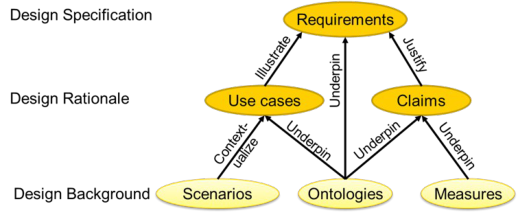
Design Rationale Using the terms and concepts defined in the ontology, we can formulate a precise specification of the envisioned system. The design rationale is used to specify what the system should be capable of, why this is the case, and how we intend to achieve this. For this purpose, we use the method of situated Cognitive Engineering (sCE) (Neerincx & Lindenberg, 2008). The sCE specification framework originates from the field of cognitive engineering (Norman, 1986) taking a user-centered perspective in the design of human-computer interaction, taking into account both people and machines. sCE focuses on the design and evaluation of functional aspects of this interaction (situated user goals and needs). An overview is presented in figure 3.
Figure 3. Overview of the different parts in the sCE framework.
Scenarios are used to capture the domain background by describing a general comprehensive story. Use-cases occur within the larger scenario and are short and structured prototypical examples of the envisioned man-machine interaction. Requirements describe what the machine should be able to do in order to realize the use cases. Claims describe the expected advantages and disadvantages of the requirement. They are used to justify the requirements by describing the effect on a certain measures that the requirement is expected to have. Ontologies provide a constrained vocabulary in which use cases, requirements and claims must be described.
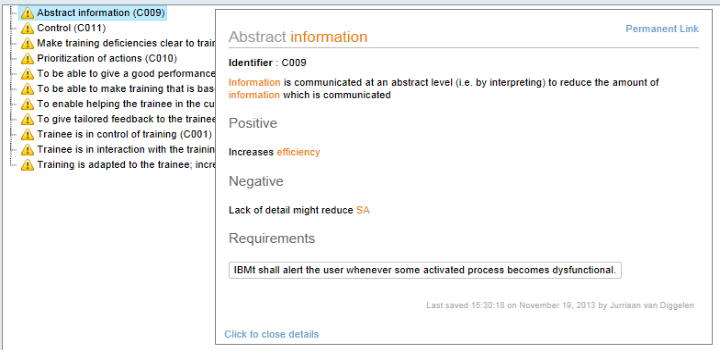
SCET The design rationale approach sCE is supported by a web-based tool called sCET (www.scetool.nl). Essentially, it is an online accessible environment to capture and record the different parts of sCE and that enables a definition (ontology) highlighting and cross referencing between different parts. Figure 4 (left) shows a screen shot of sCET’s tree structure. The main parts of sCE can be recognized. Foundation are subdivided in Operational Demands (again subdivided in CWA, Observations and External Constraints; the latter two are in development), Human Factors, and Technologies. Specification is subdivided in Scenarios, Use cases, Requirements and Claims. To incorporate Cognitive Work Analysis, we expanded sCET with a “CWA module”, both to record CWA information that is used and to support referencing to it from use cases, requirements and claims.
Figure 4. Screen dump of the cognitive engineering tool sCET.
Figure available in the original PDF paper.
Specification Windows An example use case specification within sCET is shown in Figure 5. It describes how the function Internal Battle Management is realized by the Internal Battle Manager (IBM), responsible for the management of the complete Internal Battle, so flood control, material control, personnel control and fire control. For all those core functions, he monitors and controls the progress of all decision ladder steps and the outcome of the complete process. This use case clarifies one of the possible operational concepts, in which the IBM has an assistant at his disposal to help him with all the work, namely the support system IBMt. The description makes use of the ontology. All defined concepts are colored. Data processing activities are in italic; States of knowledge are in bold. Core functions are underlined.
Use Case Internal Battle Management Operational Concept IBM, assisted by IBMt carry out complete internal battle management, consisting of Flood Control, Fire Control, Material Control and Personnel Control.
Pre-conditions
1. Ship in readiness state 1 is hit by a RPG, resulting in a fire, a flood, material failure, and wounded personnel. Command aim is Self Defence. Post-condition
1. Internal Battle under control
Action Sequence.
1. Flood sensor x activates flood alert f; pump sensor x activates pump failure alert p; personnel sensor x activates personnel alert h ; fire sensor x activates fire alert f. 2. IBM asks IBMt to support Flood Control flood f; Material Control pump p; Personnel Control person p; Fire Control fire f 3. IBMt continuously observes information (flood y; pump p; person p; fire f). IBMt delegates information gathering on (flood y; pump p; person p; fire f) to blanket search personnel BSP. IBMt informs IBM about the progress. 4. IBMt diagnoses the available information and assesses the seriousness of the current system state. Blanket search for Material Control points out a degradation of pump capacity: one of the pumps fails. Personnel Control indicated a wounded mechanic. Both Flood Control and Fire Control is depending on this degraded pump capacity. This is an unfamiliar situation, and the planning process of what to do next cannot be done in a procedural way, and knowledge based activities are needed IBMt warns the IBM. 5. IBMt helps the IBM with predicting the consequences when fire f and flood f are developing further: The fire threatens the location of the APAR, the flood is in the drinking water compartment. 6. IBMt helps the IBM with deciding how to resolve the conflict. Since the APAR is an external sensor system essential to the current Command Aim, and the drinking water compartment is isolated, and lack of drinking water doesn’t threatens the Command Aim directly, priority order is easily advised. 7. Based on this advice, the IBM decides on the target state, and allocates the pump to Fire Control fire f, but adds that Personnel Control should be prioritized to treating the mechanic, such that the Material Control issue with the pump can be resolved, by tasking the mechanic, when treated, with repairing the pump. 8. IBMt helps the IBM to plan the plan details for the implementation of these decisions and initiates all activities involved.
Figure 5. Screen dump a use case specification window in sCET
Figure available in the original PDF paper.
From this use case, we derived requirements, of which Figure 6 shows an example. The parent requirement “The IBMt shall provide overview, transparency and control on every active internal battle process” merely serves as a collector for its sub-requirements such as “IBMt shall alert the user whenever some activated process becomes dysfunctional”.
Figure 6. Screen dump a design specification window in sCET
Figure available in the original PDF paper.
Each requirement ought to be justified by a claim of expected advantages as well as disadvantages of the requirement. The claim, shown in Figure 7, is associated with the example requirement described above is one of information abstraction. In this example, the predicted positive effect is increased efficiency, and the possible negative effect is that lack of detail might reduce situational awareness. Both efficiency and situation awareness should be defined as a metric on which to evaluate the claimed result of the requirement.
Figure 7. Screen dump a claim specification window in sCET
SIMULATION AND EVALUATION METHODS Simulator development
We have developed a first version test bed for the simulation and evaluation of socio-technical systems. We define simulation as human-out-of-the-loop testing, and evaluation human-in-the-loop testing, but our approach to testing is to vary from complete simulation to partly simulation / partly evaluation to complete human-in-the-loop evaluation. This allows us to explore the design space initially without a strong dependency of, often scarce, experimental subjects, and utilize their availability especially for testing promising design solutions. The test bed has been built in the task-oriented programming and rapid prototyping language iTask (see Plasmeijer et al.. 2012). This language uses task as the central programming concept, in contrast to traditional programming languages such as Java and C+ +), where instruction plays the central role. From a precisely defined task description, a multi-user application is automatically generated, presenting all required user interfaces, dealing with data persistence issues, etc. This philosophy perfectly matches our socio-technical system approach. An important additional advantage is the reduced programming efforts.
The basic test bed facility – a server and a router - fits in a suitcase. It further requires a scenario operator, who can control the scenario, and subjects, who carry out the experimental work. They can all use a laptop, a tablet, or a smartphone, with a web browser and Wi-Fi (or a wire to the server) to reach the web based application.
Currently, the test bed only supports system-out-the-loop simulation and evaluation. So, systems, such as heat and smoke sensors, water mist, etc. are simulated. The test bed it is evolving further towards the following functional requirements:
- Work representation. All socio-technical systems should be represented as a set of core functions, each represented by sequences of decision ladder steps.
- Work specification. Each decision ladder should define what will be produced in a particular condition, provided the available resources (human/machines, available time, consumables, etc.)
- Work allocation. Each decision ladder step should be allocable to a human or a machine, where both can be either virtual or real task executors.
- Communication and Information exchange. By specifying how information should flow between and within decision ladder steps, the possible communication mean should be automatically derived: 1) Directly (e.g., face to face) or mediated (telephones, plot boards, etc.) between humans; 2) Between humans and systems, by means of a user interface; 3) Between systems, by means of any kind of information passing.
- Scenario functions: Scenario control, for starting and stopping events, such as leaks, fires and damaged materiel; Platform specification, such as compartments; Threat development models, such as fire development, leak development, etc.
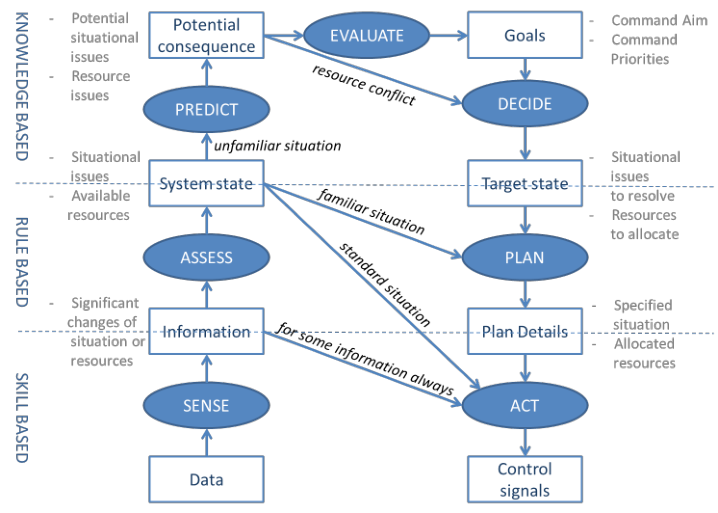
We are currently working on a graphical interface for the specification of operational concepts, using the states of knowledge, data processing activities and the specific types of links as standard entries (figure 8). The visualization shows that every object and relation has its own characteristics. Every state of knowledge (data, information, system state, etc.) describe both the situation to handle and the resources to handle it. From down to up, information is enriched from detailed to aggregated and grows in significance. Lower data processing activities (sense, act) are typical work for ratings. These activities are skill based, involves a lot of work, and usually require less cognitive competences. They are early candidates for automation and mechanisation. The activities assess and plan require know-how, and is typical work for petty-officers. The can usually be described in rules and procedures, and therefore can probably be automated. The activities predict, evaluate and decide require know-why: deeper knowledge of the situation, the resources and the world. They depend on competences to recognize the essentials, to imagine and handle uncommon situations, and to be decisively. Typical work for officers. These activities are hard to automate, but candidate for support.
Figure 8. The objects and relations represent graphical user interface entries for an operational concept specification tool.
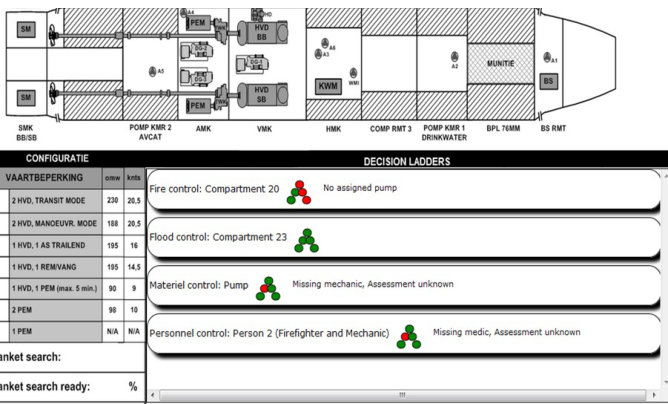
Evaluation In the test bed, we brought our socio-technical system concept alive. See figure 9 for some screen dumps of the IBMt, representing the assistant of the Internal Battle Manager. Apart from platform information, it shows a pile of work, a stack of ‘work tickets’ which are instantiations of core functions. In this case it shows a fire control issue in compartment 20, a flood control issue in compartment 23, a materiel control issue (a pump failure) and a personnel control issue (unavailable mechanic). Note that we use decision ladders as a means for monitoring and control the progress of the control processes. It is represented by the five-dotted triangles, where the dots stand for sense, assess, decide (we put predict, evaluate and decide together in one dot), plan and act. In this case, the decide dot of fire control is red, indicating progress alarm. By clicking on the work ticket, the details of that work ticket are shown. The figure presents the details of the materiel control issue with a pump: information about the missing ETBOL (Estimation Back On Line) and a resource conflict: the only available mechanic is allocated to fire control.
Figure 9. Screen dumps of our socio-technical system simulator, instantiated for function level monitoring & control of the internal battle. On the left, the rudimentary interface of the IBMt, on the right an interface presenting the details of a materiel control issue. Information about the missing ETBOL (Estimation Back On Line) and a resource conflict: the only available mechanic is allocated to fire control. The mechanic needs to be reallocated.
The IBMt automatically prioritizes the processes based on the command aim, and shows the processes with highest priority on top of the list. The IBM can see in one glance all the processes that are running, and the processes and related processing steps that need attention. This gives the IBM the opportunity to manage the processes on a functional level, instead of on the system level.
All decision ladders for the internal battle management functions were initiated and the interfaces were, partly automatically, built (such as sensing smoke, assessing fire, planning an attack route, activating water mist). This was added with various functionalities, such as the allocation of tasks to agents (man or machine), initiating scenario events (system failures, injured personnel, fires and floods), and (simplified) models for the development of fires and floods. The interfaces are rudimentary, but all basic elements socio-technical system simulation are functioning.
CONCLUSIONS AND DISCUSSION We reviewed, selected, integrated and applied methods for socio-technical system analysis, design, simulation and evaluation and achieved an innovative operational maintenance concept, in terms of a new ways of working, significantly reduced crew composition, and a support tool, as a prove of concept for our methods suite. The results are still preliminary, and the simulation tool we developed rudimentary, but our client assessed it as promising and found it worth it to continue.
The development of a new naval platform, let alone three different types within the coming 10 years, is a tremendous amount of work. A proper integration of methods and tools can be very supportive, if not essential, but that needs to be proved in advance. Specifying platforms as socio-technical systems in such a way engineers and designers can do their work effective and efficiently was one of the struggles in this research, but also guided us towards the necessary further formalization of methods such as CWA. While doing so, we got an interesting insight: developing and adapting operational concepts, using the CWA concepts of abstraction hierarchies and decision ladders takes place not only during the design phase but in many other phases of the life cycle as well. When a platform is tested for the first time, the first signs of how well the users and systems perform in its new configuration, depending on how well the educators of personnel, suppliers of equipment, and the ship builder did their jobs. Adaptations of the operational concept are usually necessary. Next, the crew training phase starts. Again, adaptations to the operational concept often happen, due to individual differences of personnel and occasional system malfunctioning. Then, during an internal battle, by definition the socio-technical system degrades, and adaptation, or resource management, is required. Also, halftime a life cycle, the platform will have its life extension program, and most of the time, new systems and crew concepts will be introduced, and again redesign is required. Finally, after 30 to 40 years when the platform is decommissioned, usually by selling it to another country, the RNLN helps the new owner with adapting the crew to their wishes. So, the impact of our work can be much greater than to the design phase only. Our special interest is using our approach for supporting adaptations of the operational concept during a missing.
Future work will be carried out in close collaboration with the industry, for which we will extend our work with system-in-the-loop simulation and evaluation. Obviously, this requires multidisciplinary and multiparty collaboration, which is an endeavour by itself. To prevent Babylonian confusion, we will start to with further ontological underpinning of our concepts. We have also started working on the dynamic visualisation of operational concepts, to create maximal understanding of it, both during development and operation.
ACKNOWLEDGEMENTS
The work reported in this paper has been carried out in the context of Research and Development Program V1209 “Human Factors in Operational Maintenance Support”. Program supervisor Cdr Jos Schreurs and domain matter expert Nine Badon Ghijben, both with MoD-NL/DMO, are acknowledged for their indispensable guidance and support. We are grateful to our colleagues at TNO, Mark Houben, Hilbert Kuiper, Wietse Ledegang, Jan Maarten Schraagen and Wessel van Staal for their valuable contributions to this work. And we are appreciative of the hospitality and helpfulness of the RNLN Ocean Going Patrol Vessels.
REFERENCES
Collins, J. (2004). Education techniques for lifelong learning: Principles of adult learning. RadioGraphics, 24, 1483-1489. Gouin, D & Lavigne, V. (2010). Trends in Human-Computer Interaction to Support Future Intelligence Analysis Capabilities.
16th Command and Control Research and Technology Symposium International, Quebec City, Canada, June 21-23, 2010. Gruber, Thomas R. "A translation approach to portable ontology specifications." Knowledge acquisition 5.2 (1993): 199-220. Jenkins, D. P., Stanton, N. A., Salmon, P. M. & Walker, G. H. (2009). Cognitive work analysis: coping with complexity.
Aldershot: Ashgate. Lubbers, J. & Coetsier, D.J. (2009) Serious Gaming: Gaming in het opleidingstraject van Defensie. ETNOS. Nr. 31, December
2009. McGuinness, D. L., & Van Harmelen, F. (2004). OWL web ontology language overview. W3C recommendation, 10(2004-03),
10. Neerincx, M.A. & Lindenberg, J. (2008). Situated cognitive engineering for complex task environments. In: Schraagen, J.M.C., Militello, L., Ormerod, T., & Lipshitz, R. (Eds). Naturalistic Decision Making and Macrocognition, pp. 373-390, Aldershot, UK: Ashgate Publishing Limited. Norman, D. (1986). Cognitive engineering. In: User Centered System Design, pp. 31–61, Lawrence Erlbaum Associates, 1986. Plasmeijer, R., Achten, P., & Koopman, P. (2007). iTasks: executable specifications of interactive work flow systems for the
web. ACM SIGPLAN Notices, 42(9), 141-152. Post, W.M., Grootjen, M., Kuiper, H., Rakhorst-Oudendijk. M. L.W. & Schraagen, J M. C. (2013). Methods for Socio- Technical System Analysis applied to OPV Operational Maintenance. TNO report 2013 R11327. Rasmussen, J., Pejtersen, A. & Goodstein, L.P. (1994). Cognitive systems engineering. New York: Wiley. Vann, B. A. (1996b). Learning self-direction in a social and experiential context. Human Resource Development Quarterly, 7,
121-130. Vicente, K. J. (1995). Task Analysis, Cognitive Task Analysis, Cognitive Work Analysis: What’s the difference? Proceedings of the Human Factors and Ergonomics Society, 39th Annual Meeting. Vicente. K. J. (1999). Cognitive work analysis: toward safe, productive, and healthy computer-based work. Mahwah, NJ:
Lawrence Erlbaum Associates. Uschold, M., & Gruninger, M. (1996). Ontologies: Principles, methods and applications. Knowledge engineering review, 11(2), 93-136. Westera, W (2000). Competences in education: a confusion of tongues. Journal of Curriculum Studies (2001) 33 (1), 75-88. Human Aspects of Transportation III (2022)
LISTED IN THE AHFE DIGITAL BOOKSTORE CATALOGUE
Explore the complete digital volume
Advances in Human Aspects of Transportation: Part III
Read this individual research paper free through the original publisher, or explore the full digital proceedings book.
ISBN 978-1-4951-2099-2
Explore this ISBN in the AHFE Bookstore ↗Listed in the July 2026 bookstore catalogue; search by ISBN to confirm current availability · Digital book purchase optional