Tammy Ott, Sonja Schmer-Galunder (2019). Learning and Recognition of Facial Images Without Awareness. In: Advances in Cognitive Engineering and Neuroergonomics. AHFE Open Access, vol. 7. https://doi.org/10.54941/ahfe100227
Bombardment with concurrent information while completing a complex task often leads to cognitive overload. We develop an approach to provide information in a way that requires extremely low demands on attention and cognition. Brief exposure evaluative conditioning is used as a workable method for improving facial recognition performance, with learning occurring during a baggage screening task and identification occurring through skin conductance response (SCR). Here we determine the efficacy of our approach as well as effects with primary task performance. Results show that our methodology is effective at producing measurable SCR upon later exposure to the images. Specifically, we demonstrate that 1) SCRs to previously primed faces begin significantly later, 2) will be significantly slower to peak 3) produce significantly higher peaks than SCRs to non-primed faces and 4) primed faces can be liked more than non-primed faces. Furthermore, our priming methodology was successfully performed during the completion of the baggage screening task without affecting priming or significantly affecting the screening task. We demonstrate the ability of people to unconsciously react to a previously conditioned facial image (presented and paired according to our paradigm) without detracting from other ongoing tasks (at least for the situation tested here).
Most of our life is determined not by our conscious intentions and deliberate choices but by mental processes that operate outside conscious awareness, and these processes are put into motion by features of the environment (Bargh & Chartrand, 1999; Bargh, 2005). In fact, research in social psychology, cognitive psychology, and neuropsychology have all converged on the conclusion that complex behavior and other higher mental processes can proceed independently of conscious will (Bargh, 2005). This includes the ability to acquire new information. However, few studies have been conducted that try to harness this ability and use it successfully to solve an applied problem.
The current research is interested in exploiting situations in which we can bypass the involvement of the higher cortical functions (e.g. conscious effort) while still achieving information transfer. If this were possible (and we believe recent research shows it is – in certain limited circumstances), then information transfer without additional workload is feasible. Our training approach, which we call ELADIS: Extremely Low Attentional Demand Information System, leverages this ability by exposing participants to images for brief periods – shorter than would allow for conscious awareness – resulting in demonstrable information acquisition as measured by physiological, affective reactions to the images when later presented at awareness levels.
Necessity of Attention While we are bombarded with a large amount of sensory information on a daily basis, very little of that information is consciously perceived. In fact, it has been estimated that the capacity of our senses is 200,000 times greater than the capacity of our consciousness, so a decision that can be made in 10 minutes by the unconscious processing of information, would require four years to consciously process the same amount of information (Dijksterhuis, Aarts, & Smith, 2005). Attention allows us to select the information that is processed; however there is evidence that information that is not relevant to the task at hand can influence our behavior and that some attention is needed for even automatic processes.
Seitz, Lefebvre, Watanabe, and Jolicoeur (2005) had participants complete a paired recognition task where they were asked to identify two target digits separated by 200 or 800 msec, with a 5% coherence dot motion field paired with the second target. Due to attentional blink, which causes participants to miss a target presented 200-500 msec after the first target, significant improvement in motion identification was only seen in the 800 msec separation condition. These results show that the unconscious learning for motion identification may involve attentional processing, but attention need not be directed toward a feature for that feature to be learned. These results also suggest that some attention is necessary.
Through a series of experiments using a lexical decision task in which participants determined whether a letter string was a word or not, it was shown that some attention is even necessary for the identification of brief, masked primes (Lachter, Forster, & Ruthruff, 2004). The identification of unattended objects occurred because of attentional slippage where attention was unintentionally allocated to irrelevant items. A later study confirmed that semantic priming only occurred for stimulus information that was selectively attended to (Spruyt, Houwer & Hermans, 2009). Therefore, some attention to primes may still be necessary to produce effects. Furthermore, the traditional view that automatic processes occur independently of any cognitive resources (Schneider & Shiffrin, 1977) has been challenged by showing that temporal attention to a target stimulus is a prerequisite for automatic response priming (Naccache, Blandin & Dehaene, 2002). In fact, studies looking at event-related brain potentials (ERPs) have demonstrated unconscious automatic processes are susceptible to attentional modulation, with temporal attention to a prime required for obtaining masked N400 priming effects (Kiefer & Brendel, 2006).
Learning without Awareness: Evaluative Conditioning In 1988, Hayes and Broadbent suggested the existence of two independent systems involved in learning: 1) an unconscious system that acquires predictive environmental events and 2) a conscious system that tests hypotheses. According to this model, the conscious system depends on the availability of cognitive resources while the unconscious system can act independent of any limited-capacity systems. The following findings lend support to the placement of evaluative conditioning within the unconscious system. It is proposed that this learning technique can be used to enhance information acquisition without interference or an increase in cognitive load, making it an ideal learning technique for the current approach.
Evaluative conditioning is a technique used to influence the valence associated with an object. Using evaluative conditioning, the valence of a neutral stimulus can be changed by repeatedly pairing it with another stimulus that already has a positive or negative valence associated with it. The neutral stimulus is referred to as the conditioned stimulus or CS while the valenced stimulus is referred to as the unconditioned stimulus or US. After repeated pairings of the US with CS the valence associated with the US is transferred to the CS, positive or negative. Previous studies have demonstrated that attitudes can be formed based on this relationship (for example, Krosnick, Betz, Jussim, Lynn, & Stephens, 1992) and that the conditioning can occur when stimuli are presented without awareness (Krosnick, Betz, Jussim, Lynn, & Stephens, 1992; Knight, Nguyen, & Bandettini, 2003; Flykt, Esteves, Ohman, 2006).
For example, Olson and Fazio (2006) found support for evaluative conditioning without awareness of CS-US pairings in a study to reduce racial prejudice. In a follow up experiment, this reduction in prejudice was found to persist when the dependent measure was administered 2 days after the completion of the conditioning procedure. Not only does this study support conditioning without awareness, but it also indicates that unconscious learning may have a greater impact on attitudes than conscious learning, given that previous studies examining racial prejudice have shown the difficulty of changing prejudicial attitudes through common conscious learning processes.
Walther & Nagengast (2006) also found larger evaluative conditioning effects when participants were not aware of the conditioning. Specifically, they found an inverse relationship between the affective conditioned reaction and awareness, with evaluative learning only occurring when participants were considered to be unaware of the US-CS relationship. It was hypothesized that awareness of the US-CS relationship resulted in the use of control mechanisms that inhibited affective reactions, while lack of awareness resulted in the use of simple associative processes.
Seeing the Results Skin conductance response (SCR) is an involuntary, psycho-physiological function of the sympathetic (“fight or flight”) nervous system. This response can be used as a measure of affective arousal as well as startle in response to a change (known as the orienting response). The more relaxed a person is, the dryer the skin and the higher the skin’s electrical resistance. When under stress, specific regions on a person’s hand sweat and the resistance goes down. The magnitude of the resistive response is correlated with the degree of discomfort or emotional arousal experienced (Bradley, Codispoti, Cuthbert, & Lang, 2001). The following findings suggest that facial ‘recognition’ can occur at a level below conscious awareness through physiological processes and lend support to our use of SCR to determine the unconscious recognition of previously primed faces.
The recognition of faces through SCR has been demonstrated with people with prosopagnosia. Prosopagnosia is a disorder in which there is an inability to recognize known faces. Individuals with this disorder have difficulty recognizing family members, close friends, and even themselves. However, the usual method of testing for recognition is using verbal reports, which do not take into consideration non-conscious recognition. Studies that examine non-conscious recognition through SCR find that prosopagnosics have more frequent and larger SCR responses to familiar faces compared to unfamiliar, even though verbal responses do not indicate the same discrimination (Tranel & Damasio, 1988; Bauer, 1984).
Tranel & Damasio (1988) conducted three experiments to determine the overt and covert discrimination abilities of prosopagnosics. During each experiment, participants were shown two types of stimuli: targets (facial images of people the participant was well acquainted with) and non-targets (facial images of people unfamiliar to the participant). During the first stimuli presentation, SCR was recorded and participants were asked to simply direct their attention to the slide. During the second presentation, participants were asked to provide a verbal familiarity rating on a 6-point scale. The three experiments differed in the type of familiar stimuli presented. The familiar stimuli were either family members known before the onset of the disorder, politicians and actors famous before the onset of the disorder, or people the participant had a lot of contact with after, but not before, the onset of the disorder. Evidence for electrodermal discrimination between familiar and non-familiar stimuli was found for all familiar stimuli categories. The fact that discrimination can occur even for faces that participants came into contact with only after the onset of the disorder suggests that “the neural operations responsible for the formation and maintenance of new face records can proceed independently of ‘conscious’ influence” (Tranel & Damasio, 1988).
In a study of the Iowa Gambling Task, Bechara and his colleagues established that discomfort in a decision making task under uncertainty can be seen in physiological measures before behavioral changes occur. Following this paradigm, participants tend to exhibit increased skin conductance response amplitudes prior to disadvantageous choices and do so before they develop explicit knowledge about the situation (Bechara et al., 1994, 1997, 2005). Northoff et. al. (2005), and Fukui, et al. (2005) have replicated these findings using FMRI of the ventromedial pre- frontal cortex, providing ancillary evidence that the effects are significant and readily observable.
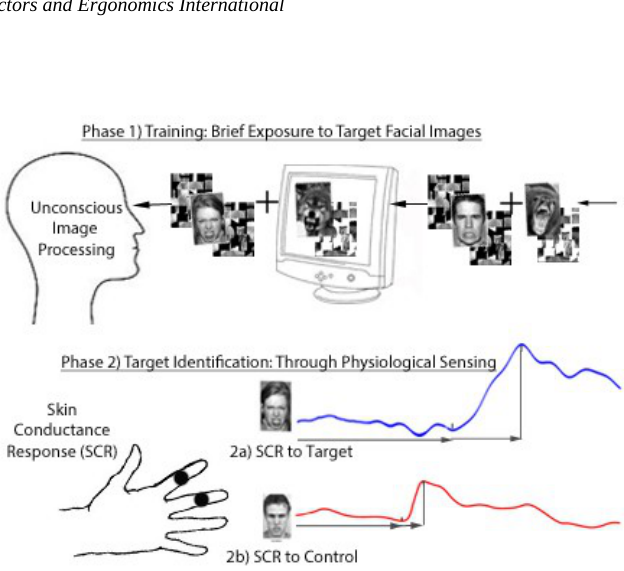
ELADIS APPROACH: IMPROVING RECOGNITION WITH COGNITIVE PRIMING The focal point of ELADIS is using a human operator to create a passive identification sensor. We integrate multiple subconscious phenomena to create a brief presentation training paradigm consisting of a two phases: learning & identification, see Figure 1. In the learning phase, an evaluative conditioning procedure is used to present images at a duration below conscious awareness. The priming used during this phase prepares the human for detection capability, so that he or she may later act as a “passive human recognition sensor”. After learning is complete, skin conductance is measured in the identification phase and peaks in the skin conductance data that are associated with the learned stimuli are identified. Both phases involve only the operator’s lower-cortical, unconscious, processing resulting in a cognitive primer that requires virtually no attentional resources. Thus, the operator’s normal duties and attentional resources remain unchanged while they concurrently receive additional visual information through brief exposures. This additional visual information can be used to improve performance on a subsequent detection task by exploiting a human autonomic response.
Figure 1. Depiction of the two phase ELADIS process of creating a human sensor through unconscious learning and identification.
Current Study Priming research is typically conducted using a fixation paradigm in which participants fixate on a point where the prime will appear. If priming is to successfully move to real application scenarios it is important to determine if priming effects can occur in less constrained situations. The purpose of the current experiment was to determine if the strength of the priming effect is altered when the priming occurs during primary task execution. Due to a programming error, task performance was not correctly recorded, so the effects of priming on task performance are reported from a follow up experiment. The follow up experiment was also used to confirm the main findings. The follow up experiment differed from the primary experiment due to the omission of the fixation condition and the additional screening of 160 more baggage images to accommodate the learning of 8 more faces (the number of exposures also varied between 10, 20 or 30 presentations of each face). Each experiment had two phases: a training phase during which faces were learned using brief exposure evaluative conditioning and an identification phase during which SCR was measured to faces while performing a likert scale task.
METHOD
Participants 26 Hamline University students voluntarily participated for monetary compensation. The sample consisted of 17 females and an average age of 20.9 years. We were unable to collect data from 3 volunteers due to the inability to detect skin conductivity. 34 students participated in the follow up experiment, 24 were females and the average age was 21.3. Four volunteers were turned away due to lack of conductivity.
Apparatus & Stimuli Baggage Stimuli: Macromedia Photoshop was used to fabricate 270 baggage stimuli. All bags were moderately (13- 17 items) to densely cluttered (18-25 items) with a variety of everyday objects (e.g., clothes, pens, combs, toothbrushes). Three types of dangerous items (guns, scissors or knives) were randomly inserted into the baggage. No more than one dangerous item was inserted into each bag. All dangerous items were imaged with their flat side perpendicular to the line of sight. A dangerous item was present in 32% of the bags, which were chosen randomly during the experiment. All bags were presented in a green monochrome, within a 387x329 pixel black rectangle. The black rectangle was centered on a gray background, see Figure 4.
Face Stimuli: Standardized facial stimuli (Palermo and Coltheart, 2004) were used as primes (facial stimuli originated from Mazurski and Bond, 1993 and Tottenham et al., 2002). 10 angry faces were randomly chosen from the set of 20 available such that half were male, see Figure 5 for an example.1 The faces were scaled such that the interpupillary distance was the same for each face and they were cropped to be of equivalent size. Visibility of clothing and jewelry was minimized and any remaining background was colored grey.
Unconditioned stimuli images (UCS): These stimuli consisted of pictures of an attacking animal oriented toward the participant. Previous studies have found that similar pictures result in a high SCR (Bradley, Codispoti, Cuthbert, & Lang, 2001). Images were refined based on results of our previous experiments and tests to determine which animals resulted in the largest mean skin conductance response across participants. Figure 2 shows the final results of this process and the images that typically resulted in the largest skin response by participants.
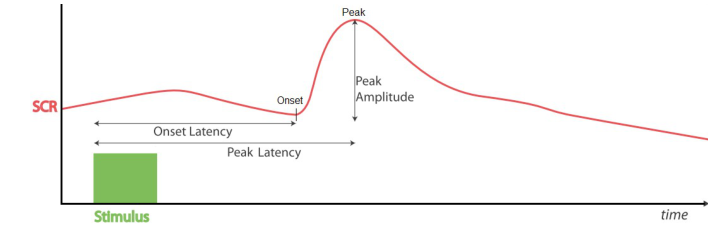
Skin conductance response (SCR): Two 8mm pre-wired Ag/AgCl electrodes with conductive gel were attached to the medial phalanx of the index and middle fingers of the non-dominant hand. A SC5 skin conductance amplifier was connected to Precision Instruments PSYCHLAB Stand Alone Monitor (SAM) with a parallel port signal-input cable. PSYCHLAB Physiology software recorded the inputs and was used to process the data, sampled at a rate of 100 samples per second. The data was processed to determine the onset latency, peak latency and peak amplitude of the SCR. See Figure 3 for a visual depiction of these SCR elements.
Figure 3. Elements of a skin conductance response (SCR)
1 The original Palermo and Cotheart facial set included additional faces from Pictures of Facial Affect (Ekman & Friesen, 1976) and facial images collected by Gur et al. (2002), we were only able to obtain permission for using the Mazurski and Bond (1993), and Tottenham et al., 2002 faces.
Design and Procedure The experiment was a mixed design with condition between groups and image type within groups. Participants were either in a fixation or screen condition, see Figure 4. In the fixation condition participants were asked to fixate on a plus sign in the center of a blank screen with the prime appearing in the sign’s location; no screening baggage were used. The screen condition had no fixation requirement and participants screened baggage for dangerous items while the primes were presented in the center of the screen. Image type had three levels: primed, not primed and threat. Primed and not primed images were of similar faces, but the primed facial images were shown during training and paired with threat images of attacking animals (e.g. a snarling dog); the not primed facial images were not used during training, and thus were only used during the Likert rating portion of the experiment.
Figure 4. Left: Priming during screening task. Right: Priming during fixation.
Figure available in the original PDF paper.
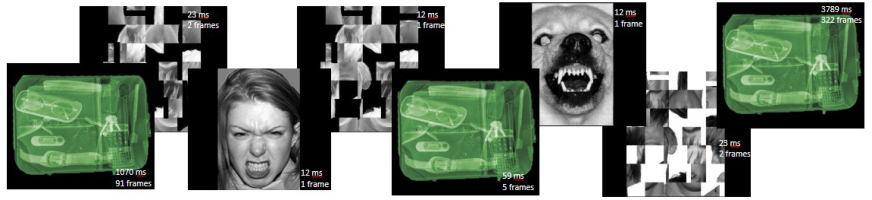
Millisecond Software was used to create the simulation environment. During screening, participants were instructed to look for images of dangerous objects, specifically guns, knives and scissors in images of x-rayed baggage. They had a maximum of 5 seconds to flag dangerous items by pressing the ‘x’ key on the keyboard. They were instructed that if the baggage contained no dangerous items, to not press any keys. The next bag appeared when the 5 seconds expired (indicating the participant thought the baggage was safe), or earlier when the ‘x’ key was pressed (indicating the participant thought the baggage was dangerous). During this time participants were primed with brief images of faces, presentation of the faces lasted approximately 12 msec. Primes were followed by threatening images, also presented below awareness, in order to create the conditioning effect. Those in the fixation condition were told they would be completing a reaction time task in which they must press the “x” key after they screen flashes and the plus sign is red, the flashes coincided with the image priming and the frequency of the red plus was equivalent to the percent of dangerous baggage. The timing of the fixation trials was the same as in the screening condition. Each face was presented 20 times, resulting in 200 pieces of baggage being scanned. The screening task took about 20 minutes to complete; 5 s for each piece of baggage and 1 second for changing baggage. A summary of the timeline for 1 screened bag is presented in Figure 5. With the 85Hz monitor, each frame lasts 11.76ms.
Figure 5. Timeline for one evaluative conditioning trial.
In the follow up experiment, participants completed the baggage screening task in seven blocks of 60 trials. During the first block, participants were not primed, but in all remaining blocks, priming occurred. The ratio of safe vs. dangerous items was 68/32 for the blocks with priming and 50/50 for the block without priming. While this design resulted in significantly more trials during which priming occurred, it was deemed necessary to reduce the duration of the experiment. We expected that this design would result in an increase in performance in the priming blocks due to practice effects; however, this was determined to be acceptable because we were only interested in detecting a decrease in performance due to priming, not an increase.
In a subsequent task, the primed images of faces, as well as new, unprimed images of faces, were presented for periods long enough to allow recognition and evaluation. Participants’ physiological response was recorded during this conscious presentation period to identify the hypothesized affective changes as well as their response to Likert scale ratings of how much they like the image on a 24 point scale. In the follow up experiment, participants were also shown non-threat animals and unprimed happy faces for additional comparison.
Results
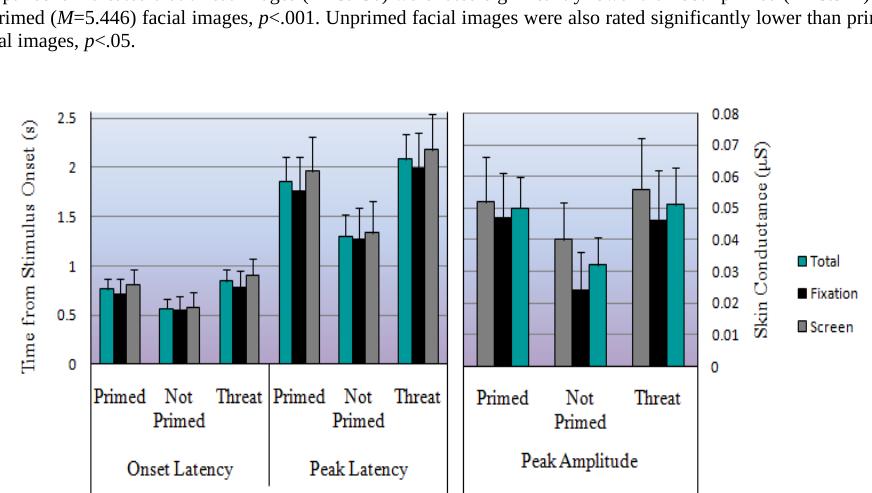
Main Experiment: To determine if our different conditions affect priming, we conducted three, 2 (condition) x 3 (image type) mixed ANOVAs with different skin conductance dependent variables, see Figure 6, and a mixed ANOVA with a Likert response dependent variable. There was a main effect of image type for SCR onset latency, F(2,48)=7.578, p<.01, partial η2=.240. Pairwise comparisons indicated that onset latency for unprimed images (M=.565) was significantly lower than both primed facial images (M=.762) and threat (M=.846), p<.01. There was a main effect of image type for SCR peak latency, F(2,48)=9.647, p<.01, partial η2=.287. Pairwise comparisons indicated that peak latency for unprimed images (M=1.299) was significantly lower than both primed facial images (M=1.861) and threat (M=2.081), p<.001. There was a main effect of image type for SCR peak amplitude, F(2,48)=4.495, p<.05, partial η2=.158. Pairwise comparisons indicated that peak amplitude for unprimed images (M=.032) was significantly lower than for both primed facial images (M=.050) and threat (M=.051), p<.01. There was also a main effect of image type for likert responses, F(2,48)=18.916, p<.001, partial η2=.441. Pairwise comparisons indicated that threat images (M=3.250) were rated significantly lower than both primed (M=5.927) and unprimed (M=5.446) facial images, p<.001. Unprimed facial images were also rated significantly lower than primed facial images, p<.05.
Figure 6. Differences in SCR response during likert image presentation in the main experiment. Differences between the fixation and screen conditions were not significant but are given for comparison purposes. The teal bars give the means collapsed across condition and depict the means used during analyses
Follow-up Experiment: Similar results were found in the follow up experiment. Note in this experiment the likert scale was completed before and after priming so the dependent variable used for the analyses is the difference between the pre and post prime SCR. There was a main effect of image type for SCR onset latency, F(4,132)=5.494, p<.001, partial η2=.143. Pairwise comparisons indicated that onset latency for primed facial images (M= .312) was significantly higher than unprimed angry facial images (M= -.231), unprimed happy facial images (M= -.292) and non-threat animals (M= -.125), p<.01. Additionally, onset latency for threat animals (M= .022) was significantly higher than unprimed happy faces. There was also a main effect of image type for peak latency, F(4,132)=2.825, p<.05, partial η2=.079. Pairwise comparisons indicated that peak latency for primed facial images (M= .352) was significantly higher than unprimed facial images (M= -.365), unprimed happy facial images (M= -.475), and non- threat animals (M= -.267), p<.05. Finally, there was a main effect of image type for peak amplitude, F(4,132)=3.338, p<.05, partial η2=.092. Pairwise comparisons indicated that peak amplitude for primed facial images (M= .043) was significantly higher than unprimed images (M= -.036), unprimed happy facial images (M= -.035), and non-threat animals (M= -.027), p<.01. There were no significant effects with Likert ratings, F(4,132)=1.43, p>.05, partial η2=.042.
Figure 7. Differences in SCR response during likert image presentation in the follow up experiment. The likert scale was presented at the beginning and end of the experiment so the dependent variable is post prime SCR minus pre prime SCR.
Figure available in the original PDF paper.
Overall, our results indicate that there was no difference between our screening and fixation conditions. However, SCRs to previously primed faces begin significantly later, will be significantly slower to peak, and produce significantly higher peaks than SCRs to non-primed faces.
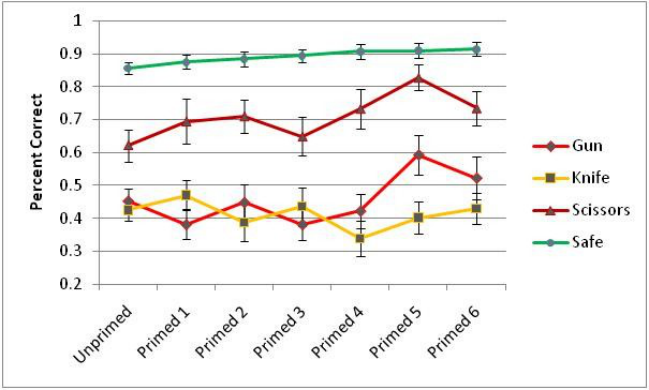
Follow-up Experiment Primary Task Performance: To determine if priming affects task performance, we conducted a 4(baggage type; safe, gun, knife, scissor) x 7(block; unprimed and 6 priming blocks) within subjects ANOVA for accuracy. A significant main effect of type was found, F(3,87)=55.161, p<.001, partial η2=.655, see Figure 8. Participants were more accurate at identifying safe baggage than baggage that contained guns, knives, and scissors, p<.001. Additionally, participants were more accurate at identifying baggage that contained scissors than guns or knives, p<.001. A significant main effect of block was also found, F(6,174)=3.511, p<.01, partial η2=.108, see Figure 8. Accuracy during the fifth priming block was greater than the unprimed block and the first, second, third and fourth priming blocks, p<.05. For our purposes, it is important to note that the accuracy between the unprimed block and the first primed block were similar, indicating that our priming methodology did not affect our participants’ ability to identify dangerous items in baggage. On the basis of this evidence, it would appear that the use of ELADIS techniques is unlikely to disrupt or diminish the performance of a primary task (such as baggage screening). It is also interesting to note that performance begins to decrease during the sixth priming block, indicative of fatigue effects.
Figure 8. Percent of baggage correctly identified as containing a weapon (gun, knife and scissors) or identified as safe
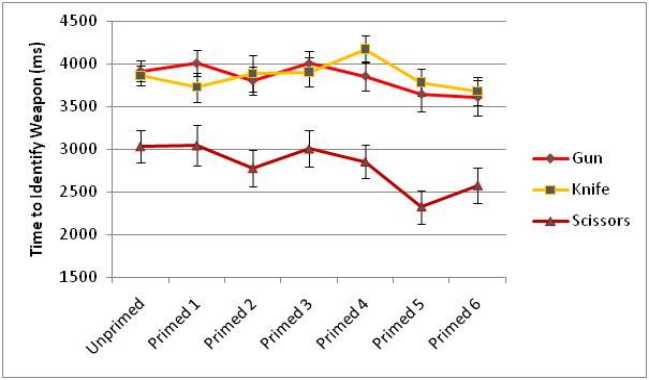
A 3(weapon type; gun, knife, scissor) x 7 (block) within subjects ANOVA for latency was also conducted. Safe baggage was not included in this analysis because participants indicated that a bag was safe by allowing the trial to timeout. Therefore, we do not know when the bag was initially determined to be safe. A significant main effect of weapon type was found, F(2,58)=33.613, p<.001, partial η2=.537, see Figure 9. Scissors were identified faster than guns and knives, p<.001. A main effect of block was also found, F(6,174)=3.618, p<.01, partial η2=.111, see Figure 9. Participants responded faster during the fifth priming block than the first four priming blocks and the unprimed block. Participants also responded faster during the sixth priming block than the first, third and fourth priming blocks, along with the unprimed block. The latency results indicate that there was a tendency for participants to get faster at identifying weapons as they obtained more practice, as would be expected. Together with the accuracy results, the latency results indicate that participants found the identification of guns and knives to be difficult.
Figure 9. Time taken, in milliseconds, to identify each type of weapon (gun, knife and scissors).
CONCLUSIONS
These results provide compelling evidence that our underlying associative priming methodology is effectively producing measurable SCRs upon later exposure to the images, and is encouraging evidence that our approach may work in a real-world setting. We found that our priming methodology could be successfully completed during the completion of an alternative task without affecting priming (at least for the situation tested here). In the follow up experiment, we found that our priming methodology did not affect our participants’ ability to identify dangerous items in baggage. Therefore, it would appear that a primary task does not affect our priming effect and the use of ELADIS techniques is unlikely to disrupt or diminish the performance of a primary task (such as baggage screening) on the basis of current evidence. As expected, we began to see fatigue effects in baggage screening towards the end of the priming blocks with performance beginning to decrease, however we also saw the tendency for participants to get faster at identifying weapons as they obtained more practice. Together with the accuracy results, the latency results indicate that participants found the identification of guns and knives to be more difficult than the identification of scissors.
A consistent finding between experiments was that people will subconsciously react to a previously conditioned facial image (presented and paired according to our paradigm) with later, slower and higher peaks in their SCRs compared to their reactions to non-conditioned faces—and that that difference in SCR peak can be detected with statistical reliability.
Relation to larger scientific community Our work extends classic research conducted by cognitive and social psychologists by applying unconscious phenomena to solve a known problem, and by further identifying characteristics that will aid in developing effective methodologies. While the importance of the unconscious is well documented, practical applications remain sparse. Additionally, there is limited research on priming during task execution, or specific & effective priming methodologies.
Our work could also lead to a new direction for facial recognition research by focusing on improving human capabilities and not improving automated recognition technologies. The current focus is on improving automated facial recognition technologies NOT improving human capabilities, even though human recognition capabilities are generally recognized to be superior to automated techniques, in most contexts and at least with existing technologies (Zhao, Chellappa, Phillips, & Rosenfeld, 2003; Sinha, Balas, Ostrovsky, & Russell, 2006). It would be pertinent to compare our methodology’s effectiveness against conscious human recognition abilities, as well as current automated facial recognition technologies. Few comparisons on accuracy of computer-based systems with conscious human abilities (O'Tool, Abdi, Jiang, & Phillips, 2007) have been performed; none (that we are aware of) compare with unconscious human abilities.
Next Steps We see various paths this research could follow, given the current characteristics of ELADIS methodology. Specifically, the learning phase requires screen monitoring time, but can be concurrent with other tasks with no/little performance decrement. The recognition targets are faces, but there is the potential for expanding to other image types (e.g., image analysis). Finally, the identification phase requires viewing individual faces (currently limited to facial images in prescribed orientation and size; currently shown still images). Future research should look at increasing the realism of the identification task. For example, participants could view video containing the targets in lieu of the still images.
First, we could improve the current methodology by including an additional physiological measure, such as EEG. There is seldom a one-to-one relationship between psychological constructs and physiological events. The concurrent use of multiple physiological measures allows for the identification of differential response patterns (Ravaja, 2004) allowing us to obtain a physiological ‘signature’ that combines several physiological measures resulting in higher specificity and sensitivity compared to use of a single measure (Cacioppo, Tassinary, & Berntson, 2000). As a first step, we have begun collecting pulse data as well as skin conductance in our later experiments. We failed to find significant effects using several different measures derived from pulse. However, it is possible that combining pulse and SCR measures to create a physiological signature would improve differentiation between primed and unprimed images, opposed to using pulse as a singular measure. The use of multiple measures will also allow us to better explore low hit frequency environments. Our current results are based on averages, so detecting single hits may be problematic.
Second, we expect that our results could be amplified by using a stronger unconditioned stimulus in lieu of the attacking animal images that we are currently using. This could take the form of more arousing images or even light electrical shocks, both of which have been shown to be equal or more potent unconditioned stimuli in other studies (Bradley, Codispoti, Cuthbert, & Lang, 2001; Lissek et al., 2004), but are more likely to be associated with ethical concerns than the current unconditioned stimuli.
Finally, we expect that we will be able to extend the methodology to include additional types of stimuli. As an example keeping with our current theme, instead of using faces during our priming procedures we could use images of weapons to help baggage screeners identify dangerous objects in luggage. This might enhance the ability to detect specific weapon types, though it might also increase false positives. The same could be done with other visual search tasks—such as seeking specific types of installations, vehicles, etc. in imagery analysis tasks.
REFERENCES
Bargh, J. A., & Chartrand, T. L. (1999). The unbearable automaticity of being. American psychologist, 54(7), 462. Bargh, J. A. (2005). “Bypassing the will: Toward demystifying the nonconscious control of social behavior”, in: The New Unconscious, Ran R. Hassin, James S. Uleman, & John A. Bargh (Eds.). pp. 37-58. Oxford: University Press. Bauer, R. M. (1984). Autonomic recognition of names and faces in prosopagnosia: A neuropsychological application of the
guilty knowledge test. Neuropsychologia, 22(4), 457-469. Bechara, A., Damasio, A. R., Damasio, H., & Anderson, S. W. (1994). Insensitivity to future consequences following damage to human prefrontal cortex. Cognition, 50(1), 7-15. Bechara, A., Damasio, H., Tranel, D., & Damasio, A. R. (1997). Deciding advantageously before knowing the advantageous
strategy. Science, 275(5304), 1293-1295. Bechara, A., Damasio, H., Tranel, D., & Damasio, A. R. (2005). The Iowa Gambling Task and the somatic marker hypothesis: some questions and answers. Trends in cognitive sciences, 9(4), 159-162. Bradley, M. M., Codispoti, M., Cuthbert, B. N., & Lang, P. J. (2001). Emotion and motivation I: defensive and appetitive
reactions in picture processing. Emotion, 1(3), 276. Cacioppo, J. T., Tassinary, L. G., & Berntson, G. (Eds.). (2007). Handbook of psychophysiology. Cambridge University Press. Dijksterhuis, A., Aarts, H., & Smith, P. K. (2005). “The power of the subliminal: On subliminal persuasion and other potential applications”, in: The New Unconscious, Ran R. Hassin, James S. Uleman, & John A. Bargh (Eds.). pp. 77-106. Oxford: University Press. Flykt, A., Esteves, F., & Öhman, A. (2007). Skin conductance responses to masked conditioned stimuli:
Phylogenetic/ontogenetic factors versus direction of threat?. Biological psychology, 74(3), 328-336. Fukui, H., Murai, T., Fukuyama, H., Hayashi, T., & Hanakawa, T. (2005). Functional activity related to risk anticipation during performance of the Iowa Gambling Task. Neuroimage, 24(1), 253-259. Hayes, N. A., & Broadbent, D. E. (1988). Two modes of learning for interactive tasks. Cognition, 28(3), 249-276. Kiefer, M., & Brendel, D. (2006). Attentional modulation of unconscious “automatic” processes: Evidence from event-related
potentials in a masked priming paradigm. Journal of Cognitive Neuroscience, 18(2), 184-198. Knight, D. C., Nguyen, H. T., & Bandettini, P. A. (2006). The role of awareness in delay and trace fear conditioning in humans.
Cognitive, Affective, & Behavioral Neuroscience, 6(2), 157-162. Krosnick, J. A., Betz, A. L., Jussim, L. J., Lynn, A. R., & Stephens, L. (1992). Subliminal conditioning of attitudes. Personality and Social Psychology Bulletin, 18(2), 152-162. Lachter, J., Forster, K. I., & Ruthruff, E. (2004). Forty-five years after Broadbent (1958): still no identification without attention.
Psychological review, 111(4), 880. Lissek, S., Powers, A. S., McClure, E. B., Phelps, E. A., Woldehawariat, G., Grillon, C., & Pine, D. S. (2005). Classical fear conditioning in the anxiety disorders: a meta-analysis. Behaviour research and therapy, 43(11), 1391-1424. Mazurski, E. J., & Bond, N. W. (1993). A new series of slides depicting facial expressions of affect: a comparison with the
pictures of facial affect series. Australian Journal of Psychology, 45(1), 41-47. Naccache, L., Blandin, E., & Dehaene, S. (2002). Unconscious masked priming depends on temporal attention. Psychological Science, 13(5), 416-424. Northoff, G., Grimm, S., Boeker, H., Schmidt, C., Bermpohl, F., Heinzel, A., ... & Boesiger, P. (2006). Affective judgment and
beneficial decision making: ventromedial prefrontal activity correlates with performance in the Iowa Gambling Task. Human brain mapping, 27(7), 572-587. Olson, M. A., & Fazio, R. H. (2006). Reducing automatically activated racial prejudice through implicit evaluative conditioning.
Personality and Social Psychology Bulletin, 32(4), 421-433. O’Toole, A.J., Abdi, H., Jiang, F. & Phillips, P.J. (2007). Fusing face recognition algorithms and humans. IEEE: Transactions on Systems, Man & Cybernetics, 37(5), 1149-1155. Palermo, R., & Coltheart, M. (2004). Photographs of facial expression: Accuracy, response times, and ratings of intensity.
Behavior Research Methods, Instruments, & Computers, 36(4), 634-638. Ravaja, N. (2004). Contributions of psychophysiology to media research: Review and recommendations. Media Psychology, 6(2), 193-235. Schneider, W., & Shiffrin, R. M. (1977). Controlled and automatic human information processing: I. Detection, search, and
attention. Psychological review, 84(1), 1. Seitz, A., Lefebvre, C., Watanabe, T., & Jolicoeur, P. (2005). Requirement for high-level processing in subliminal learning.
Current Biology, 15(18), R753-R755. Sinha, P., Balas, B., Ostrovsky, Y., & Russell, R. (2006). Face recognition by humans: Nineteen results all computer vision researchers should know about. Proceedings of the IEEE, 94(11), 1948-1962. Spruyt, A., Houwer, J. D., & Hermans, D. (2009). Modulation of automatic semantic priming by feature-specific attention allocation. Journal of Memory and Language, 61(1), 37-54. Tottenham, N., Borscheid, A., Ellertsen, K., Marcus, D. J. & Nelson, C. A. (2002). Categorization of facial expressions in children and adults: Establishing a larger stimulus set. Journal of Cognitive Neuroscience, 14 (Suppl.), S74. Tranel, D., & Damasio, A. R. (1988). Non-conscious face recognition in patients with face agnosia. Behavioural brain research,
30(3), 235-249. Walther, E., & Nagengast, B. (2006). Evaluative conditioning and the awareness issue: assessing contingency awareness with the four-picture recognition test. Journal of Experimental Psychology: Animal Behavior Processes, 32(4), 454. Zhao, W., Chellappa, R., Phillips, P. J., & Rosenfeld, A. (2003). Face recognition: A literature survey. Acm Computing Surveys
(CSUR), 35(4), 399-458.
LISTED IN THE AHFE DIGITAL BOOKSTORE CATALOGUE
Explore the complete digital volume
Advances in Cognitive Engineering and Neuroergonomics
Read this individual research paper free through the original publisher, or explore the full digital proceedings book.
ISBN 978-1-4951-2101-2
Explore this ISBN in the AHFE Bookstore ↗Listed in the July 2026 bookstore catalogue; search by ISBN to confirm current availability · Digital book purchase optional