J. Christopher Brill, Veronica E. Scerra (2019). Effectiveness of Vibrotactile and Spatial Audio Directional Cues for USAF Pararescue Jumpers (PJs). In: Advances in Cognitive Engineering and Neuroergonomics. AHFE Open Access, vol. 7. https://doi.org/10.54941/ahfe100212
The purpose of this study was to investigate the relative effectiveness of vibrotactile and 3-dimensional (3D) auditory cues. The vibrotactile display consisted of a belt of stimulators worn around the abdomen, and the 3D audio display consisted of synthesized binaural cues played through headphones. Seven participants were presented with two types of vibrotactile signals and four types of 3D audio signals in eight azimuthal directions: 0° (ventral midline), 45° left/right, 90° left/right, 135° left/right, and 180° (dorsal midline). Participants indicated the perceived direction by clicking on discrete virtual response buttons surrounding an isomorphic on-screen graphic. On average, localization accuracy was significantly better for vibrotactile signals (92%) than for 3D audio signals (65%) ( p= .004). One type of 3D audio signal, dubbed the alternate clicktrain, failed to yield a significant difference (p = .08), though this is likely due to the small sample size. The results suggest vibrotactile displays may provide a viable alternative to 3D audio for spatial cueing, which has implications for developing potential system for US Air Force Pararescue Jumpers (PJs).
The goal of this research was to compare the relative effectiveness of vibrotactile and 3-dimensional (3D) audio displays for USAF ground forces. The modern warfighter is faced with an incredible barrage of information, requiring multitasking in extreme environments. Information is typically presented visually, taking one’s eyes and attention away from scanning the environment for threats and other mission-relevant information, thereby contributing to change blindness (Simons & Levin, 1997) and reduced situation awareness (Ensley, 1996). Nighttime usage of visual displays may be further limited due to negative effects on dark adaptation and incompatibility with covert operations. An alternative is to present information aurally. However, auditory presentation poses its own limitations. Spatial auditory cues can result in front-back reversals, leading to faulty cue perception and errors. Additionally, the battlefield is replete with sources of auditory masking, as noise interferes with the reception of critical, potentially lifesaving information. Hearing protection can dampen mission-relevant communications. Even with hearing protection, consistent exposure to noise can result in temporary threshold shifts or permanent hearing damage. Unilateral hearing damage, specifically, would interfere with binaural cue perception, though monaural cues could remain unaffected. An alternative mode of communication is desirable, one unbound by the constraints of visual and auditory information: touch. Vibrotactile displays offer access to a relatively unused sensory channel, potentially alleviating workload and circumventing constraints inherent to vision and audition.
Specifically, vibrotactile displays may be well-suited to receiving critical alerts/alarms and navigation. However, it is necessary to directly compare baseline performance for vibrotactile and 3D audio displays. The present investigation compares localization accuracy for directional vibrotactile and 3D audio cues. The reason for comparing simple directional cues, as opposed to more complex information, is driven by their potential for conveying navigation and threat information to constituent communities, namely, United States Air Force (USAF) Pararescue Jumpers (PJs).
BACKGROUND
Tactile Displays and the Warfighter The use of tactile displays for enhancing warfighter performance has been explored since the 1960s. Applications have included assessing vigilance performance (Hawkes & Loeb, 1962), improving situation awareness (Brill, Gilson, Mouloua, Hancock, & Terrence, 2004; Brill, Terrence, Downs, Gilson, Mouloua, & Hancock, 2004; Rupert, 2000), facilitating battlefield communication (Brill & Gilson, 2006; Brill, Terrence, Stafford, & Gilson, 2006), improving spatial orientation (Rupert, 2000; Terrence, Brill, & Gilson, 2005), and aiding navigation (e.g., Van Erp, 2007). Interest in tactile displays for warfighters has resurfaced repeatedly, primarily due to their unique properties and capabilities. They are omni-present, usable at night, relatively quiet, do not require use of vision or hearing, and they effectively capture one’s attention (Brill et al., 2004). Despite over 60 years of work, technology has only recently reached a level of maturity necessary to create wearable wireless vibrotactile communication systems.
Potential Applications Navigation by touch is a natural application of these concepts. Research on tactile navigation has focused upon waypoint finding and distance coding (e.g., Rupert, 2000; Van Erp, Van Veen, Jansen, & Dobbins, 2005). Previous approaches have provided continuous feedback through vibrotactile pulses varying in spatiotemporal frequency based upon proximity to targets or waypoints. For some operational scenarios, continuous tactile signaling would provide critical information for fast egress from buildings or for finding wounded soldiers in unfamiliar environments or situations with reduced visibility. Beyond navigation, vibrotactile displays can also serve as communication media for alerts, alarms, and other mission-critical information, such as hand-arm signals (Brill & Gilson, 2006; Brill et al., 2006).
VIBROTACTILE AND 3D AUDIO LOCALIZATION Cholewiak, Brill, and Schwab (2004) conducted a comprehensive study to determine the spatial resolution of the torso for vibrotactile signals. They compared belt-worn arrays comprised of 12, 8, and 7 vibrotactile stimulators (heretofore referred to as “tactors”) covering different portions of the torso and with varying spacing between loci. Although there are many nuances to their findings, they generally found that cue localization performance was most accurate for an eight-tactor circular array. More specifically, participants achieved the greatest accuracy for stimuli near anatomical anchor points on the midline (i.e., near the navel and on the spine), but they were less accurate in localizing vibrotactile stimuli on the sides of the torso.
The minimum audible angle (MAA) of the horizontal plane is 1-10° azimuth (Senn, Kompis, Vischer, & Haeusler, 2005), although it varies greatly for sounds coming from the sides versus those located more medially (Mills, 1958). Perrott and Saberi (1990) found MAA thresholds could be smaller than 1°. The human auditory system is clearly very sensitive to spatial differences in the lateral plane. However, MAAs are typically based upon the difference threshold, which involves the forced-choice comparison of stimuli, rather than absolute localization. Absolute auditory localization is less accurate than MAAs might imply. To illustrate, Brungart, Durlach, and Rabinowitz (1999) found auditory angular errors of 13.3° to 20.0° azimuth (mean = 19.9°), depending upon distance, and localization accuracy for headphone-based 3D audio systems can differ from free-field listening. Wightman and
Kistler (1989) found that free-field and headphone-based azimuth localization was generally comparable, but the latter produced more fore-aft reversals. Indeed, subsequent research has reaffirmed the problem of reversals, especially if using non-individualized head-related transfer functions (HRTFs; Begault, 2000). Begault and Wenzel (1993) performed a study on 3D localization of speech sounds presented at 12 azimuth positions (30° separation, representing the clock face); the average error angle ranged from 17.6° to 47° (mean = 27.9), and the frequency of fore-aft reversals ranged from 0 to 60% (mean = 29.2%), depending upon the position. The regions of reduced localization accuracy are commonly represented as cones of confusion (Mills, 1972).
PRESENT INVESTIGATION Despite the spatial limitations of headphone-based 3D audio systems, they represent a compact, portable method of presenting spatial cues. However, vibrotactile displays also offer their own distinct advantages, and with the advent of battery-powered wireless systems, they too represent a viable display option. The present investigation sought to compare cue localization accuracy for several vibrotactile and binaural displays. The comparison included two types of vibrotactile signals and four types of auditory signals. Three of the four audio signals were developed by AFRL and have been used for numerous spatial audio experiments. A fourth alternative auditory signal was also included in the comparison because the aforementioned signals, though effective, resembled bursts of static and could be unpleasant for listeners after several minutes of exposure. This alternative signal was dubbed a "musitone," as it had a musical quality and detectable pitch.
The 3D audio and vibrotactile displays were configured to be equivalent, in that they were comprised of eight equidistant directional signals, each separated by 45° azimuth at 0° elevation. This 8-locus spatial configuration was adopted because it met the minimum perceptual requirements for potential applications we were considering, such as navigation, while also meeting our minimum criterion for accurate vibrotactile localization (based upon Cholewiak et al., 2004).
Based upon previous research (i.e., Cholewiak et al., 2004), we hypothesized vibrotactile localization accuracy would be greatest for the 0° and 180° positions, and less so for the sides of the torso (e.g., +/- 90° from center). However, we expected the pattern to reverse for the 3D audio conditions. It was hypothesized that, due to the common problem of fore-aft reversals in 3D audio, overall localization accuracy would be greater for vibrotactile cues.
METHOD
Participants A convenience sample of seven participants took part in the experiment. All seven participants were recruited from AFRL's human subjects panel, the laboratory's staffed pool of participants. All were trained observers who had participated in numerous auditory perception experiments. Participants were between the ages of 18 and 30, and all had normal bilateral hearing, a precondition of employment on the human subjects panel.
Apparatus Computer and Experiment Software. The experiment was presented on an Acer model AS 1410 laptop computer using SuperLab version 4.5. The software is capable of presenting stimuli (e.g., digital photos, audio files, videos, and serial outputs) and recording inputs from several types of devices. For this experiment, a USB optical mouse was used to record participant inputs.
Vibrotactile Display. The vibrotactile display consisted of an Engineering Acoustics, Inc., (Casselberry, FL) 8-tactor array with a wireless controller. The array is contained within an adjustable belt and is comprised of model C2 tactors. The C2 tactor is a disc-shaped linear actuator tuned to respond most optimally to a 250 Hz sinusoid, although it is capable of presenting a wider range of frequencies and multiple waveforms. The belt was worn around the abdomen approximately 1 inch above navel height. The tactors were positioned to be equidistant with the 0° tactor on the frontal midline and the 180° tactor aligned with the spine. The tactor aligned with the spine was raised with padded backing to compensate for the natural indentation at the spine; this facilitated an even degree of mechanical loading among all eight tactors. The tactor belt has an umbilical-style cable that attaches to a wireless control unit, which supplies battery power and houses the circuitry that drives the tactors. The vibrotactile display was controlled by SuperLab software via serial strings sent wirelessly through Bluetooth®.
3-Dimensional Audio Display. The 3D audio display consisted of a pair of Sennheiser HD-280 headphones connected to the sound card of a laptop. The 3D audio sound files were created using NASA SLAB version 5.8.1. A custom spherical head-related transfer function (HRTF) was used to exaggerate spatial cues to facilitate more accurate performance.
Spatial Cues Two types of vibrotactile signals were used in the experiment. The first signal type consisted of 250 Hz sinusoidal vibration, which is a common default stimulus of the C2 tactor. The second type consisted of simulated low- frequency vibration at 12 Hz. Even though 12 Hz is far outside the normal frequency response of the C2 tactor, convolving two sinusoids of different frequencies within its frequency response range can produce a resultant beat frequency. Stimulus intensity for the vibrotactile cues was set at 80% gain. Four types of audio signals were used in the experiment: a 150 Hz clicktrain, an alternative clicktrain, a pulsetrain, and a "musictone." The alternative clicktrain consisted of slightly different frequency content to help improve localization performance. The musictone consisted of a blend of sinusoids and square waves at 500, 1000, 1500, 2000, and 8000 Hz. The intensity of the audio signals was set based upon the results of pilot testing. Prior to the experiment, a sample of pilot participants (N = 5) equated the perceptual loudness of the 0° position audio signals to the 0° position vibrotactile signals using the method of adjustment.
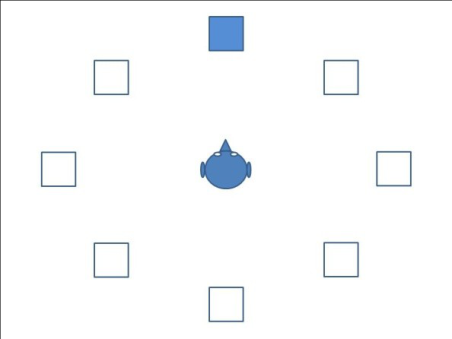
Procedures Participants were welcomed to the laboratory and given an overview of the study. Written informed consent was obtained. They were then seated at a desk in front of a laptop computer and asked to wear headphones. The experimenter read the task instructions while they were presented simultaneously on-screen. Participants were informed they would be presented with several spatial audio and vibrotactile cues. Exemplar stimuli positioned at 0° were presented to familiarize participants with the sensations. Participants were in presented an orientation and response graphic (see Figure 1) and instructed to click the box corresponding with the direction of the cue.
Figure 1. The response screen for the cue localization task. Participants clicked in one of the boxes representing the direction of the cue. For example, a cue that was heard or felt straight ahead was indicated by clicking the top box. In this figure, the box is shown in blue, indicating the box was clicked. However, no feedback was present during the experiment.
Participants were asked to remain seated and facing forward at all times. Cue duration was 500 ms. Each cue was presented, in random order, six times for each signal type and position. The auditory cues were presented together as a block, as were the vibrotactile cues. The order of blocks was counterbalanced. To prevent participants from getting into a rhythm of rote responding, a randomly selected inter-trial interval (2.5, 3.5, or 4 s) was used. Total session duration was approximately 30 minutes.
RESULTS
One participant did not complete all blocks due to an equipment malfunction. Data were not screened specifically for fore-aft reversals, and they were NOT filtered out, as is commonly done for auditory localization data. The reasoning behind this is the data presented here represents accuracy using discrete responses rather than continuously variable responses, such as absolute angle. In the case of the latter, failing to remove fore-aft reversals would skew means, making them meaningless. Further, for the present study, removing fore-aft reversals would actually produce meaningless data by downplaying the most consequential form of localization error. As a result, all error types were retained in calculations.
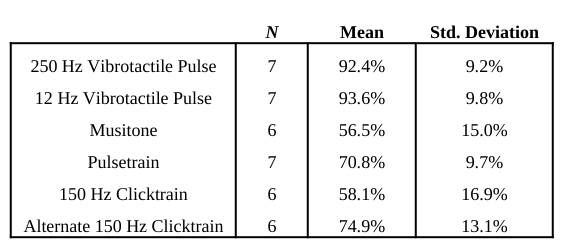
Descriptive statistics were calculated for each signal type and position. On average, localization accuracy was much better for vibrotactile signals (92%) than for binaural signals (65%), regardless of type (see Table 1).
Table 1: Localization Accuracy by Signal Type N Mean Std. Deviation
Localization accuracy by signal type and position is represented using spider plots (see Figures 2-7). For ease of interpretation, cue directions are coded as follows: 0° = navel/ventral, 180° = spinal/dorsal, L = left side, and R = right side.
Due to the small sample size used for this study, parametric statistics could not be used for analyses. Friedman's non-parametric Analysis of Variance (ANOVA) by Ranks (alpha = .05) was used to test the hypothesis that overall accuracy would be greater for vibrotactile cues than for 3D audio cues. Accuracy for both vibrotactile cue types was significant better than all audio signal types (p = .004), except for the alternative clicktrain (p = .08).
CONCLUSIONS
The data clearly show localization accuracy for vibrotactile cues was superior to 3D audio, at least in this context. The only audio cue type that approximated the accuracy of vibrotaction was the alternate clicktrain. In this experiment, a significant difference between the alternate clicktrain and the vibrotactile signals was not observed. However, this result must be taken tenuously due to the small sample size. The difference in mean localization accuracy between the alternate clicktrain and vibrotactile signals was 10-20%, depending upon the position. With a larger sample size, it is likely a significant difference would be found.
As expected, localization accuracy for vibrotactile displays was best for the ventral and dorsal locations on the midline. Performance was poorest for the sides, corresponding to the 3 and 9 o'clock positions (90° left and right). These data are highly consistent with those of Cholewiak et al. (2004). Cue localization accuracy was generally poorer for 3D audio than vibrotaction, with the musitone and original 150-Hz clicktrain being the worst (mean accuracy of 56.5% and 58.1%, respectively). The musitone produced a particularly interesting pattern; the relative high accuracy of the 0° position (92%) suggests few fore-aft reversals occurred. The greatest error rates occurred for loci located behind the head. More detailed analyses are required to determine how to improve the localizability of the musitone.
As previously mentioned, USAF dismounted warfighters need to be constantly aware of their environment, team members, information displays, and potential threats to efficiently carry out the mission while maintaining their safety. The investigation of non-visual cues is important in order to quickly and accurately depict critical information to the dismounted warfighter without contributing additional workload or undue distractions. The results from this study contribute to the investigation and development of multi-sensory cues to efficiently convey directional information. In addition to the main finding that vibrotactile cues demonstrated effective localization, differences in auditory tones by azimuthal location was also observed, thus, suggesting that different auditory cues based on the intended directional information may improve auditory localization. Based on the desired effects of the cue, a multi-sensory display which takes advantage of the efficiencies of each modality may lead to the most beneficial display. Future efforts will explore this issue.
ACKNOWLEDGEMENTS
This research was funded by the American Society for Engineering Education (ASEE) through the Summer Faculty Fellowship Program. Dr. J. Christopher Brill was the Principal Investigator. The views and opinions of authors expressed herein do not necessarily state or reflect those of the United States Government or any agency thereof.
REFERENCES
Begault, D. R. (2000). 3-D sound for virtual reality and multimedia. NTIS. Begault, D. R., & Wenzel, E. M. (1993). Headphone localization of speech. Human Factors: The Journal of the Human Factors and Ergonomics Society, 35, 361-376. Brill, J. C., & Gilson, R. D. (2006). Tactile technology for covert communications. Proceedings of the Human Factors and
Ergonomics Society Annual Meeting, 50, 1692-1696.
Brill, J. C., Gilson, R. D., Mouloua, M., Hancock, P. A., & Terrence, P. I. (2004). Increasing situation awareness of dismounted soldiers via directional cueing. In D. A. Vincenzi, M. Mouloua, & P. A. Hancock (Eds.), Human Performance, Situation Awareness, and Automation: Current Research and Trends (Vol. 1, p. 130-132). Mahwah, NJ: Lawrence Erlbaum Publishers, Inc. Brill, J. C., Terrence, P. I., Downs, J. L, Gilson, R. D., Hancock, P. A., & Mouloua, M. (2004). Search space reduction via multi-
sensory directional cueing. Proceedings of the Human Factors and Ergonomics Society Annual Meeting, 48, 2134-2136. Brill, J. C., Terrence, P. I., Stafford, S., & Gilson, R. D. (2006). A wireless tactile communication system for conveying U.S.
Army arm-hand signals. Proceedings of the Human Factors and Ergonomics Society Annual Meeting, 50, 2247-2249. Brungart, D. S., Durlach, N. I., & Rabinowitz, W. M. (1999). Auditory localization of nearby sources. II. Localization of a broadband source. The Journal of the Acoustical Society of America, 106, 1956-1968. Cholewiak, R. C., Brill, J. C., & Schwab, A. (2004). Vibrotactile localization on the abdomen: Effects of place and space.
Perception & Psychophysics, 66, 970-987. Endsley, M. R. (1996). Automation and situation awareness. In R. Parasuraman & M. Mouloua (Eds.), Automation and human performance: Theory and applications (pp. 163-181). Mahwah, NJ: Erlbaum. Hawkes, G. R., & Loeb, M. (1962). Vigilance for cutaneous and auditory stimuli as a function of intersignal interval and signal
strength. The Journal of Psychology: Interdisciplinary and Applied, 53, 211-218. Mills, A. W. (1972). "Auditory Localization," Foundation of Modern Auditory Theory (Academic, New York) Vol. II, Chap. 8. Mills, A. W. (1958). On the minimum audible angle. The Journal of the Acoustical Society of America, 30, 237-246. Perrott, D. R., & Saberi, K. (1990). Minimum audible angle thresholds for sources varying in both elevation and azimuth. The Journal of the Acoustical Society of America, 87, 1728-1731. Rupert, A. H. (2000). Tactile situation awareness system: Proprioceptive prostheses for sensory deficiencies. Aviation, Space,
and Environmental Medicine, 71(9 suppl), A92-A99. Senn, P., Kompis, M., Vischer, M., & Haeusler, R. (2005). Minimum audible angle, just noticeable interaural differences and speech intelligibility with bilateral cochlear implants using clinical speech processors. Audiology and Neurotology, 10, 342-352. Simons, D. J., & Levin, D. T. (1997). Change blindness. Trends in Cognitive Sciences, 1, 261-267. Terrence, P. I., Brill, J. C., & Gilson, R. D. (2005). Body orientation and the perception of spatial auditory and tactile cues.
Proceedings of the Human Factors and Ergonomics Society Annual Meeting, 49, 1663-1667. van Erp, J. B. F. (2007). Tactile Displays for Navigation and Orientation: Perception and Behavior. PhD thesis, Leiden, The Netherlands. van Erp, J. B. F., van Veen, H. A. H. C., Jansen, C., & Dobbins, T. (2005). Waypoint navigation with a vibrotactile waist belt.
ACM Transactions on Applied Perception, 2, 106-117. Wightman, F. L., & Kistler, D. J. (1989). Headphone simulation of free-field listening. II: Psychophysical validation. The Journal of the Acoustical Society of America, 85, 868-878.
LISTED IN THE AHFE DIGITAL BOOKSTORE CATALOGUE
Explore the complete digital volume
Advances in Cognitive Engineering and Neuroergonomics
Read this individual research paper free through the original publisher, or explore the full digital proceedings book.
ISBN 978-1-4951-2101-2
Explore this ISBN in the AHFE Bookstore ↗Listed in the July 2026 bookstore catalogue; search by ISBN to confirm current availability · Digital book purchase optional