Ryang-Hee Kim (2018). The Treatment Performances of Smart Healthcare Clothing System Based on u-Computing Using Transcutaneous Electrical Nerve Stimulator for the Hypertensive. In: Advances in Physical Ergonomics and Human Factors: Part I. AHFE Open Access, vol. 1. https://doi.org/10.54941/10016
Publisher statistics will load when you open Metrics.
AHFE OPEN ACCESS OPEN ACCESS CONFERENCE PROCEEDINGS PAPER
The Treatment Performances of Smart Healthcare Clothing System Based on u-Computing Using Transcutaneous Electrical Nerve Stimulator for the Hypertensive
Recently, the healthy industry is interested in more innovative portable devices for healthcare with ubiquitous computing environment. There are integrated medicine, advanced high-tech smart devices, electronics technology, and other research areas. For these issues, we aimed to develop the ubiquitous computing Smart Healthcare Clothing System (SHCS) using Transcutaneous Electrical Nerve Stimulator (TENS) for the hypertensive. Wearable smart technologies will give the wearable functional industry a high-tech value of making healthy and anywhere-anytime comfortable life. Hypertension is a typical chronic disease stressful life. TENS is especially the effective rehabilitation and preventive treatment healthcare device for the hypertensive. We designed SHCS with TENS which was embedded in glove with four textile-based electrodes, and instructed by oriental medical ergonomics. This research was conducted the healthcare performance and wear comfort of SHCS by clinical experiment. The results of effect analysis of care performances were as follows: 1) the mean of subject’s blood pressure was decreased to the lower ranges after wearing the SHCS with tens in the systolic pressure (p1<.001, as the paired t-test using statistical analysis method SAS 9.1). We could suggest SHCS with TENS that is easy-to-use, and effective rehabilitation and preventive treatment healthcare device for the hypertensive.
New smart clothing technologies have advanced in healthcare smart wear systems to measure bio-physiological signals and environment conditions of the wearer, and are now maturing, as others continually emerge. Smart clothing represents the future of both the textile/clothing industry and electronic industry and has an effort to make electronic devices a genuine part of our daily life. Many high-tech companies have been conducted their own researcher, and carried out collaborative work academic institutes.
Significantly, it can be deduced that the leading companies perceive smart clothing as the next generation of electronic devices, and the smart clothing is the next emerging market. Textile and Fashion Korea (2008) predicted that smart wear market would be expanded to the areas of military, medical care, business and leisure industry. The world market size is expected to grow from $70.9 billion in the year of 2006 to $ 391.7 billion by the year 2012.
Physical Ergonomics I (2018)
Smart clothing is designed to sense user requirements and environment contexts, and provide appropriate service at the right time and place accordingly with minimum effort required from the users and operator (Marzano, S., 2000). The application of textile based sensors and electrodes for “smart wear” systems has resulted in more accurate measuring and analyzing of biological signals of wearer. Some notable applications of such systems include the Wearable Cardioverter Defibrillator by LifeCor Inc., which has a chest harness and hip pack that provides immediate emergency medical aid to people prone to cardiac arrest. An audio warning is given before electricity is discharged, and then the nearest hospital is notified. Another example is a form of undergarment called the wearable motherboard by Georgia Tech, which has sensors that can be used to monitor vital signs, such as the heart beat, respiration rate or temperature, of patients recovering from specific illness, or to monitor patients at home rather in a hospital (Xiaoming Tao, 2003, Lanagehove, L. V. 2007).
Hypertension is typical chronic disease which frequently occurs under stressful conditions. For the treatment of hypertension, preventative lifestyle changes such as a regularly physical exercise, and weight loss for significant reduction of blood pressure, and antihypertensive drugs are currently available. However, medications could cause medical poisoning and side effects over time, leading to additional complications, and also side effects of these medications are not negligible.
There is a need for research on medical clothing which is centered on the concepts of more personalized healthcare and greater empowerment of the patients that will enable them to manage their health conditions anytime and anywhere. Therefore, this research is to design the portable Smart Healthcare Clothing System (SHCS) with Transcutaneous Electrical Nerve Stimulation (TENS), which may be able to cure for the hypertensive patients in daily life, and to estimate the effectiveness of the Smart Healthcare Clothing System with a cure performance.
CONCEPT OF SMART CLOTHING SYSTEM FOR HEALTHCARE Smart Clothing System
‘Smart textiles’ have been defined as 'textiles with integrated electro-active, and micro-systems which could be in clothes, and defined smart technical and interactive textiles. They respond or interact to environmental stimuli, which can be delivered in mechanical, thermal, chemical magnetic, or other form, and suggested three levels of integration but without specific names: solutions adapted to clothes, e.g., mobile phone in a pocket, electronics and micro systems integrated into clothes or textiles with comfortable modules, e.g., with textile conductors, and functions integrated into the textile via direct insertion into textile fibers, e.g., woven displays.
This may include changes in properties such as physical shape and length-as in textiles made from shape memory polymers or changes in color or surface as in textiles incorporating phase change materials such as the integration of optical or conductive textiles into textiles structures to create new textile sensors with smart textiles technologies (El-Sherif, M., 2003).
Requirements The main functions may be expected of 'intelligent textiles' and 'smart clothes'. Whatever the nuances interpreted, the fundamental property expected of smart textiles is a measurable, reliable and useful responsiveness to environmental conditions and stimuli, such as heat, light and moisture. Another functions that may be expected of 'intelligent textiles' and 'smart clothes' in information, and actuator technologies, switches, transponders and touch pads, sensors for pressure and temperature.
Other functions that may be expected of 'intelligent textiles' and 'smart clothes' in information, and actuator technologies, switches, transponders and touch pads, sensors for pressure and temperature, and global positioning system (GPS) modules communicating with a server system. Some or all of these elements will be formed of textiles Physical Ergonomics I (2018) elements themselves (Figure1.). 'Smart' is a recently adopted term in the context of materials and textiles, which can also cover earlier technologies in its wider definition (Hooper, S., et al. 2003).
Figure 1. Systemization of wearable systems. (R.-H., Kim, 2011) Applications of High-Tech Healthcare Device with Smart Materials
Figure available in the original PDF paper.
The initial forays into wearable computing applications for outdoor and sports clothing, such as Levi's and Philips' ICD + jacket (2000), Burton's snowboarding jacket (2001) and France Telecom's create wear (2004) were relatively short-lived due to their niche appeal, rather cumbersome nature and expense, although new designs have recently been released. Imperatives provided by medical needs have given stimulus to the resolution of these problems in new ways. The potential benefits of smart textiles in medical use can be summarized as follows: integration of functionality into textile interface, flexible materials which conform to the body, enable patient mobility whilst undergoing monitoring, continuous monitoring of vital signs for post-operative chronically ill babies and elderly patients, reduction of invasive procedures, inclusive design solutions for all users, low power needs linked to communication network, cost-effective solutions appropriate for disposable usage, facilitate healthcare, enable integration of feedback and therapies into monitoring Effective development of smart textile solutions to medical problems and procedures can be achieved only through a combination of several areas of expertise and research: several research groups now have combined medical knowledge and requirements with those of material scientists, textile developers and clothing designers and manufacturers. With the advent of ubiquitous (or pervasive) computing, sensors, antennae, miniature processor chips, radio frequency identification (RFID) tags and readers embedded in the domestic or hospital environment will be able to interact with sensors on the body or clothing, the 'smart home' for the elderly then becomes a reality- enabling a greater degree of independence and dignity whilst still being cared for. The union of the electronics industry with textiles has bred the new field of electronic textiles or e-textiles to provide the next generation of wearable computing. This research process starts from user requirements and needs, and takes a human centered product development approach focused on design solutions.
Physical Ergonomics I (2018)
Figure 2. Applications of smart wearable systems. (R.-H., Kim, 2011)
Figure available in the original PDF paper.
A number of technology platforms have now been established, based on different underlying technologies, by pioneering companies such as Softswitch and Eleksen, which integrate electronic functionality into textiles and clothing. Yet, primarily research for sportswear, portable entertainment and lifestyle products, and power supply for all electronic solutions still remains a fundamental problem when attempting to impart electronic functionality into clothing whilst simultaneously remaining completely portable.
Especially in medicine (physiotherapy, some areas of surgery), for the issues of protection against ELF and EMF through shielding have not yet found appropriate application, among other reasons due to high costs and lack of information regarding such possibilities. Furthermore, the complexity and variety of fields existing in the environment of high-frequency devices, interactions between the EMF source and the screen and the complex character of phenomena occurring within the structures themselves mean that this is a very difficult task requiring vast knowledge and experience.
DEVELOPING SMART HEALTHCARE CLOTHING Smart fabrics promise to revolutionize clothing by incorporating sensors into cloth for health, lifestyle and business applications. In the long term, they could consist of circuits and sensors that provide all of the typical electronics we carry around today, like mobile phones and PDAs.
Currently, first-generation applications are far more modest, and pioneering medical smart fabrics are used to monitor vital signs like heart rate and temperature. Now one research team has developed groundbreaking medical- sensing smart fabrics, and its work could lead to pregnancy monitoring belts, sports clothing that provides training tips, a wearable physical game controller, a vest that helps to prevent repetitive strain injury, and comfortable and unobtrusive biochemical measurement equipment could play a significant role in preventative and recovery medicine, among other areas.
Smart clothing is designed to sense user requirements and environment contexts, and provide appropriate service at the right time and place accordingly with minimum effort required from the users and operator (Marzano, S., 2000). The application of textile based sensors and electrodes for “smart wear” systems has resulted in more accurate measuring and analyzing of biological signals of wearer (Lee, J. R., 2008, Jang, S. E., Cho, J. Y., Jeong, G. S. and Cho, G., 2007, Jeong, G. S. and Cho, G., 2004, Park, H. J., 2006).
Some notable applications of such systems include the Wearable Cardioverter Defibrillator by LifeCor Inc., which has a chest harness and hip pack that provides immediate emergency medical aid to people prone to cardiac arrest. An audio warning is given before electricity is discharged, and then the nearest hospital is notified. Another example is a form of undergarment called the wearable motherboard by Georgia Tech, which has sensors that can be used to
Physical Ergonomics I (2018) monitor vital signs, such as the heart beat, respiration rate or temperature, of patients recovering from specific illness, or to monitor patients at home rather in a hospital (Xiaoming Tao, 2003, Lanagehove, L. V. 2007).
Effective development of smart several textile research which combine medical knowledge and requirements with those of material scientists, textile developers and clothing designers and manufacturers. As the first of its kind, the BIOTEX project is developing optimal electric, electrochemical and optical sensors which will be embedded into a textile substrate to create 'sensing patches' able to monitor the biochemical parameters of a user. The aim of these 'sensing patches' will be to continuously monitor the bodily fluids (blood, sweat and urine) of the wearer throughout the day. In this way, the project aims to be of particular use for people working in extreme conditions as well as people suffering from diabetes or sportspeople.
the wearable Wealthy(2004), Milior-Smartex® Project Fusion Sensatex (GTWMTM)
Figure 3. Smart wearable healthcare devices. (R.-H., Kim, 2011)
Figure available in the original PDF paper.
HYPERTENSION AND ACUPUNCTURE USING TENS Hypertension
Hypertension is a typical chronic aging disease which frequently occurs under stressful circumstances. Since 1995, the rate of hypertension in the United States has been increasing and reached 29% in 2004. The United Nations report said that Korea is categorized an “Aged society” by the year 2022. Most of all, with growth of ageing population, the most important thing is to improve a quality of life and health of the elderly, and psychological well- being is related to physical health. (Kim, W. K., 2001).
Hypertension is defined as a condition of elevated blood pressure, with at least 130mmHg systolic blood pressure and 90mmHg diastolic blood pressure (Ha, K. S., 1998, Shin, M.S., Han, C. H., Kim, B. Y., Kim, K. J., Park, S. H. and Choi, S. M.., 2008). Blood pressure is usually classified based on the systolic and diastolic blood pressures. Systolic blood pressure is the blood pressure in vessels during a heartbeat. Diastolic blood pressure is the pressure between heartbeats.
Acupuncture and Electro-Stimulation using TENS Recently, acupuncture treatment or electro-stimuli is already well known to be effective in disease treatment and prevention. A research was to investigate the effect of sensory stimulation on different points on arterial blood pressures and heart rates hypertension being well established. In that study, six healthy men had participated, exercise on a running machine of 10km/hr for 10min, and then blood pressures and heart rates measured before and Physical Ergonomics I (2018) after acupuncture, plan acupuncture, electro-acupuncture (50Hz). The results were found to be trends of reduction in blood pressure and heart rates, and there were statistically significant decreases heart rates. However, stimulation with traditional acupuncture needles can often cause pain or injury to the patient and in some cases may also cause them to feel uncomfortable with what they view as invasive treatment.
TENS by definition covers the complete range of transcutaneously applied currents used for nerve excitation although the term is often used with a more restrictive intent, namely to describe the kind of pulses produced by portable stimulators used to treat pain. Transcutaneous electrical nerve stimulation (TENS) is the use of electric current produced by a device to stimulate the nerves for therapeutic purposes.
A recent research, with the E-textile based Smart Healthcare Clothing System (SMGS) with Transcutaneous Electrical Nerve Stimulator (TENS) as a healthcare device for the elderly hypertensive, showed to be trends of reduction in blood pressure for hypertensive treatment (R. H. Kim, S. M. Cho, and G. Cho, 2010, R. H. Kim and G. Cho, 2011, Kim, R. and Cho, G., July, 2012).
In this study, the optimal type of SHCSas an effective high-tech healthcare device for the hypertensive patients were found, and then continually increasing expectations and needs for enhanced healthcare for the hypertensive. The last purposes of this research were to develop the E-textile based Smart Healthcare Clothing System (SMGS) with Transcutaneous Electrical Nerve Stimulator (TENS) as a healthcare/medical device for the hypertensive, and then will suggest being able to treat the effective device for hypertensive.
METHODOLGY
Design of Smart Healthcare Clothing System (SMGS)
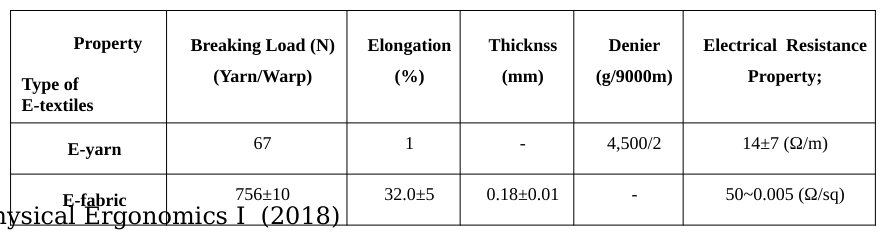
Specimens (E-textiles) for SMGS The types of electro-conductive yarn and electroless plated fabric were chosen as test specimen. The conductive properties (Linear Resistance (Ω/m), Sheet Resistance (Ω/sq)) were measured by DMM4050® digital multi-meter (Hitachi). They have excellent flexible and durable functionalities, commercially available specimens. The general characteristics of the test specimen were shown in Table 1.
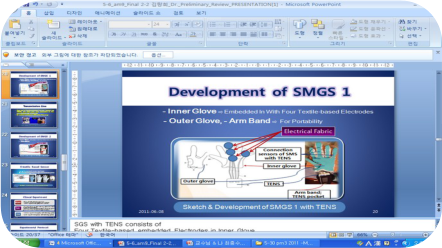
Design of Smart Healthcare Clothing System (SMGS) with TENS SHCS was designed the outer glove protects the inner glove with a sensor and transmission line. An arm band was selected to enable the use of TENS as a portable SHCS which was separated glove and TENS. The conductive sewing thread for embedding electrodes is stainless steel filament E-yarn.
Table 1: Characteristics of specimens (E-textiles)
We used the textile-based sensor which was made with stainless steel yarn and fabric to convey the electrical stimulation, electrical resistivity of stainless steel yarn and fabric specimens was measured according to 2000 20K 20M 2000M, for Linear Resistance (Ω/m) of conductive thread and sheet Resistance (Ω/sq) of conductive fabric using multi-o-meter is an electronic measuring instrument by using DMM4050® digital multi-meter (Hitachi). Transcutaneous Electrical Nerve Stimulator (TENS) were adapted two types of TENS. TENS for SHCSis the low frequency stimulator MB-430 (Hubidic Co. LTD., Korea) as the TENS model, with a stimulating frequency range of 1~1200Hz. The user can control the device manually by using set programs.
Framework for Treatment Performance Test Subject
In this study, the subjects were 32 male hypertensive patients who had at least 130mmHg systolic and 90mmHg diastolic blood pressure. They had been suffering from high blood pressure during the past three years, and had all received hospital treatment for hypertension. The participants were enrolled in a clinical study conducted by the previous studies. The range of age is from 30 to 70’s years old. 32 male subjects who were suffering from high blood pressure 130mmHg as systolic and 90mmHg as diastolic participated in this study. They were divided into two groups in accordance with their hypertension history and Age (Shin, 2007), (Van, 2007), (Kim, R. H. and Cho, G. 2011). They were divided into two group: Acute group (male ; N: 16), Chronic group (male ; N: 16).
Figure 4. Sketch and Development of SHCSwith TENS
Experimental Procedure The subjects were rested for 15 min and then were measured their physiological signals of blood pressure and pulse rate before wearing the SMGS. Then they were stimulated on the meridian points of hypertension on their left hand by the SHCSwith TENS during 15 min. Then, we measured the blood pressure and pulse rate after wearing SMGS.
Statistical Analysis The evaluation and analysis of the results of before-after their physiological signals of blood pressure and pulse rate were statistically assessed by using the paired t-test with SAS 9.1.
Physical Ergonomics I (2018)
RESULTS AND DISCUSSION
The Results of Treatment Perpormances of Smart Healthcare Clothing System (SHCS) The results of the treatments performance test of the smart healthcare clothing system (SHCS) with Transcutaneous Electrical Nerve Stimulator (TENS) are presented below. A system that performs palm stimulation as a mean of lowering blood pressure and pulse rate was presented, with the results in terms of effect presented in Table 2 and Figures .
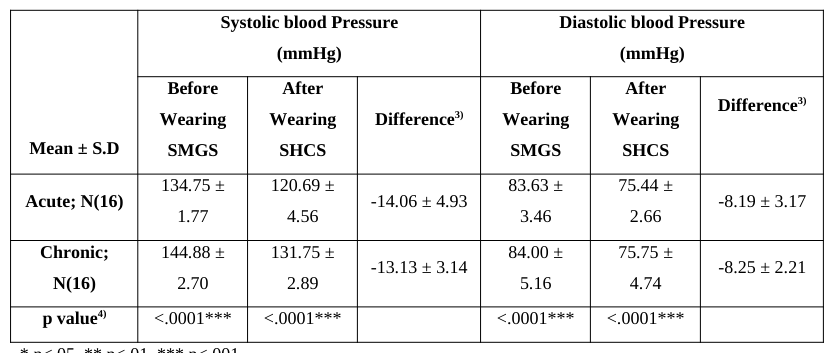
Blood pressure “Diastolic-Before” represents diastolic blood pressure before wearing the system, “Diastolic-After” represents diastolic blood pressure after wearing, “Systolic-Before” represents systolic blood pressure before wearing and “Systolic-After” represents systolic blood pressure after wearing. Changes of blood pressure and pulse rate within Chronic hypertension group before and after wearing SHCS(N=16) are shown in Table 3 and Figure 5.
Before wearing the SMGS, the mean of chronic subject’s blood pressure were 144.88 ± 2.70 mmHg for systolic blood pressure and 84.00 ± 5.16 mmHg for diastolic blood pressure. After wearing the SHCSwith TENS for 15 minutes, the mean blood pressure decreased to 131.75 ± 2.89 mmHg and 75.75 ± 4.74 mmHg.
The results show a significant difference in the systolic blood pressure (p-value; 0.0007***, p<.0001) and the diastolic blood pressure (p-value; .0001***, p<.001) after treatment (Table 3).
Table 2: Changes of blood pressure within 16 Acute and 16 Chronic hypertension groups before and after wearing SHCS by Wilcoxon rank sum test
* p<.05, ** p<.01, *** p<.001 1) p-value for independent two-sample t-test 2) p-value for paired t-test 3) Difference: Before wearing SHCS-After wearing SHCS 4) p-value for Wilcoxon rank sum test
Physical Ergonomics I (2018)
.
(A) (B) Figure 5. Changes of blood pressure within Acute (A) and Chronic (B) hypertension group (N=16) before and after wearing SHCS
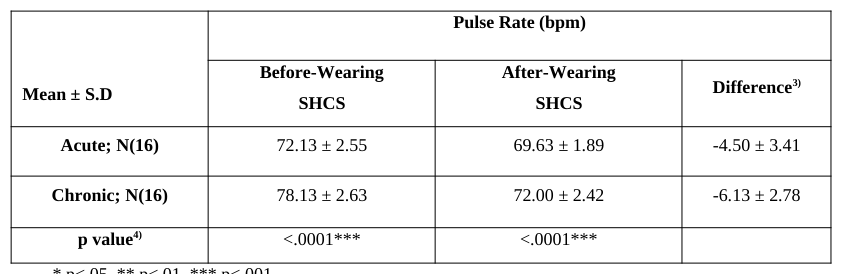
Pulse rate Changes of pulse rate within Acute hypertension group before and after wearing SHCS (N=16 are shown in
Table 3 and Figure 6. The mean pulse rates were 72.13 ± 2.55 bpm before wearing the SHCS and 69.63 ± 1.89 bpm after wearing the SHCS. Significantly, the pulse rate (p-value; 0.00052***, p<.0001) decreased to the normal range (Table 3, Figure 6).
In the same way, the changes of pulse rate within Chronic hypertension group before and after wearing SHCS (N=16) are shown in Table 3, Figure 6. The mean pulse rate dropped significantly from 78.13 ± 2.63 bpm to 72.00 ± 2.42 bpm (p-value; < 0.0000***, p<.001).
Table 3: Changes of pulse rate within 16 Acute and 16 Chronic hypertension groups before and after wearing SHCS by Wilcoxon rank sum test
* p<.05, ** p<.01, *** p<.001 1) p-value for independent two-sample t-test 2) p-value for paired t-test 3) Difference: Before wearing SMGS2-After wearing SMGS2 4) p-value for Wilcoxon rank sum test
Physical Ergonomics I (2018)
(A) (B) Figure 6. Changes off pulse rate within Acute (A) and Chronic (B) hypertension group (N=16) before and after wearing
SHCS
CONCLUSIONS
Recently, as the demand for wearable smart textile systems continue to expand, the importance of high-level textiles integration of electronic sensor and textile-based healthcare device are rising. E-textiles technology and smart textile systems could allow new innovative and comfort healthcare system for user needs.
The smart healthcare clothing system (SHCS) using Transcutaneous Electrical Nerve Stimulation (TENS) have been successfully developed by using E-textiles and using embedded process. The smart healthcare clothing system (SHCS) with Transcutaneous Electrical Nerve Stimulation (TENS) might be able to care for hypertensive patients.
Finally, this research found that the blood pressure of all of the subjects after wearing SHCS decreased significantly, and the SHCS with TENS could be suggested an easy-to-use and comfortable high-tech healthcare device based on E-textiles for the hypertensive Elderly.
REFERENCES
Digby, G. C., Daubney, M. E., Baggs, J., Campbell, D., Simpson, C. S., Redfearn, D. P., Brennan, F. J.; Abdollah, H. (2009), Hysiotherapy and cardiac rhythm devices: a review of the current scope of practice, The European Journal of Pacing: Europace 11: 850-859. ISO 9241-11, 1998, Ergonomic Requirements for Office Work with Visual Display Terminals (VDTs)-Part II: Guidance on
usability, ISO, Geneva. Kim, R. H., Cho, S. M. and Cho, G. (2010), Smart medical glove system for hypertension, Proceedings of Applied Human Factors and Ergonomics, paper ID : 1091.Kim, R. H., Cho, S. M. and Cho, G. “Care performance and utility of Smart Glove System”, Proceedings of The 14th annual IEEE International Symposium on Wearable Computers, pp. 208-214, 2010. Kim, R. H. and Cho, G. 2011, Effectiveness of the Smart Healthcare Glove System for the Elderly with Hypertension, Journal of
Human Factors and Ergonomics in Manufacturing & Service Industries, ID HFM-10-0159 1002/hfm, Wiley Periodicals, Inc Lanagehove, L. V. (2007), Smart textile for medicine and healthcare: Materials, systems and applications, pp. 4-23, pp.183-205, Cambridge: WOODHEAD Publishing Limited and CRC Press LLC. Lee, M. S. and Woo, M. K. (2002), A study of health-related habits, dietary behaviors and the health status of the middle-aged
and Elderly living in the Chonju area (II), Journal of the Korean Community Nutrition, 7(6), pp.749-761. Lee, W. I., Chiu Y., Helena T., Liu C. Chi, and Chen C. Y. (2011), Assessing the Effects of Consumer Involvement and Service Quality in a Self-Service Setting, Journal of Human Factors and Ergonomics in Manufacturing & Service Industries, 00 (0) 1-12 DOI: 10. 1002/hfm, Wiley Periodicals, Inc.
Physical Ergonomics I (2018)
Rossi, D. D. (2003), Eletroactive fabrics and wearable man-machine interface, Wearable Electronics and Photonic, pp.59-75, Cambridge: WOODHEAD Publishing Limited and CRC Press LLC Shin, M. S., Han, C. H., Kim, B. Y., Kim, K. J., Park, S. H., Choi, S. M. 2008, A study on the recognition and actual condition of
clinic oriental doctors’ treatment for hypertension, Journal of Korean Acupuncture Society, 6(25), 23-33. Tao, X 2003, Wearable Electronics and Photonic, pp. 8-12, Cambridge: WOODHEAD Publishing Limited and CRC Press LLC. Jang, W. S., and Ji, Y. G., 2011, Usability Evaluation for Smartphone Augmented Reality Application User Interface, Thesis, University of Yonsei. Williamson, G. M. and Schulz, R. (1995), Symptoms of depression in elderly person: Beyond the effects of physical illness and
disability. In B. J. Vellas, Journal of L. Albarede, and P. J. Garry (Eds.), Facts and research in gerontology 1995: Mood and cognitive disorders (pp. 9-19), New York: Springer.
Physical Ergonomics I (2018)
LISTED IN THE AHFE DIGITAL BOOKSTORE CATALOGUE
Explore the complete digital volume
Advances in Physical Ergonomics and Human Factors: Part I
Read this individual research paper free through the original publisher, or explore the full digital proceedings book.
ISBN 978-1-4951-2104-3
Explore this ISBN in the AHFE Bookstore ↗Listed in the July 2026 bookstore catalogue; search by ISBN to confirm current availability · Digital book purchase optional