Karina Satiko Takekewa, Josiane Sotrate Gonçalves, Fabiana Almeida Foltran, Cristiane Shinohara Moriguchi, Ana Beatriz de Oliveira, Tatiana de Oliveira Sato (2018). Factors Associated With Spinal Disorders Among Visual Display Unit Workers. In: Advances in Physical Ergonomics and Human Factors: Part I. AHFE Open Access, vol. 1. https://doi.org/10.54941/10047
The aim of this study was to identify factors associated with spinal disorders among video display unit workers. Ninety-two workers answered the Nordic Questionnaire; Need for Recovery scale; Rolland-Morris Disability questionnaire; Work Ability Index; Job Content Questionnaire and Utrecht Work Engagement Scale. Workers reported musculoskeletal symptoms in last 7 days, functional limitation and medical seek in the last 12 months, respectively, for the neck (13.0%, 5.4%, 9.8%), upper (15.2%, 7.6%, 9.8%) and lower back (22.8%, 10.9%, 10.9%).Symptoms in the neck were predicted by gender; in the upper back by age; and in the lower back by dedication and absorption. Functional limitation in the neck was predicted by vigor; in the upper back by age, need for recovery and social support; and in the lower back by gender, need for recovery and work ability. Seek for health care due to neck symptoms was predicted by work ability and absorption; in the upper back by control, work ability and absorption; and in the lower back by age, work ability and absorption. Low back disability was predicted by need for recovery and functional limitation. Musculoskeletal complaints are predicted by multiple factors, which reinforces the importance of a multidisciplinary approach.
Spinal complaints are highly prevalent among video display unit (VDU) users (Wærsted et al., 2010; Taylor et al., 2014). Carter and Banister (1994) imputed the main causes of these symptoms among to static strain, stress on connective tissue due to rectification of the lumbar curvature and awkward posture. On the other hand, more recent studies recognized several risk factors, such as individual, physical, psychosocial and organizational ones as related to the development of musculoskeletal disorders among these workers (Madeleine et al., 2013; Cieza et al., 2004; Bautz-Holter et al., 2008, Punnett, 2004). The Wahlstrom’s model of musculoskeletal disorders development among computer work states that there is an interaction between risk factors (Wahlstrom, 2005). Organizational factors might influence physical and mental demands, but individual factors may modify the overload effects. Despite the knowledge progress from ergonomics studies, the causal relationship between risk factors and musculoskeletal disorders does not present satisfactory scientific evidence (Wærsted et al., 2010). Considering the main importance of recognizing risk factors in workplaces to support the implementation of ergonomics intervention, the present study aims to identify individual and psychosocial factors associated with pain, functional limitation and seek medical care due to cervical, thoracic and lumbar symptoms among VDU workers.
METHODS
Subjects Ninety-two VDU workers, 57 women and 35 men, aged between 19 and 60 years, from the Distance Education Department at the University, were evaluated.
Inclusion criteria for the study were working with computer for 4 hours or more per day, showing interest to participate in the study, signing an informed consent, and aging between 18 and 60 years. Workers who have not answered all primary questionnaires were not included.
Instruments The Nordic Musculoskeletal Questionnaire (NMQ), Work Ability Index (WAI), Need for Recovery Scale (NFR), Roland-Morris Disability Questionnaire (RDQ), Job Content Questionnaire (JCQ), International Physical Activity Questionnaire (IPAQ) and the Utrecht Work Engagement Scale (UWES) were applied to all eligible workers.
The NMQ evaluates symptoms in body regions in the last 7 days and in the last year, thereby differentiating acute from chronic pain, seeking for health care and functional limitation due to these symptoms (Barros and Alexandre, 2003).
The WAI assess the current work ability related to physical and mental requirements. It consists of ten items, divided into seven dimensions: (1) work ability compared with best lifetime status, (2) work ability in relation to physical work demands, (3) number of current diseases diagnosed by a physician, (4) estimated work loss because of diseases, (5) absence from work due to illness in the last 12 months, (6) own prognosis of work ability in 2 years and (7) mental resources. The WAI score ranges from 7 (poor) to 49 points (excellent).
The NFR scale evaluates the short-term effects of work, being sensitive to detect acute symptoms such as lack of attention, irritability, social withdrawal, reduced performance, and the quality of recovery after work. The scores range from 0 to 33, which are recoded to a scale ranging from 0 (minimum) to 100 (maximum). High scores indicate higher levels of need for recovery (Moriguchi et al., 2010).
The RDQ was applied only to workers who reported low back pain, and for this reason it was considered as a secondary questionnaire. This questionnaire evaluates functional limitation due to low back symptoms and consists of 24 questions. The score is the sum of the number of positive answers; a score above 14 represents severe disability (Nusbaum et al, 2001).
The JCQ assesses the stress at work using the demand-control model. The questionnaire contains 17 questions (5 on demand, 6 on control and 6 on social support). The questions are scored from 1 to 4, according to a Likert scale. The stress classification is given from the group median through the association between the responses of demand and control. The worker is classified as active, passive, high or low strain (Alves et al, 2004).
The IPAQ is an instrument for measuring physical activity level. The number of hours per week used to practice low, moderate and vigorous physical activity is calculated. The level of physical activity reported by workers is converted into metabolic equivalent (MET-minute/week). Workers were classified into one of three categories based on the level of reported physical activity, according to the recommendations established by the American College of Sports Medicine (Guedes et al, 2005).
The UWES evaluates how well the employee feels performing their occupational activities, through three domains: vigor, dedication and absorption. Vigor is measured by energy and resilience, the willingness to invest effort, not fatigued easily and persistence to face difficulties. Those with high scores in vigor generally have a lot of energy. Dedication is measured by five items that refer to a sense of purpose of the work, feeling proud and excited about the work, feeling inspired and challenged by it. Those with high scores on dedication identify themselves strongly with their work because the experience is meaningful, inspiring and challenging. Absorption is measured by six items that refer to being totally immersed in work and having difficulty to disconnect from work tasks. The high absorption is related to the feeling that time passes quickly while working, and that the work makes the worker to forget everything not relate to the work.
Procedures Initially a lecture was delivered to all employees to present the study and encourage their participation. In this occasion the consent form was filled. A web link, login and password for online access to the questionnaires were sent by e-mail to all workers included in the study.
Data Analysis Data were descriptively analyzed by absolute and relative frequencies. A binary logistic regression was used to identify factors that predict spinal symptoms, functional limitation, seek for health care and lumbar spine disability. Data was analyzed using SPSS (version 11.5) with 5% significance level.
RESULTS
Table 1 shows the results of the NMQ. About 31% (n=29) of the workers reported symptoms in the last 7 days in any of the three spinal regions.
Table 1. Prevalence of symptoms, functional limitation and seek for health care for women, men and total sample.
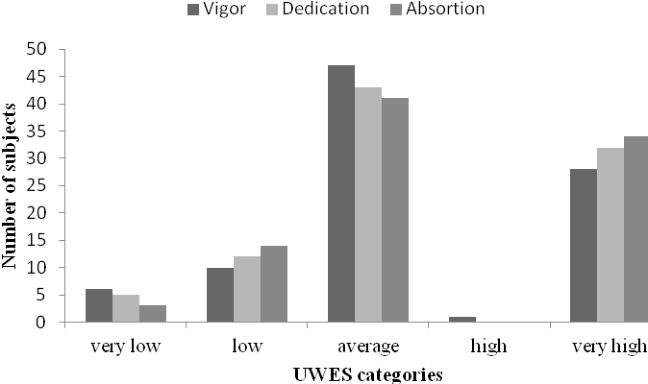
Good levels of work ability were recorded among the workers. The WAI was rated as excellent for 55% (n=50) of the VDU workers, good for 36% (n=33), moderate for 6% (n=6) and poor for 3% (n=3). The mean NFR score was 36.4±17.4. Only twelve out of the 47 workers answering the RDQ have not indicated any degree of disability (0 points). On the other hand, the remaining 35 workers showed low level of disability. The JCQ indicated that 42% (n=33) of the workers had high working demand, 60% (n=55) reported low control, and 46% (n=42) reported low social support. The IPAQ showed that 34% (n=31) of the workers practice low level of physical activity, 35% (n=32) moderate level, and 31% (n=29) high level of physical activity. The UWES revealed that most workers had medium levels of vigor, dedication and absorption, as shown in Figure 1.
Figure 1. Frequency distribution of UWES domains.
Table 2 shows the results from the binary logistic regression analysis. Neck symptoms were predicted by gender; musculoskeletal symptoms in the upper back were predicted by age; and musculoskeletal symptoms in the lower back were predicted by dedication and absorption. Functional limitation in the neck was predicted by vigor; in the upper back by age, need for recovery and social support; and functional limitation in the lower back was predicted by gender, need for recovery and work ability. The seek for medical consultation due to neck symptoms was predicted by work ability and work absorption; upper back symptoms was predicted by work control, work ability and absorption. Low back symptoms predictors for medical consultation were age, work ability and absorption.
Table 2: Predictors for neck, upper and lower back symptoms, functional limitation, seek for health care and low back disability in visual display unit workers.
Table available in the original PDF paper.
Dependent variable Factor β SE p OR 95%IC R2 7-days symptoms
neck gender -1.050 0.261 0.00 0 0.350 0.210-0.584 0.434 upper back age -0.039 0.010 0,00 0 0.962 0.962-0.982 0.346
The main objective of this study was to identify predictive factors for spinal complaints among VDU workers. The results indicated a high prevalence of musculoskeletal symptoms in the last seven days for the low back, followed by the upper back and neck. The prevalence of musculoskeletal symptoms in this study was low compared to previous studies with VDU workers (Fejer, 2006; Griffiths et al, 2011; Wu et al, 2012; Mahmud et al, 2014).
Gender was identified as a predictive factor for neck pain in the last 7 days and lower back functional limitation. Women had a higher prevalence of symptoms in the last 7 days in the neck region as reported by other studies (Cagnie et al, 2007; Johnston et al, 2009; Madeleine et al, 2013). However, women and men had equal prevalence of symptoms in the lower back, which is not consistent with data from other studies that found a higher prevalence of low back pain in women (Bressler et al, 1999; Schneider et al, 2006; Hoy et al, 2012). The results also showed a greater low back functional limitation in men (17%) compared to women (7%). According to previous studies, it is expected that low back pain can lead to functional limitations and frequent use of health services (Melloh et al, 2008).
Age was a predictor for upper back symptoms and functional limitation, as well as lower back seek for health care. Younger workers showed high prevalence of symptoms and functional limitation at the upper back whereas older workers had higher rates of seeking health care due to lower back complaints.
Regarding the WAI results, 91% of the workers have excellent or good work ability. Smolander et al. (2000) evaluated sedentary workers and also found a high mean score (44.2±4.0). WAI predicts lower back functional limitation and seek for health care due to neck, upper and lower back symptoms. Workers with moderate WAI had higher rates of seek for health care and functional limitation when compared with excellent or good work ability. Work ability involves aspects of health and its individual, social and economic implications (Martinez et al, 2009). High levels of work ability are related to lower absenteeism, lower rates of chronic diseases and musculoskeletal pain as well as improved productivity (Martinez et al, 2009; Tuomi et al, 1997; Neupane et al, 2011).
The results of the IPAQ showed that most workers practice a moderate to high level of physical activity. Madeleine et al (2013) have also evaluated computer workers. They report that the majority of the individuals (94%) were classified in moderate and high level of physical activity. Regular physical activity has been associated with better quality of life and health (Penedo and Dahn, 2005). Many benefits can be directly related to physical activity practice, such as well being, better functional capacity and ability to perform various tasks in both personal and professional life. However, in this study the IPAQ result was not a predictive factor for spinal complaints.
Despite these positive findings, the results have also shown that the majority of workers reported high need for recovery. The NFR levels found among these workers were similar to those found in young workers from the public sector of Belgium, which included administrative workers (Kiss and Meester, 2005), and in a Dutch study (Jansen et al, 2003). NFR was a predictive factor for upper and lower back functional limitation, as well as for lower back disability. Lundeberg (2002) also found that insufficient recovery is associated with accumulated fatigue levels and can lead to health complains.
Sixty percent of the workers presented low job control, which is related to lack of decision latitude (Karasek and Theorell, 1990). Job control was a predictive factor for seeking health care due to upper back symptoms. However the proportion of workers who seek health care was high among workers with high job control (19%) in comparison to those with low job control (4%). Woods (2005) found that low control in sedentary workers was related with complaints, which was not supported by our results. Social support was high in 54% of the workers and was a predictive factor for upper back functional limitation. Workers with low social support had higher proportion of limitation. This result has been previously reported (Burdorf and Sorock, 1997). A systematic review of Janwantanakul et al (2012) investigated risk factors for low back pain in office workers. They reported strong evidence for the combination of postural and psychosocial risk factors at work and low back pain.
Most workers reported average levels of vigor, dedication and absorption. Vigor was a predictive factor for functional limitation due to neck symptoms. Workers with low vigor had more neck functional limitation. Dedication predicted lower back symptoms, and absorption predicted lower back symptoms and seeking health care due to neck, upper and lower back symptoms. Workers with very high absorption scores seek health care more frequently due to spinal symptoms. These results was unexpected, since Barbieri et al (2012) found high levels for the three domains (dedication, vigor and absorption) for asymptomatic workers; symptomatic workers showed low level of dedication and absorption suggesting that low to moderate levels may be related to musculoskeletal complaints.
Low back disability is predicted by high levels of need for recovery and functional limitation due to lumbar symptoms. According to some studies acute and chronic low back pain can lead to functional limitations and disability and it is a prominent complaint of individuals seeking medical care (Stewart et al, 2003; Walker et al, 2004). Thus, preventive measures must be applied as soon as symptoms appear in order to prevent work disability.
CONCLUSIONS
The results revealed that musculoskeletal symptoms, functional limitation, demand and medical disability due to spinal problems are predicted by multiple factors, which reinforces the need for multidisciplinary intervention to prevent musculoskeletal disorders among VDU operators.
REFERENCES
Alves, M.G.M., Chor, D., Faerstein, E., Lopes, C.S., Werneck, G.L. (2004). Versão resumida da “job stress scale”: adaptação para o português. Revista de Saúde Pública, 38(2):164-171. Barbieri, D.F., Nogueira, H.C., Bergamin, L.J., Oliveira, A.B. (2012, February 6). Physical and psychosocial indicators among
office workers from public sector with and without musculoskeletal symptoms. Work: A Journal of Prevention, Assessment and Rehabilitation, 41 Suppl 1, 2461-2466. Barros, E.N.C., Alexandre, N.M.C. (2003). Cross-cultural adaptation of the Nordic musculoskeletal questionnaire. Int Nursing Review, 50(2):101-8. Bautz-Holter, E., Sveen, U., Cieza, A., Geyh, S., Røe, C. (2008, Dec). Does the International Classification of Functioning,
Disability and Health (ICF) core set for low back pain cover the patients' problems? A cross-sectional content-validity study with a Norwegian population. European Journal of Physical and Rehabilitation Medicine, 44(4):387-397. Bressler, H.B., Keyes, W.J., Rochon, P.A., Badley, E. (1999, Sep 1). The prevalence of low back pain in the elderly: a systematic review of the literature. Spine (Phila Pa 1976), 24(17):1813-1819. Burdorf, A., Sorock, G. (1997, August). Positive and negative evidence of risk factors for back disorders. Scandinavian Journal
of Work and Environmental Health, 23(4), 243–256. Cagnie, B., Danneels, L., Van, T.D., De Loose, V., Cambier, D. (2007, May). Individual and work related risk factors for neck pain among office workers: a cross sectional study. European Spine Journal, 16:679-686. Carter, J.B., Banister, E.W. (1994, Oct). Musculoskeletal problems in VDT work: a review. Ergonomics, 37(10):1623-1648. Cieza, A., Stucki, G., Weigl, M., Disler, P., Jackel, W., Linden, S.V.D., Kostanjsek, N., Bie, R. (2004). ICF Core Sets for low
back pain. Journal of Rehabilitation Medicine, Supplement 36(44):69-74. Fejer, R., Ohm-Kyvik, K., Hartvigsen, J. (2006, Jun). The prevalence of neck pain in the world population: a systematic critical review of the literature. European Spine Journal, 15:834-848. Griffiths, K.L., Mackey, M.G, Adamson, B.J. (2011, Dec). Behavioral and psychophysiological responses to job demands and
association with musculoskeletal symptoms in computer work. Journal occupational health, 21(4):482-492. Guedes, D.P., Lopes, C.C., Guedes, J.E.R.P. (2005). Reprodutibilidade e validade do Questionário Internacional de Atividade Física em adolescentes. Revista Brasileira de Medicina do Esporte, 11(2):151-158. Hoy, D., Bain, C., Williams, G., March, L., Brooks, P., Blyth, F., Woolf, A., Vos, T., Buchbinder, R. (2012, June). A Systematic
Review of the Global Prevalence of Low Back Pain. Arthritis & Rheumatism, 64(6):2028-2037. Janwantanakul, P., Sitthipornvorakul, E., Paksaichol, A. (2012, Sep). Risk factors for the onset of nonspecific low back pain in office workers: A systematic review of prospective cohort studies. Journal of Manipulative and Physiological Therapeutics, 35(7):568-577. Jensen, N.W.H., Kant, I., van Amelsvoort, L.G.P.M., Nijhuis, F.J.N., van den Brandt, P.A. (2003, June). Need for recovery from
work: evaluating short-term effects of working hours, patterns and schedule. Ergonomics, 46(7):664-680. Johnston, V., Jimmieson, N.L., Jull, G., Souvlis, T. (2009, Oct). Contribution of individual, workplace, psychosocial and physiological factors to neck pain in female office workers. European Journal of Pain, 13:985-991. Karasek, Robert & Theorell, Töres. 1990. Healthy Work: Stress, Productivity and the Reconstruction of Working Life. Basic
Books, Inc., Publishers. New York.. 381 pp. Kiss, P., Meester, M. (2005, June). Need for recovery in ageing workers. International Congress Series, 1280: 202-207. Lundberg U. (2002, May). Psychophysiology of work: stress, gender, endocrine responses, and work-related upper extremity disorders. American Journal of Industrial Medicine, 41(5), 383–392. Madeleine, P., Vangsgaard, S., Andersen, J.H., Ge, H-Y., Arendt-Nielsen, L. (2013, August). Computer work and self-reported
variables on anthropometrics, computer usage, work ability, productivity, pain, and physical activity. BMC Musculoskeletal Disorders, 214-226. Mahmud, N., BahariSiti, F., Zainudin, N.F. (2014, July). Psychosocial and Ergonomics Risk Factors Related to Neck, Shoulder and Back Complaints among Malaysia Office Workers. International Journal of Social Science and Humanity, 4(4), 260- 263. Martinez, C.M., Latorre, M.R.D.O., Fischer, F.M. (2009). Validade e confiabilidade da versão brasileira do Índice de Capacidade
para o Trabalho. Revista de Saúde Pública, 43(3),525-532. Melloh, M., Roder, C., Elfering, A., Theis, J.C., Muller, U., Staub, L.P., Aghayev, E., Zweig, T., Barz, T., Kohlmann, T., Wieser, S., Juni, P., Zwahlen, M. (2008, June). Differences across health care systems in outcome and cost-utility of surgical and conservative treatment of chronic low back pain: a study protocol. BMC Musculoskeletal Disorders, 79:81. Moriguchi, C.S., Alem, M.E.R., Van Veldhoven, M., Coury, H.J.C.G. (2010), Cultural adaptation and psychometric properties of
Brazilian Need for Recovery Scale. Revista de Saúde Pública, 44(1):131-139. Neupane, S., Miranda, H., Virtanen, P., Siukola, A., Nygård, C-H. (2011, December). Multi-site pain and work ability among an industrial population. Occupational Medicine (Oxford, England), 61(8), 563–569. Nusbaum, L., Natour, J., Ferraz, M.B., Goldenberg, J. (2001). Translation, adaptation and validation of the Roland-Morris
questionnaire – Brazil Roland-Morris. Brazilian Journal of Medical and Biological Research, 34:203-210. Penedo, F.J., Dahn, J.R. (2005, March). Exercise and well-being: a review of mental and physical health benefits associated with physical activity. Current Opinion in Psychiatry, 18(2), 189-193. Punnett, L., Wegman, D.H. (2004, Feb). Work-related musculoskeletal disorders: the epidemiologic evidence and the debate. J
Electromyogr Kinesiol, 14(1):13-23. Schneider, S., Randoll, D., Buchner, M. (2006, Oct). Why do women have back pain more than men? A representative prevalence study in the federal republic of Germany. The Clinical Journal of Pain, 22: 738-747. Smolander, J., Blair, S.N., Kohl, H.W. (2000, September). Work Ability, Physical Activity, and Cardiorespiratory Fitness: 2-year
Results From Project Active. Journal of Occupational & Environmental Medicine, 42(9):906-910. Stewart, W.F., Ricci, J.A., Chee, E., Morganstein, D., Lipton, R. (2003, Nov 12) Lost productive time and cost due to common pain conditions in the US workforce. JAMA, 290(18):2443-5244. Taylor, J.B., Goode, A.P., George, S.Z., Cook, C.E. (2014, Jan). Incidence and Risk Factors for First-Time Incident Low Back
Pain: A Systematic Review and Meta-Analysis. The Spine Journal, pii: S1529-9430(14)00103-X. Tuomi, K., Ilmarinen, J., Martikainen, R., Aalto, L., Klockars, M. (1997). Aging, work, life-style and work ability among Finnish municipal workers in 1981-1992. Scand J Work Environ Health, 23 Suppl 1:58-65. Wærsted, M., Hanvold, T. N., Veiersted, K.B. (2010). Computer work and musculoskeletal disorders of the neck and upper
extremity: A systematic review. BMC Musculoskeletal Disorders, 11:79. Wahlstrom, J. (2005). Ergonomics, musculoskeletal disorders and computer work. Occupational Medicine, Volume 55 Pages 168–176. Walker, B.F., Muller, R., Grant, W.D. (2004, May). Low back pain in Australian adults: Prevalence and associated disability.
Journal of Manipulative and Physiological Therapeutics, 27(4), 238-244. Woods, V. (2005). Musculoskeletal disorders and visual strain in intensive data processing workers. Occupational Medicine, 55(2), 121–127. Wu, S., He, L., Li, J., Wang, J., Wang, S. (2012). Visual display terminal use increases the prevalence and risk of work-related
musculoskeletal disorders among Chinese office workers: a cross-sectional study. Journal occupational health, 54(1):34- 43.
LISTED IN THE AHFE DIGITAL BOOKSTORE CATALOGUE
Explore the complete digital volume
Advances in Physical Ergonomics and Human Factors: Part I
Read this individual research paper free through the original publisher, or explore the full digital proceedings book.
ISBN 978-1-4951-2104-3
Explore this ISBN in the AHFE Bookstore ↗Listed in the July 2026 bookstore catalogue; search by ISBN to confirm current availability · Digital book purchase optional