Working on visual display units (VDUs) for prolonged periods of time leads to peculiar effects on physical and cognitive functioning of the users. COVID-19 pandemic brought the world to a point where all the work activities and interactions became dependent on various types of VDUs. The teaching-learning process switched to virtual classrooms bringing about a shift in the knowledge exchange scenario across the globe. An optimisation of conditions for VDU usage needs to be done in order to minimise the long term effects and reduce discomforts while using any such technology based media. The study focuses on a real time comprehensive analysis of VDU usage related musculoskeletal disorders, particularly computer vision syndrome and postural problems. The exposure assessment in both physical and cognitive domains provides the basis for optimisation of conditions for VDU usage.
Virtual classroom settings create a whole new classroom experience for students. COVID-19 pandemic led to peculiar work setups where humans became totally dependent on visual display units (VDUs) for all their activities and interactions. Various studies suggest that over exposure to such work setups have irreversible
Human Interaction & Emerging Technologies (IHIET-AI 2022) Artificial Intelligence & Future Applications https://openaccess.cms-conferences.org/#/publications/book/978-1-7923-8989-4 effects on the physical and cognitive functioning of the users. UNICEF (2020) showed a serious concern that millions of children are at increased risk of harm as their lives move increasingly online during lockdown in the COVID-19 pandemic. The major concerns in relation to over exposure to VDUs are musculoskeletal disorders, psychological and cognitive effects like fluctuations in concentration and attention of the users. Constant gaze on VDUs leads to a significant amount of ocular fatigue. Prolonged awkward and static postures lead to multiple musculoskeletal problems. A comprehensive analysis of ergonomic risk factors associated with over exposure to VDUs can help in determining the optimum levels of VDU usage, in terms of both duration and conditions in which they are being used. Steele (2020) suggested that future research is needed to examine the associations among components of digital stress and clinical outcomes, and to provide valid measures to assess digital stress in research and clinical settings.
LITERATURE REVIEW
Takahashi et al. (2001) concluded that high luminance with noise had the most significant effect on subjective fatigue and mental activities. Yen-HuiLin et al (2008) concluded that time-based and environment-based factors influence operator visual fatigue and task performance. Bergqvist and Knave (1994) reported that the occurrence of eye discomfort increases as the extent of VDT work increases, as do sensitivity to light and smarting, gritty feeling, or redness. Khan et al. (2020) suggested that COVID-19 outbreak has imposed psychological consequences on people to a great extent which requires attention from the concerned authorities to cope with this situation and perception about the outbreak can also play a big role in psychological impact. Fruehwirth et al. (2021) suggested that colleges may be able to reduce the mental health consequences of Covid-19 by investing in resources to reduce difficulties with distance learning and reduce social isolation during the pandemic. Almhdawi (2021) concluded that Jordanian healthcare students had relatively low level of satisfaction with their online teaching activities. Straker et al (2008) found out that musculoskeletal stresses using tablet and paper were higher than with the conventional screen with a more asymmetrical trunk posture, greater elevation of the shoulders, and increased muscle activity around the neck. Asgariet al. (2021) concluded that students indicate lack of engagement in class, difficulty in maintaining their focus and Zoom fatigue after attending multiple online sessions. Yadav (2021) concluded that the students suffer from mental sickness and eye problems due to the screen effect.
MATERIALS AND METHODS
The study was conducted on 30 students (males n=18, females n=12) in the age group of 18 to 25 years who were attending their classes in online mode. The ergonomic assessment of risks involved in overuse of VDUs was done by postural analysis
(measurement of kyphosis index and musculoskeletal loading) and assessment of ocular fatigue (CVS symptoms). The measurements were recorded after the subjects had already been into the same position in front of VDUs for at least two hours on the given day.
Postural Analysis
Kyphosis Index: The kyphosis index was assessed by flexicurve technique. A 60 cm long flexible ruler was positioned on the back of the subject aligned to the anterior-posterior spinal curves from C7 to T12. The ruler was then placed on a plain paper and the shape was traced and a vertical straight line was drawn from the C7 to T12.This corresponded to the length of thoracic kyphosis (l). A perpendicular line was drawn from the highest point in the thoracic curve to the point intersecting the vertical line drawn from C7 to T12 to determine the height of the thoracic kyphosis (h). Kyphosis index was then calculated by (h/l)× 100.
Musculoskeletal Loading: The musculoskeletal loading was established by Rapid Upper Limb Assessment (RULA) developed by McAtanney and Corlett (2004). Posture of each body partwas scored along with the loads and muscle use required to maintain that particular posture while working with a VDU. Posture scores were calculated and the grand score was then compared with the action levels.
Ocular Fatigue Assessment: The ocular fatigue was measured by Visual Fatigue Questionnaire developed by Bangor (2000). The scoring was done on a continuum with the left end point Not Noticeable At All, midpointSomewhat Noticeable and right end point Extremely Noticeable for CVS symptoms. The distance of participant’s response from the left endpoint scale was measured to the nearest half millimetre, divided by the entire scale’s length (99mm), multiplied by 100 and rounded to the nearest tenth to index the response. A greater value indicated more noticeable fatigue symptoms.
STUDY FINDINGS The sample consisted of 30 university students in the age group of 18-25 years who have been taking online classes for at least a year. Table 1 shows the sample profile.
Table 1: The Sample Profile No. of male participants 18
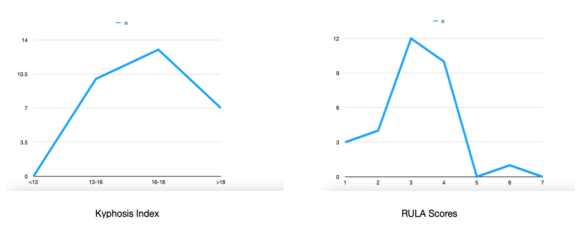
Postural Analysis Postural analysis was conducted by determining kyphosis index and RULA scores.Figure 1 shows the distribution of respondents on Kyphosis Index and RULA scores. The distribution shows that 33.3% respondents had kyphosis index in the range of 13-16, 43.3% in 16-18 and 23.3% respondents had kyphosis index >18. 10% respondents had a score of 1 and 13.3% had a score of 2 which fall under Action Level 1 indicating acceptable posture, 40% respondents had a score of 3 and 33.3% had a score of 4 falling under Action Level 2 indicating a need for further investigation, None of the respondents had a score of 5 and 1 (3.33%) respondent had a score of 6 i.e. Action Level 3 indicating changes may be required soon and none of the respondents had a score of 7 i.e. Action level 4 indicating an immediate need for investigation and changes.
Fig 1. Frequency Distribution of respondents on Kyphosis Index &RULA scores
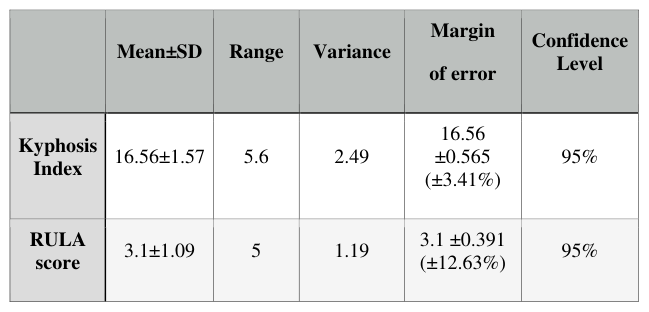
Table 2: Statistical Summary of Kyphosis Index and RULA scores Margin
The kyphosis index had a mean of 16.56 with a standard deviation of ±1.57, range=5.6, variance=2.49 and margin of error=16.56 ±0.565 (±3.41%) at confidence level of 95%.The RULA scores had a mean of 3.1 with a standard deviation of ±1.09, range= 5, variance=1.19 and margin of error=3.1 ±0.391 (±12.63%) at confidence level of 95%.
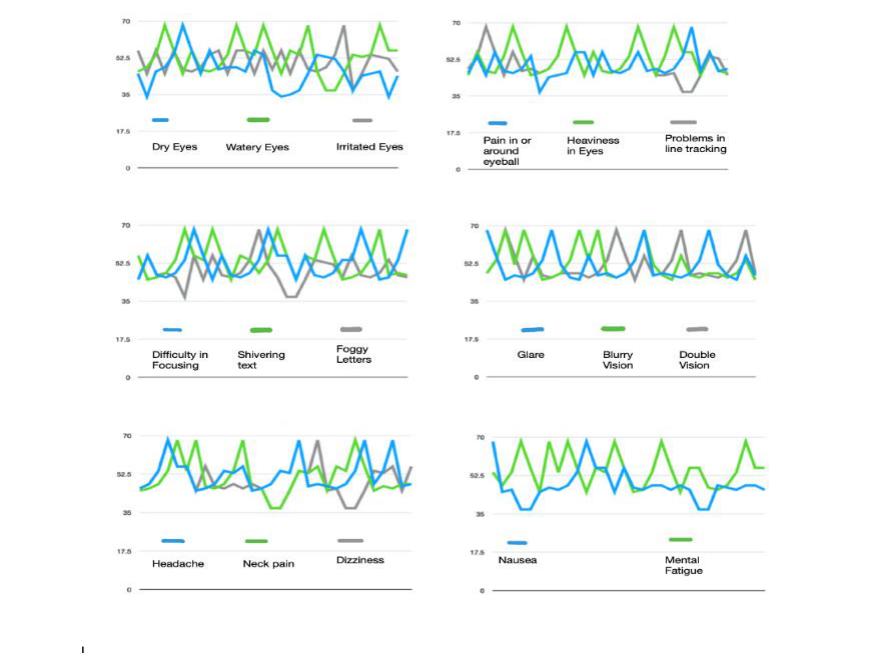
Fig.2 Relative Distribution of Kyphosis Index and RULA Scores
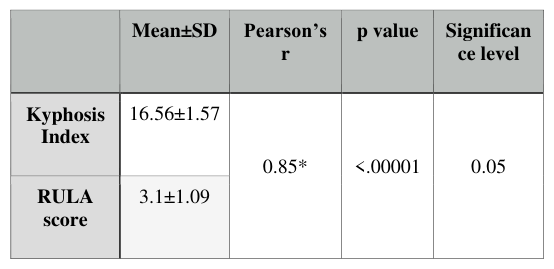
Table 3: Correlation between Kyphosis Index and RULA scores Mean±SD Pearson’s p value Significan r ce level
The value of r=0.85, p=<.00001indicates a positive strong relationship between postural deviations and musculoskeletal loading. Since the p-value is < .00001, the result is significant at p< .05 Ocular Fatigue
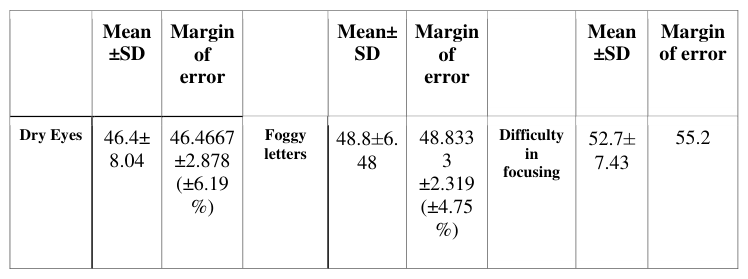
The data shows that majority of the respondents had symptoms of ocular fatigue to a considerable extent. The major symptoms of CVS include sometimes dry eyes, sometimes watery eyes, gritty sensation in eyes, burning sensation in eyes, pain around eyeballs, heaviness of eyes, problems with line tracking, difficulty in focusing, shivering/jumping text, foggy letters, glare, blurry and double vision, and directly/ indirectly related symptoms like headaches, neck pain, dizziness, nausea and mental fatigue.
The findings of the study reveal that there is a strong correlation between the kyphosis index and RULA scores of the respondents. As kyphosis index for a respondent increase, musculoskeletal loading increases. Corresponding to this, the possibility of experiencing musculoskeletal discomfort also increases. When body is required to attain an awkward alignment of body parts for prolonged periods of time, ergonomic risks come into being. Sedentary work has always been associated with number of musculoskeletal risks particularly those involving upper extremities. Working on a VDU requires static postures and usually involves small frequent movements of head, neck, eyes, arms and wrists. Maintaining a fixed posture for extended periods of time leads to muscle fatigue and in the long term may lead to muscular pains and injuries.
Studies suggest that eye gaze and body positions play a major role in determining the stresses imposed while working on VDUs. Viewing angle is mainly determined by the inclination of neck and eyes, but thoracic bending also contributes in setting the viewing angle. If this bending exceeds the prescribed limits, ergonomic risks increase. Graf and Krueger (1995) reported that work tasks which have a higher incidence of musculoskeletal disorders are found to produce less frequent and less marked postural change. Gigante et al (2005) reported that fixed and prolonged sitting working posture may lead to thoracic hyperkyphosis. Ocular fatigue is very common among those who use VDUs for extended periods of time. Symptoms of CVS may mostly be temporary in nature initially, they vanish as soon as one takes a break from staring at the screen, but the discomfort experienced during the work is usually very high and there may be various long-term effects. A comprehensive analysis of ergonomic risk factors associated with over exposure to VDUs can help determining the optimum levels of VDU usage, in terms of both duration and conditions in which they are being used. This optimisation can help in minimising the long-term effects of the peculiar conditions of sedentary work, the most prominent one being working with VDUs.
REFERENCES
UNICEF. Children at increased risk of harm online during global COVID-19 pandemic. Press Release 14 April 2020 Steele RG, Hall JA, Christofferson JL. Conceptualizing Digital Stress in
Adolescents and Young Adults: Toward the Development of an Empirically Based Model. Clin Child Fam Psychol Rev. 2020 Mar;23(1):15-26. Kyoko Takahashi, Hiroko Sasaki, Takeshi Saito, Toshiyuki Hosokawa, Masaaki Kurasaki& Kazuo Saito Combined effects of working environmental conditions in VDT work, Ergonomics, 2001, 44:5, 562-570 Chiuhsiang Joe LIN, Wen-Yang FENG, Chin-Jung CHAO, Feng-Yi TSENG (2008)
Effects of VDT Workstation Lighting Conditions on Operator Visual Workload, Industrial Health, 2008, Volume 46, Issue 2, Pages 105-111 Bergqvist UO, Knave BG. Eye discomfort and work with visual display terminals.
Scand J Work Environ Health. 1994 Feb;20(1):27-33 Khan AH, Sultana MS, Hossain S, Hasan MT, Ahmed HU, Sikder MT. The impact of COVID-19 pandemic on mental health & wellbeing among home- quarantined Bangladeshi students: A cross-sectional pilot study. J Affect Disord. 2020 Dec 1;277:121-128. doi: 10.1016/j.jad.2020.07.135. Epub 2020 Fruehwirth JC, Biswas S, Perreira KM. The Covid-19 pandemic and mental health
of first-year college students: Examining the effect of Covid-19 stressors using longitudinal data. 2021, PLoS ONE 16(3): e0247999. Almhdawi, Khader A., et al. "Healthcare students’ mental and physical well-being during the COVID-19 lockdown and distance learning." Work Preprint 2021: 1-8. Straker LM, Coleman J, Skoss R, Maslen BA, Burgess-Limerick R, Pollock CM. A
comparison of posture and muscle activity during tablet computer, desktop computer and paper use by young children. Ergonomics. 2008 Apr;51(4):540- 55.
Asgari S, Trajkovic J, Rahmani M, Zhang W, Lo RC, Sciortino A. An observational study of engineering online education during the COVID-19 pandemic. 2021, PLoS ONE 16(4): e0250041 Yadav Kumar Avadhesh, “Impact of Online Teaching on Students’ Education and
Health in India during the Pandemic of COVID-19”, Coronaviruses 2021; 2(4) McAtamney, Lynn, and Nigel Corlett. "Rapid upper limb assessment (RULA)."
Handbook of human factors and ergonomics methods. CRC Press, 2004. 86- 96. Bangor, A.W. Display Technology and Ambient Illumination Influences on Visual Fatigue at VDT Workstations. Dissertation. Faculty of the Virginia Polytechnic Institute and State University, Blacksburg, Virginia 2000 Graf, U. Guggenbühl, H. Krueger. An assessment of seated activity and postures at
five workplaces, International Journal of Industrial Ergonomics,1995 Volume 15, Issue 2, 81-90. Gigante MR, Sciascia G, Basso A, Lovreglio P, Russo A, De Frenza MD, Musti M, Soleo L. L'attivitàlavorativa al videoterminalepuòcondizionare la comparsa di alterazionicifotichedorsali? Datipreliminari [Could VDT use induce thoracic hyperkyphosis? Preliminary data]. G Ital Med Lav Ergon. 2005 Jan- Mar;27(1):119-23.
Read this individual research paper free through the original publisher, or explore the full digital proceedings book.
ISBN 978-1-7923-8989-4
Explore this ISBN in the AHFE Bookstore ↗Listed in the July 2026 bookstore catalogue; search by ISBN to confirm current availability · Digital book purchase optional