Oksana Isaeva, Marina Boronenko, Pavel Gulyaev (2022). Measuring the Velocity and Temperature of Particles in a Low-Temperature Plasma Flow. In: Production Management and Process Control. AHFE Open Access, vol. 36, pp. 136–144. https://doi.org/10.54941/ahfe1001628
The improvement of optical methods for diagnosing fast processes in plasma deposition technologies is associated with the solution of a well-known contradiction between an increase in the speed of recording a track of a moving particle and a decrease in the signal level to a critical noise threshold. Improving the accuracy of measuring the temperature of the condensed phase of the flow, under the conditions of plasma background radiation, is possible with the transition from the brightness pyrometry of individual particles to spectral methods for determining the temperature distribution of a large group of particles by their thermal spectrum. The purpose of this study is to experimentally verify the effectiveness of using microchannel photomultipliers and nanosecond electron-optical switches to improve the accuracy and speed of time-of-flight anemometry and brightness pyrometry methods. The experimental technique for detecting tracks of self-luminous heated particles in plasma is based on the use of specialized high-speed video cameras with parallel signal reading. The technical possibilities of using high-speed video cameras for registration of particles in the technological process of plasma spraying of coatings are shown. The use of an optical shutter with a nanosecond resolution makes it possible to measure the particle velocity in the range from 10 to 350 m/s with an accuracy that ensures the calculation of the dynamic parameters of particle acceleration in the jet. The use of a microchannel photomultiplier makes it possible to measure the brightness temperature of particles even at high speeds. The set of experimental data makes it possible to determine the form of the fundamental diagram of a two-phase plasma jet by the value of the particle transfer velocity in the idle mode and the maximum load capacity of the flow. The considered experimental technique makes it possible to measure the dynamic constants of motion and heating of both individual particles in a plasma flow and the fundamental diagram of interaction during collective motion. The proposed diagnostic method is recommended to be used to study the load capacity of two-phase flows, as well as an indicator of the limiting technological state of the plasma torch and the transition to unstable spraying modes.
In gas-thermal coating technologies, low-temperature plasma flows with a condensed dispersed phase containing solid or liquid macroparticles are used. The speed and temperature of the particles upon impact with the substrate are the determining thermophysical parameters of the formation of the stru- cture and phase composition of the deposited surface layer. Measurement of these parameters by a contactless method directly in a two-phase plasma jet became possible with the advent of MIS photodiode matrices, which make it possible to carry out parallel reading of the signal (Goskov, Gulyaev P., 1987; Goskov, Gulyaev P., Yakunin, 1987). The first results of the use of such measuring instruments for studying dusty plasma jets showed the effi- ciency of measuring the temperature of the condensed phase in the range of 1200–2500 °C at a flow velocity of 80–120 m/s (Goskov, 1989). The impro- vement of optical methods for diagnosing fast processes in plasma deposition technologies is associated with the solution of a well-known contradiction between an increase in the speed of registering a track of a moving parti- cle and a decrease in the signal level to a critical noise threshold Gulyaev P., 1999; Gulyaev P., Dolmatov, 2009). Increasing the accuracy of measuring the temperature of the condensed phase of the flow, under the conditions of plasma background radiation, is possible with the transition from the brigh- tness pyrometry of individual particles to spectral methods for determining
Measuring the Velocity and Temperature of Particles in a Low-Temperature Plasma Flow 137
the temperature distribution of a large group of particles according to their thermal spectrum (Gulyaev P., 2000; Gulyaev I., Gulyaev P., 2008).
The purpose of this study is to experimentally test the effectiveness of microchannel photomultipliers and nanosecond electron-optical switches to improve the accuracy and speed of time-of-flight anemometry and brightness pyrometry methods.
MODEL OF MOTION AND HEATING OF PARTICLES IN PLASMA The theoretical model of the motion and heating of macroscopic particles in a plasma flow is based on the classical principles of heat and mass transfer in heterogeneous plasma flows, which in each specific case can be applied with allowance for the processes of melting, sublimation and convective mixing and the formation of gas cavities in the substance of molten particles (Boronenko, 2012; Gulyaev, 2009; Solonenko O., 2009).
The simplest equations of one-dimensional motion in a plasma flow, which describe the change in the velocity Up and temperature Tp, of a single particle, have the following form (1,2): ρ(Uf −Up)|Uf −Up|
Equations and mathematical formulas are available in the original paper PDF.
2 (1)
In the above notation: Uf and Tf are the local velocity and temperature of the plasma flow; ρ is the density of the gas (plasma) at the flow temperature Tf; Smid - midsection area of the particle; Ssurf - surface area of a spherical particle. The coefficient of frontal gas-dynamic resistance of the sphere Cd and the heat transfer coefficient α are calculated from empirical dependencies, which are mainly obtained in the study of low-temperature flows around bodies.
If at the initial moment of time the particle velocity is equal to zero, and the temperature is equal to the initial value Tp0., then in the one-dimensional approximation the velocity and temperature of a single spherical particle with a diameter Dp moving in a uniform plasma flow is determined by solution (3, 4):
1 −e−t τD
1 −e−t τT
Tf −Tp0
In this case, mp, Cd, ρ, Smid, Ssurf, Tp0, and Dp can be considered a priori known parameters in equations (1) and (2), while the dynamic parameters of equations (3) and (4) can be experimentally determined using high-speed video recording - constants acceleration and heating time: τ D and τ T. These constants have the physical meaning of the time interval that would be nee- ded for the particle to reach the velocity (temperature) of the plasma if it moved with the current acceleration (heated up with the current intensity).
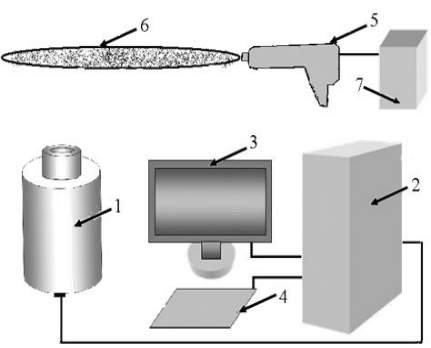
Figure 1: Experimental stand.
Note that, within the framework of this model, it is also possible to state and correctly solve the inverse problem, i.e., determination of plasma temperature and velocity based on the results of high-speed registration of tracks of cali- brated particles, for example, “nano-markers” with known thermophysical properties.
METHOD FOR MEASURING THE TEMPERATURE OF PARTICLES MOVING IN A STREAM DURING THE SPRAYING OF POWDER COATINGS The brightness of the measurement object is recorded by the OES based on a multi-element matrix photodetector, on a part of the photosensitive cells of which an image of a reference lamp filament is projected, the filament current of which in the calibration mode is changed according to a linear law. The values of the filament current are sequentially numbered and stored at the moments of increment by a given value of the output signal of the photodetector. The temperature of the object is determined in the absence of the filament current of the reference lamp by the stored value of the filament current corresponding to the gradation of the current output signal of the OES. Experimental stand in Fig. 1.
Thus, the brightness of the measured object is compared with the bri- ghtness of the reference lamp, using its digital equivalent in the form of a spreadsheet of brightness and the corresponding filament currents, imple- mented on the basis of a macro for the ImageJ program, which improves accuracy by reducing the effect of aging of the reference lamp and prolongs it. life time.
When determining the temperature of an individual particle, frames of a video file obtained by a calibrated video camera are dissected. To eliminate the influence of non-thermal plasma radiation and other interference, sub- tract the “averaged” frame from the prepared sequence of frames. To do this, video filming of the plasma jet is carried out without loading the par- ticles. In the ImageJ program, the frame is processed in such a way that the
Measuring the Velocity and Temperature of Particles in a Low-Temperature Plasma Flow 139
brightness of each pixel corresponds to the median value of the brightnes- ses recorded in it during video recording. To do this, you can use the tool Z-Project (Z-projection). Then, using the Image Calculator function, an inter- frame subtraction of the “averaged”frame is performed from the entire video file containing images of a plasma jet with sprayed particles.
All heated particles of the condensed phase have a continuous spectrum of their own thermal radiation. When determining the temperature of the particles, it is necessary to take into account their linear dimensions. For this, the assumption is made that: all particles have a spherical shape with a radius r and a particle track length l.
If the particle is moving and the camera is operating in the multiple expo- sure mode, then the total exposure time is equal to the multiple exposure period multiplied by the number of pulses N. The total radiation flux of the particle during one operation of the image intensifier tube, i.e., during the exposure (accumulation) (5):
8(t)dt. (5) t3
During this time, the incident radiation on the surface of the photomatrix creates an image of the particle. Replacing an analog signal with a sequence representing the expansion coefficients of this signal in some orthogonal basis is the most common sampling method. Instead of considering the functional dependence in an uncountable set of points, we can characterize the signal with a counting system of coefficients. The basis is chosen from the convenie- nce of physical implementation, the simplicity of calculating the coefficients, and the accuracy of the approximation. The input optical image signal E(x, y), in the general case, is a two-dimensional continuous function of continuous spatial arguments (x, y coordinates), is converted into an electrical signal described by I (x, y) a two-dimensional continuous function of discrete spatial arguments x, y, g (x. y) is the weight function.
If the particle were motionless, then charge accumulation in the photosen- sitive cell would occur throughout the exposure time, illuminating the same cells. Let the particle in the image have dimensions n × m. We also consider the radiation of the particle to be uniform over its entire surface. As it moves, the radiation illuminates an area with dimensions n × m. On the track length l there are l/m of such particles. Therefore, the discretization of the signal of a moving particle (6):
D · ¯I = k · ¯I (6) If the total brightness of the track pixels at a given exposure does not exceed 255, then according to the graph of the correspondence between the brightness temperature of the lamp and the brightness gradations of the image pixels, you can determine the temperature of the moving particle. The brigh- tness of a glowing object is less at a short exposure than the brightness of the same object at a long exposure. At different accumulation times, the particle
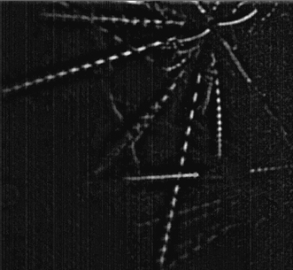
Figure 2: Registration of the flow of heated particles in the multiple exposure mode.
has time to fly different distances, and, consequently, a different number of pixels will make up the track.
1. We measure the average brightness (grayscale) in the selected track obtained by video filming on the accumulation t. 2. We measure the transverse and longitudinal size of the track (in pixels). 3. We take the transverse size of its clear image as the diameter of the moving emitter. We accept that the track length contains a minimum of L = 2D pixels. 4. According to formula (7), we calculate the accumulation time, cor- responding to the passage of the emitter in the field of view of the pixel. 5. Based on the calibration curve, we find the brightness temperature cor- responding to the measured average brightness of the image on the accumulation t1.
L −D (7)
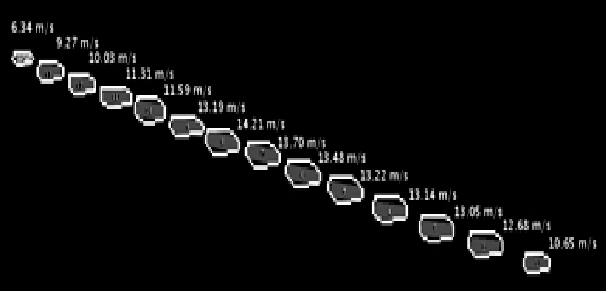
EXPERIMENTAL TECHNIQUE FOR DETERMINING THE PARAMETERS OF INDIVIDUAL PARTICLES The experimental technique for detecting tracks of self-luminous heated par- ticles in plasma is based on the use of specialized high-speed video cameras with parallel signal reading (Solonenko P., 2009). To improve the accuracy of measuring the time-of-flight data on the movement of particles, an optical shutter with a nanosecond speed “Nano Gate” was used, and to increase the sensitivity at short exposure times, a photomultiplier on microchannel plates was used. Examples of track registration are shown in Fig. 2 and 3.
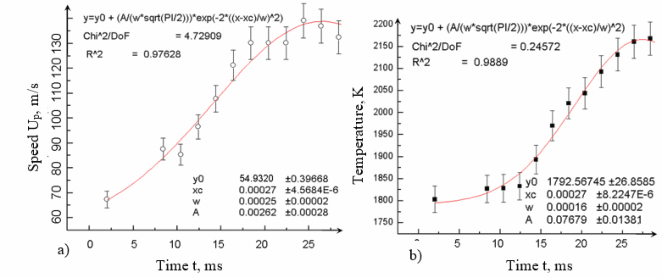
In the mode of m-fold exposure (multi-exposure) with a given interval, the thermal radiation of a flying particle is fixed on one frame m times. This makes it possible to carry out a detailed analysis not only of the dynamic parameter of motion acceleration τ D, but also of heating τ T. Fig. 4 show the results of processing the stroboscopic track of an individual particle with the approximation of the dynamic parameters τ D and τ T in the form of exponential solutions (3) and (4).
Measuring the Velocity and Temperature of Particles in a Low-Temperature Plasma Flow 141
Figure 3: Stroboscopic effect in recording the track of an individual particle in a low- temperature plasma flow.Figure 4: Determination of the acceleration time (a) and heating time (b) of particles along its track.
The above experimental technique is justified in the analysis of individual particles and lightly dusty plasma jets, but with an increase in the amount of condensed phase, it is necessary to take into account its interaction with the plasma flow, which has a limited load and throughput, which is reflected in the form of a fundamental flow diagram.
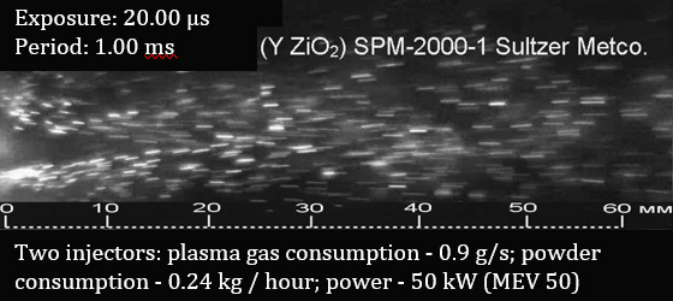
COLLECTIVE MOTION OF PARTICLE FLOW IN PLASMA AND FUNDAMENTAL DIAGRAM The basis of the physical model of the collective motion of particles in plasma is the representation of a two-phase flow shown in Fig. 5, in the form of the motion of two interpenetrating continuums of the gas phase and the “fake gas” of particles of the condensed phase (Boronenko, 2012), for which the continuity equation is valid, which describes the motion of the flow of a Newtonian fluid sensitive to shock waves (8):
Figure 5: An example frame of a high-speed video filming of a two-phase stream.
where: n=N(t)/V is the concentration of particles in a small measuring volume V=1l*S, and the value S is the cross section of the flow, 1l is the thickness of the measuring volume in the direction of the flow, ν is the flow velocity of the “fake gas”.
The dependence of the intensity of the flow of particles crossing the cross section of the measuring volume V on the density of particles in the flow determines the required characteristic (9):
where Q(ρ) is the fundamental diagram of a two-phase flow.
The speed and density of particles per unit length of the flow are determi- ned experimentally (10):
× V
1l (10) as a result, the one-dimensional continuity equation will be written in the form (11):
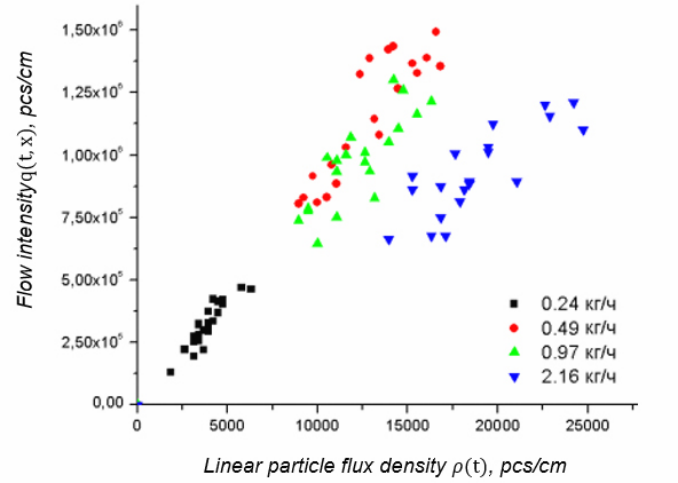
q(t, x) = ρ × v (11) Thus, it is possible to find the intensity of the flow of particles crossing the cross section of the measuring volume V by experimentally determining the average velocity of particles in the flow and their linear density, and, consequently, to construct a fundamental diagram of a two-phase plasma flow shown in Fig. 6 for laminar plasmatron MEV 50.
The curve of the fundamental diagram reflects the change in the velocity of particles in the plasma flow at different powder loadings. The straight line at zero flux density corresponds to the plasma velocity, and the maximum of the curve marks the performance limit of the plasma torch.
Measuring the Velocity and Temperature of Particles in a Low-Temperature Plasma Flow 143
Figure 6: Fundamental two-phase flow diagram.
CONCLUSION
The experimental technique considered above makes it possible to measure the dynamic constants of motion and heating of both individual particles in a plasma flow and the fundamental diagram of interaction during collective motion. The proposed diagnostic method is recommended to be used to study the load capacity of two-phase flows, as well as an indicator of the limiting technological state of the plasma torch and the transition to unstable spraying modes.
REFERENCES
Boronenko M.P., Gulyaev I.P., Seregin A.E. (2012). Model of movement and heating of particles in a plasma jet. Bulletin of the Yugra State University. 2. pp. 7–15. Boronenko M.P., Gulyaev P.Yu., Trifonov A.L. (2012). Determination of the funda-
mental flow diagram of a laminar plasma torch with a constant supply of powder. Bulletin of the Yugra State University. 2. pp. 16–20. Goskov P.I., Gulyaev P.Yu. (1987). Application of non-standard inclusion of a photodiode matrix in television systems. Film and television technology. 6. pp. 32–34. Goskov P.I., Gulyaev P.Yu., Yakunin A.G. (1987). Universal image converter PIS-2.
Instruments and technique of experiment. 3 .p. 91. Goskov P.I., Gulyaev P.Yu., Tsibirov A.M. (1989). Complex of technical means for registration of plasma radiation “Fakel-1”. Instruments and technique of experiment. 5. item 12. Gulyaev P.Yu. (1999). Optical diagnostics of combustion and explosion processes in
powder metallurgy. Bulletin of AltSTU im. I.I. Polzunov. 1. pp. 33–36.
Gulyaev P.Yu., Dolmatov A.V. (2009). Physical principles of diagnostics in plasma spraying technologies. Proceedings of the Samara Scientific Center of the Russian Academy of Sciences. 5(2). pp. 382–385. Gulyaev P.Yu. (2000). Stabilization methods for restoring the temperature distribu-
tion of particles in plasma jets from their thermal spectrum. Polzunov almanac. 3. pp. 13–15. Gulyaev I.P., Gulyaev P.Yu., Jordan V.I. (2008). Resolution of virtual devices for controlling the temperature of particles in plasma flows by the total spectrum. 2. pp. 13–14. Gulyaev P.Yu., Gulyaev I.P. (2009). Simulation of technological processes of pla-
sma spraying of coatings of nanoscale thickness. Control systems and information technologies. 1.1(35). pp. 144–148. Solonenko O.P., Gulyaev I.P. (2009). Nonstationary convective mixing in a drop of melt bypassed by plasma flow. Technical Physics Letters. 35(8). pp. 777–780. Solonenko P., Solonenko O.P., Gulyaev P.Y., Smirnov A.V. (2009). Hydrodynamic
features of the impact of a hollow spherical drop on a flat surface. Technical Physics Letters. 35(10). pp. 885–888.
LISTED IN THE AHFE DIGITAL BOOKSTORE CATALOGUE
Explore the complete digital volume
Production Management and Process Control
Read this individual research paper free through the original publisher, or explore the full digital proceedings book.
ISBN 978-1-958651-12-4
Explore this ISBN in the AHFE Bookstore ↗Listed in the July 2026 bookstore catalogue; search by ISBN to confirm current availability · Digital book purchase optional