Ruihan Zhang (2022). Design of lnteractive Experience on Participatory Art Based on Art Brut Form. In: Design for Inclusion. AHFE Open Access, vol. 45, pp. 153–158. https://doi.org/10.54941/ahfe1001880
As a mainstream art form of public art, socially-engaged participatory art takes art as an intervention means to stimulate the public's thinking on relevant social issues. With the expansion of the influence of participatory art in society, relevant problems are gradually emerging. The form of public participation is still limited, the sense of participation is not strong enough, and the acceptance of content is not high enough. The problem behind it mainly comes from the disconnection between social participatory art and regional culture, and the poor interaction with local residents. To solve these problems, improving the way of interactive experience plays an important role in enhancing the public's artistic participation and conveying the core ideas of artistic works. The Art Brut has the characteristics that the creator completes the works with the impulse of personal inspiration and the release of emotions in the creator’s heart. It does not limit the form of artistic expression, and calls on participants without artistic training to express their feelings about things in a direct way. At the spiritual level, it pursues independence and freedom, so it is more easily accepted by the public. By analyzing the examples of Art Brut involved in participatory art, comparing relevant information, analyzing the interactive mode, public participation and implementation of social participatory art projects, this project aims to seek the coincidence points between Art Brut and social participatory art.
THE ORIGIN OF SOCIAL PARTICIPATORY ART AND THE PROBLEMS IT FACES Unlike traditional artworks with a fixed aesthetic, such as paintings or sculptural installations, social participatory art is usually combined with a specific community or collaborates with a group of people to practice art in an interactive way. From the 1960s onward, the trend of socially-engaged art gradually emerged. Art’s past predominance of aesthetics was eliminated. Instead, a tendency for art to intervene in and influence society emerged. The concept of “participation” has been expanded under the new generation’s definition of relational aesthetics and developed into an artistic value that is closely connected to the public and everyday life, giving artists greater crea- tive possibilities to conduct artistic activities in public areas and to establish communication with the public through the design of interactive experiences. Art no longer aims to become an exhibition to show, but instead turns the purpose to focus on the process of creation, even to the extent that no formed
work can appear. The connection between art and society becomes closer and closer, and the open art approach brings the network of human relationships closer.
Since the 1990s, there has been a proliferation of socially participatory art practice projects. Art intervention, art participation and art transformation have become a new trend in the development of public art today. In recent years, it is easy to see that more and more socially participatory art projects have been carried out in certain areas, using different artistic practices, but these art cases are all relatively uniform in that they integrate local culture through art as a means of intervention and participate in the development of community reality. Theoretical research on socially-engaged art has also gra- dually emerged, mostly focusing on the relationship between socially-engaged art and society, as well as the aesthetic and social properties of it. However, as social participatory art projects have evolved, the relevant theoretical resea- rch has lagged behind art practice, and most of the research literature on contemporary social participatory art practices focuses on relatively superfi- cial descriptions of phenomena and case narratives. There is a lack of concrete research. The public appears as props or backgrounds in these activities, and only formally incorporates local residents to put together a “participatory” story, but in reality, the public remains a “spectator” of socially participatory art practices (Chen Xiaoyang, 2017). Therefore, artists need to consider the social and public aspects in the process of creation, pay attention to the design of interactive experiences in the relevant art practice, and promote dialogue, communication and cooperation among different groups.
IMPROVING THE INTERACTIVE EXPERIENCE MODEL OF SOCIALLY-ENGAGED ART BY MEANS OF ART BRUT The significance of Art Brut is to discover a diversity of beauty beyond the tra- ditional definition, to use artistic interventions to enable people who are not systematically trained in art to depict their feelings about things in abstract, symbolic, and emblematical ways, starting from their feelings, combining their personal experiences or fantasies, without being bound to the traditi- onal scope of plastic arts. The practice of having Jean Dubuffet use art as a healing method in the psychiatric community to understand the mental world of these patients has essentially constituted a social engagement: there is a clear group of participants, the community of psychiatric patients is allo- wed to freely express their ideas by means of artistic interventions, and this particular group of psychiatric patients is encouraged to portray the world as they see it, and ultimately through When the paintings are finally presented to the public through the exhibition, other viewers can once again feel the inner monologue of this group, enabling the mentally ill group on the mar- gins of society to speak out as creators (Zhao Cheng and Shao Xiao Feng, 2016). In the actual implementation of social participatory art, it is necessary to bring the participants into the situation set by the artist, to lead the public to think about social topics or to immerse themselves in the live experie- nce, and to allow the art to interact with the participants. How to make the
Design of lnteractive Experience on Participatory Art Based on Art Brut Form 155
audience participate is the question that artists need to ask themselves before intervening in human and social topics. The reactions and behaviors that the public will make after transforming into participants are unpredictable, and this uniqueness and episodic nature is the highlight of a socially participa- tory art practice interactive experience (Shen Xiaonan, 2019). The choice to observe contemporary social participatory art practices from the perspective of Art Brut research is based on the pure and simple artistic expression and the purity of the creative act of Art Brut. The main characteristic of Art Brut is spontaneous creativity, the pursuit of independence and freedom on a spi- ritual level, a spirit that still exists today, and the starting point of art is to liberate the human spirit, to focus on the inner spiritual world of man and the natural release of emotions. More and more socially participatory art projects are beginning to reduce the need for professional art techniques and instead focus on the healing power of nature, reducing interference and restrictions on participants, respecting their individual will as much as possible and lea- ving more room for their creativity, and calling on the public to participate in practical projects. The “no threshold” approach to participation in Art Brut forms and the call for pure artistic expression are two characteristics that can play a positive role in the formation of interactive public experiences in related socially-engaged art projects (Zhang Lei, 2009).
THE EXAMPLE ANALYSIS OF SOCIALLY-ENGAGED ART’S PUBLIC INTERACTIVE EXPERIENCE ON ART BRUT Analyzes the public interactive experience of socially participatory art in the form of Art Brut.
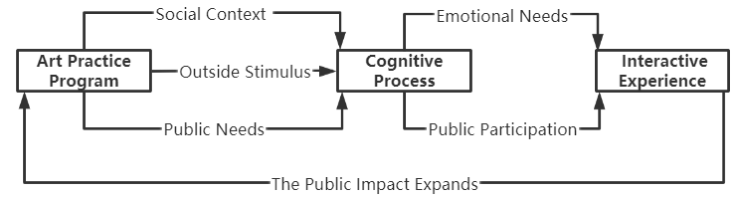
Public Interactive Experience The interactive experience is created between the subject and the object as a result of interaction, while the physical and mental changes are reactions based on the situation. The formation of interactive experience cannot be separated from the subject’s perception and cognition of the object, which is formed after the subject develops awareness of the event. Sensory subject also includes feeling and cognition (Du Xiaoru, 2020). Feeling is the reaction to the object’s own properties, while cognition is the comprehensive embo- diment of the subject’s properties on the basis of feeling, and this cognitive process starts from feeling and perception, including thinking, memory, ima- gination and speech. In the process of social participatory art, cognition is a kind of information processing process when the public is exposed to and understands the art practice plan, which is the most basic mental process of the public. Social participatory art needs to be based on specific social contexts and public needs in order to propose art practice programs that are suitable for the target community. If the practice program can make the public gain empathy more quickly, then the fluidity of this cognitive pro- cess inadvertently increases the public’s interest in the practice program (Liu Yuedi, 2012). When native art is used as a form of interactive experience, the absence of cultural experiences increases the public’s participation in the art practice program, and the creation of native art does not stick to a single
156 Zhang
Figure 1: Formation mechanism of interactive experience.
form or style, and can it helps to inspire individual creativity and imagina- tion, generating strong and infectious positive interactions, providing new possibilities for narrative and expression in this practice, and the participa- tion of the public in Art Brut as a form of interactive experience brings a more three-dimensional and richer experience for the public. And as the number of participants in this art practice begins to grow, the public impact expands (Claire Bishop, 2004).
Therefore, the public is defined in the social participatory art intera- ctive experience link as the public as the implementation subject, and the interactive experience process is shown in Figure 1.
Art Practice Program Through the analysis of the formation process of audience experience, it is understood that the interactive experience of the audience comes from exter- nal stimuli. In Xu Bing’s work “Forest Project”, the external stimulus to which visitors are exposed is the “Forest Project” social participatory art practice project. Through the social participatory art approach, Xu Bing inte- rvenes in the local environmental protection issues and conducts interactive art projects for the public, guiding individuals to understand the worst rea- lity of the local natural ecological conditions through their attention to the social issues raised (Du Xiaoru, 2020). During the fieldwork, Xu Bing also saw that the efforts of the local government’s deputy minister of resources in restoring the green belt of the mountains were not accepted by the local citi- zens, as the local government had implemented a policy of letting the villagers cultivate the land for 100 years, replanting trees for them, and then letting them redistribute the new farmland after the trees had grown, which was now abolished by the deputy minister of resources. Apparently, the revoca- tion of the local policy by the deputy minister to gradually restore the national forest green belt project did deal with some of the local ecological problems, but ignored the basic rights of local people, and at the same time, there are many environmental foundations in the Republic of Kenya, but most of them operate by requesting funding from other governments to complete conserva- tion projects, so Xu Bing also believes that such projects are not a long-term solution, and that they lack a functional link to generate their own blood (Liu Yuedi, 2012). Xu Bing plans to design a dialogical and interactive pro- cess as a curator, and to adopt a self-loop mode of thinking in the whole social participatory art practice project. This will further expand the impact
Design of lnteractive Experience on Participatory Art Based on Art Brut Form 157
of this socially participatory art, and also serve as a stronger call to action for environmental protection (Zhang Lei, 2009).
Cognitive Process The initiation of this kind of art practice requires the active participation of different groups, and public interaction and communication is the core of this art practice. Through the symbols, the children create Art Brut forms based on the theme of trees, and the viewers are no longer spectators, but have become parties to the project. In the process, they have become empa- thetic and more concerned about the current state of the local environment and social development. With this impetus, more people want to know the stories behind the scenes and turn their attention to the process of the forest project. The purchasers are having an equal dialogue with the local partici- pants, reacquainting themselves with the local culture and natural landscape through the Art Brut form of painting.
Interactive Experience The artist initiated the project by calling on children to portray trees and the environment through the creation of Art Brut, and all those involved had a say in the project. By guiding children to use a simpler symbolic visual langu- age to freely express the ecology of the trees in their own eyes, the resulting original artworks are not merely aesthetically limited to the material form of the original works, but also promote the interaction between human and natural ecology through art, generating aesthetics in the communication rela- tionship. At the same time, Xu Bing himself has also drawn inspiration from the primitive paintings of children, blurring the specific image of the Kenyan natural landscape itself and pursuing a simple expression by integrating the characteristics of local history and culture, and has also painted a number of paintings to be exhibited together with the children’s paintings (Du Xiaoru, 2020). Many of the children are new to painting and are very young in their approach, but at the same time, they are passionate and naturally release their emotions. The children’s ideas are conveyed to more people who are interested in this art event, and the public is attracted to explore the meaning behind the abstract expressions of these indigenous artworks, which in effect increases the curiosity of others about the local culture and further expands the scope of the works.Socially-engaged art in the form of Art Brut enables the public to understand the social meaning behind the art project and form an emotional resonance.
Forest Project is an important bridge between various groups of people, and it also promotes dialogues between the participants. First, there is the exchange between the children and the buyers in the natural disaster area (Lin S.H.and Li L.L., 2021). Although many of the children were new to paint, they were curious and excited about art. The children are able to create art with their own hands, transmitting their ideas and culture to the purch- asers, who in turn gain an understanding of the local culture, not just in the form of donations, but in a dialogue that is fair. The unique communicative character of socially-engaged art allows the public to not only communicate
158 Zhang
and collaborate with the artists, but also to empathize with the other groups involved (Wang Hongyi, 2012). During the execution of Forest Project, the addition of Art Brut makes the interactive experience of this social partici- patory art without a “threshold”, after the communication between people, society, and the environment. The main experience of each party in the pra- ctice through the space created by the artist to interpenetrate each other to produce communication. This kind of communication is exactly the meaning of this socially participatory art practice.
CONCLUSION
This paper analyzes the public interactive experience of socially participatory art in the form of Art Brut, compares the relationship between Art Brut and socially-engaged art as well as their developmental streams, and examines the specific ways of public participation. Through the continuous search for the matching points between Art Brut and socially-engaged art, and the in-depth analysis of the process of public participation and presentation of Art Brut forms in specific practical cases, the project finds that the direct emotional resonance required by socially-engaged art in promoting public participation has something in common with the creative characteristics of Art Brut forms, which ultimately point to the pure communication of ideas and emotions.
In this era of individuality and self-expression, social participatory art in public areas should focus on the uniqueness of the individual and take the practicality of public participation into account. Social participatory art draws on the “originality” of native art and uses the form of Art Brut to reflect on it, thus combining the two in a creative way and giving social participatory art inspiration and influence in the design of interactive expe- riences. In addition, the creation of native art does not require participants to master relevant art theories and skills, which can provide a driving force for the public nature of social participatory art, attracting public participa- tion and expanding influence, and providing ideas for public participation in interactive experience design in the public sphere.
REFERENCES Chen Xiaoyang, (2017) A kind of neo-realism:the way in and out of socially engaged art. Fine Art Observation. 12. pp. 23–25. Claire Bishop, (2004) Antagonism and Relational Aesthetics.October . Du Xiaoru, (2020) A study on the audience experience of participatory art in con-
temporary society: the example of Xu Bing’s The Woodland Forest Project. Design Art Research. 10(04). pp. 125–128. Lin S.H., Li L.L..(2021) Folk creativity in daily life and communicable urban construction: a case study based on social site art. Journalism. (08). pp. 38–48. Liu Yuedi, (2012)”Public Art” and “Public Interest” . Public Art.(6). pp. 42–51. Shen Xiaonan, (2019) Participatory art in China and its problems. Artwork. (06).
pp. 16–18. Wang Hongyi, (2012) “Aesthetics of Life”in Public Art: An Interview with Liu Yuedi.
Public Art.(1). pp. 56–60. Zhao Cheng, Shao Xiao Feng, (2016) Visual art therapy based on psychodynamic and social-humanistic orientation. Xuehai.(04). pp. 212–216. Zhang Lei, (2009) Who has destroyed the “publicness” in public art? Art Watch. (6).
pp. 22–23.
LISTED IN THE AHFE DIGITAL BOOKSTORE CATALOGUE
Explore the complete digital volume
Design for Inclusion
Read this individual research paper free through the original publisher, or explore the full digital proceedings book.
ISBN 978-1-958651-21-6
Explore this ISBN in the AHFE Bookstore ↗Listed in the July 2026 bookstore catalogue; search by ISBN to confirm current availability · Digital book purchase optional