Lina Xu, Haichuan Lin, Menglu Wang, Meng Nie (2025). The New Fear of Missing Out (FOMO): Reflecting on the Human Impact of Overly Positive Social Media Through Interactive Installation. In: Human-Computer Interaction & Emerging Technologies. AHFE Open Access, vol. 195, pp. 190–201. https://doi.org/10.54941/ahfe1006237
Fear of Missing Out (FOMO) is a psychosocial phenomenon characterized by anxiety over missing an event, activity, or opportunity, particularly when it is perceived to offer pleasure or value. The rise of social media has amplified this anxiety, as individuals are exposed to idealized portrayals of others’ lives, which can lead to feelings of dissatisfaction. Traditionally, people have attempted to mitigate FOMO by avoiding comparisons with others’ seemingly perfect lives. However, this strategy has become less effective due to evolving forms of FOMO. In modern society, FOMO is no longer confined to worrying about the activities of others; it now extends to the creation of positive content that individuals compare themselves to. When personal experiences fail to meet these idealized standards, anxiety and frustration ensue. This shift in FOMO dynamics complicates individuals’ ability to recognize and address their distress. As a result, new forms of FOMO have a profound impact on mental health and self-identity, mirroring the challenges faced in the pursuit of an idealized existence. Social media offers individuals the freedom to envision their potential, but this freedom paradoxically fuels anxiety. To explore this emerging form of FOMO, this project began with a formative study to identify the key factors of overly positive media that influence individuals. Based on these insights, a visual model was created to represent self-construction in social media, and a storyboard was developed to illustrate how people self-construct positive content. An interactive installation was then designed to simulate the process by which individuals unconsciously fall into self-comparison. Feedback from user experiences was collected to further optimize the design. The installation aims to raise awareness of new forms of FOMO, promote reflection, and encourage behavioural change. Ultimately, the project seeks to deepen public understanding of how modern FOMO impacts mental health and assist individuals in developing a more authentic relationship with social media.
Fear of missing out (FOMO) is a social phenomenon characterized by anxiety over missed experiences, often fueled by social media comparisons (Tanhan et al., 2022). This anxiety arises when users compare their lives to the idealized experiences portrayed online or become aware of opportunities others enjoy (Argan et al., 2018). Such comparisons can lead to adverse effects, including decreased focus and increased stress levels (Busch, 2016). Despite its prevalence, research has shown that individuals can mitigate FOMO by refraining from social comparisons, recognizing that idealized portrayals are often misleading, and understanding that shared images do not fully capture a person’s reality (Dossey, 2014; Oettingen, 2015).
However, these coping strategies may no longer be sufficient in today’s social landscape, which increasingly emphasizes self-fulfillment and relentless positivity. Social media has evolved accordingly, no longer merely presenting idealized lives but also promoting empowerment: ‘You can achieve this too.’ The fear of missing out has shifted—from missing social events to missing out on an ideal life itself (Burnell et al., 2019; Hodkinson, 2019). This shift has contributed to the rise of an ‘excitement society’ (Böhme, 2018), where constant stimulation and aspirational messaging dominate, reinforcing the belief that limitless opportunities are within reach.
In this environment, individuals engage in self-comparison not out of external pressure but by choice (Beyens et al., 2016). Unlike traditional FOMO, which stemmed from comparisons with others, this new form arises from aspirations toward an envisioned, idealized self (Abel et al., 2016; Roberts and David, 2020). While it may seem different, it ultimately mirrors previous social comparisons. However, the resulting anxiety is no longer caused by others’ perceived perfection but by the expectations individuals set for themselves. The frustration stems from believing that these aspirations are attainable, making it harder to disengage from self- comparison. Instead of fearing others’ success, individuals now fear falling short of their own imagined potential, becoming the architects of their own discontent (Rehman, 2016).
A key challenge in digital environments is recognizing and disengaging from this self-imposed FOMO. Exposure to curated positivity fosters a cycle where individuals continuously seek self-validation and optimization, often at the expense of critical reflection on social behaviors, values, and mental well-being. This study introduces an immersive platform designed to illustrate how curated perfection shapes self-construction in digital spaces. By visualizing these mechanisms, the platform fosters awareness of participation in this cycle and offers opportunities for disengagement.
The research follows a structured approach, beginning with a formative study on the psychological impact of excessively positive media content. Based on these findings, a self-construction model was developed to conceptualize this phenomenon, mapping key factors within a quadrant coordinate system. This framework visually represents the pervasive influence of curated perfection on self-perception. To further illustrate these dynamics, an interactive installation was designed using a three-stage storyboard, simulating the processes of content attraction, self-construction, and eventual disengagement.
This study makes three key contributions:
A formative study identified the factors contributing to and the psychological impacts of excessively positive media content.
A self-construction model was proposed to visualize the role of curated content in shaping self-perception within social media environments.
An interactive installation was implemented to simulate the unconscious process of self-construction and comparison, offering insights into mechanisms for disengagement.
RELATED WORK
Early conceptualizations of the fear of missing out (FOMO) define it as anxiety stemming from unawareness of valuable social experiences, missing important events shared on social media, or noticing the absence of oneself in friends’ photos, leading to negative emotions (Reer et al., 2019; Tanhan et al., 2022). Later, FOMO was redefined as a harmful social comparison, characterized by anxiety over the possibility that others may be engaging in more fulfilling or extraordinary experiences (Erci¸s et al., 2021). Several factors contribute to this phenomenon, including the inherent curiosity of individuals (Przybylski et al., 2013; Yang et al., 2021) and the heightened sense of competition within modern society (Tanhan et al., 2022).
Individuals experiencing FOMO often exhibit common behavioral patterns. Many frequently check their phones and carry chargers to avoid disconnection, fearing that a depleted battery may result in missing important updates (Ho¸sgör et al., 2019). Others struggle with the inability to keep up with social experiences presented in virtual spaces, leading to feelings of social exclusion. These behaviors contribute to adverse effects such as reduced concentration, procrastination, and increased stress levels (Busch, 2016). Additionally, FOMO has been associated with anxiety, fatigue, and
The New Fear of Missing Out (FOMO) 193
physical and sleep-related issues, particularly among students (Milyavskaya et al., 2018; Oberst et al., 2017).
To mitigate the effects of FOMO, researchers have proposed various strategies. Barker suggested that individuals should cultivate self-awareness (Barker, 2016), focus on personal interests, and avoid social comparisons in moments of distress, recognizing that all individuals experience both positive and negative emotions. Similarly, Dossey emphasized the importance of mindfulness, advocating for an appreciation of the present moment rather than the idealized realities portrayed on social media (Dossey, 2014).
Despite these proposed countermeasures, the transition toward a meritocratic and excitement-driven society has intensified the impact of FOMO (Shin, 2024). The aspirational lifestyles and boundless possibilities presented on social media encourage individuals to actively align themselves with curated ideals. In this context, merely prioritizing a simple and content life becomes insufficient, as the act of self-construction based on these ideals’ shapes personal reality (Baker et al., 2016; Rehman, 2016).
Addressing this phenomenon requires deeper awareness and critical reflection. Through immersive installation art, the mechanisms underlying this new form of FOMO can be made tangible, enabling individuals to recognize their unconscious participation in self-comparison and idealization. Rather than perceiving themselves as powerless within this cycle, fostering active awareness provides a means of reclaiming agency in shaping personal perceptions and emotional responses.
FORMATIVE STUDY Study Design
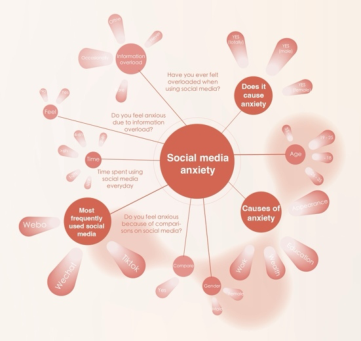
This study examined the impact of overly positive social media content on users’ daily lives, focusing on the extent, range, and contributing factors leading to anxiety. A 20-item questionnaire explored frequently used social media applications and the life aspects most affected by such content. Sixty participants aged 15–65, completed the survey.
Results and Findings Effects of Idealized Social Media Content on Daily Life The findings (Figure 2) indicate that idealized social media portrayals significantly influence daily life and contribute to anxiety. Among the 60 participants, 50 reported experiencing anxiety due to such content, with 23 describing a moderate impact and 27 citing significant disruptions in academic or professional activities.
Participants identified key sources of distress, particularly idealized representations in fashion, travel, and fitness content. One respondent described frustration with fashion and travel imagery, noting that despite purchasing identical clothing from the same locations, the results often failed to meet expectations, leading to self-doubt: “People share beautiful images, along with location details and fashion choices, making others want to recreate the same look. However, despite purchasing identical clothing
from the same location, the results differ. The person who posted the image cannot be blamed—the clothes and location remain the same—but the realization emerges that personal imperfections prevent achieving the same aesthetic.” Similarly, fitness-related content was cited as a source of pressure. Another participant expressed difficulty maintaining an idealized exercise regimen, stating: “Individuals with well-toned physiques post workout videos, implying that similar results can be attained through consistent exercise. However, maintaining such a regimen proves challenging for many, leading to self-criticism for a perceived lack of discipline. External factors such as work and academic obligations interfere with consistent practice, yet admitting this remains difficult.” Despite these challenges, some participants acknowledged that such content is often intended to inspire rather than provoke jealousy. However, the perceived unattainability of these idealized portrayals remained a source of distress: “These posts are not necessarily meant to provoke jealousy but rather to inspire self-improvement. However, the struggle arises when the goals they promote feel unattainable.”
Figure 2: Formative study.
Coping Mechanisms for Anxiety Induced by Overly Positive Content Among the 50 participants who experienced anxiety, 22 continued to struggle with its effects. Seventeen attempted to cope by accepting personal limitations, though this process was described as distressing due to the prevailing belief that “if others can achieve it, so can I.” The remaining participants mitigated anxiety by shifting focus to other aspects of life, though intermittent FOMO (Fear of Missing Out) persisted, particularly regarding an idealized lifestyle.
Types of Content With the Greatest Influence Analysis identified 13 content categories most associated with anxiety, with the top four being: 1. Education – The most anxiety-inducing content,
The New Fear of Missing Out (FOMO) 195
particularly for students and early-career professionals. 2. Work – Career- related portrayals heightened pressure to succeed. 3. Appearance – Idealized beauty standards contributed to self-comparison. 4. Wealth – Displays of affluence reinforced perceptions of inadequacy. Frequent social media users, particularly young individuals in academic and early career stages, were most affected by FOMO.
VISUAL DESIGN Coordinate Axis of Self-Construction
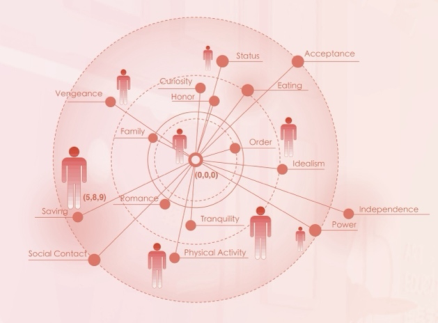
A coordinate axis was developed to visually represent how individuals position themselves relative to idealized portrayals on social media (Figure 3). The placement of each point signifies a constructed self-perception, while surrounding points represent influential life possibilities identified through formative research. Inspired by Lacan’s mirror theory, which describes how an infant’s first encounter with its reflection initiates self-awareness, this design illustrates how social media similarly presents curated ideals that shape identity construction.
Figure 3: Coordinate axis of self-construction.
Interaction and User Experience The interactive visual design responds dynamically to user movement. When individuals move away from idealized portrayals, the reference points appear smaller and more ambiguous, encouraging engagement. Approaching an ‘ideal’ self-position causes these points to become clearer, eventually surrounding the user. At the center, a real-time image is displayed, juxtaposing the authentic self against the constructed digital identity.
Conceptual Implications The visualization underscores how social media fosters a deceptive sense of autonomy and self-definition. Just as an infant’s reflection offers only
an imagined wholeness, idealized online portrayals lead to misrecognition— where external attributes are mistaken for intrinsic qualities, and borrowed ideals shape self-perception. This aligns with Lacan’s concept of ‘alienation,’ in which individuals internalize an idealized identity yet struggle with a disconnect between self-image and lived experience. Ultimately, this mirrors the paradox of Narcissus—drawn to his reflection yet unable to fully embody it—highlighting the tension between admiration and frustration in digital self-construction.
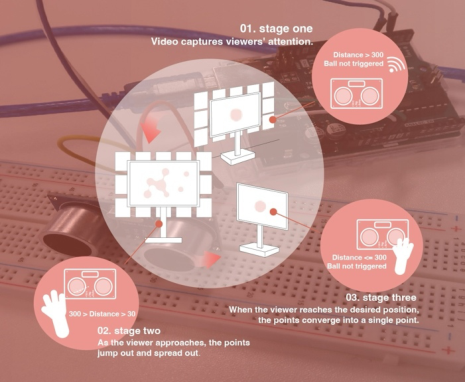
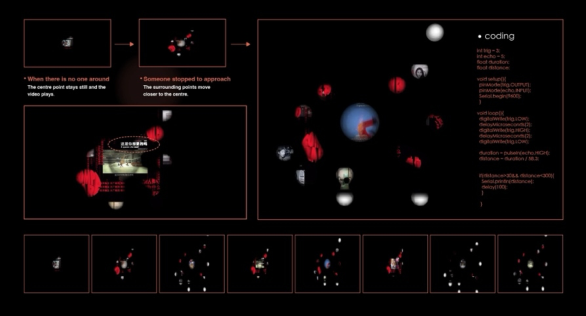
Storyboard The storyboard, depicted in Figure 4, consists of three stages illustrating how individuals become immersed in Fear of Missing Out (FOMO) through exposure to idealized portrayals. It simulates the psychological progression of self-construction within social media environments.
Stage 1: Initial Attraction The installation presents curated videos of ‘perfect lives’ to capture attention. At this stage, the display remains a single, inactive visual field, symbolizing initial engagement with aspirational content.
Stage 2: Immersion in Idealized Content As the audience moves closer, the display fragments into dispersed points that dynamically shift in response to movement. Increased proximity enhances the visibility of video content while further scattering the points, creating a surrounding effect. This stage represents the deepening engagement with idealized portrayals, leading to FOMO as individuals strive to refine their constructed self-image.
The New Fear of Missing Out (FOMO) 197
Stage 3: Self-Recognition and Reflection Upon reaching the ‘ideal’ position, the dispersed points converge into a single focal point, revealing the audience’s real-time image alongside the question: “Are you constructing your ‘behind-the-scenes’ based on someone else’s ‘highlight reel’?” As the audience moves away, the points tremble before gradually returning to their original state. This final stage signifies the recognition of the gap between one’s authentic self and a digitally constructed identity, prompting critical reflection on self-perception.
The visual outcome of this storyboard is presented in Figure 5.
Figure 5: Audience view of storyboard.
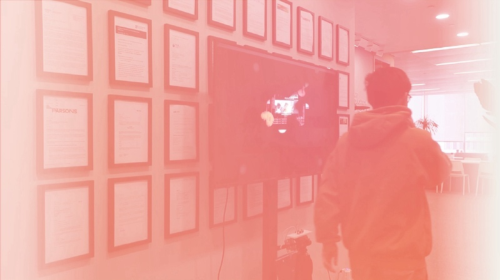
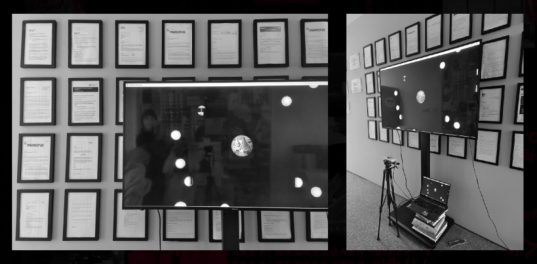
INSTALLATION The interactive sensing installation, FOMO, is depicted in its final preview in Figure 6. The video content, curated from formative research and online sources, represents the most influential overly positive narratives contributing to FOMO. These narratives span various themes, including social news, documentaries, motivational speeches, and personal accounts from bloggers. To enhance immersion, key phrases were carefully selected, edited, and spliced together. The final composition integrates success stories with an audio loop designed to evoke subtle discomfort, reinforcing the intended emotional impact.
Positioned within a school corridor—an environment where individuals frequently engage with aspirational content—the installation featured an “offer wall” displaying notions of ‘excellence’ and ‘success.’ A video installation showcasing prominent success stories was placed in front of this wall, prompting viewers to pause and reflect on their achievements in comparison. This setup was designed to heighten awareness of how individuals unconsciously immerse themselves in FOMO, encouraging deeper reflection on self-identity and social comparison.
To enhance interactivity, an Arduino-based distance sensor was integrated, allowing real-time adjustments to the display in response to viewer proximity.
Figure 6: Final preview of the interactive sensor installation ‘FOMO’.
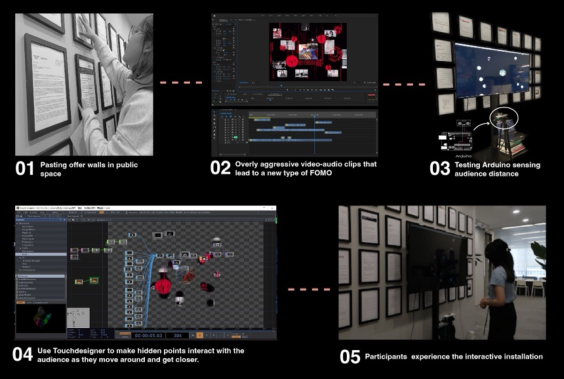
Using Touch Designer, hidden elements within the display dynamically responded to movement, with dispersed visual points converging as viewers approached. This interaction was designed to capture attention and guide users toward concealed content embedded within the videos.
By fostering an immersive experience, the installation underscores the importance of critical thinking in navigating FOMO’s influence. Beyond raising awareness, it encourages individuals to shift from passive comparison to active self-reflection. The development process of this interactive sensory installation is illustrated in Figure 7.
Figure 7: The process for making this interactive sensing installation.
USER FEEDBACK AND REFLECTIONS The installation was widely praised for its ability to transform the abstract concept of FOMO into an immersive, tangible experience. The interactive elements, particularly the act of approaching or distancing from the display,
The New Fear of Missing Out (FOMO) 199
effectively illustrated the self-comparison mechanisms triggered by overly positive social media content.
The final stage, which contrasted the viewer’s true self with idealized portrayals, prompted critical reflection on personal social media habits and self-image formation. This confrontation encouraged a reassessment of how online representations influence self-perception.
Educators and students highlighted the installation’s value in exploring social media’s psychological impact, especially for younger audiences. While feedback was largely positive, suggestions for improvement included broadening the range of social media content and incorporating practical strategies, such as follow-up workshops or informational resources, to help mitigate FOMO.
DISCUSSION AND CONCLUSION The interactive installation effectively translated the abstract concept of FOMO into a tangible experience, demonstrating the potential of interactive art in fostering awareness, critical thinking, and behavioral change. Physical engagement deepened participants’ connection with the material, underscoring the value of interactive approaches in educational and therapeutic contexts.
While the installation primarily highlighted the negative effects of overly positive social media content, it is essential to recognize its motivational potential. Aspirational content can inspire personal growth, yet its self- aggrandizing nature often promotes unattainable standards, fostering anxiety and self-doubt. Shifting perspectives to view such content as inspiration rather than an obligatory benchmark is crucial for maintaining a balanced self-perception.
Participants exhibited varied emotional responses, ranging from discomfort to enlightenment, reflecting the complexity of individual experiences with social media. While some found the experience unsettling, this discomfort often encouraged self-reflection, aligning with research on the transformative potential of confronting cognitive dissonance.
Feedback highlighted areas for refinement, including broadening the scope of social media content to enhance inclusivity and integrating follow-up resources such as workshops or informational materials. Future iterations should address these considerations, further strengthening the installation’s role in promoting healthier engagement with digital content. By fostering awareness of FOMO’s psychological mechanisms, this work contributes to a deeper understanding of social media’s influence and encourages a more mindful approach to online interactions.
ACKNOWLEDGMENT
We would like to acknowledge the participants and audiences who took part in this study.
REFERENCES
Abel, J. P., Buff, C. L. & Burr, S. A. 2016. Social media and the fear of missing out: Scale development and assessment. Journal of Business & Economics Research, 14. Argan, M., Argan, M. T. & ˙Ipek, G. 2018. I Wish I Were! Anatomy of a fomsumer.
˙Internet Uygulamaları ve Yönetimi Dergisi, 9, 43–57. Baker, Z. G., Krieger, H. & LEROY, A. S. 2016. Fear of missing out: Relationships with depression, mindfulness, and physical symptoms. Translational issues in psychological science, 2, 275. Barker, E. 2016. This is the best way to overcome fear of missing out. Time Magazine. Beyens, I., Frison, E. & Eggermont, S. 2016. “I don’t want to miss a thing”:
Adolescents’ fear of missing out and its relationship to adolescents’ social needs, Facebook use, and Facebook related stress. Computers in human behavior, 64, 1–8. BÖhme, H. 2018. Müdigkeit, Erschöpfung und verwandte Emotionen im 19. und frühen 20. Jahrhundert. Fuchs, T., Iwer, L. & Micali, S. (Hg.): Das überforderte Subjekt–Zeitdiagnosen einer beschleunigten Gesellschaft, 27–51. Burnell, K., George, M. J., Vollet, J. W., Ehrenreich, S. E. & Underwood, M. K. 2019.
Passive social networking site use and well-being: The mediating roles of social comparison and the fear of missing out. Cyberpsychology: Journal of Psychosocial Research on Cyberspace, 13. Busch, B. 2016. Fomo, stress and sleeplessness: are smartphones bad for students.
The Guardian. Dossey, L. 2014. Fomo, digital dementia, and our dangerous experiment. Explore: The Journal of Science and Healing, 10, 69–73. Erci¸S, A., Deligoz, K. & Mutlu, M. 2021. Ö˘grencilerin FoMO ve plansiz satin alma
davrani¸slari üzerine bir uygulama. Atatürk Üniversitesi ˙Iktisadi ve ˙Idari Bilimler Dergisi, 35, 219–243. Hodkinson, C. 2019. ‘Fear of Missing Out’(FOMO) marketing appeals: A conceptual model. Journal of Marketing Communications, 25, 65–88. Ho¸SgÖr, H., Ho¸SgÖr, S. K. T. D. G. & Tando ˘Gan, Ö. 2019. Üniversite ö˘grencileri arasında sosyal medyadaki geli¸smeleri kaçırma korkusu yaygınlı˘gının farklı de˘gi¸skenler açısından incelenmesi. Journal of Academic Value Studies, 3, 213–223. Milyavskaya, M., Saffran, M., Hope, N. & Koestner, R. 2018. Fear of missing out:
Prevalence, dynamics, and consequences of experiencing FOMO. Motivation and emotion, 42, 725–737. Oberst, U., Wegmann, E., Stodt, B., Brand, M. & Chamarro, A. 2017. Negative consequences from heavy social networking in adolescents: The mediating role of fear of missing out. Journal of adolescence, 55, 51–60. Oettingen, G. 2015. Rethinking positive thinking: Inside the new science of
motivation, Current. Przybylski, A. K., Murayama, K., Dehaan, C. R. & Gladwell, V. 2013. Motivational, emotional, and behavioral correlates of fear of missing out. Computers in human behavior, 29, 1841–1848. Reer, F., Tang, W. Y. & Quandt, T. 2019. Psychosocial well-being and social media
engagement: The mediating roles of social comparison orientation and fear of missing out. New Media & Society, 21, 1486–1505. Rehman, J. 2016. We Have Become Exhausted Slaves in a Culture of Positivity. Roberts, J. A. & David, M. E. 2020. The social media party: Fear of missing out (FOMO), social media intensity, connection, and well-being. International Journal of Human–Computer Interaction, 36, 386–392.
The New Fear of Missing Out (FOMO) 201
Shin, J. 2024. Jenseits der “Müdigkeitsgesellschaft”: Vita activa un Vita contemplativa in Robert Musils Roman Der Mann ohne Eigenschaften. Robert Musil in Ostasien. Brill Fink. Tanhan, F., ÖZok, H. ˙I. & Tayiz, V. 2022. Fear of missing out (FoMO): A current review. Psikiyatride Guncel Yaklasimlar, 14, 74–85. Yang, H., Liu, B. & Fang, J. 2021. Stress and problematic smartphone use severity:
Smartphone use frequency and fear of missing out as mediators. Frontiers in Psychiatry, 12, 659288.
Read this individual research paper free through the original publisher, or explore the full digital proceedings book.
ISBN 978-1-964867-71-7
Explore this ISBN in the AHFE Bookstore ↗Listed in the July 2026 bookstore catalogue; search by ISBN to confirm current availability · Digital book purchase optional