Nanthawan Am Eam (2022). The Development of Muay Thai Training Game for Tourism 4.0. In: Human Factors in Virtual Environments and Game Design. AHFE Open Access, vol. 50, pp. 247–252. https://doi.org/10.54941/ahfe1002085
This research aims to develop game training kits for Muay Thai sports in order to make Muay Thai training a leisure exercise. The training armor is equipped with 5 sensors to measure stinging forces and 5 light signals. There are three levels of light jamming time, including 1 second for beginners, 0.8 seconds for intermediate skilled athletes and 0.5 for professionals. In the light of the light signal, there are 9 forms of sticking. The research has developed a force measurement system and a real-time transmission program system to be displayed on the screen. Score counts can be accumulated for the same escalation as playing games. 15 participants from athletes and trainers tested the training equipment, with three minutes of continuous sting tests in each round and six punches in total. The results showed that the training equipment has good performance. The transmission program system can display punches, scores and counts of punches in real time, and can be statistically recorded to know the development of the athletes. The participants suggested adding sensor installation points and faster light fixture times.
Muay Thai is a very popular martial arts for both Thais and foreigners who prefer exercise. Muay Thai exercises give you a healthy body and self-defense fighting skills. To meet the needs of consumers, more fitness facilities and boxing camps are open. According to a 2019 survey conducted by the Mini- stry of Tourism and Sports, there are 1,762 boxing camps in Thailand. For Muay Thai camps abroad, Surveys from the Consulate General and the Royal Thai Embassy have been conducted. The Ministry of Foreign Affairs found that there were 3,869 Muay Thai camps. It is distributed in 36 countries, with the five countries with the most Muay Thai places: Brazil with 1,631, Iran, 650, India 256, 220 Morocco, and the United States, only California, Nevada and Illinois, 190. Modern Muay Thai training is a practice. Trainees can be divided into two categories: 1) as a training exercise to fight as a Com- mercial Martial Art Fighting Contest, and 2) as exercise exercises. According to an interview with Mr. Prem Busarakamwong, The owner of Fairtex Sports Club & Hotel in the TAT Tourism Journal magazine found that 80 percent of Muay Thai trainees at Fairtek Boxing Camp are leisure exercises to streng- then their bodies and body shape. This group does not require heavy kicks or punches, but it focuses on free sparing training, such as fast, fast kicking
or punching, which helps with healthy weight loss and only 20 percent of them are competitive drills. Muay Thai training therefore needs to be resh- aped or redefined by adapting the training style to the era. It offers more opportunities for people of all ages to experience Muay Thai.
RESEARCH OF MUAY THAI TRAINING EQUIPMENT It has state-of-the-art and convenient training equipment to meet the needs of customers and manage consumer expectations. Studies have been developed that can measure the force of the sting. For example, research by Nantha- wan, Seri, Surawet and Krisda (2010) researched the development of a series of force and response time measurement tests in Taekwondo sports. Five sen- sors and signal lights are installed in taekwondo training vests to measure the strength and response time of the athlete during training. The results sho- wed that the force sensor can redden the sting, but the sensor has no sting fastness, causing damage to the sensor. In addition, research in training kits focuses on the installation of sensors in training kits to measure points used for taekwondo events such as Patrick Kane and faculty (2005) study the use of wireless sensors to rate the international boxing training system. The main of the sensor body and the network linkage of the sensor, which is mounted on the head. Athlete’s torso and hand. Hamayan Ahmad Sai (2002) studied the device in the scoring system of martial arts sports and used the location point of the attack attached to the plate, which is attached on the area vulne- rable to attack at the time of the competition. The device consists of a plate mounted in the chest area and a protector to the athlete’s head, combined with the attack’s location point system. The device also uses electronically run attack location points. Douglas Lovesion (2004) invented a scoring tool in combat sports, which users can wear while competing to measure the num- ber of times a force impact hits the attack’s position. The device consists of a section of the shirt and a plate attached to the chest, which can be attached to the body. The studies have shown that the development of game-style trai- ning kits for recreational training has not yet evolved concretely. This research aims to develop a training kit equipped with sensors and signal lights in the vest, as well as developing a game-based signal light mounting pattern, as well as signaling to display real-time drills, and being able to collect training data for promotion in the same way as gaming. This developed training kit is a fun training device. Challenge and encourage finesses to continue to deve- lop their abilities, strengthening the way Muay Thai tourism is developed in Thailand and abroad.
RESEARCH METHODOLOGY Training Armor Design
The research began by surveying and collecting information on the needs of designing and developing training armor training kits from boxing camps and Muay Thai clubs from universities. Number 121 people from 22 places and take the information that is the basis for the design of the training kit, using the user center according to the ergonomic principles, with the installation
The Development of Muay Thai Training Game for Tourism 4.0 249
position of the sensor in the training kit, 5 points installed at the point where the athlete performs regular punches according to the athlete’s training. Sen- sor mounting points include: the upper center of the body (A), the center of the lower body (B), the center of the body (E), the left side point under the milk rail (C) and the right side point under the milk rail (D) are equipped with a signal light on the sensor to measure the response time of the athlete’s signal light. A signal light used in green to encourage practitioners to punch at the sensor with a sense of security. The response time to the signal light starts, measured from the time the signal light is on until the athlete punches to extinguish it. The response time of the signal light indicates the sensitivity of the athlete to stimuli. The signal light holds for 0.8 seconds and 1 second according to the time of the indicator’s exposure to the eye and hand response meter.
Research Participant This research was tested using game-based training kits in Muay Thai sports. 15 testers, 8 females and 7 males, were school athletes and university athletes. 8 trainers, 3 trainers and 2 athletes and fitness subjects.
Experiment The athletes tried to punch the sensor-attached area to extinguish the fire, with a variable to study: a sting force. Athlete sting time for a specified period of time. The sting score and number of misses were missed, with the athletes performing a minute of armor stinging exercises before the test, familiarizing themselves with the training armor before the actual test. The athletes perfor- med a total of six rounds at three minutes each with a continuous sting, and the athletes repeated two tests, with each test time at least 48 hours apart to give the athlete’s muscles time to recover.
Data Analysis Analyze data from tests with Paired T Test statistics. Sting force, punching scores, and the number of missed stings.
RESULT
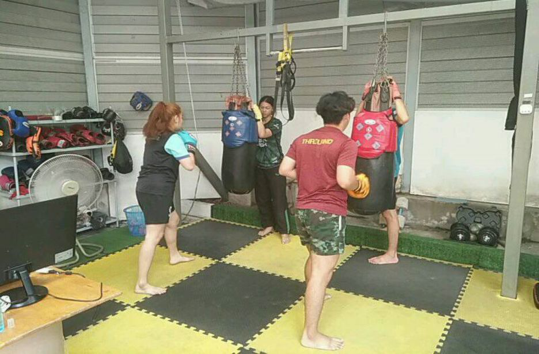
The training armor is equipped with a sensor with 5 control points along with the light to show the point where the Muay Thai trainer must kick or punch to put out the light at that point. As shown in Figure 1.
Determination of the Average Wage of the Initial Sting This research tested the operation of sensors and display systems on the moni- tor in the operating room in order to set the default value of the force exerted on the sensor. The athlete performs the maximum sting with maximum force for 3 minutes and bring that stinging wage to the average. The test showed that the average initial force for a suitable sting was 1500 kilograms-force, or 14.71 kN.
250 Eam
Figure 1: Shows sensor mounting points and signal lights.Figure 2: Shows the athlete’s sting score and stinging force.Table 1. Athlete test results at 0.8 seconds of stalemate.
Table available in the original PDF paper.
Participant Test Force (KN) Score No Mode Fault Point A Point B Point C Point D Point E 1 1A 17.56 18.32 17.28 17.96 17.22 76 6 F 18.96 17.20 16.84 16.86 16.96 77 10 1C 18.01 17.95 17.38 16.64 17.81 53 12 G 17.94 18.70 17.30 18.45 16.85 61 29 E 16.64 18.06 18.86 18.47 17.84 52 25
This game-style training kit is counted to earn points used to promote the same format as gaming. The threshold for counting points consists of 1) athletes must punch with forces greater than the initial force of 14.71 kN, and 2) the accuracy of the sting is to punch the sensor at the point where the signal light is ignited. If the tester fails to touch the installed sensor or punches beyond the signal light’s mounting time, the result will show the
The Development of Muay Thai Training Game for Tourism 4.0 251
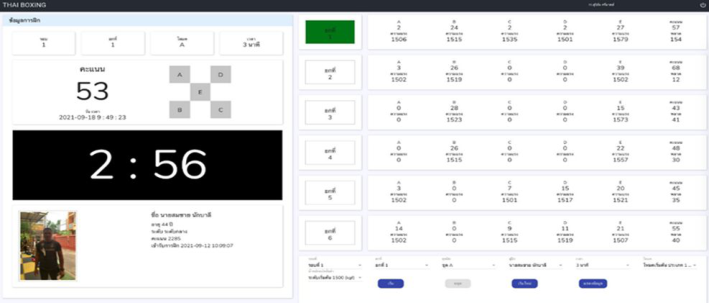
value in F, and the sting labor value is 0. Punch scores and stinging forces can be displayed in real time on the monitor screen. As shown in Figure 2.
Test results can send information displayed in an excel file to use for further statistical analysis. Samples of athlete test results can be shown in Table 1.
From Table 1, when testing the stinging force of students at each point, points A, B, C, D, and E, the average sting of each point was statistically dif- ferent at a significant level of 0.05 (P value = 0.61), which corresponds to the results of the analysis comparing averages by the Tukey Pairwise Com- parisons method. The results of the training can be used to analyze the development of the trainer.
CONCLUSION
Developing a game-based training kit for Muay Thai to make Muay Thai training a recreational exercise. It’s fun and accessible for all genders and reduce the violent image of Muay Thai. The development of training armor is equipped with five sensors for measuring stings and lights at the area where the athlete stings, including the upper midpoint (A), the center of the lower body (B), the center of the body (E), the left side point under the milk rail(C) and spots on the side of the right body under the milk rail (D). There are two levels of signal jamming, consisting of 1 second for beginners, 0.8 seconds for experts. The test uses a training kit in an engineering laboratory to test the operation of various systems and test the force to set the initial sting force. The optimum starting wage is 1500 kilograms-force or 14.71 kN to be used as a threshold for counting sting score. The score counting criteria is to punch the point at which the signal light is ignited in time for the signal to catch on and sting with a force of more than 14.71 KN. When training armor is taken for testing, 15 participants conducted a three-minute continuous sting test in each round and six punches and two repeat trials, with random switching the signal signal’s caught patterns and the signal jamming time. The results sho- wed that the training armor had good performance, was able to display the results of the punches, points, and the number of crashes that went wrong in real time and could be collected statistically to know the development of the training. Participants suggested to increased sensor mounting point and faster power signal mounting time. Training armor is pleasing to testers, especially foreign tourists who like it because they are enjoying it and want to speed up the signal light.
ACKNOWLEDGMENT
The authors would like to acknowledge Office of the Board of Science, Rese- arch and Innovation (NEC). The research team would like to thank you very much for supporting this research funding.
REFERENCES
Douglas Lovetion (2004) United State Patent No. US2004 /0009851 A1. Hamayan (2002) United State Patent No. 2002/0077223 A1 PIEZOTECH S.A.Data Sheet
252 Eam
Nanthawan Am Eam, Seri Tuprakai, Suravet Tocharoen and Krisda Pisalyabutr (2010) “Development of Force and Response Time Test Kits in Martial Arts Sports” Research Report, Research and Development Institute, Ramkhamhaeng University Research Funding 2010. National Tourism Policy Committee (2017). “National Tourism Development Plan
No. 2 (2017 – 2021) Website: https://www.ubu.ac.th/ Online magazine TAT Tourism Journal “Muay Thai Keep Fighting “ Website: http: //etatjournal.com/ Patrick Kane (2005) “A wireless-sensor scoring and training system for combative
sports”Materials, Nano and Micro-Smart Systems, Sydney, Australia.Proceedings Vol 5649, Smart Structures, Devices, and Systems II.Smart (2005).
LISTED IN THE AHFE DIGITAL BOOKSTORE CATALOGUE
Explore the complete digital volume
Human Factors in Virtual Environments and Game Design
Read this individual research paper free through the original publisher, or explore the full digital proceedings book.
ISBN 978-1-958651-26-1
Explore this ISBN in the AHFE Bookstore ↗Listed in the July 2026 bookstore catalogue; search by ISBN to confirm current availability · Digital book purchase optional