Gaku Sueta, Ryoto Kato, Yusuke Kikuchi, Vibol Yem, Yasushi Ikei (2022). Generation of Walking Sensation by Providing Upper Limb Motion. In: Human Factors in Virtual Environments and Game Design. AHFE Open Access, vol. 50, pp. 41–47. https://doi.org/10.54941/ahfe1002059
For an immersive first-person experience in a VR space, the user (or an avatar)needs to walk freely within the space because locomotion is essential and the basisfor a variety of activities. The present study investigates the arm swing of a user toinduce a bodily sensation during walking in a VR space. We built an arm swingdisplay that moves the upper limbs similarly to the motion appears in a real walking.The amplitude and flexion ratio of swing motion to present the sensation of virtualwalking were determined via the user study. The optimal swing angle and itsforward part ratio (flexion ratio) to create the sensation of a straight waking werearound 30 degrees and 54 percent, respectively. For a turning walking, the relationbetween the asymmetric flexion ratio of both arms and the curvature of a turningpath was also determined by an experiment.
For an immersive first-person experience of a virtual reality (VR) space, the ability to move freely within the space is an essential function and the basis for a variety of experiences. Since an ordinary body motion in a real space causes multisensory information, it is necessary also in the VR space for the display device to impart the user not only visual information of the VR space but also physical (bodily) information consistent with it. The VR experience or a mediated experience implies three types of spatial relations: own body-base experience, remote robot-base experience, and past person-base experience. The own body-base experience is an exploration of the VR world using an avatar reflecting self-body movement that causes multimodal sensation. The remote robot-base experience is the exploration of a remote world through the robot body movement that transfers sensor information to the VR display system to reproduce the same information to the user. The past person-base experience is to know via self-body what kind of world and sensations the past person experienced.
The last type is an important configuration in which the skills and tacit knowledge of others can be transferred to the user by reproducing their spa- tial experiences. Our system is the last type that renders multisensory stimuli to reproduce sensation of walking in a VR space (Ikei et al. 2014). In this
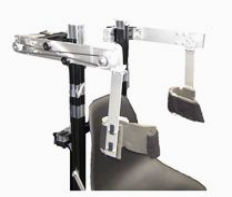
Figure 1: Arm swing display and the posture of the user.
type, as the experience was already performed and recorded in the past, the user can learn the content of the spatial experience but can not change it by executing a voluntary motion. The experience is passively transferred to the user via his/her own body motion. Unlike active walking in the case of the own body-base experience in a VR space (Boletsis, 2017), the body of the user is moved and controlled by the system to follow the past experience. This gives flexibility of user posture design of the display system. To enable long duration of the experience in addition to ease of control of the body, we adopted a sitting posture of the user who receives the sensation of walking motion.
Thus we have developed a multisensory display that included multiple modalities of vision, audition, proprioception, vestibular sensation, tactile sensation, and olfaction (Shimizu, 2018). In this paper, as part of the proprio- ception display, we introduce an arm swing display that imparts the sensation of walking by letting both arms swing by mechanical links and motors. The objective of this study is to investigate the method of arm motion presentation that can provide the sensation virtual walking.
ARM SWING DISPLAY We built an arm swing display device (see Figure 1) to present swing motion of arms during walking to a seated person. The motor at the rear of the seat produces the rotational force around the axis near the shoulder using a belt mechanism. A Velcro cloth band at the end of the link holds the upper arm to push and pull the upper limbs of the user passively to generate the sensation of walking. A possible range of link motion is 230° forward and 50° backward; the rotation speed is 0-120 rpm, and the maximum torque is 16 Nm.
Arm swing motion in a real walking is thought to arise mechanically passi- vely with trunk motion and reduces energy consumption (Meyns, 2013). This passivity of arm swing during natural walking may suggest that the mechani- cally activated passive arm swing plays a similar function to a real arm swing and imparts a natural sensation of walking.
GENERATION OF STRAIGHT WALKING SENSATION BY ARM SWING MOTION The amplitude of arm swing (angle) and flexion ratio were investigated through the user study to obtain an optimal profile of the swing motion that
Generation of Walking Sensation by Providing Upper Limb Motion 43
imparted walking sensation. The magnitude of stimulus that simulates the voluntary motion in this passive form was often smaller than the real motion but the amount of such a stimulus is not known. In addition, the profile of motion is not completely similar to the real swing. From our previous study, it is known that walking sensation depends on the flexion ratio which is the forward part arm swing within the total swing angle (Saka, 2016).
Optimal Swing Amplitude and Flexion Ratio The number of participants of the user study was ten; they were students of an average age of 22.5 years. The participant verbally altered the amount of swing angle and the flexion ratio to best produce the sensation of walking straight according to the procedure of the method of adjustment. The initial amplitude of the arm swing was four levels of {10, 20, 30, 40} degrees that were used in a random order, and the initial flexion ratio was constant at 50 %. The participant wore headphones that emitted white noise and kept their eyes closed during the stimulation.
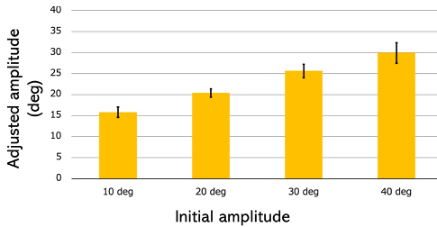
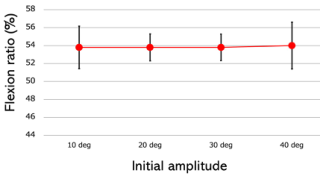
Figures 2 and 3 show the results of the swing amplitude and the flexion ratio. The amplitude increased from 16 to 30 degrees along with the initial angle. The flexion ratio was almost constant at 54 %. The one-way analy- sis of variance of adjusted amplitude indicated a significant difference for the factor of initial amplitude (p < .01) whereas the flexion ratio was not significant for the initial amplitude.
The adjusted amplitude changed with the initial amplitude looks conver- ging to a value around 20 degrees for unknown reasons. In addition, it is considered that the adjustment process had a hysteresis to the initial value to stick to the first stimulation, making a large difference among the adjusted amplitudes. The amplitude of a real (natural) walking and its flexion ratio measured in the past study using an optical motion capture device were 37.8 degrees and 38.3 %, respectively (Saka, 2016). The optimal swing magni- tude was smaller by more than 20 % than that of the real walking. This difference may be caused by the passivity of the arm swing where the active control of arms was not involved at all, and therefore the sensation of motion was not attenuated. Thus, a reduced amplitude is perceived as equivalent to natural arm motion. In addition, the optimal flexion ratio under the passive arm drive indicated a larger value of 54 % than that of a real walk (38.3 %). In a real walk, humans swing arms with a larger amplitude to backward than forward, whereas in a passive swing condition the arm swing goes more forward than backward. It is considered that the forward acceleration of a body in a real walk may have shifted the equilibrium point of the arm swing to the rear.
Walking and Moving Sensations by Arm Swing Display The walking and moving sensations were measured through the user study. Seven students of a mean age of 23.4 years participated in the experiment. The four arm motions obtained in the previous section were presented before the participant answered a questionnaire consisting of two visual analog scales that span from “no sensation” to “equivalent to real walking” and
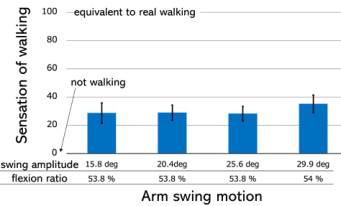
Figure 2: Adjusted arm swing amplitude.Figure 3: Adjusted flexion ratio.Figure 4: Sensation of straight walking. (N = 7).
“staying at the place” to “moving forward at the same velocity of a real walk”.
Figure 4 shows the sensation of walking in which no significant difference was observed. The mean level of walking sensation was around 30 % of real walking only by the arm swing stimulus. It is considerably large value because an ordinary arm motion is not voluntarily initiated and maintained but eventually originated with legs and body motion that is recognized as a voluntary motion.
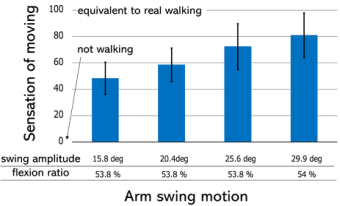
Figure 5 shows the sensation of moving where significant difference (p < .05) was observed. The sensation of moving increased almost linearly with the swing amplitude. From these results, we concluded that the ampli- tude of 29.9 degrees and a flexion ratio of 54 % were the optimal value because this stimulus created the largest sensation of walking and moving.
Generation of Walking Sensation by Providing Upper Limb Motion 45
Figure 5: Sensation of straight moving. (N = 7).
GENERATION OF TURNING WALKING SENSATION For a walk free in a VR space, a turning sensation has to be provided as well as a straight walking sensation. Our previous study suggested that the sensation of turning walking can be generated by presenting different flexion ratios to the left and right arms (Sueta, 2019). The amount of arm swing to generate the sensation of a turning walking was investigated using the method of adjustment. Fifteen participants with an average age of 22.7 years participated in the experiment.
The flexion ratios of both left and right-arm swings were adjusted by the participants to generate the sensation of actual turning walking of radiuses {1, 2, 3} m (both left/right turns). The swing amplitude of both arms was fixed to 30 degrees. Before the adjustment operation, the participant walked one of the turning radiuses in a real space to memorize the walking sensation. The walk cycle time was 1.2 s (0.7 s for a step). The adjustment of flexion ratio was performed by oral requests to change the forward part of the swing angle to the experimenter.
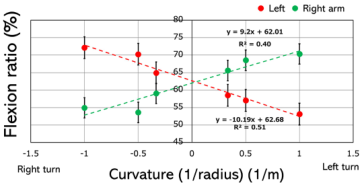
Figure 5 shows the result. The relation between the curvature x of the walk path and the flexion ratio y of the arm swing was approximately expressed as y = −−10.2x + 62.7 (r = .71) and y = 9.2x + 62.0 (r = .64) for left and right arms, respectively. A larger difference in the left/right flexion ratios generated the sensation of a smaller turning radius where the outer arm swung at a larger amplitude than the inner arm. This difference is in common with a real walk. It was expected that this asymmetric swing stimulus might cause an orientation change (rotation) of the trunk because the arms moves more at the outer side.
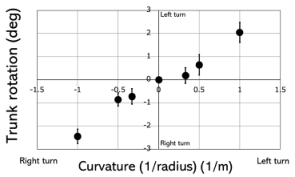
Rotation of a trunk of nine participants (students, mean age of 23.0 years) was measured by an optical motion capture device when the arms were swung by the display in six curvature conditions. Figure 6 shows the result. The trunk rotation was linearly increased with the curvature. This trunk rotation is considered to contribute to the sensation of turning because the rotation angle of the trunk is deviated to the direction of a center of curvature.
These results suggest that the asymmetric swing flexion corresponding to curvature was necessary for creating the sensation of turning walking, and the resultant trunk rotation is considered to be a part of a turning sensation.
Figure 6: Flexion ratio for turning walking. (N = 15).Figure 7: Trunk rotation angle. (N = 9).
CONCLUSION
For a passive walking experience in a VR space, we built an arm swing display as part of a whole-body stimulation system. We demonstrated that only a pas- sive arm swing could produce both straight and turning walking sensations. Optimal arm swing motion for straight walking was around 30 degrees with a 54 % flexion ratio. The amplitude was smaller than that of a real walk, and the flexion ratio was larger (more forward) than a real arm swing. About 30% of real walking sensation and around 80% of moving sensation could be produced only by a passive arm swing. The sensation of turning walking was created by asymmetric swing of arms in which the flexion ratios of the outer and inner arms were around 71% and 52%, respectively, in the case of 1 m turning radius. These results indicate that the arm swing display can be effectively integrated with a multisensory display to play a part in the ability to create past experiences.
ACKNOWLEDGMENT
This work was supported by the MIC/SCOPE #191603003, JSPS KAKE- NHI Grant Number 18H04118, 21K19785, 18H03283 and TMU local-5G project.
REFERENCES
Boletsis, C. (2017). The New Era of Virtual Reality Locomotion: A Systematic Literature Review of Techniques and a Proposed Typology. Multimodal Technol. Interact. 2017, 1, 24. https://doi.org/10.3390/mti1040024. Ikei, Y. et al. (2014). Rendering of Virtual Walking Sensation by a Passive Body
Motion. In: Auvray, M., Duriez, C. (eds) Haptics: Neuroscience, Devices, Mode- ling, and Applications. EuroHaptics 2014. Lecture Notes in Computer Science, vol 8618. Springer, Berlin, Heidelberg. https://doi.org/10.1007/978-3-662-44193-0_ 20.
Generation of Walking Sensation by Providing Upper Limb Motion 47
Meyns, P. Bruijn, SM. Duysens, J. (2013). The how and why of arm swing during human walking. Gait Posture. 2013 Sep;38(4):555-62. doi: 10.1016/j.gaitpost.2013. 02.006. Epub 2013 Mar 13. PMID: 23489950. Saka, N. Ikei, Y. Amemiya, T. Hirota, K. Kitazaki, M. (2016). Passive arm swing motion for virtual walking sensation, In Proceedings of the 26th International Conference on Artificial Reality and Telexistence and the 21st Eurographics Sym- posium on Virtual Environments (ICAT-EGVE ‘16). Eurographics Association, Goslar, DEU, 17–23. Shimizu, K. Sueta, G. Yamaoka, K. Sawamura, K. Suzuki, Y. Yoshida, K. Yem,
V. Ikei, Y. Amemiya, T. Sato, M. Hirota, K. Kitazaki, M. (2018). Five- Star VR: shareable travel experience through multisensory stimulation to the whole body. In SIGGRAPH Asia 2018 Virtual & Augmented Reality (SA ‘18). Association for Computing Machinery, New York, NY, USA, Article 2, 1–2. DOI:https://doi.org/10.1145/3275495.3275502. Sueta, G. Saka, N. Yem, V. Amemiya, T. Kitazaki, M. Sato, M. Ikei, Y. (2019).
Generation of Walking Sensation by Upper Limb Motion. ICAT-EGVE.
LISTED IN THE AHFE DIGITAL BOOKSTORE CATALOGUE
Explore the complete digital volume
Human Factors in Virtual Environments and Game Design
Read this individual research paper free through the original publisher, or explore the full digital proceedings book.
ISBN 978-1-958651-26-1
Explore this ISBN in the AHFE Bookstore ↗Listed in the July 2026 bookstore catalogue; search by ISBN to confirm current availability · Digital book purchase optional