Mohammed Aminu Sanda (2022). Students Quality Assessment of the Interactivenesses of Virtual Teaching and Learning Platforms. In: Human Factors and Systems Interaction. AHFE Open Access, vol. 52, pp. 188–195. https://doi.org/10.54941/ahfe1002155
This research provides insights on students’ perspectives on the functional interactivenesses of the virtual platforms that serve as online digitized classrooms used for teaching and learning in tertiary academic institutions, and which usage has gained global significance since the advent of COVID-19 pandemic. In this vein, there has been a significant global systemic and structural shift towards virtual education among tertiary institutions, with the requisite restructuring of the face-to-face teaching-learning mechanisms into new online delivery systems. Considering the fact that such new online systems, which are digitized educational instruction media, are mostly designed by third parties who are not the direct users, there is a need to provide users, namely teachers and students, the space to share their evaluative perspectives on the effectiveness of the current approaches to such instructional design, in terms of the quality of interactivenesses they provide users. This is because, systemic interaction in virtual education, as it is with all distance education systems, includes the way the user, especially the student, interact with the online platform, fellow students, lecturers, and the educational contents of programme. In this respect, systemic interaction is recognized as a key factor in determining the quality of the online platform’s functionality and effectiveness, and by implication, the reputation of its delivery. Thus, taking cognizance of argument in the extant literature that in distance education, as it is with virtual education, the transactional distance between students and teachers is not determined by their respective geographical locations, but by the quality of the interactive relationship and the balance between dialogue and other instructional events. As such, it important for designers of virtual teaching-learning platforms to understand the implication of such transactional distance, especially from the students perspectives, that should be effectively managed to engage the students to enable quality interactive teaching-learning. In this research, therefore, a model reflective of this dynamic interaction was firstly developed to provide a conceptual framework. Guided by this framework, a study was conducted among six hundred and eighty-seven graduate students in a Ghanaian university, a structured questionnaire was used to ask the students to assess the quality of their interaction with the virtual platform used in teaching them throughout the semester, from the perspectives of its enablement of connectivity with colleagues, derivation of sense of community and personalization, ease of communication and contents following, and how all these factors inform the quality of teaching-learning outcome, in terms of the effectiveness of systemic interaction and delivery reputation. The conceptual framework was tested using the Using the AMOS-based structural equation modelling approach. In the systemic analysis, the students evaluation of connectivity with colleagues, derivation of sense of community and personalization, ease of communication and contents following as quality enhancing derivatives, and their implications on the systemic interaction and delivery reputation of the quality of teaching-learning media is determined. The findings will provide additional insight in the design of virtual platforms serving as online classrooms for teaching-learning.
Starting in the year 2020, institutions of learning, as it was with several busi- nesses, experienced a huge disruption in their direct physical interactions with clients. For institutions of higher learning in the education sector, almost all in-person courses transitioning to virtual instruction due to the COVID-19 pandemic. That is, there has been a significant global systemic and structural shift towards virtual education among tertiary institutions, with the requi- site restructuring of the face-to-face teaching-learning mechanisms into new online delivery systems. As a result, lecturers with little to no training were required to make rapid decisions about how to adjust their courses for vir- tual teaching. Virtual platforms are now served as online digitized classrooms used for teaching and learning in tertiary academic institutions, and which usage has gained global acceptance since the advent of COVID-19 pandemic in 2019. This pedagogic dynamics has resulted in a systemic and structural shift towards virtual education among tertiary institutions, with the requisite restructuring of face-to-face teaching-learning mechanisms into new online virtual delivery systems. Understanding the functional interactivenesses of this mechanism, with students as learners, is significant toward enhancing
Students Quality Assessment of the Interactivenesses of Virtual Teaching 189
the pedagogy of effectiveness students learning. This is due to the fact that such new online systems, which are digitized educational instruction media, are mostly designed by third parties who are not the direct users, there is a need to provide users, namely teachers and students, the space to share their evaluative perspectives on the effectiveness of the current approaches to such instructional design, in terms of the quality of interactivenesses they provide users. This is because, systemic interaction in virtual education, as it is with all distance education systems, includes the way the user, especially the stu- dent, interact with the online platform, fellow students, lecturers, and the educational contents of programme. In this respect, systemic interaction is recognized as a key factor in determining the quality of the online platform’s functionality and effectiveness, and by implication, the reputation of its deli- very. Thus, taking cognizance of argument in the extant literature that in distance education, as it is with virtual education, the transactional distance between students and teachers is not determined by their respective geogra- phical locations, but by the quality of the interactive relationship and the balance between dialogue and other instructional events. As such, it impor- tant for designers of virtual teaching-learning platforms to understand the implication of such transactional distance, especially from the students per- spectives, that should be effectively managed to engage the students to enable quality interactive teaching-learning. In this stead, it is important to provide insights on students’ perspectives on the functional interactivenesses of the virtual platforms that serve as online digitized classrooms used for teaching and learning in tertiary academic institutions, and which usage has gained global significance since the advent of COVID-19 pandemic. The purpose of this research was to assess the quality of students systemic interactions with the virtual platform used in teaching them, from the perspectives of its enable- ment of connectivity with colleagues, derivation of sense of community and personalization, ease of communication and contents following, and how all these factors inform the quality of teaching-learning outcome, in terms of the effectiveness of systemic interaction and delivery reputation.
LITERATURE REVIEW
Several studies have been conducted in recent years to examine the influe- nce of human factors in the design of virtual education systems. According to Sanda (2021), it is the ease of use of digital platforms complimented by the incorporation of special characteristics to the platform job designs that enables client to derive a feeling of self-attention, collaboration and coo- peration are of great importance. Sanda (2021) noted that both genders tend to cherish the prevalence of communal atmosphere and a characteri- stic sense of care during their interactive activity with the digital platforms. In the education sector, based on the argument that virtual spaces for lear- ning are becoming increasingly prominent in both the business and education spaces (Muñoz Cristóbal et al., 2017), the adaption of virtual platforms as classrooms to provide open online courses have created more accessible edu- cational opportunities to many individuals (Wong et al., 2013). However, there prevail the argument that discrepancy exists between enrolment and
completion rates in online courses which suggests that learning online pre- sents unique challenges to learners who may require some form of additional support to become successful (Wong et al., 2013). Some studies have shown that learners in the online teaching-learning environments tend to struggle due to the non-usage of critical self-regulated learning strategies (Azevedo, 2005), and which strategic processes have been identified by Winters et al. (2008) as enabling learners to successfully learn in online environments. In virtual teaching-learning environment, it is not the location that determines the effect of instruction, but the frequency and quality of interaction between student and lecturer (Pittinsky and Chase, 2000). According to Wulff et al. (2000), interaction includes the way students interact with fellow students, lecturers, and the educational contents of the programme. As such, the tran- sactional distance in virtual education is not determined by geography, but rather, by the quality of the interactive relationship and the balance between dialogue and other instructional events (Moore, 1990). In this vein, it has been argued that for lecturers involved in virtual teaching to be successful it is imperative for them to the understand and appreciate the relevance of the transactional distance and the extent to which it should be managed to enable effective engagement with students in interactive learning (Frith and Kee, 2003; Halpin et al., 2003; Christopher et al., 2004).
Ragan (1999) has observed that interaction in distance education is not something that happens automatically but is something that needs to be incor- porated consciously into the instructional design. Thus, with the increased adaption of virtual education by academic institutions of higher learning, there is also the need to assess the effectiveness of the current approa- ches to instructional design using the Constructionist educational approach (Boettcher, 1997), with the quality of systemic interaction recognized as a key factor (Ragan, 1999; Wulff et al., 2000; Pittinsky and Chase, 2000). Accor- ding to the constructivist educational theory, the student is viewed as an active participant who constructs knowledge in the learning process (Boettcher, 1997). This therefore requires that dialogue that supports active learning should be discursive, interactive, adaptive and reflective (Laurillard, 2002). In this regard, as observed by Chickering and Gamson (2003), effective instructional designs should include student–lecturer interaction, coopera- tion among students, prompt feedback and active learning. Sanda (2021) reported that most clients believe that their excitement as online shoppers is induced by the flexibility of choice, customization, character, care, and sense of community, provided by digital platforms. Thus, Sanda (2021) suggested that to generate a large network of future online shoppers, digital platforms must continually improve on the choices available to clients on digital plat- forms. This according to Sanda (2021), requires that firms should design their digital platforms to enable user care since this resonates with online shoppers as they feel loved on a personal level. The implication is that, digital custo- mization is very relevant in not only in today’s e-commerce (Sanda, 2021), but also in virtual education, since it makes clients feel a sense of acceptance and recognition, and also being in charge of the digital transaction themse- lves (Sanda, 2021). In this wise, educational institutions should incorporate such perspectives in the design of their digital platforms to create conducive
Students Quality Assessment of the Interactivenesses of Virtual Teaching 191
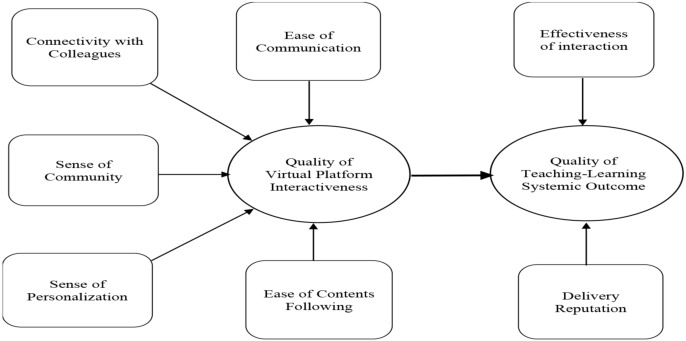
Figure 1: Conceptual model for students quality assessment of the interactivenesses of virtual teaching and learning platforms.
digital virtual teaching-learning environments that will excite their students learning experiences and knowledge construction. In this wise, the model shown in Figure 1 below is proposed for testing.
METHODOLOGY
In this research, a model reflective of the dynamic interaction was firstly pro- posed to serve as study framework. Guided by this framework, a data was collected from six hundred and eighty-seven graduate students in a Ghanaian university using a structured questionnaire. The measured factors entailed include the quality of students interaction with the virtual platform used in teaching them throughout the semester, from the perspectives of its enable- ment of connectivity with colleagues, derivation of sense of community and personalization, ease of communication and contents following, and how all these factors inform the quality of teaching-learning outcome, in terms of the effectiveness of systemic interaction and delivery reputation. All the respon- dents are Master Degree students enrolled in variety of master programmes at the University of Ghana Business School. The questionnaire entailed a synopsis that explained the purpose of the study. Due to the COVID situ- ation, during which there was no direct contact with students, the question was posted online on a platform that all students can access. The completed questionnaires were returned by each respondent and dropped in a special sealed box provided for such purpose by the researcher.
In the data analysis, the stepwise approach was used. The data was col- lated and firstly analyzed descriptively. Secondly, the data was analyzed inferentially using the structural equation modelling (SEM) approach. In this approach, the analysis of moment structures (AMOS) was used as the analytical technique as applied by (Sanda and Kuada, 2016). This analy- tic procedure has the advantage of maximizing the validity of the estimates (Sanda and Kuada, 2016; Di Stefano et al., 2009). The AMOS graphics stati- stical software was used as the analytical tool. The tool facilitates the conduct
of analyses for multiple levels of variables using a range of in-built statistical techniques (Sanda and Kuada, 2016). In testing the predictability of measured individual factors that constitute the various components of the conceptual model shown in Figure 1, path analysis was conducted. The analysis was started by loading each of the latent variables in the conceptual model (i.e., Figure 1) in the AMOS software in order to assess the model-fitness of their respective measurable indicators (factors). Factor predictiveness was interpretated using factor loadings greater than 0.50 (Tabachnick and Fidell, 2012; Forsell et al., 2020, Amankwah and Sanda, 2021). The model fit was interpreted using the path coefficient benchmark value of 0.7 or higher as proposed by Schumacker and Lomax (2004) in order to ensure robustness. The criteria used to determine model fit are the Chi Square (CMIN) value, which is the absolute test of model fit and the Comparative Fit Index (CFI) value. A CMIN value below 0.05 implies model acceptance. For the CFI, a value close to 1.0 indicates a very good model fit.
RESULTS AND DISCUSSION
Demographic Distribution of Study Participants All the six hundred and eight-seven (687) questionnaires administered were retrieved and all were found to be completes and usable for the analysis. The gender distribution of the respondents showed that 374 (54.40%) were graduate female students and 313 (45.60%) were graduate male students.
Structural Analysis of Systemic Virtual Platform Model A confirmatory structural analysis was conducted to assess the systemic inter- relations between the quality of students interaction with the virtual platform used in teaching them throughout the semester, from the perspectives of its enablement of connectivity with colleagues, derivation of sense of commu- nity and personalization, ease of communication and contents following, and how all these factors inform the quality of teaching-learning outcome, in terms of the effectiveness of systemic interaction and delivery reputation. The AMOS-generated standardized path diagram showing the standardized indi- cator loadings of the respective latent variables in the tested structural model is shown in Figure 2 below. Based on the goodness of fit statistics, it is evident that the overall model fit appears quite good. This is because the estimated CMIN (χ2) value of 62.27 (df = 13) has probability level of 0.00 which is les- ser than the 0.05 used by convention. Therefore, the null hypothesis that the model fits the data is accepted. The model has a Comparative Fit Index (CFI) value of 0.94, which is close to 1.0, and as such, indicated an acceptance of the null hypothesis that the tested model has a good fit.
The results, as highlighted in Figure 2 above, firstly, showed that the measured factors relative to the virtual platform’s enablement of students connectivity with colleagues (IP32), Sense of Community (IP34), ease of communication (IP35), ease of contents following (IP36), and delivery repu- tation (IP31) showed significant predictiveness. In this regard, five indicators
Students Quality Assessment of the Interactivenesses of Virtual Teaching 193
Figure 2: AMOS-generated path diagram showing standardized indicator loadings in the structural model for students systemic quality assessment of the interactivenesses of virtual teaching and learning platforms.
Figure available in the original PDF paper.
(i.e., connectivity with colleagues, sense of community, ease of communica- tion, ease of contents following and delivery reputation) have factor loadings (R) with factor loadings whose values are approximately or greater than or equal to the 0.5 threshold (Tabachnick and Fidell, 2012; Forsell et al., 2020, Amankwah and Sanda, 2021). Therefore, four factors are predictive of the unobserved variable “quality of virtual platform interactiveness (QVPI)”. This implies that the quality of students interaction with the virtual platforms that are used to teach them in the COVID-19 period is largely informed by their ability to connect with their colleagues (R = 0.77, R2 = 0.59), their derivation of a sense of community (R = 0.83, R2 = 0.69), the ease of communication (R = 0.75, R2 = 0.56) and the ease of contents following on the platform (R = 0.55, R2 = 0.30). Also, only one factor is predictive of the unobserved variable “quality of teaching-learning systemic outcome (QTLSO)”. This is the platform’s delivery reputation (R = 0.53, R2 = 0.28).
On the other hand, the quality of the measured factors relative to the virtual platform’s enablement of students sense of personalization (IP33) and effectiveness of interaction (IP37) showed non-significant predictiveness. This implies that the quality of students interaction with the virtual plat- forms that are used to teach them in the COVID-19 period was not informed by the platforms’ Sense of Personalization (R = 0.46, R2 = 0.36) and its interactive effectiveness (R = 0.31, R2 = 0.10). Secondly, the results sho- wed that the unmeasured variables relative to the quality of virtual platform interactiveness (QUPI) and the quality of teaching-learning systemic outcome (QTLSO) showed significant predictiveness between the two with a factor loading of more than the 0.7 threshold (Schumacker and Lomax, 2004). In this stead, the quality of virtual platform interactiveness significantly predicts the quality of teaching-learning systemic outcome (R = 0.81, R2 = 0.66).
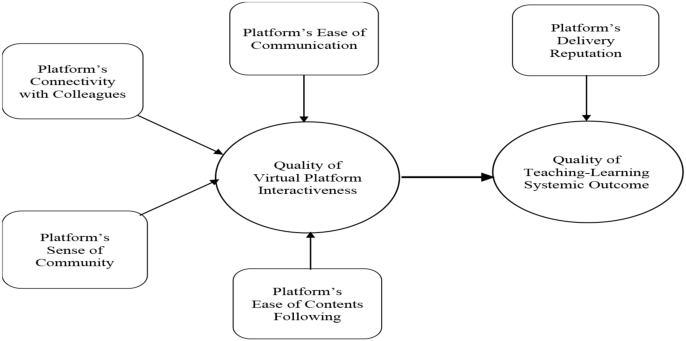
Factoring the above findings in the conceptual model, Figure 3 shown below is obtained to serves empirical model for understanding students systemic quality expectation of the interactivenesses of virtual teaching and learning platforms.
Figure 3: Empirical model for assessing students quality expectation of the systemic interactivenesses of virtual teaching and learning platforms.
CONCLUSION
This study has provided understanding on the dynamics of students’ cognitive expectations of the quality of their systemic interactions with virtual platform used in teaching them as a result of the COVID-19 situation. Based on the findings, it is concluded that in designing the virtual platforms used in the teaching-learning system, the quality of the students systemic interactiveness with the platforms could be enhanced by ensuring that the connectivity with their colleagues is not constrained, and also enable them to derive a sense of personalization and community, while finding it easy to communicate and follow instructional contents provided in the teaching process. this will help enhance the reputation of teaching delivery on the virtual platforms which will help enhance the expected quality of teaching-learning systemic outcome.
REFERENCES
Amankwah, M.O and Sanda, M.A. (2021) Factors Predictive of University Students’ Job Values and Their Influences on Future-Oriented Employment Preferences: A Ghanaian Perspective. Universitepark Bulletin, Volume 10 No. 1. pp. 7–25. DOI: 10.22521/unibulletin.2021.101.1 Azevedo, R. (2005). Using Hypermedia as a Metacognitive Tool for Enhancing Stu-
dent Learning? The Role of Self-Regulated Learning. Educational Psychologist, Volume 40 No. 4. pp. 199–209. Boettcher, J. (1997) Pedagogy and learning strategies. California State University.
Website: http://vccslitonline.cc.va.us/usingweb/bckgrnd.htm Chickering, A and Gamson, Z. (2003) Seven principles for good practice in undergraduate education. Honolulu Community College. Website: http://honolulu.haw aii.edu/intranet/committees/FacDevCom/guidebk/teachtip/7princip.htm Christopher, M., Thomas, J. and Tallent-Runnels, M. (2004) Raising the Bar:
Encouraging High Level Thinking in Online Discussion Forums, Roeper Review, Volume 26, pp. 166–171.
Students Quality Assessment of the Interactivenesses of Virtual Teaching 195
Di Stefano, C., Zhu, M. and Mîndril˘a, D. (2009). Understanding and Using Factor Scores: Considerations for the Applied Researcher. Practical Assessment, Research and Evaluation Volume 14 No. 20, pp 1–11. Doi:10.7275/DA8T-4G52. Forsell, T., Tower, J., Polman, R. (2020). Development of a Scale to Measure Social
Capital in Recreation and Sport Clubs, Leisure Science., Volume 42, No. 1. pp. 106–122. Frith, K. and Kee, C. (2003). The Effect of Communication on Nursing Student Outcomes in a Web-Based Course, Journal of Nursing Education, Volume 42, pp. 350–358. Halpin, D., Scheer, S. and Lockee, B. (2003) Supporting Distance Learners: The
IT Studio Model, International Journal of Instructional Media, Volume 30, pp. 343–345. Laurillard, D. (2002) Rethinking University Education: A conversational framework for the effective use of learning technologiesm, 2nd edn, London: RoutledgeFalmer Moore, M. (1990) Background and overview of contemporary American dista-
nce education, In: Moore, M. (Ed.) Contemporary Issues in American Distance Education (pp. xii–xxvi). New York: Pergamon. Muñoz Cristóbal, J.A., Rodríguez-Triana, M.J., Gallego-Lema, V., Arribas-Cubero, H.F., Asensio-Pérez, J.I., Martínez-Monés, A. (2017), Moni- toring for Awareness and Reflection in Ubiquitous Learning Environments. International Journal of Human-Computer Interaction, Volume 34, pp. 146–165. Doi:10.1080/10447318.2017.1331536 Pittinsky, M and Chase, B. (2000) Quality on the line: Benchmarks for Success in Internet–based Distance Education. Washington, DC: Institute for Higher Education Policy. Ragan, L. (1999) Good Teaching is Good Teaching: An Emerging Set of Guiding
Principles and Practices for the Design and Development of Distance Education, Cause/Effect Journal, Volume 22, pp. 1–7. Sanda, M.A. (2021) Client’s quality assessment of digital transaction platforms interactivenesses in a Covid-19 E-commerce business environment. In: Nunes, I. L. (ed.), Advances in Human Factors and Systems Interaction, (pp. 182–190). Cham: Springer. https://doi.org/10.1007/978-3-030-79816-1_23 Sanda, M.A. and Kuada, J. (2016) Influencing Dynamics of Culture and Emplo-
yee Factors on Retail Banks’ Performances in a Developing Country Context. Management Research Review, Volume 39 No. 5, pp. 599–628. Schumacker, R.E. and Lomax, R.G. (2004) A Beginner’s guide to structural equation modeling. Mahwah, NJ: Lawrence Erlbaum, Tabachnick, B.G. and Fidell, L.S. (2012) Using multivariate statistics: Pearson new
international edition, 6th edition. Noida: Pearson Winters, F.I., Greene, J.A., Costich, C.M. (2008). Self-Regulation of Learning Within Computer-Based Learning Environments: A Critical Analysis. Educational Psychology Review, Volume 20 No. pp. 429–444. Wong, J., Baars, M., Davis, D., Van Der Zee, T., Houben G-J. and Paas, F. (2019) Sup-
porting Self-Regulated Learning in Online Learning Environments and MOOCS: A Systematic Review, International Journal of Human-Computer Interaction, Volume 35 No. 4-5, pp. 356–373. Wulff, S., Hanor, J. and Bulik, R. (2000) The roles and relationships of presence, reflection, and self-directed learning in effective world wide web-based pedagogy, In: Cole, R. (Ed.), Issues in Web-based Pedagogy: A Critical Primer (pp. 143–160). Westport, CT: Greenwood Publishing.
LISTED IN THE AHFE DIGITAL BOOKSTORE CATALOGUE
Explore the complete digital volume
Human Factors and Systems Interaction
Read this individual research paper free through the original publisher, or explore the full digital proceedings book.
ISBN 978-1-958651-28-5
Explore this ISBN in the AHFE Bookstore ↗Listed in the July 2026 bookstore catalogue; search by ISBN to confirm current availability · Digital book purchase optional