Mohammed Aminu Sanda (2022). The Psyche of “Self” in Students’ Systemic and Structural Interaction with Online Teaching-Learning Platforms. In: Neuroergonomics and Cognitive Engineering. AHFE Open Access, vol. 42, pp. 10–18. https://doi.org/10.54941/ahfe1001813
This research explores and provides insights on students’ psyche of “self” as characterized by their self-evaluations of their systemic and structural interactions with the online teaching-learning platforms that serves as their virtual classroom since the advent of the COVID-19 pandemic. Having such insights is of significance towards understanding the functional interactivenesses of virtual platforms that serve as online digitized classrooms used for teaching and learning in tertiary academic institutions, and which usage has gained global acceptance since the advent of COVID-19 pandemic. This has resulted in a systemic and structural shift towards virtual education among tertiary institutions, with the requisite restructuring of face-to-face teaching-learning mechanisms into new online delivery systems. Considering the fact that such new online systems, which are digitized educational instruction media, are mostly designed by third parties who are not the direct users, there is a need to provide users, namely teachers and students, the space to share the psyche of their “selves” which could be used to develop a sense of their self-evaluative perspectives of the effectiveness of the current approaches to such instructional design, in terms of the quality and effectiveness of their interactivenesses. As it is posited in the extant literature, self-evaluation is crucial to mental and social well-being due to the influences it exerts on a person’s aspirations, personal goals and interaction with others. Thus, self-evaluation, provides personal insights on the beliefs and evaluations individuals hold about themselves, helping to determine who they are, their capabilities, and future developments. These insights are manifestation of the psyche of “self”, deemed as powerful inner influences that provide individuals internal guiding mechanisms that help steer and nurture them through the dynamics of life, governing their behavior in the process, and defining the character of their individual self-concept and self-esteem, and by extension their self-image and self-perception. With self-concept manifesting individual beliefs and knowledge about personal attributes and qualities, it represents a cognitive schema that organizes abstract and concrete views about the “self”, and controls the processing of self-relevant information. The extraction of such an information, especially from students perspectives, is deemed important to enable the systemic and structural design of quality virtual platforms used as online classrooms and quality interactive teaching-learning activity. In this study, therefore, data was collected from six hundred and eighty-seven graduate students in a Ghanaian university, using a structured questionnaire that enabled the students to process self-relevant information associated with the quality of their systemic and structural interaction with online teaching-learning platform used in teaching them throughout the semester. Guided by Bedny and Karwowski's well-established knowledge that activities of individuals are realized by goal-directed actions, informed either by mental or motor conscious processes, as objects of the cognitive psychology of skills and performances, systemic analysis is conducted and the learning from the students self-evaluation determined. The findings will provide additional insight in the design of virtual platforms serving as online classrooms for teaching-learning.
Starting in the year 2020, institutions of learning, as it was with several busi- nesses, experienced a huge disruption in their direct physical interactions with clients. For institutions of higher learning in the education sector, almost all in-person courses transitioning to virtual instruction due to the COVID-19 pandemic. As a result, instructors, often with little to no training, made rapid decisions about how to adjust their courses for virtual instruction (Gillis and Krull, 2020). Virtual platforms are now served as online digitized classro- oms used for teaching and learning in tertiary academic institutions, and which usage has gained global acceptance since the advent of COVID-19 pandemic in 2019. This pedagogic dynamics has resulted in a systemic and structural shift towards virtual education among tertiary institutions, with the requisite restructuring of face-to-face teaching-learning mechanisms into new online virtual delivery systems. Having insights and understanding of the functional interactivenesses of this mechanism, with students as key users, is significance toward enhancing the pedagogy of students learning. Inferring
The Psyche of “Self” in Students’ Systemic and Structural Interaction 11
from early journalistic reporting, Gillis and Krull (2020) noted that the most common strategy for the virtual instruction was to embed existing course in a learning management system while holding synchronous meetings. This vir- tual transition strategy, according to Gillis and Krull (2020), maintained the same teaching strategies, activities, and outcomes from face-to-face learning (Lederman, 2020; Gillis, and Krull, 2020). This is because, in the midst of these transitional changes, students, had to adjust to new course structures along with many added barriers in their own lives that made completing their academic work more difficult (Gillis and Krull, 2020). Thus, arguing from the perspective of Gillis and Krull (2020), it is imperative, when analyzing the transition to emergency virtual instruction, to consider the prevalence of such barriers as well as how some groups, especially students, were at disproporti- onate risk of encountering them, thus potentially leading to unequal learning outcomes. This position necessitate the need to understand the dynamics of the transition and its associated barriers from students perspectives. As it is established in the extant literature, self-evaluation is crucial to mental and social well-being due to the influences it exerts on a person’s aspirations, per- sonal goals and interaction with others. Thus, students’ self-evaluation of their interactiveness with the virtual platforms and the effect it has on their learning from the online teaching, will provide personal insights on the beli- efs and evaluations they hold about themselves, which will help to determine who they are, their capabilities as learners, and pedagogically, their learning and future developments. These insights are manifestation of the psyche of “self”, deemed as powerful inner influences that provide individuals internal guiding mechanisms that help steer and nurture them through the dynamics of life, governing their behavior in the process, and defining the character of their individual self-concept and self-esteem, and by extension their self- image and self-perception. With self-concept manifesting individual beliefs and knowledge about personal attributes and qualities, it represents a cogni- tive schema that organizes abstract and concrete views about the “self”, and controls the processing of self-relevant information. The extraction of such an information, especially from students perspectives, is deemed important to enable the systemic and structural design of quality virtual platforms used as online classrooms and quality interactive teaching-learning activity. The purpose of this research was to explore and provide insights on students’ psyche of “self” as characterized by their self-evaluations of their systemic and structural interactions with the online teaching-learning platforms that serves as their virtual classroom since the advent of the COVID-19 pandemic, and which usage has gained global acceptance since the advent of COVID-19 pandemic in the year 2019.
LITERATURE REVIEW
In recent years, several studies have examined the influence of human factors in virtual education. Based on the argument that virtual spaces for learning are becoming increasingly prominent in both the business and education spa- ces (Muñoz Cristóbal et al., 2017), massive open online Courses are deemed to have created more accessible educational opportunities to people (Wong,
12 Sanda
2019). However, there prevail the argument that discrepancy exists between enrolment and completion rates in online courses which suggests that lear- ning online presents unique challenges to learners who may require some form of additional support to become successful (Wong, 2019). Prior studies have shown that learners in the online teaching-learning environments tend to struggle because they do not use critical self-regulated learning strategies (Azevedo, 2005), and which strategic processes have been identified as ena- bling learners to successfully learn in online environments (Winters, 2008). In this stead, some studies have found that self-regulated learning supports in online environments (Tsai, 2013) due to its identified role in online academic success (Wong, 2019). Self-evaluation is established in the extant literature as having an influence on the aspirations and personal goals of individu- als, and their interactions with others, and as such, is crucial to mental and social well-being. It is in this stead that Burns (1982) situated self-evaluation as the beliefs and evaluations individual’s hold about themselves which ena- ble their abilities to determine who they are, what they can do and what they can become. It is these powerful, inner influences that provide an inter- nal guiding mechanism, steering and nurturing individuals through life, and governing their behavior (Burns, 1982) . In this wise, individuals’ concepti- ons and feelings about themselves are generally labelled as their self-concept and self-esteem. Such individual conceptions and feelings, together with the ability to deal with life’s challenges and to control what happens to them, are widely documented in the extant literature (Seligman, 1975; Bandura, 1977; Bowlby, 1980; Rutter, 1992; Harter, 1999).
Self-concept is defined as the sum of an individual’s beliefs and knowledge about his/her personal attributes and qualities. It is classed as a cognitive sch- ema that organizes abstract and concrete views about the “self”, and controls the processing of self-relevant information (Markus, 1977; Kihlstrom and Cantor, 1983). In this respect, self-image and self-perception, are equivalents to self-concept. According to Harter (1999), self-esteem is the evaluative and affective dimension of the self-concept, and is considered as equivalent to self- regard, self-estimation and self-worth (Harter, 1999). From the perspectives of Rogers (1981) and Markus and Nurius (1986), self-esteem is a measure of one’s global appraisal of his/her positive or negative value, and is determi- ned by the scores one gives him/herself in different roles and domains of life. This observation is justified by Erikson (1968) to the effect that individuals are occupied with their self-esteem and self-concept as long as the process of crystallization of identity continues. According to Erikson (1968), if this process is not negotiated successfully, the individual will remain confused, not knowing who he/she really is. The consequence being the emergence of identity problems, such as unclear and diffused identities as well as lacking in confidence. Studies on the relationship between self-esteem and acade- mic achievement is well documented in the extant literature (e.g., Marsh and Yeung, 1997; Filozof et al., 1998; Hay, 1998). Positive feelings of self-esteem have been shown to increase children’s confidence and success at school in their critical childhood years (Coopersmith, 1967) and is found to be a predi- cting factor for academic success, for example, reading ability (Markus and Nurius, 1986).
The Psyche of “Self” in Students’ Systemic and Structural Interaction 13
Results of a longitudinal study among elementary school children reported by Mann (2004) indicated that children with high self-esteem have higher cognitive aptitudes (Mann, 2004). Further research by Judge, et al. (2000) has revealed that core self-evaluation’s measured in childhood and in early adulthood are linked to job satisfaction in middle age. Following this fin- ding by Judge, et al. (2000), it becomes imperative to also know the outcome of such measure of self-evaluation in adults in tertiary institutions, which domain is for matured adults. In this context, positive self-esteem is not only seen as a basic feature of mental health, but also as a protective factor that contributes to better health and positive social behavior through its role as a buffer against the impact of negative influences (Rogers, 1981). Thus, posi- tive self-esteem is seen to actively promote healthy functioning as reflected in life aspects, such as achievements, success, satisfaction (Markus and Nurius, 1986). Finally, negative, and positive feelings of self-worth could be the result of a cognitive, inferential process, in which children observe and evaluate their own behaviours and competencies in specific domains (self-efficacy). The poorer they evaluate their competencies, especially in comparison to those of their peers or to the standards of significant others, the more negative their self-esteem. Such self-monitoring processes can be negatively or positi- vely biased by a learned tendency to negative or positive thinking (Seligman et al., 1995). Other sources of negative self-esteem are discrepancies betw- een competing aspects of the self, such as between the ideal and the real self, especially in domains of importance.
METHODOLOGY
The strategies of gathering and interpreting information in an activity, should entail cognitive, emotional evaluative and motivational features (Bedny and Karwowski, 2007; Sanda et al., 2014). The strategies are integral part of an individual’s thinking processes, and is controlled by the mechanism of self-regulation that characterize the dynamic nature to which the individual make sense and exact meaning to situations informed by the psyche of his/her “Self”, both emotionally motivational and semantic (Bedny and Karwow- ski, 2007; Sanda et al., 2014). This manifestation of “self” will cause an individual to make a totally different sense of an activity within the same situation (Bedny and Karwowski, 2007; Sanda et al., 2014). Thus, going by the arguments of Bedny and Karwowski (2007) and Sanda et al. (2014), an individual’s strategies of activity performance can generally be influe- nced by factors associated with the psyche of his/her “self”. The factors include the individual’s procedural, professional and general knowledge, all acquired from experiences in past activity undertakings, and his/her know- ledge of acceptable sociocultural behavioral norms underlining the functions of communities Bedny and Karwowski (2007). According to Sanda et al. (2014), an individual’s comprehension and interpretation of a situation will be influenced by the level of the individual’s psyche of “self” and significa- nce the individual assign the situation. According to Bedny and Karwowski (2007), real categories of semantic features that relieve the goal of activity, the significance of the situation, and the motivational state of individuals
14 Sanda
involved are those that can be included in exacting meaning in an activity undertaking Bedny and Karwowski (2007). In this study, data was collected from six hundred and eighty-seven graduate students, using a structured self- administering questionnaire that enabled the students to process self-relevant information associated with the quality of their systemic and structural interaction with online teaching-learning platform used in teaching them throughout the semester. The measured factors entailed psychological associ- ated with self-evaluations and self-esteem that informs the students thoughts and feelings regarding their interactiveness with the online teaching-learning systems used for the immediate courses they took. All the respondents are Master Degree students enrolled in variety of master programmes at the Uni- versity of Ghana Business School. The questionnaire entailed a synopsis that explained the purpose of the study. The University’s research ethic proto- col was also followed, and respondents had the option to opt out. Due to the COVID situation, during which there was no direct contact with stu- dents, the question was posted online on a platform that all students can access. The completed questionnaires were returned by each respondent and dropped in a special sealed box provided for such purpose by the researcher. Using the systemic analytical approach (Bedny and Karwowski, 2007; Sanda et al., 2014), and guided by Bedny and Karwowski (2007)’s well-established knowledge that activities of individuals are realized by goal-directed acti- ons, informed either by mental or motor conscious processes, as objects of the cognitive psychology of skills and performances, systemic analysis is conducted on the students evaluation of “self”.
RESULTS AND DISCUSSION
Demographic Distribution of Study Participants The gender distribution of the respondents showed that 374 (54.40%) were graduate female students and 313 (45.60%) were graduate male stu- dents. Being students at the graduate level, all the respondents have a good understanding of the digital platforms experience covered in this study.
Analysis of Factors Predictive of the Students Psyche of “Self” To assess whether the measured factors in the self-evaluations and self-esteem psychological scale are predictive of the students psyche of “Self” relative to their thoughts and feelings regarding their interactiveness with the online teaching-learning systems, principal component analysis was conducted. The estimated Kaiser-Meyer-Olkin (KMO) value for personal social capital is 0.860 which exceeded the recommended 0.6 value (Kaiser, 1974; Forsell et al., 2020; Sanda, 2019). The estimated chi-square (χ2) value from the Bartlett’s test is 4294 (p = 0.000, df = 78), which is very, very significant (p < 0.001). These values indicate that the correlation pattern of the psyche of “Self” factors are good and is therefore appropriate to factor analyze the students’ psyche of “Self”indicators tested. Thus, factors analysis was perfor- med to identify and segregate the factors perceived by the study participants as predictive of those that informs the students’ psyche of “Self” relative
The Psyche of “Self” in Students’ Systemic and Structural Interaction 15
to their thoughts and feelings regarding their interactions with the online teaching-learning systems. Principal component analysis was conducted as an extraction method to characterize the various predictive factors of client’s excitement with digital platforms. Varimax with Kaiser Normalization was used as the method of rotation, which converged in three (3) iterations. All the 3 components (i.e., C1, C2 and C3) have individual items with factor loadings greater than 0.50 (Forsell et al., 2020; Sanda, 2019). This implies that each component have factors with predictive strengths to informs the students’ psyche of “Self” relative to their thoughts and feelings regarding their inte- ractions with the online teaching-learning systems. For the first component (C1), the following items manifested predictive strengths.
Equation reproduced from the original PDF.
My interactive learning experience made me satisfied with the quality of knowledge gained from the online teaching (r = 0.84).
My interactive learning experience made me develop a preference for remaining courses to be taught online (r = 0.78).
All the items above manifest the students measure of their psyche of “self” as informed by the psychological characteristics of their interactive lear- ning experience online. For the second component (C2), the following items manifested predictive strengths.
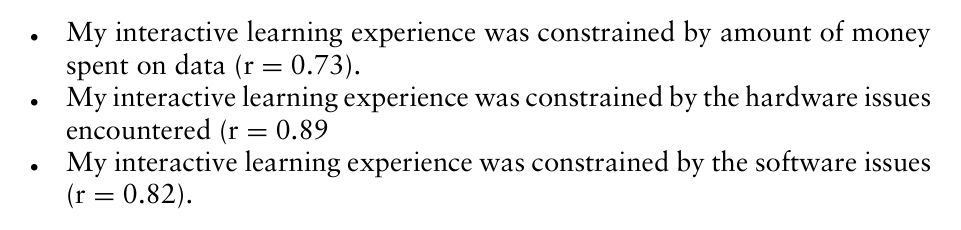
Equation reproduced from the original PDF.
All the items above manifest the students measure of their psyche of “self” as informed by the economic characteristics of their interactive learning expe- rience online. For the third component (C3), the following items manifested predictive strengths.
My interactive learning experience was constrained because of my feeling isolated, as if I did not belong to a peer student group (r = 0.863).
Equation reproduced from the original PDF.
My interactive learning experience was constrained because, the notations and graphic designs of the multimedia presentations used in the online teaching were not elaborate (r = 0.62).
My interactive learning experience was constrained because, the online teaching-learning setting made me feel as if did not belong to a peer student group (r = 0.86).
My interactive learning experience was constrained because, I always get distracted by surfing the web, checking emails, and chatting with friends while lectures is in progress (r = 0.60).
16 Sanda
All the items above manifested the students measure of their psyche of “self” as informed by the environmental characteristics of their interactive learning experience online.
As it is indicative from the findings, it could be posited that the psychologi- cal, economic and environmental that influenced the character of the students psyche of “self” during their interactions with the online teaching-learning mechanisms represent their individual conceptions and feelings about them- selves, and as such manifest their self-concept sand self-esteems. Arguing from the perspectives of Burns (1982), such students self-concepts and self-esteems is of significant pedagogic value in curricula design since they represent pow- erful, inner influences that provide an internal guiding mechanisms which steers and nurture their individual “selves” through their changed academic- life, thus governing their behavior towards the virtual mode of teaching and learning. Therefore, considering findings from the other studies (such as, Seligman, 1975; Bandura, 1977; Bowlby, 1980; Rutter, 1992; Harter, 1999), the findings in this study, provide insight on students individual conceptions and feelings regarding the quality of their interactions with the online teaching-learning mechanisms, and which insight could provide pathways for developing appropriate solutions to enable students ability to deal with virtual teaching-learning challenges and to control what happens to them.
CONCLUSION
Based on the study findings discussed above, it is concluded that students, as learners in the online teaching-learning environment manifest a psyche of “self” that excite their self-regulation mechanisms. It is also concluded that the students’ psyche of “self” supports their learning in the online teaching-learning environments which if incorporated in the pedagogic of their teaching, could result in their attainment of academic success.
REFERENCES
Azevedo, R. (2005) Using Hypermedia as a Metacognitive Tool for Enhancing Student Learning? The Role of Self-Regulated Learning. Educational Psychology, Volume 40 No. 4, pp. 199–209. Bandura, A. (1977) Social learning theory. Englewood Cliffs, NJ: Prentice-Hall. Bedny, G.Z. and Karwowski, W. (2007) A systemic-structural theory of activity:
applications to human performance and work design. Boca Raton, FL: Taylor and Francis. Bowlby, J. (1980) Attachment and loss III: Loss sadness and depression. London: Hogarth Press. Burns, R. (1982) Self-concept: developing and education. Dorchester: Dorset Press Coopersmith, S. (1967) The Antecedents of Self Esteem. San Francisco, CA: Freeman. Erikson, E.H. (1968) Youth, identity, and crisis. New York: Norton. Filozof, E., Albertin, H., Jones, C., Sterne, S., Myers, L., McDermott, R. (1998)
Relationship of Adolescent Self Esteem to Selected Academic Variables. Jour- nal of School Health, Volume 68 No. 2, pp. 68–72. doi: 10.1111/j.1746- 1561.1998.tb07194.x.
The Psyche of “Self” in Students’ Systemic and Structural Interaction 17
Forsell, T., Tower, J., Polman, R. (2020) Development of a Scale to Measure Social Capital in Recreation and Sport Clubs, Leisure Science., Volume 42 No. 1, pp. 106–122. Gillis, A., Krull, L.M. (2020) COVID-19 Remote Learning Transition in Spring 2020:
Class Structures, Student Perceptions, and Inequality in College Courses. Teach- ing Sociology, Volume 48 No. 4, pp. 283–299. https://doi.org/10.1177/0092055X 20954263. Harter, S. (1999) The construction of the self. A developmental perspective. New York: Guilford Press. Hay, I., Ashman, A.F., van Kraayenoord, C.E. (1998) Educational Characteristics
of Students with High or Low Self Concept. Psychol Schools, Volume 35 No. 4, pp. 391–400. Judge, T.A., Bono, J.E., Locke, E.A. (2000) Personality and Job Satisfaction: The Mediating Role of Job Characteristics. Journal of Applied Psychology, Volume 85 No. 2, pp. 237–249. https://doi.org/10.1037/0021-9010.85.2.237 Kaiser, H.F. (1974) An Index of Factorial Simplicity. Psychometrika, Volume 39,
pp. 31–36. Kihlstrom, J.F., Cantor, N. (1983) Mental representations of the self. In: Berkowitz, L. (Ed.), Advances in Experimental Social Psychology, Volume 17 (pp. 1–47). San Diego, CA: Academic Press. Lederman, D. (2020) How Teaching Changed in the (Forced) Shift to Remote Learning, Digital Learning, Inside Higher Ed, April 22. Web- site: https://www.insidehighered.com/digital-learning/article/2020/04/22/how-pr ofessors-changed-their-teaching-springs-shift-remote Mann, M.M., Hosman, C.M.H., Schaalma, H.P., de Vries, N.K. (2004) Self-Esteem
in a Broad-Spectrum Approach for Mental Health Promotion. Health Education Research, Volume 19 No. 4, pp. 357–372. Marsh, H.W., Yeung, A.S. (1997). Causal Effects of Academic Self-Concept on Academic Achievement: Structural Equation Models of Longitudinal Data. Journal of Educational Psychology, Volume 89 No. 1, pp. 41–54. Markus, H. (1977) Self schemata and processing information about the self. Journal
of Personality and Social Psychology, Volume 35 No. 2, pp. 63–78. Markus, H., Nurius, P. (1986) Possible Selves. American Psychologist, Volume 41 No. 9, 954–969. Muñoz Cristóbal, J.A., Rodríguez-Triana, M.J., Gallego-Lema, V., Arribas- Cubero, H.F., Asensio-Pérez, J.I., Martínez-Monés, A. (2017) Monitoring for awareness and reflection in ubiquitous learning environments. Interna- tional Journal of Human-Computer Interaction, Volume 34, pp. 146–165. DOI:10.1080/10447318.2017.1331536 Rogers, T.B. (1981) A model of the self as an aspect of the human information pro-
cessing system. In: Canton, N., Kihlstrom, J.F. (Eds.), Personality, Cognition and Social Interaction (pp. 193–214). Hillsdale, NJ: Erlbaum. Rutter, M. (1992) Psychosocial resilience and protective mechanisms. In: Rolf, J., Masten, A.S., Cicchetti, D., Nuechterlein, K.H., Weintraub, S. (Eds.), Risk and Protective Factors in the Development of Psychopathology. (pp. 181–214), Cambridge: Cambridge University Press. Sanda, M.A. (2019) The systemic-structural activity theory paradigm as a method
of designing efficient human performance. In: Bedny, G.Z., Bedny, I.S. (Eds.), Applied and Systemic-Structural Activity Theory: Advances in Studies of Human Performance, 1st edition (pp. 279–300). Boca Raton: CRC Press Seligman, M.E.P. (1975) Helplessness. San Francisco, CA: Freeman.
18 Sanda
Seligman, M.E.P., Reivich, K., Jaycox, L., Gillham, J. (1995). The optimistic child.
Boston, MA: Houghton Mifflin. Sanda, M.A., Johansson, J., Johansson, B. and Abrahamsson, L. (2014) Using Systemic Structural Activity Approach in Identifying Strategies Enhancing Human Per- formance in Mining Production Drilling Activity. Theoretical Issues in Ergonomic Science, Volume 15 No. 3, pp. 262–282. Tsai, C.W., Shen, P.D., Fan, Y.T. (2013). Research Trends in Self-Regulated Learning
Research in Online Learning Environments: A Review of Studies Published in Selected Journals from 2003 to 2012. British Journal of Educational Technology, Volume 44, No. 5, pp. 107–110. Winters, F.I., Greene, J.A., Costich, C.M. (2008) Self-Regulation of Learning Within Computer-Based Learning Environments: A Critical Analysis. Educational Psychology Review, Volume 20 No. 4, pp. 429–444. Wong, J., Baars, M., Davis, D., Van Der Zee, T., Houben G-J. & Paas, F. (2019)
Supporting self-regulated learning in online learning environments and MOOCS: A systematic review, International Journal of Human-Computer Interaction„ Volume 35 No. 4-5, pp. 356–373.
LISTED IN THE AHFE DIGITAL BOOKSTORE CATALOGUE
Explore the complete digital volume
Neuroergonomics and Cognitive Engineering
Read this individual research paper free through the original publisher, or explore the full digital proceedings book.
ISBN 978-1-958651-18-6
Explore this ISBN in the AHFE Bookstore ↗Listed in the July 2026 bookstore catalogue; search by ISBN to confirm current availability · Digital book purchase optional