Alexander M. Yemelyanov, Rahul Sukumaran, Alina Yemelyanov (2022). Application of ExpressDecision2 in User-Centered and Shared-with-Expert Decisions Under Risk and Uncertainty. In: Neuroergonomics and Cognitive Engineering. AHFE Open Access, vol. 42, pp. 1–9. https://doi.org/10.54941/ahfe1001812
ExpressDecision2 is a general-purpose web application designed to support the individual in making difficult decisions under uncertainty, which are emotionally driven and typically solved by using rational intuition. This web app is based on the self-regulation model of the thinking process developed within the framework of the systemic-structural activity theory. This paper demonstrates the application of two customized versions of ExpressDecision2: 1. ED2StatinChoice – for making a patient-centered and shared-with-clinician decision about taking statins for cholesterol reduction to prevent a heart attack or stroke. The two primary resources regarding taking statins for cholesterol reduction are The 2018 AHA/ACC Cholesterol Guideline and Mayo Clinic Statin Choice Decision-Aid tool. These and other guidelines and decision aids, as well as information derived from a health professional, provide the patient with essential information regarding the pros and cons of using statins, while also empowering the patient to make the ultimate decision regarding whether they should take statins. Overall, such a problem is both uncertain and difficult for the patient and so requires them to establish both short- and long-term goals, as well as relevant options for selection. ED2StatinChoice is designed specifically to help the patient make the best choice in such a difficult scenario. ED2StatinChoice complements existing decision-support tools, such as the Mayo Clinic Statin Choice Decision Aid. Its method of assistance involves clarifying the goal and various choices with subsequent aggregation of all pros and cons, thus helping make a motivated decision regarding which statin therapy is most preferable. 2. ED2InsuranceChoice – for making a client-centered and potentially shared-with-agent decision about buying an insurance policy in order to reduce financial uncertainty and make accidental loss more manageable. People buy health, car, life, home and other types of insurance to protect themselves from financial loss in the event of illness, car damage, house fire and other accidents, respectively. For example, they make decisions when choosing from among liability, comprehensive and collision insurance types. This decision-making process is guided by tangible statistical factors regarding people’s risks of accidental losses and by non-tangible factors, such as “peace of mind” due to being protected against financial loss in the event of an accident. It is important to note that peace of mind is an essential and decisive factor when selecting an insurance policy. It reflects subjective justification of rate adequacy for the premium: the premium should be reasonable and coverage must be sufficient. Unfortunately, such non-tangible factors as peace of mind from being protected against financial loss in an accident, as well as anxiety from losing money while paying an insurance premium for coverage that doesn’t get used unless you have an accident are not sufficiently reflected in existing models of insurance choice.
ExpressDecision2 (https://expressdecision2.com) is a web application desi- gned to support the individual in making difficult decisions under uncertainty, which are emotionally driven and typically solved by using rational intui- tion. This web app is based on the self-regulation model of the thinking process developed within the framework of the systemic-structural activity theory (G. Bedny, Karwowski, I. Bedny, 2015). ExpressDecision2 can be used both for everyday and for professional decisions, and can be run on both desktop and mobile platforms, including smartphones. In this work, the self- regulation model is further expanded to help apply ExpressDecision2 more efficiently to difficult decisions under uncertainty in scenarios dealing with healthcare (ED2StatinChoice) and insurance (ED2InsuranceChoice). These types of decisions under uncertainty are characterized by anxiety and peace of mind.
We consider anxiety a negative emotional state and peace of mind a positive emotional state, both of which are associated with future risk and uncertainty. For example, in healthcare, it is common for patients to
experience “anxiety” from wondering whether they will be able to endure a particular medical treatment (for example, to help lower their blood pres- sure). However, they may also experience “peace of mind” from recognizing how this medicine, even despite its potential risk for side effects, will ulti- mately help improve their health. In a case regarding insurance, an insured person’s “anxiety” may stem from wondering whether they will actually receive the appropriate compensation guaranteed by their insurance company in the event of accidental loss (for example, if they experience loss of health). However, “peace of mind” for them may come from recognizing that paying the required insurance premium will ultimately provide them with financial protection in the future. We demonstrate that in the self-regulation model, the factor of difficulty creates anxiety, and the factor of significance creates peace of mind. Both these factors are intangible outcomes of the decision- making involved in the formation of the mental model; they help determine the level of motivation for achieving the goal. We also demonstrate how both factors can be measured, and how these factors finally contribute to the level of motivation for choosing an alternative.
SELF-REGULATION DECISION-MAKING AND PROBLEM-SOLVING ExpressDecision2 implements the Performance Evaluation Process (PEP), which uses the self-regulation model of decision-making activity (A. M. Yemelyanov, A. A. Yemelyanov, 2019; A. M. Yemelyanov, 2019). This makes ExpressDecision2 behaviorally comparable to the user, which increases deci- sion advice acceptance. PEP includes the following three stages: decomposing the problem, evaluating alternatives, and making a decision. PEP imple- ments two concurrently and dynamically running processes: formation of the mental model (FMM) and formation of the level of motivation (FLM) by using two regulators: factor of significance and factor of difficulty (G. Bedny, I. Bedny, 2019). The factor of significance provides feedforward control, and the factor of difficulty provides feedback control. Both factors contribute to the formation of the level of motivation.
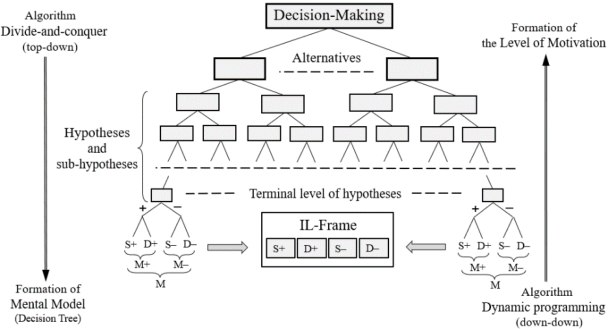
The design strategy for FMM implements a divide-and-conquer algorithm (D&C) to construct a Decision Tree (see Figure 1). The divide-and-conquer technique uses a recursive breakdown approach in decision-making: decom- pose the problem into smaller sub-problems, solve them, and then recombine their results to solve the bigger problem. This division of the problem into sub-problems may span several levels deep until a basic (ad hoc) level of certainty will be reached, at which point the problem can be positively evalu- ated within the process of FLM. In other words, the problem will contain only those outcomes for which the decision-maker will be able to deter- mine their respective positive (or negative) intensity and likelihood, which in turn, will allow to determine the positive (or negative) motivational level (preference). It should be noted that the efficiency of the divide-and-conquer algorithm increases when people apply hypotheses and split the problem into two mutually exclusive hypotheses.
In FMM, feedback control is based on the factor of difficulty and used to verify whether the current state of the individual’s mental model is capable of
Application of ExpressDecision2 in User-Centered and Shared-with-Expert Decisions 3
either evaluating the problem or choosing the best alternative. The feedback is positive (+fb_FMM) when the individual can perform the verification, and negative (–fb_FMM) when the individual cannot perform it. When the feed- back is negative, feedforward control (ff_FMM), which is based on the factor of significance, leads to an upgrade of the existing mental model. For this pur- pose, by considering various hypothetical situations and alternative solutions, the problem is divided into sub-problems, with corresponding sub-goals that help reduce existing difficulties of verification.
The design strategy for FLM implements a dynamic programming algori- thm (DP). This algorithm determines the level of an alternative’s motivation by evaluating its outcomes in IL-Frame and aggregating results with the help of K-Rules. IL-Frame is used as a template to evaluate outcomes, according to four performance shaping factors (PSFs): positive significance S+ (presen- ted by positive intensity I+), positive component of difficulty D+ (positive likelihood L+), negative significance S– (negative intensity I–), and negative component of difficulty D– (negative likelihood L–).
K-Rules are relations between these PSFs which have been experimentally determined by M. Kotik (1994), with the purpose of defining positive M+(I+, L+), negative M–(I–, L–), and cumulative M(M+, M–) levels of preference of outcomes, as well as combining these levels into a cumulative level of prefe- rence (motivation) for an alternative. IL-Frame uses verbal characteristics to measure the intensity (magnitude) and likelihood of outcomes on the verbal scales “weak – strong” and “seldom – often,” respectively. This soft eva- luation of outcomes enables better interpretation of an uncertain goal and conditions while improving decision accuracy. When measuring the motiva- tional level of an alternative, the level of positive motivation (motivation to attain positive outcomes) and the level of negative motivation (motivation to avoid negative outcomes) are measured. The level of positive motiva- tion is determined by the level of significance of positive outcomes and the level of difficulty in obtaining them, and the level of negative motivation is determined by the level of significance of negative outcomes and the level of
difficulty in avoiding them. With this in mind, the evaluation of significance of positive (negative) outcomes reflects the level (intensity) of their positive (negative) importance to the individual. Evaluation of difficulty depends on the valence of outcomes; for positive outcomes, it reflects the level of subje- ctive possibility to attain these outcomes, and for negative outcomes, the level of subjective possibility to avoid them. Since the decision takes place in uncer- tain conditions regarding the outcomes, we assume that subjective possibility can be reflected by subjective perception/feeling of their likelihood.
ExpressDecision2 provides the user with two modes: decision-making and problem-solving. The decision-making mode helps make quick decisions on the fly, but this decision has a low level of instrumental rationality (accu- racy). The decision is problem-centered and targeted to reach the proximate or short-term goal. For example, to save a patient’s life, emergency physici- ans must decide rapidly whether a patient is at “high risk” for having a heart attack and thus needs to be sent to the “coronary care unit,” or if they are at “low risk” and thus only need to be sent to a “regular nursing bed.” The problem-solving mode requires setting goals and recognizing problems. Here, arriving at the decision (solution) is not as rapid as in the decision-making option, but its level of instrumental rationality (accuracy) is higher because it is supported by applying the principle of instrumental rationality, which was formulated by Yemelyanov in (Yemelyanov, Bedny, 2019). According to this principle, the goal of each sub-problem should be a sub-goal in order to help reach the main goal. The decision (solution) is user-centered and targe- ted to reach the short-term goal from the perspective of the long-term goal. For instance, the solution for reducing high cholesterol (short-term goal) by taking either low, high, or no dose of statins is made from the perspective of “high quality of life,” which serves as the long-term goal.
There are two motivation shaping factors (MSFs) that determine the level of motivation for achieving the goal: the factor of significance (FS) and the factor of difficulty (FD). FD presents difficulties in achieving the goal and FS presents the significance of the goal. Both FS and FD determine the level of motivation for achieving the goal.
There are four performance shaping factors (PSFs) that determine the level of motivation for selecting the best alternative: positive significance (S+), positive component of difficulty (D+), negative significance (S–), and negative component of difficulty (D–).
The best alternative will be chosen based on the highest level of motivation. It’s important to note that each motivation and performance shaping factor has information (cognitive-based) and energy (emotion-based) components, and that MSFs contribute to the value of PSFs (Yemelyanov, Bedny, 2020).
THE FACTORS OF SIGNIFICANCE AND DIFFICULTY The goal in activity theory (G. Bedny, Karwowski, I. Bedny, 2015) has two components: information (cognitive-based) and energy (emotion-based). The first component splits outcomes into desirable (positive) and undesira- ble (negative). The second one splits outcomes, according to the factor of significance (FS) and the factor of difficulty (FD). The factor of significance
Application of ExpressDecision2 in User-Centered and Shared-with-Expert Decisions 5
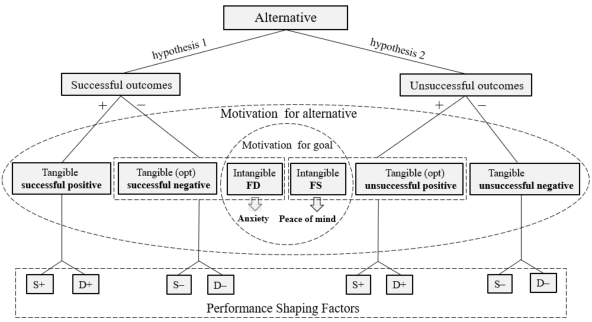
Figure 2: The level of motivation for selecting alternative as a result of evaluation of successful and unsuccessful tangible and intangible outcomes.
characterizes significance of the goal, while the factor of difficulty characteri- zes the difficulty of achieving this goal. It’s worth noting that FS characterizes significance of the goal as a short-term goal from the perspective of achieving the long-term goal. In other words, FS is a significance of the directness of the goal towards the long-term goal. FS forms the level of positive motiva- tion for achieving the goal and creates peace of mind. FD forms the level of negative motivation for achieving the goal and creates anxiety. In problem- solving mode (when selecting the best or most preferable alternative from available options), in order to satisfy the principle of instrumental rationa- lity, each alternative’s outcomes of achieving the short-term goal must be evaluated from the perspective of achieving the long-term goal. The existing uncertainty in evaluating outcomes makes the evaluation process difficult.
⌋
To reduce this uncertainty and the related difficulties, we consider two exclusive hypothetical situations: hypothesis 1, when the short-term goal (goal) is achieved (STG) while producing “successful” outcomes; and hypo- thesis 2, when the short-term goal is not achieved (
STG) while producing “unsuccessful” outcomes (see Figure 2).
It is important to note that
⌋
1) If STG,then positive outcomes are tangible only, while negative outcomes can be tangible, intangible or both; 2) If
STG, then negative outcomes are tangible only, while positive outcomes can be tangible, intangible or both.
Figure 2 demonstrates that the level of motivation for achieving the goal is formed by FS (intangible unsuccessful positive outcome) and FD (intangible successful negative outcome).
Both FS and FD are present in any goal-directed activity and impact PSFs and the level of motivation for selecting an alternative. However, in some cases, the factor of significance can be the only unsuccessful positive outcome, and the factor of difficulty can be the only successful negative outcome.
There are three logical relations among achieving short- and long-term goals, which lead to intangible outcomes only.
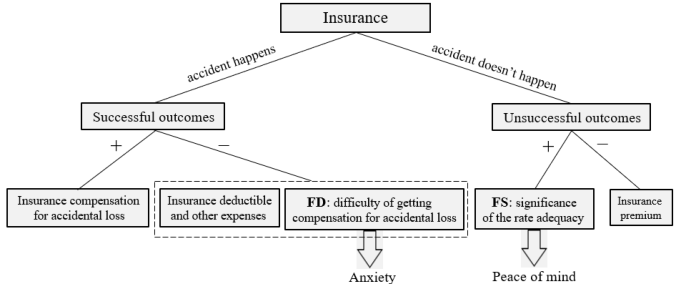
Figure 3: Factor of significance (FS) and factor of difficulty (FD) in insurance evaluation.
1) STG ⇒LTG: If the short-term goal is achieved (successful), then the long-term-goal is achieved.
The successful negative outcomes are intangible and presented by FD only. For example, when a patient with a high total cholesterol level decides to take statins vs adopt a healthy lifestyle, they may identify “lowering total chol < 200” as a short-term goal and “reducing risk of heart attack” as a long-term goal.
FD: difficulty of lowering total chol < 200, which causes anxiety from knowing that statins (or healthy lifestyle) may not produce the expected result of lowering total chol < 200 – patient’s uncertainty regarding whether statins (healthy lifestyle) will work to help lower their total chol < 200.
⌋ ⌋ 2) STG ⇒ LTG: If the short-term goal is not achieved (unsuccessful), then the long-term goal is not achieved.
The unsuccessful positive outcomes are intangible and presented by FS. For example, when people try to decide about the best life, health, house, car or other insurance policies for themselves, they typically lean towards “getting financial protection in the event of accidental loss” as the short-term goal and “saving money” as the long-term goal. Their successful outcomes are associated with a hypothetical situation in which accidental loss happens, while their unsuccessful outcomes are associated with a hypothetical situation in which accidental loss doesn’t happen (see Figure 3).
FS: significance of the rate adequacy (how insurance coverage is sufficient to cover its operating expenses and claims obligations to result in a reaso- nable profit when insured loss does not happen but the insurance premium must be paid). This significance creates peace of mind from knowing that you have been protected. It’s important to recognize that “peace of mind” becomes a tangi- ble outcome if we consider a long-term goal more certain than simply “saving money,” such as “saving money peacefully.” In this case, both unsuccessful positive tangible “peace of mind” and unsuccessful positive intangible, signi- ficance of the “rate adequacy and peace of mind,” will contribute to the level of motivation for choosing an alternative.
Figure 3 demonstrates that there is another intangible outcome, FD (dif- ficulty of getting compensation for accidental loss), which causes anxiety.
Application of ExpressDecision2 in User-Centered and Shared-with-Expert Decisions 7
Even if this negative outcome comes with a tangible “insurance deductible and other expenses,” it may considerably impact the decision to select an insurance policy.
⌋ ⌋
3) (STG ⇒LTG) & (
STG ⇒
LTG): If the short-term goal is achieved (successful), then the long-term goal is achieved, and if the short-term goal is not achieved (unsuccessful), then the long-term goal is not achieved.
The successful negative outcomes are intangible and presented by FD and the unsuccessful positive outcomes are intangible and presented by FS. For example, when choosing among different cardiopulmonary resuscitation devices, the short-term goal may be focused on “restarting the heart and bre- athing,” while the long-term goal may ultimately be focused on “saving a life.”
FD: difficulty of restarting the heart and breathing, which creates anxi- ety from knowing that the cardiopulmonary resuscitation device may not produce the expected result of restarting the heart and breathing.
FS: significance of the class of recommendation (COR) and the level of evidence (LOE). The class of recommendation indicates the strength of recommendation, encompassing the estimated magnitude and certainty of benefit in proportion to risk.
The level of evidence rates the quality of scientific evidence supporting the intervention on the basis of the type, quality and consistency of data from clinical trials and other sources (Halperin, et al., 2016). This significance creates peace of mind from knowing that everything possible was done to save someone’s life.
APPLICATION IN HEALTHCARE AND INSURANCE ED2StatinChoice and ED2InsuranceChoice are two customized versions of ExpressDecision2.
ED2StatinChoice is intended to help make a patient-centered and shared- with-clinician decision regarding taking statins for cholesterol reduction to prevent a heart attack or stroke. The two primary resources on taking sta- tins for cholesterol reduction are The 2018 AHA/ACC Cholesterol Guideline (Grundy et al., 2019). and Mayo Clinic Statin Choice Decision-Aid tool (https://statindecisionaid.mayoclinic.org). These and other guidelines and decision aids, as well as information derived from a health professional, pro- vide the patient with essential information regarding the pros and cons of using statins, while also empowering the patient to make the ultimate decision regarding whether they should take statins. This decision-making process is guided by tangible statistical factors regarding patient’s risks of getting heart attack or stroke as well as by intangible factors, such as “peace of mind”from recognizing how statins, even despite their potential risk for side effects, will ultimately help improve patient health outcomes. It reflects subjective justifi- cation of the strength of recommendation and the level of evidence. Overall, such a problem is both uncertain and difficult for the patient and so requires them to establish both short- and long-term goals, as well as relevant opti- ons for selection. ED2StatinChoice is designed specifically to help the patient
make the best choice in such a difficult scenario. ED2StatinChoice comple- ments existing decision-support tools, such as the Mayo Clinic Statin Choice Decision Aid. Its method of assistance involves clarifying the goal and vari- ous choices with subsequent aggregation of all pros and cons, thus helping make a motivated decision regarding which statin therapy is most preferable.
ED2InsuranceChoice is designed to help make a client-centered and shared-with-agent decision regarding buying an insurance policy in order to reduce financial uncertainty and make accidental loss more manageable. People buy health, life, car, home and other types of insurance to protect themselves from financial loss in the event of illness, death, car damage, house fire and other accidents, respectively. For example, they make decisions when choosing from among liability, comprehensive and collision insurance types. This decision-making process is guided by tangible statistical factors regar- ding people’s risks of accidental losses, as well as by intangible factors, such as “peace of mind” from being protected against financial loss in the event of an accident. It is important to note that peace of mind refers to a posi- tive emotional state; it is an essential and decisive factor when selecting an insurance policy. It reflects subjective justification of rate adequacy for the premium: the premium should be reasonable and coverage must be sufficient. Unfortunately, such intangible factors as peace of mind from being protected against financial loss in an accident, as well as anxiety associated with the difficulties of obtaining compensation for accidental loss, are not sufficien- tly reflected in existing models of insurance choice. ED2InsuranceChoice is specifically designed to fill this gap.
CONCLUSION
In this paper, we identified two key regulators of problem-solving activity: the factor of difficulty that creates anxiety, and the factor of significance that creates peace of mind. We demonstrated how both factors that were initi- ally intangible can be measured, and how these factors finally contribute to the level of motivation for choosing an alternative. For this, we considered hypothetical situations regarding success and unsuccess in reaching the goal as a short-term goal from the perspective of reaching the long-term goal, which allows us to clearly identify the role of intangible significance and intangible difficulty in the formation of the level of motivation. The factor of difficulty is involved as the successful negative intangible outcome, which leads to anxiety and contributes to the level of negative motivation for choo- sing an alternative. The factor of significance participates as an unsuccessful positive intangible outcome, which leads to peace of mind and contributes to the level of positive motivation. When it’s difficult to choose the best alter- native, it’s recommended to reduce uncertainty of the long-term goal and make it more specific. This makes intangible outcomes more tangible from the perspective of the new long-term goal, which can produce a more accu- rate decision. It’s important to note that intangible outcomes are present in any goal-directed activity. For example, if a successful negative intangible outcome becomes tangible, a new successful negative intangible outcome will substitute the previous one. In some cases, the factor of significance can be
Application of ExpressDecision2 in User-Centered and Shared-with-Expert Decisions 9
the only unsuccessful positive outcome, and the factor of difficulty can be the only unsuccessful negative outcome. In this situation, anxiety and peace of mind can be the main regulators in choosing the best alternative. We gathe- red all our findings and input them into ExpressDeision2, which helps make difficult decisions under risk and uncertainty to be user-centered and shared with expert.
REFERENCES
Bedny, G., Karwowski, W., and Bedny, I. (2015). Applying Systemic-Structural Activity Theory to Design of Human-Computer Interaction Systems, CRC Press. Taylor & Francis Group. Bedny, G. Z., Bedny, I. (2019). “The Study of Work Motivation and the Concept
of Activity Self-Regulation”, Chapter 6, in Bedny, G., Bedny, I. (Eds.). Study of Human Performance: Applied and Systemic-Structural Activity Theory Approach, 69–102. CRC Press, Taylor & Francis Group. Grundy, S. M. et al. (2019): Cholesterol Clinical Practice Guideline. Journal of the American College of Cardiology (JACC), 73 (24), June 25, 2019, e285–350. Halperin, J. L. et al. (2016). Further Evolution of the ACC/AHA Clini- cal Practice Guideline Recommendation Classification System: A Report of the American College of Cardiology/American Heart Association Task Force on Clinical Practice Guidelines. Circulation, 133, pp. 1426–1428. https://doi.org/10.1161/CIR.0000000000000312 Kotik, M. A. (1994). Developing Applications of “Field Theory” in Mass Studies.
Journal of Russian East European Psychology, 2 (4), July-August, pp. 38–52. Yemelyanov, A. M. (2019). “Self-Regulation Model of Decision-Making,” in H.
Ayaz (Ed.), Advances in Neuroergonomics and Cognitive Engineering. Advances in Intelligent Systems and Computing, 953, Springer International Publishing, pp. 245–255. Yemelyanov, A. M., Yemelyanov, A. A. (2019). “Performance Evaluation Process and Express Decision”, in H. Ayaz (Ed.), Advances in Neuroergonomics and Cogni- tive Engineering. Advances in Intelligent Systems and Computing, 953, Springer International Publishing, pp. 280–287. Yemelyanov, A. M., Bedny, I. S. (2020). “Instrumental and value rationality of
the self-regulation model of decision-making”, in: Ayaz, H., Asgher, U. (Eds.). Advances in Neuroergonomics and Cognitive Engineering. Advances in Intelligent Systems and Computing, 1201, Springer International Publishing, pp. 199–206. Yemelyanov, A. M., Bedny, I. S. (2021). “Self-Regulation Approach for Setting Goals in Problem-Solving”, in: H. Ayaz et al. (Eds.), Advances in Neuroergonomics and Cognitive Engineering. Lecture Notes in Networks and Systems, 259, Springer, pp. 194–200.
LISTED IN THE AHFE DIGITAL BOOKSTORE CATALOGUE
Explore the complete digital volume
Neuroergonomics and Cognitive Engineering
Read this individual research paper free through the original publisher, or explore the full digital proceedings book.
ISBN 978-1-958651-18-6
Explore this ISBN in the AHFE Bookstore ↗Listed in the July 2026 bookstore catalogue; search by ISBN to confirm current availability · Digital book purchase optional