Sai Mukkavilli, Alexander M. Yemelyanov, Rahul Sukumaran (2023). Applying Smart Assistants in Express Decision for Insurance Choices. In: Neuroergonomics and Cognitive Engineering. AHFE Open Access, vol. 102, pp. 1–8. https://doi.org/10.54941/ahfe1002999
In this work, the self-regulation model of decision-making is further expanded to help Express Decision apply voice smart assistants to provide a service through a particular version of Express Decision in insurance (ED2-Insurance-Choice) when deciding which insurance policy to buy. We demonstrate that with the help of Express Decision, existing smart voice assistants like Alexa can be used more efficiently, specifically when setting goals. They can support instrumental rationality of the self-regulation model of Express Decision not only by voice recognition, but also by recognizing intuition as an inner voice.
“Express Decision is a decision-making augmentation system that imple- ments a method for both augmenting the decision-maker’s short-term memory and guiding the decision-maker through considering positive and negative aspects (“pros and cons”) of each option of a current decision in a manner that integrates both instrumental rationality and value rationality based on the values of the decision maker” (Yemelyanov, 2022). It was cre- ated based on the self-regulation model of the thinking process developed within the framework of the systemic-structural activity theory (G. Bedny, Karwowski and I. Bedny, 2015).
In this work, the self-regulation model is further expanded to help Express Decision apply smart assistants such as Alexa, Siri, Google Voice or Cortana with learning algorithms for voice recognition, speech synthesis, and natu- ral language processing to provide a service through a particular version of Express Decision in insurance (ED2-Insurance-Choice) when deciding which insurance policy to buy. ED2-Insurance-Choice is designed to help make a client-centered and shared-with-agent decision regarding buying an insura- nce policy. This is a proactive decision to reduce risk of losing money and make accidental loss more manageable. People buy health, life, car, home and other types of insurance to protect themselves from financial loss in the event of illness, death, car damage, house fire and other accidents, respecti- vely. They make decisions when choosing, for example, from among liability,
comprehensive and collision insurance types. Express Decision is designed for difficult problems under uncertainty, which are emotionally driven and typically solved by using rational intuition. We demonstrate that with the help of Express Decision, existing smart voice assistants like Alexa can be used more efficiently, specifically when setting goals. They can support instru- mental rationality of the self-regulation model of Express Decision not only by voice recognition, but also by recognizing intuition as an inner voice.
SMART DECISION ASSISTANTS With the increase in the “Smartness” of AI, the technology led to several innovations in this field and one such particular things of interest is the “Smart Assistants”. Smart assistants such as Siri, Alexa, Google Voice, Cor- tana etc. have advantages and concerns in terms of their applications. Though these assistants are extremely helpful with their applications in healthcare and other areas, they are of major concern especially when dealing with privacy issues. Hang, Limin, Shihan, and Gang (2020) in their paper talks about the vetting process of the security in Smart home applications. The authors mention that the vetting process in Amazon is both automatic and manual whereas Google only implements a manual vetting process. Though Amazon’s vetting process is quite rigorous, some areas such as application identifiers have been ignored and also third-party developers. The authors further state that it is easy for a third-party application to get into the cloud because of the same private key being used to sign all the traffic for all the skills. This in turn enables a mechanism to launch attacks on various levels. A paper by Efthimios and Constantinos (2017) talk about some attacks to voice assistants from a malicious app that could trigger an adversary. The authors also proposed that the attacks mainly in the android world is possible because of its ubiquity and the vulnerabilities it possesses. Tavish, Yuankai, Micah, and Clay (2015) talk about the gaps in human and machine speech recognition and how one word with similar sound can be used to exploit ano- ther word in the case of voice assistants. e.g., “Cocaine Noodles” is enough to trigger the google voice assistant as phonetically it sounds similar to “OK Google”. One of the fundamental questions that they try to answer is “do the differences in how humans and machines understand spoken speech lead to exploitable vulnerabilities? Do the differences in how humans and machines understand spoken speech lead to exploitable vulnerabilities?”
Assistants “Smartness” in Speech Recognition Speech recognition algorithms are used on a ubiquitous basis in day to day life. With the advent of new devices such as smart home speakers, smart watches along with several other IoT devices, the need for better and more sophisticated algorithms has become a more common need. Also, the modern algorithms have become so adaptive that even a non-English speaker’s phrase could be easily understood by these devices to perform the desired task.
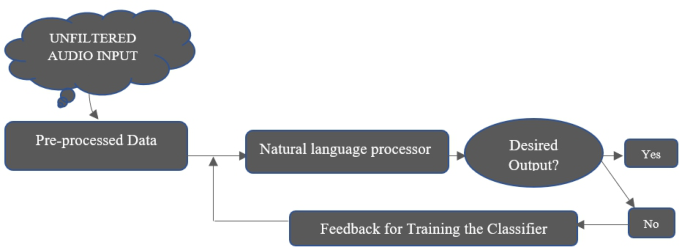
Figure. 1 describes how the input i.e. an unfiltered audio signal is proces- sed and the steps the smart assistant takes to improve the output accuracy of
Applying Smart Assistants in Express Decision for Insurance Choices 3
Figure 1: Steps involved in the improvement of predictive output for a smart assistant.
the activity. Most smart assistants use Natural language processing to deci- pher the words uttered by a user. One of the common techniques used by a language classifier is the Bayes theorem in Hidden Markov Models where the posterior event is based on the probabilities of the prior events.
If an input audio stream is converted into a series of vectors V1, V2, V3,…, Vn and the database of the dictionary consists of words W1, W2, W3,…, Wn, then the software (smart assistant) chooses the best word sequence Wfit by applying Bayes theorem: Wfit = argmax [P(W)×P(W/V)/P(V)] (Shaun, Rene, Chloe, and Jin, 2018).
In our application, the chosen smart assistant is Alexa and it uses a series of questions as part of a skill to understand the user requirements and then act as an “intuition motivator” where it tries to help a user make some decisions. Our Alexa skill uses the following approach to help with decision making: Step1: User uses the skill on an Alexa enabled device like Echo dot, Echo etc. Step2: Alexa asks a series of questions to the user to help with the selection decision. Step3: Users feedback is collected if the necessary outcome was provided. Step4: Based on the provided feedback data is sent for better algorithm outcome.
EXPRESS DECISION APPLICATION IN INSURANCE According to the self-regulation model (Yemelyanov, 2019), problem solving includes the continuous reformulation of a problem and the development of its corresponding mental models. Setting and resetting goals as part of the formation of the mental model is regulated by the dynamic programming algorithm to form the level of motivation and apply the rule of self-regulation. At the beginning of problem solving under uncertainty, the goal of problem solving is formulated in a very general manner, so that only later does the goal gradually become clearer and more specific.
With instrumentally rational goal setting (Yemelyanov, Bedny, 2021), when the long-term goal (LTG) is “reduce risk sufficiently” and the short- term goal (STG) is a tactical goal leading to LTG, successful negative and
unsuccessful positive outcomes become behavioral, thus representing the difficulty and significance of achieving STG, respectively.
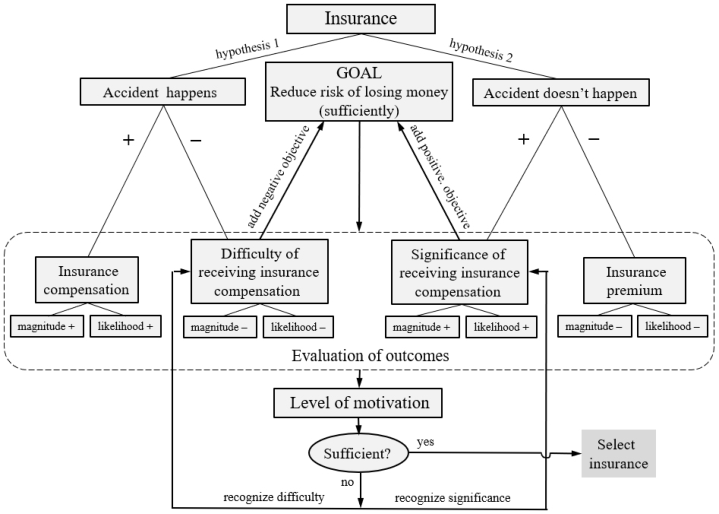
Figure 2 presents the self-regulation model of problem-solving for suffici- ent risk reduction with two hypotheses and four types of related outcomes: Hypothesis 1: accident happens
Magnitude and likelihood of these outcomes are evaluated on the corre- sponding verbal scales:
- magnitude scale: extremely weak, very weak, weak, not weak–not strong, strong, very strong, extremely strong; - likelihood scale: extremely seldom, very seldom, seldom, not seldom–not often, often, very often, extremely often.
If the level of motivation for achieving goal is sufficient (positive feedback), then the problem is solved and insurance is selected. If the level of motivation is insufficient (negative feedback), then feedforward control of forming the
Figure 2: Self-regulation model of selecting insurance for reducing risk of losing money
Applying Smart Assistants in Express Decision for Insurance Choices 5
mental model must be activated to recognize difficulty or significance of beh- avioral successful-negative or unsuccessful-positive outcomes; subsequently, the corresponding negative or positive objective must be added to the goal.
In the process of self-regulation, the mental model with an uncertain goal is specified by adding new criteria of success: negative objectives from successful-negative outcomes (difficulty) and positive objectives from unsuccessful-positive outcomes (significance). For difficulty, “mitigate this difficulty” must be added as a negative objective to the LTG to specify it in the following way: “reduce the risk, while mitigating this type of difficulty.” For significance, “apply this significance” must be added as a positive obje- ctive to the LTG to specify it in the following way: “reduce the risk, while applying this type of significance.”
Proactive Problem Solving With ED2-Insurance-Choice Using Alexa Here we demonstrate how the self-regulation model was implemented in ED2-Insurance-Choice, a web application designed to help make a client- centered and shared-with-agent decision regarding buying an insurance policy (Yemelyanov, Sukumaran, Yemelyanov, 2022). This is a proactive decision to reduce risk of losing money and make accidental loss more manageable.
The decision process is guided by cognitive statistical data regarding peo- ple’s risks of accidental loss, as well as by behavioral factors that reflect their beliefs and experiences. The factor of difficulty and factor of significance are the two main behavioral factors. Both factors play an important role when deciding which insurance to buy. They determine the level of motivation for receiving insurance compensation for accidental loss after an accident occurs.
Factor of difficulty (FD) reflects difficulty of receiving insurance compen- sation due to:
tricky terms and conditions;
insurance companies are slow to respond to claim;
it may take months of back and forth with your insurance company;
your insurance company may delay paying you, etc.
FD creates anxiety from wondering whether a client will receive the appropriate compensation for accidental loss guaranteed by their insurance policy.
Factor of significance (FS) reflects significance of receiving insurance com- pensation. The existing state regulations on implementing insurance rates largely determine the factor of significance. According to the Insurance Information Institute, states’ regulatory guidelines dictate that rates must be adequate and must not be excessive and unfairly discriminatory.
FS creates peace of mind from knowing that the client will be protected from losing money even if an accident doesn’t happen.
FD and FS are viewed as multidimensional factors, which encompass material, physical, psychological, social, and spiritual well-being subfactors.
Unfortunately, factors of difficulty and significance are not sufficiently presented in existing models of insurance choice. ED2-Insurance-Choice is
specifically designed to fill this gap. With the help of ED2-Insurance-Choice, both factors that were initially behavioral can be measured and contribute to the level of motivation for selecting insurance.
In the future risk event of accident, select the best alternative in order to reduce the risk of losing money.
Setting goals STG: receive insurance compensation for accidental loss. LTG (goal): reduce the risk of losing money sufficiently.
Measuring advantages and disadvantages Hypothesis-1: accident happens (alternative is successful from the perspe- ctive of achieving STG). Hypothesis-2: accident doesn’t happen (alternative is unsuccessful from the perspective of achieving STG).
Insurance-1
Hypothesis 1: accident happens (+) Advantages (cognitive successful positive outcomes): insurance com- pensation for accidental loss. Measuring advantages from the perspective of LTG using Alexa: – how are advantages appealing to you from the perspective of reducing the risk of losing money sufficiently? (magnitude+: “weak – strong”); – how likely are you to experience these disadvantages? (likelihood +: “seldom – often)”.
(–) Disadvantages (behavioral successful negative outcomes): factor of dif- ficulty (FD). Even if alternative “Insurance-1” is successful (i.e. accident happens) and therefore has positive outcomes on risk reduction, there are still negative outcomes that present FD of receiving insurance compensa- tion for accidental loss. Unlike positive outcomes, these negative outcomes are behavioral and reflect personal beliefs and experiences. For each of these beliefs/experiences to be considered a measurable disadvantage, they must be recognized by the user as one of the following types of difficulty: material, physical, psychological, social, or spiritual. Alexa recognizes difficulty: For example, the belief that an insurance policy contains tricky terms and conditions makes up psychological difficulty, while experiencing high insurance deductible and payment delay makes up material difficulty. Experiencing months of back and forth with your insurance company makes up physical difficulty, because this requires your time and effort. Measuring disadvantages from the perspective of LTG (Alexa): – how are disadvantages unappealing to you from the perspective of reducing the risk of losing money sufficiently? (magnitude-: “weak – strong”);
Applying Smart Assistants in Express Decision for Insurance Choices 7
– how likely are you to experience these disadvantages? (likelihood-: “seldom – often)”.
Hypothesis 2: accident doesn’t happen (+) Advantages (behavioral unsuccessful positive outcomes): factor of significance (FS). Even if alternative Insurance-1 is unsuccessful (accident doesn’t happen) and therefore has negative outcomes on risk reduction, there are still positive outcomes that present FS of receiving insurance compensation for accidental lost. Unlike negative outcomes, these posi- tive outcomes are behavioral and reflect personal beliefs and experiences. For each of these beliefs/experiences to be considered a measurable advan- tage, they must be recognized by the user as one of the following types of significance: material, physical, psychological, social, or spiritual. Alexa recognizes significance: For example, the belief that “insurance rates are adequate” makes up material significance; the belief that people from your neighborhood pre- fer this particular insurance makes up social significance, while personally experiencing good service from the insurance company within the last five years makes up psychological significance. Measuring advantages from the perspective of LTG using Alexa: – how are advantages appealing to you from the perspective of reducing the risk of losing money sufficiently? (magnitude+: “weak – strong”); – how likely are you to experience these disadvantages? (likelihood+: “seldom – often”).
(–) Disadvantages (cognitive unsuccessful negative outcomes): insura- nce premium. Measuring disadvantages from the perspective of LTG (Alexa): – how are disadvantages unappealing to you from the perspective of reducing the risk of losing money sufficiently? (magnitude-: “weak – strong”); – how likely are you to experience these disadvantages? (likelihood-: “seldom – often)”.
Resetting LTG using Alexa LTG is specified by adding negative or positive objective to the goal; a) for difficulty, “mitigate this difficulty” must be added as a negative obje- ctive to the LTG to specify it in the following way: “reduce the risk of losing money sufficiently, while mitigating this type of difficulty”; for example: “reduce the risk of losing money sufficiently, while mitiga- ting psychological difficulty from believing that insurance policy contains tricky conditions”; b) for significance, “apply this significance” must be added as a positive objective to the LTG to specify it in the following way: “reduce the risk of losing money sufficiently, while applying this type of significance”; for example: “reduce the risk of losing money sufficiently, while applying material significance of believing that your insurance rates are adequate”.
CONCLUSION
We demonstrated that with the help of Express Decision, a decision-making augmentation system, existing smart voice assistants like Alexa can be used more efficiently, specifically when setting goals. They can support instrumen- tal rationality of the self-regulation model of Express Decision not only by voice recognition, but also by recognizing intuition as an inner voice. We beli- eve that this is the first attempt at using this type of smart assistant. However, a lot of work remains ahead of us, both in the direction of further under- standing the role of intuition in the self-regulation of decision-making and improving smart algorithms for voice assistance.
REFERENCES
Yemelyanov, A. (2022). Express Decision. US Patent. No. 11, 358, 611, U. S. Patent and Trademark Office. Bedny, G., Karwowski, W., and Bedny, I. (2015). ApplyingSystemic-Structural
Activity Theory to Design of Human-ComputerInteraction Systems, CRC Press. Taylor & Francis Group. Hang, H., Limin, Y., Shihan, L. and Gang, W. (2020). “A Case Study ofthe Security Vetting Process of Smart-home Assistant Applications”, IEEE Security and Privacy. Efthimios, A. and Constantinos, P. (2017). “Monkey Says, Monkey Does: Security
and Privacy on Voice assistants”, IEEE Access. Tavish, V., Yuankai, Z., Micah, S. and Clay, S. (2015). “CocaineNoodles: Exploiting the Gap between Human and Machine SpeechRecognition”, USENIX Workshop. Shaun, A., Rene, P., Chloe, K., and Jin, W. (2018). “On SpeechRecognition
Algorithms”, IJMLC. Yemelyanov, A. M. (2019). “Modeling and Mobile Device Support ofGoal-Directed Decision Making under Risk and Uncertainty, Chapter 4”. In G. Bedny, I. Bedny (Eds.), Study of Human Performance: Appliedand Systemic-Structural Activity Theory Approach. CRC Press, Taylor & Francis Group, pp. 69–103. Yemelyanov, A. M., Bedny, I. S. (2021). “Self-Regulation Approach forSetting Goals
in Problem-Solving”. In H. Ayaz et al. (Eds.), Advances in Neuroergonomics and Cognitive Engineering. LectureNotes in Networks and Systems, Vol. 259, Springer, pp. 194–200. https://doi.org/10.1007/978-3-030-80285-1_24 Yemelyanov, A. M., Sukumaran, R., Yemelyanov, A. (2022). Application ofExpress- Decision2 in User-Centered and Shared-with-Expert Decisions UnderRisk and Uncertainty. In: Hasan Ayaz (eds) Neuroergonomics and CognitiveEngineering. AHFE (2022) International Conference. AHFE Open Access, vol42, 1–9. AHFE International, USA;http://doi.org/10.54941/ahfe1001812
LISTED IN THE AHFE DIGITAL BOOKSTORE CATALOGUE
Explore the complete digital volume
Neuroergonomics and Cognitive Engineering
Read this individual research paper free through the original publisher, or explore the full digital proceedings book.
ISBN 978-1-958651-78-0
Explore this ISBN in the AHFE Bookstore ↗Listed in the July 2026 bookstore catalogue; search by ISBN to confirm current availability · Digital book purchase optional