Alexander M. Yemelyanov, Harikrishnan U Nair (2025). Enhancing decision-making in risk and uncertainty through OpenAI API integration. In: Neuroergonomics and Cognitive Engineering. AHFE Open Access, vol. 167, pp. 62–72. https://doi.org/10.54941/ahfe1006128
In today's complex and rapidly evolving environment, decision-making and problem-solving under risk and uncertainty present significant challenges for individuals. Traditional methods often fall short due to cognitive limitations, information overload, and emotional biases. Express Decision, the decision-making augmentation system developed from the framework of systemic-structural activity theory, helps decide on the most satisficing alternative for solving the problem of risk reduction. A satisficing alternative is an alternative that satisfies requirements for risk reduction and is sufficient for the decision-maker. The process of solving the problem is self-regulating, where the problem goal, initially set up as an uncertain “sufficient risk reduction”, should be clarified in the process of problem-solving to reflect the formation of the mental model, while the activity goal should be accordingly modified by adding corresponding objectives as criteria for success to reflect the formation of the level of motivation. This iterative process ultimately leads to the most satisficing solution to the problem. Given human limitations in computational capacity due to the size of working memory, the augmentation system supports computation on various levels, encompassing motivation, self-efficacy, and risk reduction. This paper explores the integration of OpenAI APIs into Express Decision, enhancing cognitive functions, motivation, self-regulation, and self-efficacy in decision-making contexts. Cognition, fundamentally rooted in information processing, can be significantly augmented through OpenAI APIs. These advanced language models can analyze vast amounts of data, identify patterns, and generate insights that might be overlooked by human cognition alone. By providing timely, relevant, and comprehensible information, these APIs reduce cognitive load and support more informed and effective decision-making. They assist in risk assessment and forecasting outcomes, enabling users to more easily navigate complex problems. Motivation, the energetic force driving individuals toward goal achievement, is also positively impacted by the integration of OpenAI APIs. The interactive and responsive nature of these tools promotes better engagement in challenging tasks. By offering tailored feedback and recommendations, the AI models create an interactive environment supporting problem-solving. This interaction can help sustain motivation under uncertainty. Self-regulation is crucial when facing risk and uncertainty, as it enables the user to manage their behavior, emotions, and thoughts when pursuing long-term goals,. OpenAI APIs can enhance self-regulation by assisting users in setting goals and objectives, as well as prompting users to consider alternative strategies when obstacles arise. OpenAI APIs reinforce self-efficacy, which is the belief in one's capacity to execute actions for desired outcomes. By breaking down complex problems into manageable steps and providing guidance, the AI models empower users to tackle challenges with increased confidence. As users experience increased self-efficacy with the assistance of AI, their belief in their abilities is reinforced, which results in greater persistence and willingness to engage in more difficult decision-making.Integrating OpenAI APIs not only augments cognitive and motivational processes but also supports psychological factors essential in an effective decision-making and problem-solving environment, reducing uncertainty with data-driven insights.
Express Decision is a decision-making augmentation system designed to manage risk and uncertainty by identifying the most “satisficing” alternative for effective risk reduction (Yemelyanov, 2023). A “satisficing” alternative meets the requirements for reducing risk while remaining sufficient for the decision-maker. The problem-solving process is self-regulating, wherein the problem goal—initially set as an uncertain “sufficient risk reduction”— is clarified through the formation of the mental model, and the activity goal is refined by adding relevant objectives that reflect the user’s level of motivation. This iterative cycle ultimately leads to the most satisficing solution. Because human computational capacity is limited by working memory constraints, the system provides support at multiple levels, including motivation and self-regulatory efficacy for achieving goals and overcoming challenges. By integrating Microsoft Azure OpenAI APIs into ED2®— the mobile application of Express Decision—users are supported through automatically generated prompts based on their profiles, which are used to produce personalized risk-related outcomes with associated confidence levels, as well as motivational outcomes supported by goal-oriented strategies and tailored solutions for overcoming challenges. This process strengthens
Enhancing Decision-Making in Risk and Uncertainty Through OpenAI API Integration 63
self-regulatory efficacy and promotes more effective decision-making. We demonstrate the application of the system in a medical context—ED2® Statin Choice—to support individuals in navigating risk and uncertainty while leveraging their self-regulatory efficacy to improve both decision quality and confidence in the choices they make.
PROBLEM-SOLVING AND SELF-REGULATORY EFFICACY Herbert Simon (1987) differentiates between decision-making and problem- solving. Decision-making involves evaluating and choosing among alternative actions, while problem-solving entails identifying issues that require attention, setting goals, and devising or discovering suitable courses of action. According to Simon (1976), decision-making demonstrates substantive rationality, i.e., “what” choice is made, optimizing decisions based on expected utility, whereas problem-solving demonstrates procedural rationality, i.e., “how” a choice is made by looking for satisficing solutions. The term “satisficing” is derived from the amalgamation of “satisfy” and “suffice,” both serving as criteria in the search process. Satisficing proves effective in dealing with uncertainty, particularly in ill-defined situations where not all alternatives and consequences can be fully anticipated and defined. When setting goals under conditions of risk and uncertainty, a risk reduction strategy is commonly employed. This approach is applied extensively in various domains, such as financial decision-making, healthcare, environmental planning, and more. In this paper, we explore problem-solving under uncertainty, framing it as a pursuit of risk reduction. This approach involves establishing two goals: a problem goal, which is “risk reduction”, and an activity goal, which is a sub-goal that leads to the problem goal and makes it achievable. The activity goal is established in response to the risk event and pertains to the implementation of objectives directed at realizing the overarching problem goal. The activity goal can be either achieved or not achieved, while the problem goal is an uncertain goal that cannot be completely achieved but only satisfied, i.e., achieved to a level that is sufficient for the individual. Therefore, “risk reduction” actually refers to “sufficient risk reduction.” This is how the problem goal should be initially formulated to clarify it later within the process of self-regulation.
Problem-solving can be reactive or proactive. Reactive problem-solving happens under pressure after the event that causes the risk; its focus is on reducing risk after the fact. Proactive problem-solving happens before the event that causes the risk; its focus is on reducing risk in advance. In both reactive and proactive problem solving, achieving the activity goal is associated with successful outcomes, while not achieving the activity goal is associated with unsuccessful outcomes. When selecting an activity goal, the principle of instrumental rationality (Yemelyanov, 2024) must be met — “achievement of the activity goal is a sufficient and necessary condition for achieving the problem goal”. With instrumentally rational goal setting where the problem goal is “sufficient risk reduction” and the activity goal is a sub-goal leading to the problem goal, successful negative and unsuccessful positive outcomes become motivational, representing the difficulty and
64 Yemelyanov and Nair
significance of achieving the activity goal, respectively. Difficulty represents the challenges associated with achieving the activity goal, while significance reflects the alignment of the activity goal with the problem goal. Both factors are viewed as multidimensional, encompassing material, physical, psychological, social, and spiritual well-being.
Effective problem-solving relies on clearly defined goals, strong motivation, and robust self-regulation (Zimmerman, 2000). Albert Bandura (1991), who introduced the term self-efficacy to describe individuals’ beliefs in their capabilities to perform actions that lead to desired outcomes, expanded this concept to include self-regulatory efficacy, which refers to individuals’ confidence in managing their thoughts, emotions, and behaviors while working toward their goals. Within this framework, Bandura (1997) also identified coping self-efficacy, which reflects an individual’s belief in their ability to manage stressors and overcome challenges.
SELF-REGULATION MODEL The self-regulation model of problem-solving (Yemelyanov, 2024) is based on the self-regulation model of the thinking process developed by Gregory Bedny (Bedny et al., 2015), as well as experimental studies on human- operator self-regulation and risk assessment conducted by Michael. Kotik (1989). The model incorporates two concurrently and dynamically running processes: formation of the mental model and development of the level of motivation by using two regulators: significance and difficulty. Significance provides feedforward control, while the difficulty provides feedback control, thus jointly shaping the level of motivation.
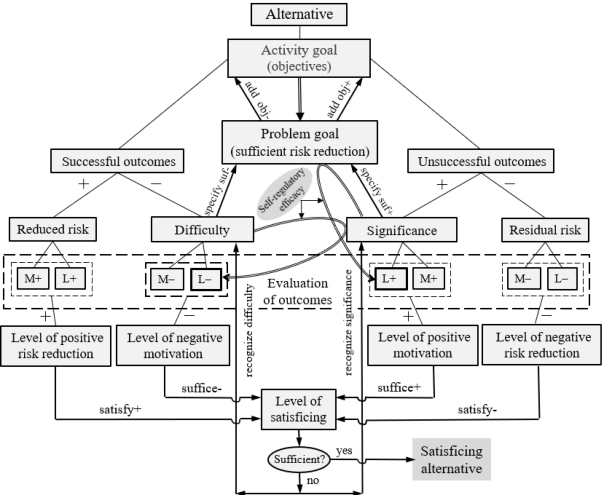
In this paper, the model is extended to include self-regulatory efficacy. Figure 1 presents the enhanced self-regulation model for selecting satisficing alternatives, where both the problem goal and activity goal follow the principle of instrumental rationality.
As shown in Figure 1, the activity goal initially classifies outcomes as either successful or unsuccessful. The problem goal classifies successful outcomes into reduced risk (cognitive) and difficulty (motivational), and unsuccessful outcomes into residual risk (cognitive) and significance (motivational). Each outcome is evaluated according to its magnitude (M), using a verbal scale ranging from “extremely weak” to “extremely strong,” and its likelihood (L), using a scale from “extremely seldom” to “extremely often.”
Michael Kotik’s experimental research was applied to aggregate these outcomes into levels of positive (satisfy+) and negative (satisfy–) risk reduction, as well as positive (suffice+) and negative (suffice–) motivation. This aggregation is based on functional dependencies identified through empirical studies (Kotik, 1994). These values are then combined to determine the overall level of satisficing. For a detailed description and further discussion of Kotik’s empirical findings, see Yemelyanov & Yemelyanov (2019).
Enhancing Decision-Making in Risk and Uncertainty Through OpenAI API Integration 65
Figure 1: Self-regulation model of selecting satisficing alternatives.
If the overall level of satisficing—i.e., integrating the positive and negative aspects of “satisfy” and “suffice”—is sufficient (i.e., produces positive feedback), the alternative is considered satisficing. If it is insufficient (negative feedback), feedforward control is activated, identifying new difficulty or significance within either successful-negative or unsuccessful-positive outcomes, respectively. This process determines the positive (suf+) or negative (suf–) component of sufficiency with the problem goal (“sufficient risk reduction”), which in turn refines the activity goal by adding positive (obj+) or negative (obj–) objectives.
When recognizing significance, “apply this significance” is added as a positive objective in the activity goal. For example, one might lower LDL-C by 30% (activity goal) while following medical guidelines (physical significance) to reduce the risk of heart attack and stroke. When recognizing difficulty, “avoid this difficulty”is added as a negative objective in the activity goal, such as lowering LDL-C by 30% while also mitigating side effects (physical difficulty) from statins. An alternative is considered satisficing if its level of satisficing exceeds 50%; otherwise, the evaluation process repeats by recognizing any new difficulty/significance, specifying the problem goal, and amending the activity goal with the appropriate objectives.
During self-regulation, the uncertain problem goal is clarified by identifying new difficulty or significance, while the activity goal is modified by adding corresponding objectives as success criteria. This iterative process gradually leads to a satisficing solution.
Figure 1 also shows the role of self-regulatory efficacy, a key motivational driver influencing both positive and negative motivation in problem-solving
66 Yemelyanov and Nair
through its impact on the likelihood of significance (L+) and the likelihood of difficulty (L–). Specifically, L+ reflects an individual’s willingness to invest effort in achieving the problem goal (e.g., sufficient risk reduction): as more effort is expended, L+ increases. This effort is affected by the magnitude of significance (M+) and the desirability of the problem goal. In contrast, L– indicates an individual’s readiness to overcome obstacles; with increased effort, L– decreases. The required effort depends on the magnitude of difficulty (M–) and the level of positive motivation for attaining the activity goal, which is shaped by both M+ and L+. Self-regulatory efficacy influences these likelihoods by shaping an individual’s confidence in both anticipating challenges and achieving success. It raises L+ when individuals believe they can reach positive outcomes and lowers it when that belief is weak. Meanwhile, coping self-efficacy modulates L–, reflecting one’s confidence in managing difficulties. Individuals with high coping self-efficacy view challenges as manageable, thereby minimizing L–, whereas those with low coping self-efficacy perceive them as more daunting, increasing L–.
For example, consider an activity goal of lowering LDL-C by 30% while mitigating statin side effects. Medical guidelines indicate that “strong” side effects (e.g., those affecting the liver or muscles) can often be alleviated by maintaining a healthy lifestyle and diet. Individuals with high self-efficacy in following these changes may perceive such side effects as occurring “seldom,” whereas those with low self-efficacy may view them as happening “very often.”
AI-POWERED EXPRESS DECISION The self-regulation model served as the foundation for the development of Express Decision, a decision-making augmentation system (Yemelyanov, 2024). With the integration of the Azure OpenAI API. Express Decision evolved into an AI-powered solution offering two distinct modes: decision- making and problem-solving.
In the decision-making mode, which is information-driven, Azure OpenAI generates positive and negative outcomes based on the user’s profile. The user evaluates the magnitude and likelihood of these outcomes to identify the alternative with the highest overall utility. The problem-solving mode is goal-driven. Based on the user’s profile, Azure OpenAI generates risk-related outcomes (i.e., reduced and residual risks) and motivational outcomes (i.e., difficulty and significance). Difficulty and significance are further categorized as material, physical, psychological, social, and spiritual. Reduced risk outcomes are presented with a confidence level reflecting the strength of evidence supporting the estimated risk reduction, while residual risk outcomes have a confidence level representing the projected remaining risk. Tailored solutions for overcoming anticipated challenges support each category of difficulty, while strategies for achieving the goal support each category of significance. From the perspective of attaining the problem goal, users evaluate the magnitude and likelihood of these outcomes to arrive at a satisficing solution. When users evaluate the likelihood of a difficulty or significance, they engage self-regulatory efficacy—the belief in their ability
Enhancing Decision-Making in Risk and Uncertainty Through OpenAI API Integration 67
to overcome challenges or pursue meaningful goals. Personalized solutions and strategies are designed to enhance this efficacy by helping users manage difficulties and apply significance more effectively.
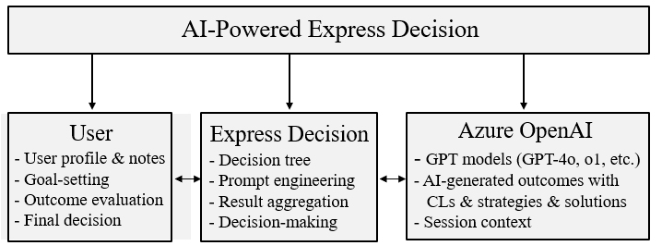
Figure 2 presents the architecture of the AI-powered Express Decision system, which consists of three interconnected components: the User, Express Decision, and Azure OpenAI. The User defines goals, maintains a personal profile, submits additional notes if necessary, evaluates AI-generated outcome data, and ultimately makes the final decision. Express Decision assists by structuring the decision tree, engineering prompts, aggregating results, and guiding the decision-making process. Azure OpenAI leverages advanced large language models (LLMs), such as GPT-4o and GPT-1o, to process prompts based on the user’s profile and inputs (notes). It generates personalized risk-related and motivational outcomes—including confidence levels, strategies, and solutions —while maintaining session context throughout the interaction.
Figure 2: Architecture of AI-powered express decision.
The system’s application architecture integrates a frontend developed with Angular, a Spring Boot backend, and a PostgreSQL database. AI functionalities are incorporated through Spring AI with Azure OpenAI. Communication within the system is managed via HTTP request-response and Server-Sent Events (SSE) for real-time updates, ensuring seamless interaction between components and efficient processing of AI-generated insights. AI-powered Express Decision is implemented in ExpressDecision2® as a general-purpose web application and in ED2® as a customized solution developed for specific user types and decision problems.
Below is an example of ED2® Statin Choice, an AI-powered medical application of Express Decision designed to help users decide whether to take statins, adopt lifestyle therapy, or consider a combination of both approaches.
ED2® STATIN CHOICE ED2® Statin Choice is designed for people without clinical atherosclerotic cardiovascular disease (ASCVD) but with high cholesterol and, therefore, a higher risk of heart attack and stroke. It helps decide whether to take statins or apply lifestyle therapy (or combine statins with lifestyle modification) to
68 Yemelyanov and Nair
help lower cholesterol. This is a reactive decision to reduce the risk of heart attack and stroke after a diagnosis of high cholesterol. ED2® Statin Choice is designed to facilitate a patient-centered decision, in collaboration with a clinician, on whether to use statins, lifestyle therapy, or a combination of both to lower low-density lipoprotein-cholesterol (LDL-C) and reduce the risk of heart attacks and strokes. In medicine, lowering LDL-C is a key strategy in managing blood cholesterol.
Azure OpenAI provides ED® Statin Choice with efficient access to clinical guidelines and integrates with the ASCVD risk calculator to personalize risk calculations and maintain session context. More specifically, Azure OpenAI helps extract recommendations from sources such as ACC/AHA guidelines based on patient-specific factors (e.g., age, LDL levels, diabetes, hypertension) found in the user profile. This approach proves especially helpful for lengthy clinical guidelines, such as the 2018 AHA/ACC Guideline on Cholesterol Management. Once the risk calculation is retrieved, Azure OpenAI uses an LLM to integrate these results with guideline recommendations. This allows the model to generate context-rich advice, for example: “Your 10-year risk of cardiovascular events is 12%. Current guidelines suggest moderate-intensity statin therapy if the risk is above 7.5%–10%, especially with these other risk factors…” Below is a demonstration of how ED2® Statin Choice works, using a hypothetical example. Assume the user is a patient with no history of cardiovascular events but has recently been diagnosed with high cholesterol, with a total cholesterol level of 250 mg/dL. The patient must choose between moderate-intensity statin therapy or low-intensity statin therapy combined with lifestyle modifications. The user logs into ED2® Statin Choice and creates a profile. The entered information includes: age 55, male, white, non- smoker, with diabetes, untreated systolic blood pressure of 150 mmHg, HDL cholesterol of 60 mg/dL, and total cholesterol of 250 mg/dL.
Based on this profile, ED2® Statin Choice formulates the following problem for risk reduction:
Problem: Moderate-intensity statin therapy vs. Low-intensity statin therapy with lifestyle modification
Equation reproduced from the original PDF.
Associated risk: Heart attack and stroke, with a 20.4% Baseline Risk, as estimated by the ASCVD risk calculator
Problem goal: Sufficiently reducing the risk of heart attack and stroke
Activity goal: Lowering LDL-C by 30% This approach employs reactive problem-solving focused on sufficiently reducing the risk of heart attack and stroke by lowering LDL-C by 30%. For each alternative, ED2® Statin Choice generates risk-related outcomes— reduced risk, considered here as relative risk reduction (RRR), and residual risk (RR)—along with motivational outcomes (difficulty and significance). The formula RR = BR × (1 – RRR) calculates residual risk using baseline risk (BR) and relative risk reduction. Relative risk reduction outcomes have a confidence level (CL) indicating the strength of evidence for the estimated
Enhancing Decision-Making in Risk and Uncertainty Through OpenAI API Integration 69
risk reduction, while residual risk outcomes have a CL representing the projected remaining risk. Each category of difficulty is paired with solutions for overcoming it, and each category of significance is paired with strategies to achieve the problem goal.
The user evaluates the magnitude and likelihood of these outcomes from the perspective of achieving the problem goal. When evaluating the likelihood of motivational outcomes, self-regulatory efficacy (SRE) is engaged, reflecting the user’s belief in their capacity to apply the recommended strategies (for significance) or solutions (for difficulty). Alternative 1: Moderate-intensity statin therapy
CL: ∼0.90 (High evidence based on large trials, e.g., CARDS, JUPITER, CTTC meta-analyses)
Satisfy+: 64% (strong, often) Residual Risk
RR: ∼14.3
CL: ∼0.70 (Moderate confidence, reflecting expected variability in patient response and adherence)
Satisfy–: 36% (weak, seldom) Difficulty in lowering LDL-C by 30%
Physical difficulty: Possible statin side effects (muscle pain, fatigue, liver enzyme elevation, increased blood sugar, and a potential increased risk of developing type 2 diabetes)
- Solutions: Take a brief break from therapy or lower the dose
Magnitude of difficulty: Strong, due to physical side effects
Likelihood of difficulty: Not seldom-not often, due to the user’s belief (SRE) in their capacity to mitigate strong side effects through breaks or dose adjustment
Suffice–: 55% (strong, not seldom-not often) Significance of lowering LDL-C by 30%
Physical significance: COR I, LOE A. According to ACC/AHA guidelines, moderate-intensity statin therapy is a Class I with Level A evidence for primary prevention in patients with LDL ≥190 mg/dL or those at elevated risk
Psychological significance: Confidence and peace of mind from substantially reducing cardiovascular risk
- Strategies: Celebrate LDL improvements, practice stress management, and maintain a positive, informed mindset
70 Yemelyanov and Nair
Magnitude of significance: Strong (combination of physical and psychological benefits)
Likelihood of significance: Often, based on the user’s belief (SRE) in their capacity to consistently monitor LDL to confirm progress and practice stress management while maintaining a positive, informed mindset
Suffice+: 64% (strong, often) Alternative 2: Low-intensity statin therapy with lifestyle modification
CL: ∼0.75 (∼10–15% from lifestyle changes plus ∼10–15% from low-intensity statin). Moderate confidence (e.g., Diabetes Prevention Program, Look AHEAD trial, and statin subgroup analyses)
Satisfy+: 55% (strong, not seldom-not often) Residual Risk
RR: ∼15.3%
CL: ∼0.60 (Influenced by variability in lifestyle adherence and metabolic response)
Satisfy–: 27% (weak, very seldom) Difficulty in lowering LDL-C by 30%
Material difficulty: Lifestyle-related expenses (cost of healthy food and gym memberships)
- Solutions: Choose budget-friendly nutritious foods, opt for free workout options (home exercises, walking), and seek community resources
Physical difficulty: Fatigue, soreness from exercise, dietary restrictions, hunger cravings
- Solutions: Gradually increase activity and take it easy when exercising, choose balanced meals, stay hydrated, and get adequate rest
Psychological difficulty: Difficulty maintaining lifestyle changes, stress from dietary restrictions, motivation struggles, and frustration with slow results
- Solutions: Set small goals, find enjoyable activities, get support, and track progress
Magnitude of difficulty: Not weak-not strong (reflecting multiple challenges)
Likelihood of difficulty: Very seldom, due to the user’s belief (SRE) in their capacity to manage costs, follow gradual exercise routines, and get support from family members
Suffice–: 36% (not weak-not strong, very seldom)
Enhancing Decision-Making in Risk and Uncertainty Through OpenAI API Integration 71
Significance of lowering LDL-C by 30%
Physical significance: COR I, LOE A for statins; COR I, LOE B for lifestyle. Guidelines strongly recommend combining pharmacotherapy (if LDL ≥190 mg/dL or 10-year risk ≥7.5–20%) with lifestyle changes for maximal cardiovascular event reduction
- Strategies: Follow recommended workouts, stick to balanced eating, and complement statins with consistent lifestyle routines
Psychological significance: Greater confidence in actively managing risk; improved well-being from regular exercise
- Strategies: Keep a health diary, visualize progress, and seek motivational support when needed
Social significance: Positive influence on family/friends adopting healthier lifestyles; improved social engagement
- Strategies: Organize healthy gatherings, invite friends to exercise, and promote shared dietary goals
Magnitude of significance: Srong (physical, psychological, and social components)
Likelihood of significance: Very often, due to belief (SRE) in the user’s capacity to strictly follow the recommended workouts along with consistent lifestyle routines, document progress, and engage a supportive social network
Suffice+: 73% (strong, very often) The evaluation of risk-related outcomes showed no significant difference between the alternatives:
Equation reproduced from the original PDF.
Alternative 2: satisfy = 64% (satisfy+ = 55%, satisfy– = 27%) In contrast, the evaluation of motivational outcomes revealed a clear difference:
Equation reproduced from the original PDF.
Alternative 2: suffice = 71% (suffice+ = 73%, suffice– = 36%) Overall, Alternative 2 achieves a higher satisficing level of 68% compared to 59% for Alternative 1:
Equation reproduced from the original PDF.
Alternative 2: satisficing = 68% (+64%, –32%) Because both alternatives have similar “pros” (64%), the lower “cons” (32%) of Alternative 2 leads to a higher overall satisficing level, making Alternative 2 the preferred choice.
This illustration demonstrates how integrating OpenAI’s API technology into ED2® allows individuals to manage risk and uncertainty more effectively, leveraging self-efficacy to enhance decision quality and confidence.
72 Yemelyanov and Nair
CONCLUSION
The integration of Microsoft Azure OpenAI APIs into ED2®—the mobile application of Express Decision—demonstrates how motivated decision- making, guided by self-regulation and self-efficacy, can be significantly enhanced through the application of AI technologies. By leveraging advanced large language models (LLMs) from OpenAI, ED2® generates personalized risk-related outcomes with associated confidence levels, as well as motivational outcomes supported by goal-oriented strategies and tailored solutions for overcoming challenges, reinforcing both motivational and cognitive processes to enhance decision-making effectiveness. Because ED2® can be configured to incorporate continuously evolving GPT models (e.g., GPT-4, GPT-4o, GPT-1o) through Azure OpenAI, we can anticipate progressively more robust results. Ongoing enhancements to ED2® are expected through the continued development of the Express Decision framework and iterative advances in AI technologies, ensuring the system remains at the forefront of motivated decision-making.
REFERENCES
Bandura, A. (1991). Social cognitive theory of self-regulation. Organizational Behavior and Human Decision Processes, 50(2), 248–287. Bandura, A. (1997). Self-efficacy: The exercise of control. New York: W. H. Freeman
and Company. Bedny, G., Karwowski, W., and Bedny, I. (2015). Applying systemic-structural activity theory to design of human-computer interaction systems, CRC Press, Taylor & Francis Group. Kotik, M. A. (1989). Psychology and safety (3rd ed.). Tallinn, Estonia: Valgus. Kotik, M. A. (1994). Developing applications of “Field Theory” in mass studies.
Journal of Russian & East European Psychology, 32 (4), July-August, 38–52. Simon, H. (1976). From substantive to procedural rationality. In S. J. Latsis (Ed.), Method and appraisal in economics (pp. 129–148). Cambridge University Press. Simon, H., et al. (1987). Decision making and problem solving. Interfaces, vol. 17(5),
11–31. Yemelyanov, A. M. and Yemelyanov, A. A. (2019). Evaluation of the factor of significance in human performance (applied activity theory approach), Chapter 7. In G. Bedny & I. Bedny (Eds.), Applied and systemic-structural activity theory (pp. 145–175) . CRC Press, Taylor & Francis Group. Yemelyanov, A. M. (2023). Express Decision: Decision-making augmentation system
(U. S. Patent No. 11, 358, 611), U. S. Patent and Trademark Office. Yemelyanov, A. M. (2024). Decision-making augmentation system for solving the problem of risk reduction. In: A. M. Yemelyanov & L. J. Elliot (Eds.) Neuroergonomics and Cognitive Engineering. AHFE 2024 International Conference. https://doi.org/10.54941/ahfe1004738 Zimmerman, B. J. (2000). Attaining self-regulation: A social cognitive perspective. In
M. Boekaerts, P. R. Pintrich, & M. Zeidner (Eds.), Handbook of Self-Regulation (pp. 13–39). Academic Press.
LISTED IN THE AHFE DIGITAL BOOKSTORE CATALOGUE
Explore the complete digital volume
Neuroergonomics and Cognitive Engineering
Read this individual research paper free through the original publisher, or explore the full digital proceedings book.
ISBN 978-1-964867-43-4
Explore this ISBN in the AHFE Bookstore ↗Listed in the July 2026 bookstore catalogue; search by ISBN to confirm current availability · Digital book purchase optional