Alexander M. Yemelyanov (2024). Decision-making augmentation system for solving the problem of risk reduction. In: Neuroergonomics and Cognitive Engineering. AHFE Open Access, vol. 126, pp. 60–71. https://doi.org/10.54941/ahfe1004738
The decision-making augmentation system for solving the problem under risk and uncertainty is demonstrated. This system helps decide on the most satisficing alternative for solving the problem of risk reduction. Satisficing alternative is an alternative that satisfies requirements for risk reduction and is sufficient for the decision-maker. The process of solving the problem is self-regulating, where the problem goal, initially set up as an uncertain “sufficient risk reduction”, should be clarified in the process of problem-solving to reflect the formation of the mental model, while the activity goal should be accordingly modified by adding corresponding objectives as criteria for success to reflect the formation of the level of motivation. This iterative process ultimately leads to the most satisficing solution to the problem. Given human limitations in computational capacity due to the size of working memory, the augmentation system supports computation on various levels, encompassing motivation, self-efficacy, and risk reduction. This system is implemented in ED2® mobile web apps, addressing both reactive and proactive risk reduction for present or future risk events, respectively.
Decision-Making Augmentation System for Solving the Problem of Risk Reduction 61
computational capacity due to the size of working memory, the augmentation system supports computation on various levels, encompassing risk reduction, motivation, and self-efficacy.
HERBERT SIMON’S CONCEPTS OF BOUNDED AND PROCEDURAL RATIONALITY Herbert Simon’s exploration of bounded rationality and procedural rational- ity was closely connected to enhancing human rationality in decision-making under conditions of risk and uncertainty. He introduced the concept of bounded rationality and formulated the principle that states, “the capacity of the human mind for formulating and solving complex problems is very limited compared to the size of problems requiring solutions for objectively rational behavior in the real world — or even for a reasonable approxima- tion to such objective rationality”(Simon, 1957). According to Simon (1982), human rationality is constrained by limitations in thinking capacity, avail- able information, and time. As an illustration, in the 1950s, computational constraints on human short-term or working memory were approximated to be limited to 7 ± 2 variables (Miller, 1956). A more recent estimate sug- gests 4 ± 1 constructs, meaning that decision quality typically degrades once this limit of four constructs is surpassed (Cowan, 2000). Bounded ratio- nality is not a study of deviation from rationality, as it is believed to be by many psychologists (Simon, 1985). In his essay in memory of Herbert Simon, Arrow insists that “boundedly rational procedures are in fact fully optimal procedures when one takes account of the cost of computation in addition to the benefits and costs inherent in the problem as originally posed” (Arrow, 2004). Simon also introduced the concept of procedural rationality, manifesting it in the form of a satisficing procedure. The term “satisficing” is derived from the amalgamation of “satisfy” and “suffice,” both serving as criteria in the search process. Satisficing proves effective in dealing with uncertainty, particularly in ill-defined situations where not all alternatives and consequences can be fully anticipated and defined. In defining procedural rationality, Simon (1976) also introduces another concept as its counterpoint: substantive rationality. Substantive rational behavior is characterized by its adequacy in achieving specified goals within given conditions and constraints, emphasizing the realization of the best possible outcome while consider- ing available information and preferences — the essence of the choice that is made (“what” choice is done). Conversely, procedural rational behavior results from thoughtful deliberation. In this context, the emphasis is on the process or procedure employed in problem-solving, prioritizing “how” the choice is made rather than the specific outcome. Simon’s studies of bounded rationality and procedural rationality predominantly focused on cognitive limitations and information processing. However, decision-making under uncertainty is not solely driven by cognition but is also influenced by emo- tions, a facet of bounded rationality that has often been overlooked (Hanoch, 2002). Emotions play a significant role in shaping cognitive processes related to decision-making, exerting the potential to both enhance and impair them (Kaufman, 1999).
62 Yemelyanov
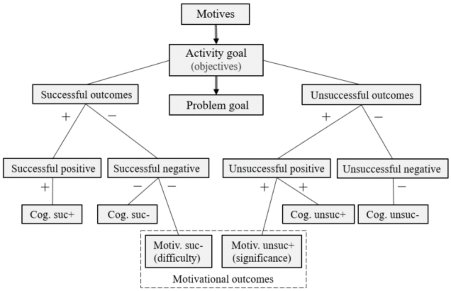
SETTING GOALS IN PROBLEM-SOLVING Herbert Simon (1987) differentiates between decision-making and problem- solving. Decision-making involves evaluating and choosing among alterna- tive actions, while problem-solving entails identifying issues that require attention, setting goals, and devising or discovering suitable courses of action. Below, we explore a motivational approach to problem-solving within the framework of systemic-structural activity theory (Bedny and Bedny, 2019). In the context of SSAT, a goal is considered a cognitive or informational element within a problem-solving activity, whereas a motive embodies a motivational or energetic component of the same activity. The goal of the problem represents the ultimate aim or desired outcome, providing a clear direction for the efforts invested. The executive component of the activity involves defining objectives that outline the specific tasks or activities needed to achieve the goal of the problem. Therefore, following activity theory, effec- tive problem-solving entails establishing two distinct goals: the problem goal and the activity goal. The latter serves as an immediate goal and pertains to the implementation of objectives directed at realizing the overarching prob- lem goal. Motivation is a key factor in pursuing and attaining goals within the problem-solving activity. A goal is intrinsically connected to motives and metaphorically establishes the vector “motive →goal”, providing both pur- pose and direction to the activity. This vector connects the motives to the activity goal (“how” the choice is made) with directness to the problem goal (“what” choice is made). Establishing the activity goal with objectives as an immediate goal toward achieving the problem goal is a strategic approach that prevents the complete shift of the motive to the problem goal. Such a shift would lead to the loss of goal-directedness in the activity, which in turn results in the loss of procedural rationality and the substitution of it by substantive rationality (Simon, 1976). Notably, integrating motives with problem goals, as demonstrated in cognitive psychology (Locke and Latham, 2002), results in a single problem encompassing multiple goals. Below, we illustrate how procedural rationality operates in generating cog- nitive and motivational outcomes when selecting alternatives (see Figure 1).
Figure 1: Successful and unsuccessful outcomes of the goal-directed problem-solving activity.
Decision-Making Augmentation System for Solving the Problem of Risk Reduction 63
The vector “motive →goal” connects the motives to the activity goal. The success or failure of achieving the activity goal of implementing objectives results in successful and unsuccessful outcomes, respectively. Subsequently, the goal categorizes these outcomes into positive and negative, contingent upon their desirability (Heath, Larrick, and Wu, 1999). As a result, successful positive and unsuccessful negative outcomes are cognitive, whereas success- ful negative and unsuccessful positive outcomes cannot be entirely cognitive. Successful negative outcomes encompass a motivational component reflect- ing the difficulty of executing objectives (referred to as “difficulty”). Con- versely, unsuccessful positive outcomes involve a motivational component reflecting the significance of objectives (referred to as “significance”) as their directness towards the problem goal. Both these factors jointly determine the level of motivation for achieving the goal.
In SSAT, motivation is viewed as a goal-directed process encompassing diverse cognitive mechanisms involving both feedforward and feedback con- trols. Within the functional mechanism of self-regulation, the assessment of difficulty plays a crucial role, particularly when individuals need to evaluate their perceived abilities and experience in accomplishing a goal.
Bandura (1977) introduced the concept of self-efficacy, which is the belief in one’s ability to successfully perform a specific task or achieve a particu- lar goal. According to his theory, high self-efficacy is associated with greater motivation, persistence, and resilience in the face of challenges. Expanding on this framework, Bandura (1982) identified self-efficacy as an essential mech- anism within the domain of motivation. Self-efficacy serves as a motivational driver within the self-regulation process. Individuals with high self-efficacy are more likely to regulate their thoughts and behaviors effectively to attain goals.
When setting goals under conditions of risk and uncertainty, the risk reduction strategy is commonly employed. This approach finds extensive application in various domains such as financial decision-making, healthcare, environmental planning, and more. In this paper, we explore problem-solving under uncertainty, framing it as a pursuit of risk reduction. This approach involves establishing two goals: a problem goal, which is “risk reduction”, and an activity goal, which is a sub-goal that leads to the problem goal and makes it achievable. The activity goal is established in response to the risk event and pertains to the implementation of objectives directed at realizing the overarching problem goal. The activity goal can be either achieved or not achieved, while the problem goal is an uncertain goal that cannot be com- pletely achieved, but only satisficed, i.e., achieved to a level that is sufficient for the individual. Therefore, “risk reduction” actually refers to “sufficient risk reduction.” This is how the problem goal should be initially formulated to clarify it later within the process of self-regulation. For example, the activ- ity goal could be “maintain a good professional relationship with your boss” to sufficiently reduce career risk. It is important to note that an activity goal can be established in various ways, contingent on the chosen objectives. For example, for a patient with high cholesterol levels, options such as “lower LDL-C by 30%” or “lower LDL-C by 50%” may be considered for suffi- cient reduction of the risk of heart attack. However, when selecting an activity
64 Yemelyanov
goal, the principle of instrumental rationality (Yemelyanov and Bedny, 2021) must be met — “achievement of the activity goal is a sufficient and necessary condition for achieving the problem goal”:
1. AG ⇒PG. If the activity goal is achieved (AG), then the problem goal is achieved (PG). It means that successfully completing the tasks or objec- tives associated with the activity goal is enough to fulfil the broader problem goal. 2. ¬AG ⇒¬ PG. If the activity goal is not achieved (¬AG), then the prob- lem goal is not achieved (¬PG). It means that the activity goal must be accomplished for the problem goal to be attainable; failure to achieve the activity goal would imply failure to achieve the problem goal.
Depending on whether the activity goal is achieved, outcomes are split into successful (activity goal is achieved) and unsuccessful (activity goal is not achieved) categories. The problem goal additionally splits them into positive and negative categories, resulting in the following four groups of outcomes: successful positive, successful negative, unsuccessful positive, and unsuc- cessful negative. Successful positive and unsuccessful negative outcomes are cognitive (information-based) outcomes that present reduced risk and resid- ual risk, respectively; while successful negative and unsuccessful positive outcomes are motivational (energy/emotion-based) outcomes that present difficulty and significance of achieving activity goal, respectively.
Therefore, with instrumentally rational goal setting (IR goal setting), where the problem goal is “sufficient risk reduction” and the activity goal is a sub-goal leading to the problem goal, successful negative and unsuccessful positive outcomes become motivational, representing the difficulty and sig- nificance of achieving the activity goal, respectively. Additionally, this allows users to consider different action goals to ensure that the principle of IR in goal setting is satisfied.
Problem-solving can be reactive or proactive. Reactive problem-solving happens under pressure after the event that causes the risk; its focus is on reducing risk after the fact. In this case, the risk event has already happened. In reactive problem solving, the activity goal is set to reduce the risk from the present risk event. For example, the activity goal could be to “lower LDL- C by 30%” after “high cholesterol” (present risk event) has been diagnosed to sufficiently reduce the risk of heart attack and stroke. Proactive problem- solving happens before the event that causes the risk; its focus is on reducing risk in advance. In this case, the risk event has not yet happened. In proactive problem solving, the activity goal is set to reduce the risk from the future risk event. For example, the activity goal could be to “receive insurance compen- sation for accidental loss” after “a car accident” (future risk event) occurs to sufficiently reduce the risk of losing money. In both reactive and proac- tive problem solving, achieving the activity goal is associated with successful outcomes, while not achieving the activity goal is associated with unsuccess- ful outcomes. The problem is split into two subproblems by considering two exclusive hypotheses: hypothesis 1 (activity goal is achieved) and hypothesis 2 (activity goal is not achieved). It should be noted that in proactive problem solving, where the occurrence of the future risk event is associated with suc- cessful outcomes, and no occurrence of the future risk event is associated
Decision-Making Augmentation System for Solving the Problem of Risk Reduction 65
with unsuccessful outcomes, both hypotheses possess a more familiar form: hypothesis 1 (future risk event happens) and hypothesis 2 (future risk event doesn’t happen).
SELF-REGULATION MODEL: INTEGRATING SELF-EFFICACY The self-regulation model of decision-making and problem-solving (Yemelyanov, 2019) is developed based on the self-regulation model of the thinking process (Bedny, Karwowski, Bedny, 2015). It implements two con- currently and dynamically running processes: formation of the mental model (FMM) and formation of the level of motivation (FLM) by using two regula- tors: factor of significance and factor of difficulty. The factor of significance provides feedforward control, and the factor of difficulty provides feedback control. Both factors contribute to the formation of the level of motiva- tion. The design strategy for FLM implements a dynamic programming algorithm. This algorithm determines the level of an alternative’s preference by evaluating its outcomes in the IL-Frame based on the results of Kotik’s (1994) experimental work, for which a detailed description can be found in Yemelyanov, and Yemelyanov, (2019). IL-Frame is a template designed to evaluate outcomes, according to four performance shaping factors: positive magnitude (M+), positive likelihood (L+), negative magnitude (M–), and negative likelihood (L–). IL-Frame uses verbal characteristics to measure the intensity (magnitude) and the likelihood of outcomes on the verbal scales “weak – strong” and “seldom – often,” respectively. This soft evaluation of outcomes enables better interpretation of an uncertain goal and conditions while improving decision accuracy.
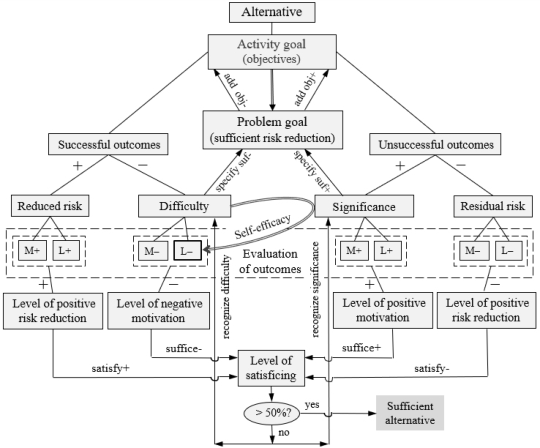
Figure 2 presents the self-regulation model of selecting sufficient (“good enough”) alternatives when both the problem goal and activity goal are set to satisfy the principle of instrumental rationality.
Figure 2: Self-regulation model of selecting sufficient alternatives.
66 Yemelyanov
According to Figure 2, the activity goal splits outcomes into successful and unsuccessful categories. Subsequently, the problem goal splits successful out- comes into cognitive “reduced risk” and motivational “difficulty” and splits unsuccessful outcomes into cognitive “residual risk” and motivational “sig- nificance”. All these outcomes are evaluated based on their magnitude (M) and likelihood (L) allowing to determine the levels of positive (satisfy+) and negative (satisfy −) risk reduction as well as the levels of positive (suffice+) and negative (suffice−) motivation. This is how each category of outcomes aligns with the “satisfy”or “suffice”criterion in the context of a “satisficing” choice.
If the level of satisficing, which integrates positive and negative levels of “satisfy” and “suffice”, is > 50% (positive feedback), then the alternative is considered sufficient for selection. If the level of satisficing is ≤50% (nega- tive feedback), then feedforward control of forming the mental model must be activated to recognize new difficulty or new significance within successful- negative or unsuccessful-positive outcomes, respectively. Subsequently, this specifies the positive (suf+) or negative (suf−) component of sufficiency in the problem goal (“sufficient risk reduction”), which in turn specifies the activity goal by adding positive (obj+) or negative (obj−) objectives, respec- tively. When recognizing difficulty, “avoid this difficulty” must be added as a negative objective to the activity goal to sufficiently reduce the risk, while avoiding this type of difficulty. For example, “sufficiently reduce the risk, while avoiding psychological difficulty.” When recognizing significance, “apply this significance” must be added as a positive objective to the activity goal to specify it in the following way: “sufficiently reduce the risk, while applying this type of significance.” For example, “sufficiently reduce the risk, while applying social significance.” Therefore, an alternative is considered sufficient, if its level of satisficing is > 50%, otherwise, the evaluation process should be repeated by recognizing new difficulty/significance, specifying the problem goal, and adding the corresponding objectives to modify the activity goal.
In the process of self-regulation, the uncertain problem goal is clarified by recognizing new difficulty or significance, whereas the activity goal is modi- fied by adding corresponding objectives as criteria for success. This iterative process ultimately leads to the most satisficing solution to the problem.
Figure 2 also demonstrates that self-efficacy as a motivational driver contributes to the level of motivation for solving the problem by shaping the likelihood of difficulty (L−), which reflects the individual’s willingness to apply effort in overcoming challenges. The degree of effort invested is inversely related to the likelihood of difficulty, as effort increases, the likeli- hood of difficulty decreases. This effort depends on both the magnitude of difficulty (M−) and the level of positive motivation for attaining the activ- ity goal, which is influenced by the magnitude of significance (M+) and the likelihood of difficulty (L+).
It is worth noting that self-efficacy contributes to forming L- as an individual’s confidence in anticipating difficulty. This confidence can vary, either being lower or higher than the evidence-based likelihood of diffi- culty, depending on the individual’s self-efficacy level. Individuals with high
Decision-Making Augmentation System for Solving the Problem of Risk Reduction 67
self-efficacy tend to minimize this likelihood, viewing difficulties as man- ageable obstacles that can be successfully overcome. Conversely, individuals with low self-efficacy may increase this likelihood due to perceiving difficul- ties as insurmountable challenges, heightening perceptions of obstacles and potential failure.
Therefore, with IR goal setting, where successful negative and unsuccessful positive outcomes become motivational, self-efficacy will lead to a sufficient solution to the problem. However, without IR goal setting, motivational out- comes will not be formed; as a result, only cognitive-based solutions will be found without applying self-efficacy.
For example, consider the problem of reducing the risk of heart attack by applying statin therapy with the problem goal “reduction of the risk of heart attack” and activity goal “lowering LDL-C by 30%.” In medicine, lowering LDL-C (low-density lipoprotein-cholesterol) is a key strategy in managing blood cholesterol. With this goal setting, “reduced risk of a heart attack” is a successful positive outcome; “side effects on liver and muscle” is a successful negative outcome; “reduced risk of stroke” is an unsuccessful positive outcome; and “residual risk of a heart attack”is an unsuccessful neg- ative outcome. Here, successful negative and unsuccessful positive outcomes are cognitive and do not present any difficulty and significance respectively. Therefore, the likelihood of side effects (L−) and the likelihood of “reduced risk of stroke” (L+) are presented by their evidence-based probabilities. This approach for setting goals is not motivational for lowering LDL-C by tak- ing statins, so individuals cannot apply their self-efficacy when using this approach. This is because both problem and activity goals were not set up to satisfy the principle of IR.
Now assume that we alter the problem goal to make it uncertain as “suf- ficient reduction of the risk of heart attack” and the activity goal remains the same: “lowering LDL-C by 30%. These two goals are set to satisfy the principle of IR. Here, the successful negative outcome “side effects on liver and muscle” is the difficulty and the unsuccessful positive outcome “reduced risk of stroke” is the significance of lowering LDL-C by 30%. The likelihood of difficulty (L−) is an individual’s confidence in anticipating difficulty, while the likelihood of significance (L+) is an individual’s confidence in anticipat- ing significance. In this situation, self-efficacy can be applied to contribute to forming L-, which in turn contributes to forming the level of motivation for lowering LDL-C by 30%.
Moreover, self-regulation can add new objectives to the activity goal by recognizing new difficulties or significance. For example, by recognizing the significance of taking a brief break from statin therapy to relieve side effects believed to be caused by statins, self-regulation will add a new objective to the activity goal to modify it as “lowering LDL-C by 30% while taking a break from statin therapy if needed.” Now the individual can more efficiently self- regulate their decision regarding taking statins by relying on their self-efficacy that statin side effects can be relieved if, for example, “taking it easy when exercising” or “taking a brief break from statin therapy to relieve side effects believed to be caused by statins” (Mayo Clinic).
68 Yemelyanov
DECISION-MAKING AUGMENTATION SYSTEM The suggested self-regulation model was employed in the decision-making augmentation system (Yemelyanov, 2023). This system helps decide on the most satisficing alternative for solving the problem of risk reduction. The system first prompts the user to identify the risk event and its type. Subse- quently, the user is required to undertake IR goal setting for problem and activity goals. The problem goal pertains to uncertain “sufficient risk reduc- tion,” while the activity goal is certain, leading to the achievement of the problem goal, and encompasses objectives that will later be modified. The process of solving the problem is self-regulating. The problem goal is clari- fied, reflecting the formation of the mental model, while the activity goal is accordingly modified by adding corresponding objectives as criteria for suc- cess, reflecting the formation of the level of motivation. This iterative process ultimately leads to the most satisficing solution to the problem.
Given human limitations in computational capacity due to the size of working memory, the augmentation system supports computation on vari- ous levels, encompassing risk reduction, motivation, and self-efficacy. More specifically, the augmentation system helps the user implement the following steps:
1. Defining the problem of risk reduction. This includes defining the risk event and the type of risk. For example, this approach can be applied to the problem of reducing the risk of heart attack due to high cholesterol, where the present risk event is “high cholesterol” and the type of risk is “risk of heart attack”. 2. Setting the problem and activity goals. The problem goal is “sufficient risk reduction”. This is how the problem goal should be initially formulated to clarify it later within the process of self-regulation. The activity goal can be any objective(s) that leads to the problem goal and make it achievable. This is IR goal setting. For example, the activity goal, “lowering LDL-C by 30%,” is set in compliance with the principle of instrumental rationality concerning the problem goal, “sufficient reduction of the risk of heart attack.” 3. Identifying cognitive and motivational outcomes. To accomplish this, con- sider two hypotheses: hypothesis 1, when the activity goal is achieved, which produces successful outcomes, and hypothesis 2, when the activity goal is not achieved, which produces unsuccessful outcomes. Successful positive and unsuccessful negative are cognitive outcomes that present reduced risk and residual risk, respectively; while successful negative and unsuccessful positive outcomes are motivational and present difficulty and significance, respectively. This happens due to IR goal setting. 4. Selecting alternatives to solve the problem. These alternatives must pro- vide satisfactory risk reduction. Generate alternative strategies for achiev- ing the problem goal. For example, Alt 1: low-dose statin therapy; Alt 2: lifestyle therapy; Alt 3: low-dose statin therapy with lifestyle modification. 5. Evaluating the alternative outcomes. Evaluate the magnitude and like- lihood of each type of outcome from the perspective of achieving the
Decision-Making Augmentation System for Solving the Problem of Risk Reduction 69
problem goal. It is important to mention that the augmentation system operates consistently within the computational constraints of working or short-term memory. When the individual evaluates the magnitude and likelihood of motivational outcomes to determine their self-efficacy and level of motivation, they consider <M−, L−, M+, L+> as a chunk or meaningful unit of information that can be formed in the working memory, because it satisfies the computational constraints of 4 ± 1. Self-efficacy contributes to forming L−by values of M−, M+, and L+. This chunk can then be compared with the corresponding “motivational” chunks of other alternatives. 6. Determining the level of satisficing of each alternative. For each alter- native, aggregate all information about outcomes to determine the sat- isficing level. An alternative is deemed sufficient (good enough) if its satisficing level exceeds 50%. 7. Deciding on the most satisficing alternative to solve the problem. Deter- mine the alternative with the highest level of satisficing. This is the best alternative that exhibits a sufficient level of motivation and results in sat- isfactory risk reduction. It is important to note that a satisfactory level of risk reduction must exceed 50%, given that all alternatives aim to reduce risk. However, a sufficient level of motivation may be lower than 50%, even for the most satisficing alternative. This occurs when none of the alternatives provide positive motivation, and one must select between the lesser of two evils. If the selection process becomes difficult, it is advis- able to specify the problem goal and reevaluate the available alternatives. Additionally, users may opt to introduce a new alternative or consider another activity goal.
The decision-making augmentation system is implemented in ED2® mobile web apps, addressing both reactive and proactive risk reduction for present or future risk events, respectively. Presented below are two decision tem- plates illustrating its application in the medical field for reactive (ED2® Statin Choice) and proactive (ED2® CPR Choice) problem-solving:
Deciding whether to take statins or implement lifestyle therapy.
Reactive problem solving for reducing the risk of heart attack and stroke from high cholesterol (ED2® Statin Choice).
What is the best alternative among Statin therapy, Lifestyle therapy, or Statin therapy with lifestyle modification to “sufficiently reduce the risk of heart attack and stroke”(problem goal) from “high cholesterol”(present risk event) by “lowering LDL-C by _ %” (activity goal) after “high cholesterol” has been diagnosed?
Deciding whether to attempt CPR.
Proactive problem solving for reducing the risk of not living as well as you can for as long as possible from cardiac arrest (ED2® CPR Choice).
70 Yemelyanov
What is the best alternative between CPR or NO CPR to “sufficiently reduce the risk of not living as well as you can for as long as possible” (prob- lem goal) from “cardiac arrest” (future risk event) by “receiving CPR/NO CPR emergency care” (activity goal) after “cardiac arrest” has happened?
CONCLUSION
The proposed augmentation system aids in selecting the most satisficing alter- native to solve the problem of risk reduction. It facilitates computations on various levels, encompassing risk reduction, motivation, and self-efficacy. With IR goal setting, where the problem goal is “sufficient risk reduction” and the activity goal is a sub-goal leading to the problem goal, the augmenta- tion system helps the decision-maker form motivational outcomes and apply their self-efficacy towards a satisfactory resolution of the problem. However, without IR goal setting, motivational outcomes will not be formed; as a result, only cognitive-based solutions will be found without applying self-efficacy.
Future development of this system will focus on making it more functional and user-friendly.
REFERENCES
Arrow, K. J. (2004). Is bounded rationality unboundedly rational? Some ruminations.
In: M. Augier and J. G. March (Eds.), Models of a Man: Essays in Memory of Herbert A. Simon. Cambridge, MIT Press. Bandura, A. (1977). Social learning theory, Englewood Cliffs, NJ: Prentice Hall. Bandura, A. (1982). Self-efficacy mechanism in human agency. American Psychologist, 37(2), pp. 122–147. Bedny, G., Karwowski, W., and Bedny, I. (2015). Applying systemic-structural activ-
ity theory to design of human-computer interaction systems, CRC Press. Taylor & Francis Group. Bedny, G. and Bedny, I. (2019). The study of work motivation and the concept of activity self-regulation, Chapter 6. In G. Bedny, I. Bedny (Eds.), Applied and systemic-structural activity theory. CRC Press, Taylor & Francis Group, pp. 125–142. Cowan, N. (2000). The magical number 4 in short-term memory: a reconsideration
of mental storage capacity. Behavioral and Brain Sciences, vol. 24, pp. 87–114. Hanoch, Y. (2002). “Neither an angel nor an ant”: Emotion as an aid to bounded rationality. Journal of Economic Psychology, vol. 23, Issue 1, pp. 1–25. Heath, C., Larrick, R. P., and Wu, G. (1999). Goals as reference points. Cognitive
Psychology, 38, 79–109. Kaufman, B. E. (1999). Emotional arousal as a source of bounded rationality. Journal of Economic Behavior and Organization, 38 (2), pp. 135–144. Kotik, M. A. (1994). Developing applications of “Field Theory” in mass studies.
Journal of Russian East European Psychology, 2 (4), July-August, pp. 38–52. Locke, E. A. and Latham, G. P. (2002). Building a practically useful theory of goal setting and task motivation: A 35-year odyssey. American Psychologist, 57(9), pp. 705–717. Miller, G. A. (1956). The magical number seven plus or minus two: some limits on
our capacity for processing information. Psychol. Rev., vol. 63, No. 1, pp. 81–97.
Decision-Making Augmentation System for Solving the Problem of Risk Reduction 71
Simon, H. (1957). Models of man, social and rational: mathematical essays on rational human behavior in a social setting, New York: John Wiley and Sons, pp. 198, 202. Simon, H. (1976). From substantive to procedural rationality. In Spiro J. Latsis,
Method and Appraisal in Economics, Cambridge University Press, pp. 129–148. Simon, H. (1982). Models of bounded rationality. Cambridge, MA: The MIT Press. Simon, H. (1985). Human nature in politics: The dialogue of psychology with political science. American Political Science Review, 79, pp. 293–304. Simon, H., et al. (1987). Decision making and problem solving. Interfaces, vol. 17,
no. 5, pp. 11–31. Yemelyanov, A. M. (2019). Modeling and mobile device support of goal directed decision-making under risk and uncertainty, Chapter 4. In G. Bedny, I. Bedny (Eds.), Applied and systemic-structural activity theory: CRC Press, Taylor & Francis Group, 69–103. Yemelyanov, A. M. and Yemelyanov, A. A. (2019). Evaluation of the factor of sig-
nificance in human performance (applied activity theory approach), Chapter 7. In G. Bedny, I. Bedny (Eds.), Applied and systemic-structural activity theory: CRC Press, Taylor & Francis Group, pp. 145–175. Yemelyanov, A. M., Bedny, I. S. (2021). Self-regulation approach for setting goals in problem-solving. In: H. Ayaz et al. (Eds.), Advances in Neuroergonomics and Cognitive Engineering. Lecture notes in networks and systems, 259, Springer, 194–200. Yemelyanov, A. M. (2023). Express Decision: decision-making augmentation system.
US Patent. No. 11, 358, 611, U. S. Patent and Trademark Office.
LISTED IN THE AHFE DIGITAL BOOKSTORE CATALOGUE
Explore the complete digital volume
Neuroergonomics and Cognitive Engineering
Read this individual research paper free through the original publisher, or explore the full digital proceedings book.
ISBN 978-1-964867-02-1
Explore this ISBN in the AHFE Bookstore ↗Listed in the July 2026 bookstore catalogue; search by ISBN to confirm current availability · Digital book purchase optional