Debora Di Caprio, Francisco Javier Santos Arteaga (2022). Identifying Complex Patterns in Online Information Retrieval Processes. In: Intelligent Human Systems Integration (IHSI 2022): Integrating People and Intelligent Systems. AHFE Open Access, vol. 22. https://doi.org/10.54941/ahfe100964
We define a computable benchmark framework that replicates the behavior of users as they proceed through the alternatives ranked by a search engine and highlights the problems faced by artificial intelligence techniques to categorize the retrieval patterns generated by users endowed with different information assimilation capacities. The research is developed through three specific stages.First, we define a decision theoretical model that relates the threshold values determining the retrieval behavior of decision makers (DMs) to the distance in terms of semantic similarity between the descriptions observed in the snippets and the ideal ones considered by the user. The model is designed to highlight the complexity of the search process defined by DMs, who must consider combinations of the variables defining the alternatives, both observed and expected, together with the number of satisficing alternatives aimed to be observed. Second, we design a set of heuristic algorithms that mimic the online information retrieval behavior of DMs as reflected in their click through rates (CTRs). We illustrate how requiring DMs to observe two satisficing alternatives provides a sufficient approximation to their CTRs. Adding a third alternative delivers an almost identical set of CTRs to those displayed by DMs ([1], [2]). The mimicking quality of the heuristic algorithms prevails as alternatives are added up to include the ten ranked within the first page of search results. Third, the set of heuristic algorithms provides two different strings of data, the pages clicked by the DMs and, more importantly, a numerical representation of each of the observations and evaluations that determine the retrieval behavior of DMs. We illustrate how, even when providing several artificial intelligence techniques with both strings of data, the models face considerable problems categorizing DMs correctly as their information assimilation capacities are enhanced.References[1] Chitika, The value of Google result positioning. Chitika Insights June 7, 2013. Chitika, Westborough (2013) Available at perma.cc/7AGCHTDH [2] B. Dean, We analyzed 5 million Google search results. Here’s what we learned about organic click through rate (2019) Available at https://backlinko.com/google-ctr-stats
Search engines provide a consistent flow of data describing the information retrieval behavior of users as they perform search queries. Eye-tracking technology has validated the fact that users evaluate the alternatives displayed sequentially, according to the ranking delivered by the engines (Lewandowski and Kammerer, 2020). Indeed, the behavior of users displays a consistent trend through time, exhibiting a substantial bias towards the first two alternatives composing the ranking (Dean, 2019; Advanced Web Ranking, 2021). This type of retrieval behavior follows from the trust placed by users on the rankings provided by the search engines (Epstein and Robertson, 2015).
At the same time, the different types of constraints faced by decision makers (DMs) when retrieving and assimilating information have been consistently emphasized in the literature (Di Caprio et al., 2014; Victorelli et al., 2020). That is, the click through rates (CTRs) observed can be generated by retrieval processes involving different degrees of cognitive complexity, ranging from simple independent evaluations to complex processes requiring a completely structured search framework based on a predetermined number of satisfying alternatives.
The current paper defines retrieval algorithms of different complexity to illustrate numerically the fact that aiming to observe two satisfying alternatives within the first ten delivered by a search engine provides a sufficient approximation to the behavior observed. Adding a third alternative allows the algorithm to mimic the CTRs observed, a feature that remains valid as additional alternatives are added to define the retrieval behavior of DMs. Finally, we illustrate how an Artificial Neural Network (ANN) faces substantial difficulties to categorize DMs correctly as the complexity of their retrieval processes is incremented. This is the case even when the ANN is provided with the pages clicked by the DMs and a numerical representation of each evaluation determining their retrieval behavior.
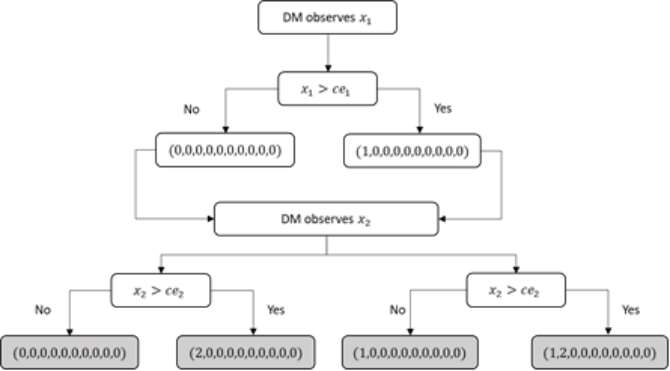
CONTRIBUTION The complexity inherent to the information retrieval processes of DMs is intuitively illustrated through the evaluation frameworks presented in Figures 1 and 2. Both these figures describe a retrieval scenario where DMs are set to evaluate a total of two alternatives from those composing the initial page of results delivered by an engine. DMs click on those alternatives whose evaluations are above a subjectively predetermined threshold value. For illustrative purposes, the reference thresholds are given by the certainty equivalent values assigned to each alternative, that is, the evaluations that provide DMs with the expected utility derived from a stochastic
Intelligent Human Systems Integration (IHSI 2022): Integrating People and Intelligent Systems https://openaccess.cms-conferences.org/#/publications/book/978-1-7923-8988-7 decision.
Figure 1 describes a standard binary tree where DMs only evaluate the first two alternatives composing the ranking and conclude the retrieval process right after. These alternatives may satisfy the subjective preferences of the DM or may not. However, independently of the results derived from the evaluations, the DM concludes the search after retrieving information from two alternatives. The tree is composed by four final nodes, i.e., vectors describing the alternatives clicked, and three binary decision nodes. Note that, whenever an evaluation is not performed or does not lead to a click, a value of zero has been assigned to the corresponding vector entry.
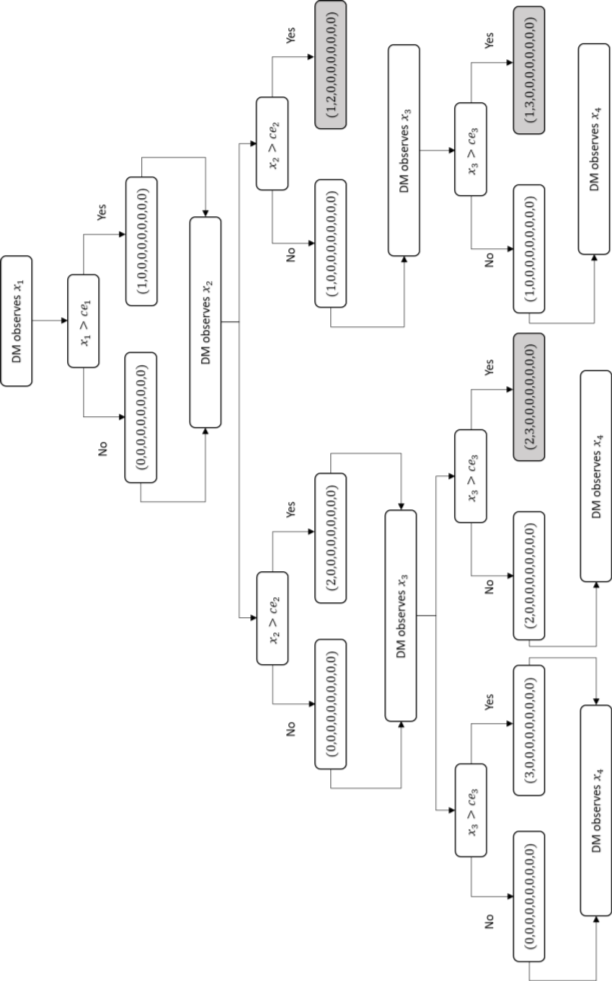
Figure 1. Binary evaluation of the first two alternatives ranked by a search engine This scenario is quite different from one where DMs aim at observing two satisfying alternatives from a total of ten composing the initial page of search results. In this case, the alternatives selected by the DMs are not necessarily the first two within the ranking. Thus, the information retrieval process requires considering the evaluations that may be observed as DMs proceed through the whole ranking of alternatives. The resulting decision tree is composed by 56 final nodes and 55 binary decision nodes. Clearly, the information assimilation capacities of DMs and the subsequent complexity of the corresponding algorithms differ considerably between both evaluation scenarios.
Intelligent Human Systems Integration (IHSI 2022): Integrating People and Intelligent Systems https://openaccess.cms-conferences.org/#/publications/book/978-1-7923-8988-7
Figure 2. Initial section of a decision tree describing the retrieval behavior of DMs who aim at observing two satisfying alternatives out of a total of ten
Intelligent Human Systems Integration (IHSI 2022): Integrating People and Intelligent Systems https://openaccess.cms-conferences.org/#/publications/book/978-1-7923-8988-7
Figure 2 presents the initial section of a decision tree illustrating the retrieval process of a DM who aims at observing two satisfying alternatives out of a total of ten. We will illustrate numerically how this retrieval scenario provides a sufficient approximation to the empirical CTRs of users (Dean, 2019; Advanced Web Ranking, 2021). Adding a third alternative delivers an almost identical set of CTRs, a mimicking quality that prevails as alternatives are added up to include the ten ranked within the initial page of search results.
NUMERICAL RESULTS The CTR of a given alternative is defined as the number of users clicking on the link to the alternative divided by the total number of users performing a search. That is, CTRs reflect the satisfying capacity of the alternatives composing the ranking based on their relative positions. The sum of the corresponding percentages across alternatives does not necessarily add up to one, since users may click on more than one alternative per search query performed.
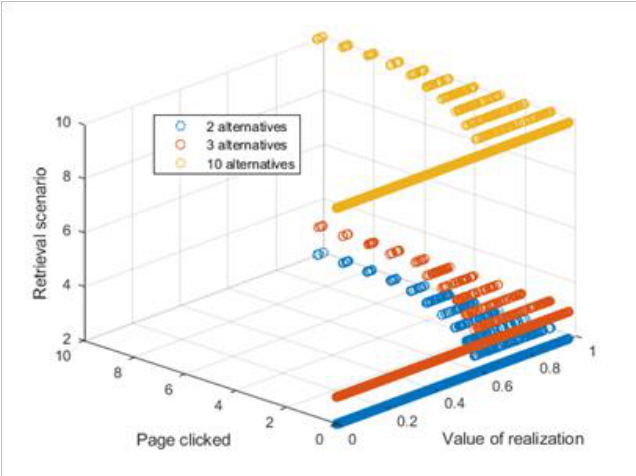
Figure 3. Evaluation patterns generated by increasingly complex information retrieval scenarios
Figure 3 illustrates the evaluation profiles generated by 300 runs of three different retrieval scenarios whose threshold values are determined by the empirical CTRs reported in Dean (2019). Each run amounts for up to 10 clicks, depending on the
Intelligent Human Systems Integration (IHSI 2022): Integrating People and Intelligent Systems https://openaccess.cms-conferences.org/#/publications/book/978-1-7923-8988-7 scenario analyzed and the stochastic realizations of the evaluations, uniformly distributed within [0, 1], relative to the corresponding threshold values. As can be observed, the scenario based on two satisfying alternatives delivers a similar retrieval framework to the limit case with ten alternatives. Thus, we do not require DMs to be endowed with complex information assimilation capacities to generate the CTRs observed empirically.
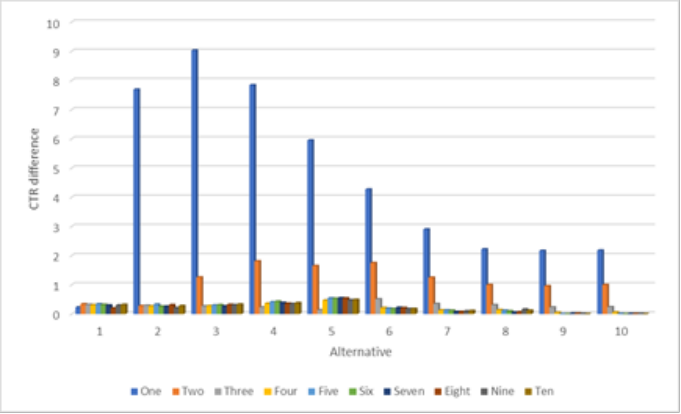
Figure 4. Absolute value of the difference between the CTRs reported by Dean (2019) and those obtained from one million runs of the current algorithms per information retrieval scenario
This intuition is validated in Figure 4, which describes the absolute value of the difference between the CTRs reported by Dean (2019) and those obtained from one million runs of the current algorithms per retrieval scenario. Note how the scenario based on one satisfying alternative fails to provide a sufficiently close approximation to the empirical CTRs. More importantly, the difference in CTRs remains below two percentage points throughout the scenario with two alternatives. The differences between the CTRs generated in the remaining scenarios and those described by Dean (2019) remain marginal, with the algorithms providing almost identical retrieval profiles in all cases.
Given the similarity of the profiles obtained when considering three alternatives or more, up to a total of ten, we investigate whether an ANN endowed with the retrieval profiles of these users can categorize them correctly. The profiles include both the pages clicked by the DMs and a numerical representation of each evaluation determining their retrieval behavior.
Intelligent Human Systems Integration (IHSI 2022): Integrating People and Intelligent Systems https://openaccess.cms-conferences.org/#/publications/book/978-1-7923-8988-7
Figure 5 presents the results obtained and highlights the difficulties faced by the ANN when categorizing 100,000 DMs from each retrieval scenario (70% of the data has been used for training, 15% for validation, and 15% for testing). These difficulties become particularly evident when the information assimilation capacities of DMs are enhanced so as to allow them to consider five satisfying alternatives or more within their evaluation processes.
Figure 5. ANN confusion matrix categorizing 100,000 DMs per information retrieval scenario
Figure available in the original PDF paper.
CONCLUSIONS
We have defined a set of retrieval algorithms of different complexity and illustrated how they mimic the behavior of DMs who aim at observing at least three alternatives satisfying their subjective preferences among those ranked within the initial page of
Intelligent Human Systems Integration (IHSI 2022): Integrating People and Intelligent Systems https://openaccess.cms-conferences.org/#/publications/book/978-1-7923-8988-7 results provided by a search engine. This result has been extended to illustrate the difficulties faced by an ANN to categorize DMs according to their information retrieval capacities when the latter aim at observing five or more satisfying alternatives within the ten composing the first page of results delivered by the engine.
REFERENCES
Advanced Web Ranking: Google organic CTR history. Last accessed September 23rd, 2021. (2021) https://www.advancedwebranking.com/ctrstudy/ Dean, B.: We Analyzed 5 Million Google Search Results. Here's What We Learned
About Organic Click Through Rate (2019) https://backlinko.com/google-ctr- stats Di Caprio, D., Santos-Arteaga, F.J., Tavana, M.: The Optimal Sequential Information Acquisition Structure: A Rational Utility-Maximizing Perspective. Appl. Math. Model. 38, 3419--3435 (2014) Epstein, R., Robertson, R.E.: The Search Engine Manipulation Effect (SEME) and
Its Possible Impact on the Outcomes of Elections. PNAS 112, E4512--E4521 (2015) Lewandowski, D., Kammerer, Y.: Factors Influencing Viewing Behaviour on Search Engine Results Pages: A Review of Eye-Tracking Research. Behav. Inf. Technol. 40, 1485--1515 (2020) Victorelli, E.Z., Dos Reis, J.C., Hornung, H., Prado, A.B.: Understanding Human-
Data Interaction: Literature Review and Recommendations for Design. Int. J. Hum. Comput. Stud. 134, 13--32 (2020)
Intelligent Human Systems Integration (IHSI 2022): Integrating People and Intelligent Systems https://openaccess.cms-conferences.org/#/publications/book/978-1-7923-8988-7
LISTED IN THE AHFE DIGITAL BOOKSTORE CATALOGUE
Explore the complete digital volume
Intelligent Human Systems Integration (IHSI 2022): Integrating People and Intelligent Systems
Read this individual research paper free through the original publisher, or explore the full digital proceedings book.
ISBN 978-1-7923-8988-7
Explore this ISBN in the AHFE Bookstore ↗Listed in the July 2026 bookstore catalogue; search by ISBN to confirm current availability · Digital book purchase optional