Erika Mamley Osae, John Victor Mensah, David Wellington Essaw, Rufai Kilu (2022). A functional support system in a bustling 24/7 economy: Perspectives on slum dwellers in Ashaiman, Ghana. In: Human Factors and Systems Interaction. AHFE Open Access, vol. 52, pp. 196–205. https://doi.org/10.54941/ahfe1002156
Slums are often associated with negativities in society including social vices, thievery and arm robbery due to the unsightly nature of the settlements, characterized with filth and insanitary conditions. However, slums provide accommodation for rural-urban migrants who are unable to afford the high cost of rent due to several factors including poor housing policy by government, high rental cost, financial difficulties, unemployment and poverty. This study aims at ascertaining the functional activities and survival strategies of slum dwellers in Ashaiman Municipality in Ghana. Ashaiman is a sprawling urban settlement, parts of which exhibit characteristics of a slum. It is a home to people from many ethnic groups within and outside Ghana who are all there to eke out a living. It also provides space for well organised and recognised professional, trade, ethnic, welfare and youth associations with formal structures and support systems to ensure good governance, compliance and reward systems. This study deployed a mixed method approach to collect quantitative and qualitative data from 490 respondents and 13 key informants in two slum communities; namely; Manmomo and Tulaku within Ashaiman Municipality. Interview schedule, interview guides and focus group discussion guides were used to collect data. Appropriate techniques were used to process and analyse the data. The results showed that the slum dwellers presented varied economic potentials as they contributed to the bustling 24/7 economy. The local economy was characterised by small and micro-scale activities in the informal sector. The municipal authority generated revenue through taxation in whatever form while the slum dwellers provided a strong voting block for politicians. However, the slums also provided the opacity needed for illegal activities. The slum residents operated in an under-served location with deficits in security, infrastructure, health and environmental sanitation. The survival strategies included social safety in terms of perception of historical and traditional ties, social acceptability, social network, security and business opportunities. The diverse characteristics, capacities, tenacity arising from survival experiences, adaptability, social capital, political clout in numbers, and youthful population contribute to make the slum communities in Ashaiman a place of survival. The main argument of the study is that slum dwellers demonstrate resourcefulness, thereby debunking their association with low levels of access to productive sources. It is therefore, recommended that the central government, local government, technocrats, the private sector and civil society groups should collaborate to enhance the potentials of the slum dwellers for local level development.
Slum settlements have become less visible as they are integrated into urban fabric as a result of urbanisation (Leke, Chinwe, Aboluwaji & Olufunke, 2021). Globally, slums are usually associated with poverty and also known as informal settlements (Cordes & Wongthongtham, 2021). Slums are usu- ally urban regions of a city that are of sub-standard quality, lacking basic services, and quality of housing. Slum dwellers are characterised by higher levels of unemployment and low education. They suffer stigmatization, iso- lation and exclusion from social interaction and economic opportunities (Bergman, 2016). Their earnings are always low to guarantee more than mere subsistence (UN-HABITAT, 2006 as cited in Leke et al., 2021).
Literature confirms that globally, slums are close knit to central business districts providing economic and employment opportunities. Slums are often associated with negativities in society including social vices, thievery and
A Functional Support System in a Bustling 24/7 Economy 197
armed robbery due to the unsightly nature of the settlements, often characte- rised with filth and insanitary conditions. They serve as the first point of call to migrants to the city in search of non-existent jobs (Asare, Osae & Pellow, 2015). They provide cheaper accommodation for rural-urban migrants who are unable to afford the high cost of rent (Asare et al., 2015; Fuseini, Yaro & Yiran, 2017; Kleemann, Baysal, Bulley, & Fürst, 2017). Slums exist ever- ywhere in the world, but are more evident in developing countries as they are aggravated by rural-urban migration, poor urban planning and weak governance (Cordes, Wongthongtham & Morrison, 2021; Mensah, Osae & Asare, 2021). Studies by Azunre and Azerigyik (2021) show that the infor- mal economy, politics, ineffectual policies, and weak urban planning and governance systems are critical in generating slum growth. This study aims at ascertaining the functional activities, survival strategies of slum dwellers and resourcefulness of slums in the Ashaiman Municipality of Ghana. It is expected that the study will contribute to both literature and slum develo- pment urban policies in Ghana. It is also obligation to contribute to Ghana’s achievement of the Sustainable Development Goals (SDGs) 11 and 9. The SDG Goal 11 states make cities and human settlements inclusive, safe, resi- lient and sustainable (UN-Habitat, 2016). The paper is structured into five sections: introduction, literature review, methodology, results and discussion, conclusion and recommendations.
LITERATURE REVIEW
Pathways-Out-of-Poverty and Cul-De-Sac Theory Under capitalist restructuring, there are established distinctions among seve- ral processes of social dynamics such as those of inequality, social exclusion, individualism and perverse integration (Castells, 2011). However, slums act as social escalators as they strengthen human capital and raise household incomes through personal networks. The path-ways-out-of-poverty and cul- de-sac theory was used by Turok and Borel-Saladin (2016) to present an appreciation of the relationship between slum characteristics and househ- old life chances. The study was set in the context of local labour market conditions where it sought to find the dynamic interactions between the phenomena – place, people and economy. It sought to investigate whether informal settlements help or hinder human progress by linking individuals to the opportunities concentrated in cities. It discovered that much as slums pre- sent symptoms of potential poverty, they are also potent vehicles for reducing poverty (Arimah, 2010; Turok & Borel-Saladin, 2016). The poverty trap also has the tendency to hamper people from grasping the economic possibilities of cities. As a result, it serves as an endpoint instead of being the first rung on the social ladder for the slum dweller. This, Turok and Bore-Saladin (2016) term as the cul-de-sac or poverty trap. The cul-de-sac idea suggests that syste- matic obstacles impede individual and collective progress. Slums also serve a good purpose for slum dwellers in that it helps to uplift households out of rural poverty onto a path of prosperity. This is consistent with literature that supports evidence that households are better off in informal areas or slum settlements than in rural areas (Mahabir, Crooks, Croitoru & Agouris,
Empirical Evidence Studies on slums and informality have been widely researched. Azunre and Azerigyik (2021) sought to address a critical question in academic studies which lingers on what are the complex drivers of this seemingly untenable phenomenon of slum growth. They sought to move beyond the population-heavy diagnosis of informal urbanisation by seeking to determine the multi-dimensional drivers of informal urbanisation beyond population heavy factors, and assessed the interconnected nature of the factors using the prism of the “push and pull theory”. The study employed the case study design which provided the opportunity to gain concrete in-depth knowledge about the myriad of factors that facilitate slum growth. They identified four themes as the drivers of informal urbanisation namely, ineffectual housing policies, informal economy, politics and distributional/investment inequali- ties, and weak urban planning and land tenure issues. Azunre et. al. (2021) used the “push-pull theory” to explain the more general factors and trends that engender informal urbanisation and how households are pushed or pul- led to live in slums. The study revealed that the informal economy, politics, ineffectual policies, and weak urban planning and governance systems are critical in generating slum growth.
Adamtey and Mensah (2021) investigated how informal ties result in in- filling and the creation of slums using the AMA as case study. The study used mixed methods of quantitative and qualitative approaches to collect data from eight focus group discussions and in-depth interviews with at least one senior official from related institutions. The findings revealed that cultural factors contribute to the creation of slums and that their social capital and networks of support systems. Leke et al. (2021) investigated the expression of social exclusion and survival strategies among slum dwellers in Ibadan, Nige- ria. Survival strategies amongst slum dwellers were measured by what slum dwellers engaged in so as to augment their income and livelihoods. The study found that the survival strategies identified to augment their major sources of income included child labour, prostitution, pick pocketing and gambling. The slum dwellers faced some form of health challenges and have identified alternative strategies to survive (UN-Habitat, 2006; Arimah, 2010). Some of the coping strategies identified are self-medication, resorting to traditional methods of medication and the use of spiritual healing (Leke et al., 2021).
METHODOLOGY
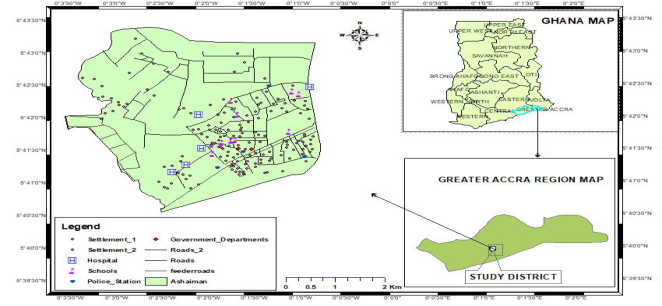
The Ashaiman Municipality is one of the biggest slum communities in not just Ghana but the world (UN-Habitat, 2003; Abass & Kucukmehmetoglu, 2021). It is located about 4 kilometres north of Tema and about 30 kilometres from Accra, the capital of Ghana as shown in Figure 1. The municipality is a bustling business community with over 90 percent of its active population engaged in economic activities (Abass & Kucukmehmetoglu, 2021) and the majority of the workforce are engaged in the informal sector (GSS, 2014).
A Functional Support System in a Bustling 24/7 Economy 199
Figure 1: Map of Ashaiman Municipality. Source: Department of Geography & Resource Development, University of Ghana (2021).
Using the mixed methods approach, the study investigated the functional activities, resourcefulness and survival strategies of slum dwellers. The study population included opinion leaders, assembly persons, association leaders, zongo chief, core staff of the municipal assembly, civil society organisation leaders and household heads operating in the two study areas namely; Man- momo and Tulaku communities. These communities were selected due to their complexities and dynamics. The study adopted both non-probability (purposive, convenience and snowball) and probability (simple random sam- pling technique and lottery method where there were multiple households within a compound) sampling methods. Purposive sampling was used to select respondents from the community opinion leaders, assembly persons, association leaders, zongo chief, core staff of the municipal assembly and civil society organisation leaders. The quantitative aspect was based on a survey of household heads who were sampled using the simple random sampling technique and lottery method.
Primary data was collected from key informant interviews using interview guides and survey from household heads using interview schedule. The key informant interviews were based on a criteria that they were officials of the Assembly, opinion leaders and residents of the slum, individual slum settlers and CSOs to further probe what the survey failed to address. The data colle- ction instruments were written in English language but the interactions were conducted mainly in English and Twi and any other local language required such as Hausa. The secondary data entailed insights from existing literature to provide a conceptual grounding of a functional support system and slum dwellers. Questions were carefully selected to ensure that responses obtained addressed the main objectives of the research. The Kobo Toolbox CAPI was used which provided real time entry of data. The Stata 14.0 computerised sof- tware was used to analyse the quantitative data by generating the frequencies, graphs and charts, while for the qualitative data, the text and narratives were coded around the questions and their contents analysed. Ethical considerati- ons were followed in the data collection exercise whereby participants were
Table 1. Number of household heads interviewed.
Table available in the original PDF paper.
Community Female Male Total Number Percent Number Percent Number Percent
assured of confidentiality and anonymity of their responses as their express consent was sought.
RESULTS AND DISCUSSION
This section discusses the results on the demographics, occupation and bustling 24/7 economy on what makes the slum community vibrant.
Demographic Characteristics of the Participants In all, 390 household respondents were interviewed comprising 49 percent female and 51 percent males as shown in Table 1. The distribution is diffe- rent from the two communities. In Manmomo the female-male percentages were 47 and 53 while in Tulaku the percentages were 53 and 47 respectively. The total spread of the female-male ratio confirms the patriarchal nature of the Ghanaian society. The average mean age was 42 years for females and 41 years for males.
Primary Occupation of Respondents The local economy was characterised by small and micro-scale activities in the informal sector as shown in Table 2. The study found that the majority of the respondents’ primary occupation was either a trader or driver/ tran- sport operator and others. The others included those engaged in menial jobs from food processing, alcohol production and sale, light manufacturing of basic household appliances, tools and utensils; then buying and selling of consumer items including “stolen goods”; herbal products, transportation of waste/ value addition, repairs of electronic appliances, personal care servi- ces such as hairdressing and barbering; entertainment/ recreational activities such as operating cinemas and betting joints. The results showed that the slum dwellers presented varied economic potentials which were deployed to enable them survive in the slum communities.
Bustling 24/7 Economy – The Functional Support System The data collected from the household heads from the two communities reve- aled that 85.93 percent of them work in the informal sector, as traders, driver or private sector operators, private sector workers and other menial jobs. Some of the key informants from the study area, indicated that they are trying to survive and make a living in whatever is convenient and responsive to their immediate needs such as to provide food, shelter and other needs which form
A Functional Support System in a Bustling 24/7 Economy 201
Table 2. Primary occupation of respondents.
Table available in the original PDF paper.
Primary Occupation Female Male All Sexes Freq. Percent Freq. Percent Freq. Percent
the functional support systems. The increasing bustling 24/7 economy, as a result of the booming informal sector workers in the area, a Community Leader through the in-depth interview confirm this with the expression: If Ashaiman didn’t provide the enabling environment, I don’t think the Syrians, Lebanese, Moroccans, Turkish, Indians and the different West African tribes engaging in business would have moved here. The population and its location attracts people which is good for business. The issue is everything you sell gets buyers. This further corroborates studies by Abass et al., (2021) which indica- tes that majority of the workforce in the municipality works in the informal sector with only about 12 percent working as managers, middle level professi- onals and technicians (GSS, 2014; Abass et al., 2021). The bustling 24/7 local economy is one that operates on flexibility and best described by a female CSO key informant as ‘that which accommodates and provides whatever can yield immediate returns. Quick entry and quick exit, providing convenience and therefore not easily regulated’. Another male key informant also summed the nature of business activities and the actors in this functional space as:
In terms of their contribution to the economy such dwellers are really hardworking and most of them are engaged in menial jobs in the community …it will surprise you some of them own shops
Table 3. Length of stay of household respondents in the community.
Table available in the original PDF paper.
Manmomo Tulaku Female Male All Sexes Female Male All Sexes Length of Stay Freq. Percent Freq. Percent Freq. Percent Freq. Percent Freq. Percent Freq. Percent
in the community some also like I said the menial jobs, truck pushing and hawking. In a way, their activities, are economi- cally good as they pay taxes to the assembly which supports development work and overhead costs. The Local Governance Act, 2016 (Act 936) makes provisions for citizens’ participation in the local governance. The municipal authority generates reve- nue through taxation in whatever form while the slum dwellers provide a strong voting block for politicians. However, the slums also provide the opa- city needed for illegal activities earlier discussed. These slum dwellers operate in an under-served location with deficits in security, infrastructure, health and environmental sanitation. The diverse characteristics, capacities, tenacity ari- sing from survival experiences, adaptability, social capital, political clout in numbers, and youthful population contribute to make the slum communities in Ashaiman a place of survival. In other words, this constitute a functional system of support to the urban dwellers. The study found that some 66.2 percent of household respondents have stayed in the community for between 1 – 10 years as presented in Table 3. On the question of whether the community provides an enabling environ- ment for a thriving economy (business) and how? A female key informant from one of the communities expressed it in the quote: … anything neatly wrapped for sale attracts buyers. It will be bought before the person realises the content. So, as I have said, opportunities abounds, it is up to the individual to make the move, whatever you sell attract buyers. You have a lot of peo- ple coming in to do business on a daily basis from all over the city and country, so whatever you sell be it pure water, drinks, food, you won’t lose. This narration corroborates the findings of Leke et al., (2021) that the major survival strategies slum dwellers adopt include hawking, child labour, prostitution, stealing and gambling. Further probing to understand what makes the community liveable all these years, another female community leader and a key informant summed it all up this way as:
We have given birth and raised responsible children here, it all depends on the parents. Not everyone in Ashaiman is a criminal, we have lots of responsible persons. Look here, we all have hou- ses outside Ashaiman, built nice houses but then it is safe and
A Functional Support System in a Bustling 24/7 Economy 203
comfortable to live here. Life is 24/7 here, whenever I travel out- side the country and return late at night, it is easier for me to come to my home in Ashaiman with a taxi and no one will attack me. The petty thefts in the area is as a result of the junkies who need money for their drugs and tend to attack sometimes. Otherwise, I personally feel living in this community ensures my safety and that of others I can speak for. From the study, the older population interviewed see prospects in the com- munity whereas the younger ones see the community as a stepping stone that is pathways-out-of-poverty instead of a cul-de-sac. The diversity of the popu- lace in terms of ethnicity, age groupings, educational background, religious communities coupled with the history of the community still gives it the attra- ction. The lifestyle of the slum dwellers is aptly described by a civil society actor in the community, thus making them appear to live on disposables and a carefree life. They came to the city to eke out a living and whatever it takes to survive, they are ready to do. So, slum dwellers in their daily interactions come into contact with people who have different opportunities and lifesty- les. Despite all the challenges bedevilling slum dwellers, they still eke out their living. This is an indication of the resourcefulness and forcefulness to make a living. These claims were also supported by findings from a male-CSO key informant from ASHMA. One of them noted that.
In terms of lifestyle, we are discussing a majority of people who are migrants who migrated to this settlement with the hope of making some eco- nomic gains. They didn’t come to Accra to watch the sea; they came to make money. We have people whose lifestyles are already modelled along getting their daily bread or making money. Some of the social trappings that guide their lifestyles have all been broken and shattered when they are in the city. They have an independent life that nobody is watching. So, they have broken their traditional lifestyles; the kinds of food they eat, their preferences and tastes. It creates a whole set of markets and local economy. For example, you see food vending thriving heavily because people will always want to buy. You will see a lot of work around the WASH sector economy. People want to bath in the public bathhouses because they don’t want to create personal ones.
CONCLUSION AND RECOMMENDATIONS Slum dwellers employ several strategies to cope with their situations. They also employ income diversification as a coping technique in slum commu- nities. The main argument of the study is that slum dwellers demonstrate resourcefulness, thereby debunking their association with low levels of access to productive sources. The study has demonstrated that slum dwellers are resourceful, engage in all manner of activities for their survival. Much as there is the threat of infiltration and increasing influence of criminal elements, the slum communities provide enormous opportunities for growth.
The Following Recommendations are Made: i) The central government, local government, technocrats, the private sector and civil society groups should collaborate to enhance the potentials of the slum dwellers for local level development.
ii) The provision of good road networks, potable water supply, effe- ctive and efficient refuse collection system to address environmental issues amongst others will address the needs of slum dwellers and enable them contribute their quota to national development.
REFERENCES
Abass, A. S., & Kucukmehmetoglu, M. (2021). Transforming slums in Ghana: The urban regeneration approach. Cities, 116, 103284. doi: 10.1016/j.cities.2021.103284 Adamtey, R., Mensah, J. V., & Obeng, G. (2021). Making Cities Resilient in Ghana: The Realities of Slum Dwellers That Confront the Accra Metropolitan Assembly. Journal of Sustainable Development, 14(1), 70-83. https://doi.org/10.5539/jsd. v14n1p70 Arimah, C. B. (2010). UN-HABITAT. Slums as expressions of social exclusion:
explaining the prevalence of slums in African countries.: Nairobi: UN-HABITAT. Retrieved from http://www.oecd.org/ development/pgd/46837274.pdf Arkorful, V. E., Lugu, B. K., Hammond, A., & Basiru, I. (2021). Decentralization and Citizens’ Participation in Local Governance: Does Trust and Transparency Matter? – An Empirical Study. Forum for Development Studies, 48 (2), 199–223. doi: 10.1080/08039410.2021.1872698 Asare, T., Osae, E.M. & Pellow, D. (2015). Recreating Housing: New Housing for
Amui Djor Residents. In S. Beck & C. Maida (Eds). Public Anthropology in a Borderless World. 351–375. New York. Berghan Books. Ashaiman Municipal Assembly (2018). Four-year Medium Term Development Plan, (2018 – 2022). Ashaiman. Azunre, G. A. & Azerigyik, R. (2021). Deciphering the Drivers of Informal Urbanisa-
tion by Ghana’s Urban Poor Through the Lens of the Push-Pull Theory. Planning Forum, 18, 11 – 44. https://www.researchgate.net/publication/354326262 Bergman, P (2016) Technology and Adoption in Education Usage, Sillovers and Student Achievement. Columbia University Teachers College Working Paper. Castells, M. (2010). The Rise of the Fourth World: Informational Capitalism,
Poverty, and Social Exclusion. In End of Millennium: With a New Preface, Volume III, Second edition With a new preface (pp. 69–170). Cobbinah, P. B., & Aboagye, H. N. (2017). A Ghanaian twist to urban sprawl. Land Use Policy, 61, 231–241. Cordes, D. L., Wongthongtham, P., & Morrison, G. (2021). Transforming Urban
Slums: Pathway to Functionally Intelligent Cities in Developing Countries. In Z. Mahmood (Ed.), Developing and Monitoring Smart Environments for Intel- ligent Cities (pp. 130–170). IGI Global. http://doi:~10.4018/978-1-7998-5062-5. ch006 De Wit, J. & Berner, E. (2009). Progressive Patronage? Municipalities, NGOs, CBOs and the Limits to Slum Dwellers’ Empowerment. Development and Change. Blackwell Publishing, Oxford, UK 40(5), 927–947. doi: 10.1111/j.1467- 7660.2009.01589.x Fuseini, I., Yaro, J. A. & Yiran, G. A. (2017) City Profile, Tamale, Ghana. Cities, 60,
64–74. Ghana Statistical Service (2014). 2010 Population and Housing Census Report: Urbanisation, Accra. Ghana Statistical Service.
A Functional Support System in a Bustling 24/7 Economy 205
Kleemann, J., Baysal, G., Bulley, H. N., & Fürst, C. (2017). Assessing driving forces of land use and land cover change by a mixed-method approach in north-eastern Ghana, West Africa. Journal of Environmental Management, 196, 411–442. Krejcie, R.V. & Morgan, D.W. (1970). Determining sample size for research activities.
Dulluth, Minnesota: Educational & Psychology Measurement, 30, 607–610. Leke, I. S., Chinwe, M. O., Aboluwaji, D. A., & Olufunke, A. F. (2021). Social exclusion and Survival Strategies among Slum Dwellers in Ibadan, Nigeria. University of Ibadan. DOI: 10.36108/NJSA/8102/61(0120) Mahabir, R., Crooks, A., Croitoru, A., & Peggy Agouris, P. (2016) The study of slums
as social and physical constructs: challenges and emerging research opportunities, Regional Studies, Regional Science, 3 (1), 737–757. Mensah, J. V., Osae, E. M., & Asare, K. Y. (2021). Emergence of Squatter Settlements in the Greater Accra Metropolitan Area in Ghana: An Issue of State Failure or Survival? International Journal of Geography and Regional Planning. 7 (1), 219–233. Paller, J. W. (2015) ‘Informal networks and access to power to obtain housing in
urban slums in Ghana. Africa Today, 62 (1), 31–55. Turok, I., & Borel-Saladin, J. (2016). The theory and reality of urban slums: pathways-out-of-poverty or cul-de-sacs? Urban Studies, 1-22. DOI: 10.1177/0042098016671109 UN-HABITAT (2003) The Challenges of Slums. UN-HABITAT’s new Global Report on Human Settlements. Retrieved January 27, 2017 from http://www.unhabitat. org/global_report.asp. UN-HABITAT (2006) The Millennium Development Goals and Urban Sustainability.
State of the World’s Cities 2006/7 Report. sustainabledevelopment.un.org. UN-HABITAT (2016). Urbanisation and Development: Emerging Futures. In UN Habitat World Cities Report 2016. https://doi.org/10.1016/S0264-2751(03) 00010-6 Yiran, G. A. B.; Ablo, A. D; Asem, F. E. & Owusu, G. (2020). Urban Sprawl in sub-
Saharan Africa: A review of the literature in selected countries. Ghana Journal of Geography, 12(1), 1–28. doi: 10.4314/gjg.v12i1.1
LISTED IN THE AHFE DIGITAL BOOKSTORE CATALOGUE
Explore the complete digital volume
Human Factors and Systems Interaction
Read this individual research paper free through the original publisher, or explore the full digital proceedings book.
ISBN 978-1-958651-28-5
Explore this ISBN in the AHFE Bookstore ↗Listed in the July 2026 bookstore catalogue; search by ISBN to confirm current availability · Digital book purchase optional