Rufai Kilu, Mohammed-Aminu Sanda, Lilian Ama Afun, Anna Alacovska (2022). The dysfunctional systems of creative entrepreneurship in Ghana. In: Human Factors and Systems Interaction. AHFE Open Access, vol. 52, pp. 206–214. https://doi.org/10.54941/ahfe1002157
This paper aim at generating knowledge on creative industries in a Ghanaian context, which drive understanding of creative entrepreneurship forward and shape theorization on dysfunctional systems of the creative entrepreneurship. Ghana’s Creative Arts Industry is perhaps the oldest industry: our forefathers danced, had theatre, played music, made amazing crafts and artifacts and created fine garments. Ghana’s Creative Arts span from smock weaving, xylophone and calabash making centers in Savanah and Northern Ghana to kente weavers of Bonwire and Agbozome; and from wood carving at Ahwia and Aburi to the bead makers at Ada and Somanya. However, little is known about the dysfunctional systems of the creative industry in Ghana. It is against this backdrop that this study seeks to explore the dysfunctional systems of creative entrepreneurship in Ghana. An empirical research design with qualitative approach was used. Interviews, Focus Group Discussions and Workshops were used for the data collection. The results showed the creative industry is a functional engine for sustainable and inclusive economic growth, it creates decent jobs and lead to sustainable development. The results however showed a system of dysfunctions among the creative entrepreneurs in a form of government and investor support related challenges, a lack of creative capacity building and research, unfavorable policies to regulate creative activities and the lack of appreciation for Ghanaian culture. The current study generated novel empirical and theoretical knowledge on both functional and dysfunctional systems of creative entrepreneurship in Ghanaian context. It is intimated that; periods of economic challenges are characterized with creative entrepreneurship playing key survival roles. This implies industry wide partnerships is key to have a salient role in driving innovation, economic growth, and welfare, in addition to their effect on job creation. Therefore, innovative and creative entrepreneurship is considered key factor in modern Ghanaian economic development.
This paper joins the general discourse on creative entrepreneurship and human system functions. More specifically, conversation relative to the dysfu- nctional systems as well as future visions of creative entrepreneurs from the global south. Labi (2015) summarises dysfunctions of creative entrepreneurs
The Dysfunctional Systems of Creative Entrepreneurship in Ghana 207
as lack of practical education and training, difficulty in access to finance and start-up capital, lack of rigorous administrative and regulatory frame- works, and business development and support services. Other studies cite starting capital as a key constraint to creative entrepreneurship (Chigunta et al., 2005; Agyemang, 2014). A pilot study conducted by ACIG members in Ghana in January 2018, the study identified dearth of data on the creative industries and concluded a lack of university-industry-government collabora- tion as dysfunctional system to the flourishing of a sustainable and inclusive cultural economy in Ghana.
Creative entrepreneurship is the practice of setting up a business or setting oneself up as self-employed in one of the creative systems (Howkins 2001). Howkins in 2001 further observes that entrepreneurs in the creative systems use creativity to unlock the wealth that lies within them. Like true capitalists, they believe that creative wealth, if managed right, will engender more wealth creation. This means that, the focus of the creative entrepreneur differs from that of the typical business entrepreneur. Essentially, creative entrepreneurs are investors who uses their creative or intellectual talent and skills to earn a living, either their own or other people’s.
The most renowned creative entrepreneurs have combined creative flair with entrepreneurial ability to build multimillion-dollar business empires. Examples include Rupert, Murdoch, Madonna and Branson. Howkins (2001) further observed that, despite a lack of recognition from economists, politicians and a traditional lack of support from society, creative entrepre- neurs tend to be bright and value their independence above all else. The freedom to manage their own time and abilities, compensate for the unpredi- ctable nature of their working environment, and irregularity of their income. As rightly said: These people instinctively think for themselves, instinctively network, instinctively keep several balls in the air at once. They are the shock troops not only for new ideas about our culture but for new ideas about working in it (Howkins 2001: p. 155).
The Creative Arts Industry is perhaps the oldest in Ghana, spanning from dance to theatre, music to amazing crafts, artifacts and fine garments. Though every facet of Ghana’s art ie painting, sculpture, literature and theatre remain known (Nunu-Amateifio, 2017), not much works have been published on creative entreprenuership. Leaving a literature and knowledge gap in the field of studies from the Global South perspectives. In view of this, Araeen (2005) lamented on the lack of African scholarly writings on African art. Labi (2015) cites the lack of appreciation and recognition of artistic works of prominent Africans by Africans themselves. This implies, a lack of Africans scholarly visibility in their own artistic intellectual spaces, thereby limiting the art rese- arch scope on Global South. This unresolved issue found in literature, bothers on a lack of critical mass in local participation on creative entrepreneurship scholarly discourse from the global south perspectives (Araeen 2005; Blier 1990; Labi 2015). Therefore, the missing link between creative art produ- ction and its scholarship in Ghana, constitute both knowledge and theoretical gaps to be bridged, and this work contribute to that effect.
METHODOLOGY
This paper draws on our experiences of conducting future workshop in the cities of Tamale and Kumasi in Ghana in, which we organised in close col- laboration with the arts faculties at Tamale Technical University and the Kwame Nkrumah University of Science and Technology (KNUST) in Kumasi. The cities of Tamale and Kumasi are cultural hubs within Ghana, home to the so-called “Kumawood” and “Talywood” film industries – industries that used to produce an astonishingly large number of films per year, mostly relea- sed on DVD for local and international Twi and Dagbani-speaking audiences, prior to its decline in recent years (Garritano, 2013). Also, the Northern and Ashanti regions of Ghana in which Tamale and Kumasi are respectively located, both have longstanding tradition of creative and artistic productions.
The Faculties of Art at Tamale Technical University and KNUST, with their on-campus galleries and tight-knit artistic communities, constitute centres for the production of visual arts and associated creative entreprenuership. Notwithstanding these networks and community ties, the majority of creative entreprenuers in Tamale and Kumasi are constrained in their daily activities.
The two workshops – Tamale and Kumasi, were organised under the auspi- ces of an international, collaborative and interdisciplinary research project which aims to generate new knowledge about the creative and cultural indu- stries in Ghana. The project employs a range of qualitative research methods to co-create knowledge with creative and artistic communities in Ghana, including arts-based methods. Artistic research and future workshops were being conducted as key activities throughout the project.
In Tamale, a problem-identification workshop was organised on the 22 – 23rd May, 2020 at the Catholic Guest House in Tamale, Northern Region of Ghana. It was attended by seventeen (17) selected stakeholders involved in creative entrepreneurship in the northern region. In Kumasi, a future work- shop was organised on the 24 – 25 December 2020 at the Kumasi Technical University in the Ashanti Region of Ghana. It was attended by twenty-three (23) selected stakeholders involved in creative entrepreneurship in the Ash- anti Region. They consisted of academics, art researchers, students, kente weavers, woodcarvers, gallery attendants, visual artists, and representatives from three civil society organizations (i.e. Aid to Artisans Ghana, Access to Life Foundation, and Women’s Hope Foundation).
The theme for the workshops were “Identification of Constraints to Successful Creative Entrepreneurship in Ghana”. The rationale behind the workshop was to allow for a fair understanding of key challenges constrai- ning creative entrepreneurship in Ghana, and which understanding could be used as a future-oriented support base for advancing creative entrepreneur- ship activities. We have made a careful assessment in our analysis and writing that the information revealed about them will not harm them or put them at risk.
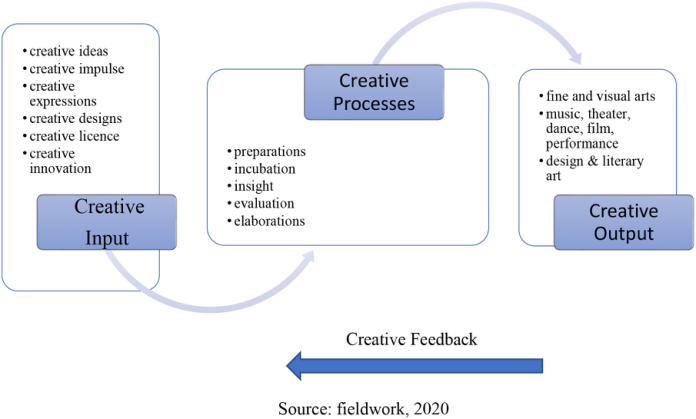
A SYSTEM OF CREATIVE ENTREPRENEURIAL ACTIVITIES Inputs, Processes, Outputs and Feedback
The creative entrepreneurial system is a cohesive group of interrelated, inter- dependent parts of it functional activities. The parts are inputs, processes,
The Dysfunctional Systems of Creative Entrepreneurship in Ghana 209
Figure 1: Domains of creative entrepreneurial activities.
outputs and feedback. The creative entrepreneurial system is bounded by space and time, influenced by its environment, defined by its structure and purpose, and expressed through its creative functioning. The system may be more than the sum of its parts if it expresses synergy or emergent behavior.
SYSTEMS OF ARTISTIC ENTREPRENEURSHIP FUNCTIONS AND DYSFUNCTIONS The creative industries are therefore viewed as range of business activities focus on knowledge and information production. Creative entrepreneurs need to master some specific skills: their basic understanding of intelle- ctual property is essential, coupled with the ability to manage cash flow, key talent acquisition and managing the creative process effectively. How- kins (2001) lists the following functions for successful creative entrepreneurs. They include: invent yourself, prioritize ideas over data, be nomadic, learn endlessly and, most importantly, have fun. Some authors, such as the Ame- rican economist, Richard Florida (2002), argue for a wider focus on the products of knowledge workers, and judge the creative class to include nearly all those offering professional knowledge-based services.
With regards to the functional system of creative entrepreneurship, Kirton (2003) view creative entrepreneurs with the basic function to initiate change. They are in continuous edge to produce something new and different which has some value or to do the same mundane thing or a new thing in a new way using a new technique which is unique in itself to get better, positive results or simply to get more business. Creative entrepreneurs create wealth and jobs through development, production or exploitation of intellectual pro- perty. UNESCO in 2018 explained the creative sector as one of organized activity whose principal function is production or reproduction, promotion,
Table 1. Creative entrepreneurial functions, dysfunctions and future visions.
Table available in the original PDF paper.
Creative Entrepreneurial Future vision
Creative Entrepreneurial Functions
Creative Entrepreneurial Dysfunctions
Graphic and digital designing
A public-private support funding scheme
Government and investor Support challenge High cost of creative production
Textiles, weaving, fashion, batik tie and dye
Provision of teaching and learning equipment (i.e. Studios, galleries, theatres, tools)
Empower indigenous business to locally produce basic raw materials Painting, Artifacts, ceramics, sculpture, pottery and leather works
Challenges on practical teaching of creative skills and research
Film production and performing arts
Lack of favorable policies to regulate creative activities
Regular organization of art festivals
Lack of appreciatio- n/marketing of Ghanaian culture
Security services should be supportive to guard against piracy, and copyright laws should be enforced Music production and sound-mixing engineering
distribution and commercialization of goods, services and activities of a cul- tural, artistic or heritage-related nature. They set up businesses, and take financial risks in the hope of profit making (Steyaert, 2007). They are widely seen as drivers of economic growth and innovation, contribute to structural changes in the economy and introduce new competition through launching new products and services (Kew, Herrington, Litovsky, & Gale, 2013). How- kins (2001) observes entrepreneurs in the creative economy use creativity to unlock the wealth that lies within them. Essentially, creative entrepre- neurs are investing and manage talents, either their own or other people’s. Modern Ghanaian creative entrepreneurs are combining creative flairs with entrepreneurial ability in building business. The functional system of creative entrepreneurs in the Ghanaian context include graphic and digital designing, textiles, weaving, fashion, batik tie and dye. Painting, Artifacts, ceramics, sculpture, pottery and leather works. Film production and performing arts, as well as music production and sound mixing engineering.
In relation to the system of dysfunctions among the creative entrepreneurs, government and investor support related challenges dominated. This was followed by a lack of creative capacity building and research. The lack of favorable policies to regulate creative activities in Ghana was identified, and then lack of appreciation for Ghanaian culture (see Table 1).
The government and investor support related constraints were captured in two forms: public sector challenges and private sector challenges. The former includes lack of funding in a form of long-term loans for creative entre- preneurs, the lack of national creative entrepreneurship programmes, and ineffective National Board for Small and medium size institutions. Others
The Dysfunctional Systems of Creative Entrepreneurship in Ghana 211
challenges are, improper documentation of the various sectors in the cre- ative industry, and the lack of apprenticeship programmes to support the industry. The later include high interest rates at private banks, lack of Civil Society Organization’s involvement (in the establishment of co-operatives, workshops, trade associations), lack of creative sector advisory boards, lack of private organization supports in creative training and funding and lack of private corporate social responsibilities targeting entrepreneurship deve- lopment. As well as high cost of creative production. In this regard, a participant had this to say: Importation of most raw materials for the manufacturing of local arti- facts tend to increase cost of production. Also, customers want or need high quality products but not willing to pay the corresponding prices. For example, high cost of utilities and interrupted power supply lead to the use of electrical generators, which in turn increase the cost of art production. The use of obsolete machines and technologies. Payment of salaries and unstable exchange rates (A 46-year-old Kentey weaver).
Creative capacity building and research was also a basic system dysfunction identified. The issues outlined as practical challenges include lack of facilities for training; scarce workshops spaces, lack of materials, logistics, machi- nery, and equipment. Lack of human resources/skilled personnel, inadequate competence training and development. Inadequate applications, lack of soph- isticated programs and software for creative designs, internet connectivity, IT infrastructure challenges and inadequate industrial attachment openings to students. Participants express dissatisfaction on this score as: Historians teaching art and marketers teaching ceramics! So, too much of the learning materials are more theoretical than practical. After com- pletion, students are not able to fit in the art market well, something I call, artist with no practical know-how (A 50-year-old ceramics lecturer).
The lack of effective policy regimes equally featured prominently as a dysfu- nction. They include lack of favorable policies for the creative industries, lack of protection to creative works, standardization issues, government policies, and patent right / copyright issues not well defined. No copyright laws to protect African art forms, and a lack of governing policies and laws. Just as a 40-year-old female artist said ‘within the creative entrepreneurship, per- forming arts and the music industry have long tradition and strong export track record but struggling due to lack of adequate intellectual property pro- tection structures.’ Participants at the workshop further lamented this policy constraints as: … Kente is our heritage so in the future maybe we will continue to weave Kente and maybe after our death...but one of the problems is that as my brother already said something about some of the people who design prints. So, when you see some prints, they look like Kente but they are not. So, we need the help of the government to ban those people who are stealing our designs to print (A 40-year-old male Kente weaver).
A lack of appreciation for Ghanaian culture was another artistic dysfuncti- onal issue. During the workshop, the lack of appreciation or difficulties in marketing of Ghanaian culture relative to creative entrepreneurship was high- lighted. The following issues were outlined as practical terms: loopholes in the educational curriculum and lack of political willpower, trade liberaliza- tion contributes to influx of substitute goods from neighboring countries and abroad, standardization challenges, unattractive packaging and finish- ing, producing on sustenance bases, inability of the Ghanaian entrepreneur to adapt, adopt and evolve over time, lack of art festivals to popularize and promote creative products and the inability of creative entrepreneurs to use digitization and technology to market their products.
Beyond the artistic and creative dysfunctions come a regime of future visi- ons with the potential of transforming creative entrepreneurship sub sector of Ghana. Participants in the study conceptualized artistic and creative future visions for the industry. Their art works question basic societal problems and seek solutions for the benefit of human kind. For them, art in the form of film, music, weaving, pottery and sculpture among others are used to predict the future of society. Some participants are of the view that, ‘… Africans can become richer when properly employ artistic applications on their everyday lives.’ Some said ‘their artistic and creative idea birthing abilities make them visionary creative entrepreneurs.’ Others think they are: … visionary entrepreneurs because they create jobs, and understand the market dynamics of the art work. They also see themselves as entre- preneurs just because they are creatives, they propose value, they build brands for their own art works, and above all, being sincere in their artistic practice.
CONCLUSION
The work explored dysfunctional systems among artistic and creative entre- preneurs in Ghana. The results show practical existence of functional systems, dysfunctional systems as well as future visions for enhancement of the creative enterprise in Ghana.
The functional systems of the creatives, notably digital designing, smocks and kente weaving and textiles. Painting, artifacts, ceramics, sculpture, pot- tery and traditional leather works, as well as film and musical productions.
However, the paper identifies a regime of artistic and creative dysfunctions, evident in public and private investor support constraints. Hikes in artistic and creative cost of production. Unwelcomed theoretical teaching of creative courses. Unfavorable policies and regulatory regimes on creative activities as well as unappreciation of Ghanaian culture. This then provide answer to the main aim of the study ‘exploring the dysfunctional systems among artistic and creative entrepreneurs in Ghana.’
Scholarship on artistic constraints and dysfunctions may long exist by vari- ous researchers in the field of artistic and creative entrepreneurship studies, therefore one may argue, there is no need for replication! However, most of such studies are foreign, Eurocentric and global north dominated, with relatively few studies on global south in general, and Ghana in particular.
The Dysfunctional Systems of Creative Entrepreneurship in Ghana 213
This work therefore makes key contributions: first contribution bothers on bridging literature gaps in the field of creative art studies. The second contri- bution centers on system of creative functions and dysfunctions as knowledge contribution in the Ghanaian context. More especially, knowledge on regime of dysfunctions relative to artistic and creative entrepreneurship development in Ghana.
It is worth emphasizing that creative and artistic constraints and dysfu- nctions, namely financial support, expensive creative productions, abstract teaching of creative skills, lack of creative regulations and a lack of appreci- ations for Ghanaian culture constitute a bane to development of successful creative entrepreneurship. To ensure sustainable and relevant business models in the artistic and creative community of practice in Ghana, key constraints and dysfunctions have to be eliminated in the creative value chain equation. Therefore, a conscious effort is recommended for public support funding, establishment of Exim Banks, self-help initiatives, private sector funding, fun- ding from 3rd sector, and public-private partnership initiates. Empowering indigenous creative entrepreneurs to locally produce basic raw materials ie. leather from animal skin, beads and broken glasses from stones is equally recommended for cost effective artistic productions. Also, equipping insti- tutions with modern learning equipment, provision of qualified teaching staff, focus on competence-based training, extension of industrial attach- ments period for students, inviting industrial personnel for in service training, motivation, organizing periodic workshops to enable trainers to be abreast with smart technologies and latest styles of teaching. The need for artistic design innovation and recognition are highly recommended. A massive edu- cation of creative artistes on existing policies will work better. MUSIGA and other creative associations must have legal backing. There should be a law to mandate creative professionals to join legislated associations and be regi- stered. Regional policies to establish creative / recreational centres for the creatives (e.g. film/music theatres). Security services should be supportive to guard against piracy and copyright laws should be enforced. We further recommend that Ghana government should introduce art-based policies and robust implementation frameworks aim at protecting intellectual property rights to promote artistic and creative economic growth. Enhancing compe- tent and practical teaching of creative and entrepreneurial courses will resolve the current abstract-centered approach to teaching of creative art.
In our estimation, effective exploitation of the results and practical imple- mentation of recommendations from the current study by relevant stakehol- ders will be a big push for de-constraining the creative and artistic ecosystem in Ghana. This will work towards achieving artistic work organizational gro- wth and development, their global competitiveness, job creation abilities, poverty eradication and their creative and artistic-driven social innovation.
ACKNOWLEDGMENT
The authors would like to acknowledge support by the Danish International Development Agency (DANIDA) [grant number DFC File No. 18-05-CBS, 2019].
REFERENCES
Agyemang, J.O.T (2014). The Creative Arts in Ghana; A picture of melancholy. https: //www.graphic.com.gh/entertainment/showbiz-news. Araeen, R. (2005). The Success and Failure of the Black Arts Movement in Shades
of Black. Duke University Press. DOI: 10.1215/9780822386445-002 Blier, S. P. (1990). African art studies at the crossroads: An American perspective. In Sieber (Ed.), African studies: The state of the discipline (pp. 91–107). Washington, DC: Smithsonian Institution. Chigunta, F. (2005). Youth Entrepreneurship: Meeting the Key Policy Challenges.
Wolfson College, Oxford University, England. Florida, R. (2002). “The Rise of The Creative Class”, Basic Books. Howkins, J (2001). “The Creative Economy: How People Make Money from Ideas”, Penguin. Kew, J., Herrington, M., Litovsky, Y. and Gale, H. (2013) Generation Entrepreneur?
The State of Global Youth Entrepreneurship. Global Entrepreneurship Monitor (GEM), Youth Business International (YBI). Kirton, M.J. (2003), Adaption-Innovation: In the Context of Change and Diversity, Routledge, New York, NY. Labi K. A. (2015). Art Studies in Ghana: Whose Responsibility? Legon Journal of
the Humanities 26:99-124. DOI:http://dx.doi.org/10.4314/ljh.v26i1.6 Nunu-Amateifio, N. (2017). Achimota’s Influence on Ghana’s Sense of Creative Arts.
Feature article, News Ghana. Steyaert, C. (Ed.), & Hjorth, D. (2007). Entrepreneurship as social change: A third new movements in entrepreneurship book. Edward Elgar Publishing. Movements in Entrepreneurship series No. 3. UNESCO/Institut d’Etudes Politiques Paris, (2004). Les barrières commerciales et
non commerciales à l’exportation des produits culturels vers les marchés d’Europe et d’Amérique du Nord: secteurs de la musique et de la danse et du théâtre, UNESCO, Paris.
LISTED IN THE AHFE DIGITAL BOOKSTORE CATALOGUE
Explore the complete digital volume
Human Factors and Systems Interaction
Read this individual research paper free through the original publisher, or explore the full digital proceedings book.
ISBN 978-1-958651-28-5
Explore this ISBN in the AHFE Bookstore ↗Listed in the July 2026 bookstore catalogue; search by ISBN to confirm current availability · Digital book purchase optional