Mohammed-Aminu Sanda, Lilian Ama Afun, Anna Alacovska, Obi Berko Damoah (2023). Humane Entrepreneurship in the Creative Fashion Industry: Role of Entrepreneurs’ Intuition on Entrepreneurial Decision-Making and Performance. In: Human-Centered Design and User Experience. AHFE Open Access, vol. 114, pp. 374–385. https://doi.org/10.54941/ahfe1004255
The purpose of this study was to identify the humane-oriented factors that are predictive of creative entrepreneurs’ intuition, decision-making and entrepreneurial performances, and also to establish the dynamics between their intuitions, decision-making and entrepreneurial performances when engaged in their entrepreneurial activities. The study was informed by the realization that the traditional concept of entrepreneurship has mainly focused on new venture creation with the entrepreneur at the centre of all entrepreneurial activities. But with the changing tide of conceptualization, the human aspect of entrepreneurship has evolved as humane entrepreneurship and is operationalized as the pursuit of entrepreneurial growth and humane development for opportunity realization and sustainable organization. Yet, unlike the application of the business aspect of entrepreneurship in established firms, the human aspect of the creative entrepreneurial approaches are often overlooked, and thus represent a knowledge gap. Thus, in the pursuit of filling such gap, exploring the human-oriented dynamics in entrepreneurship has attracted much attention and continue to gain currency in humane entrepreneurship research. In this stead, the following questions were explored relative to creative entrepreneurs’ entrepreneurial activities in the Ghanaian fashion industry. (i) what factors are predictive of the entrepreneurs’ intuitions, and decision-making as well as their entrepreneurial performance. (ii) is there an influencing association between the entrepreneurs’ intuitions, decision-making and entrepreneurial. Using the quantitative philosophical approach informed by the entrepreneurs’ subjective evaluations of their intuitions in decision-making and entrepreneurial performance was enabled, data was obtained from 728 respondents operating in the Ghanaian creative fashion industry. Analytical Findings from principal components analysis identified seven (7) factors that are predictive of the Entrepreneurs’ intuitions in decision-making, eight (8) factors that are predictive of their entrepreneurial decision-making, and ten (10) factors that are predictive of their entrepreneurial performances. The influencing association between the entrepreneurs’ intuitions, decision-making and entrepreneurial is also established. The study outcome provides an important insight on the dynamics of human-factors in creative entrepreneurship and the influencing significance of entrepreneurs’ intuition in their entrepreneurial performances. The insights provide human-oriented perspectives that could enable educators associate with the neuroergonomics constraints in creative entrepreneurship development over the past years and the impact it has, and continue to have, on individuals in developing economies who desire to create business around their creativities. The study outcome provides a good understanding of the influence of creative entrepreneurs’ intuitions on their entrepreneurial performances in the to educators and administrators, which could be used to effectively design a humane-centered creative entrepreneurship skills and practices in the Ghanaian fashion industry.
Cultural and creative entrepreneurship has been recognized to be of sig- nificance to local, national, and international economies. The value of entrepreneurial activity as innovative process and source of income and employment in both developed and developing economies has also been recognized (Saintilan and Schrieber, 2017). Despite this recognition, docu- mented knowledge in the extant literature to guide both practice and policy remains scanty. Thus, creative entrepreneurial activity appears fragile, as many creatives tend to fail after a relatively short period of their creations,
Humane Entrepreneurship in the Creative Fashion Industry 375
due to their reliance on dysfunctional and unsustainable business models. In this wise, creative entrepreneurs are challenged with excess supply, demand uncertainty and high standard set by their society (Bielby and Bielby, 1994), irregular and low earnings, high levels of risk, time pressure and an unde- fined career prospect within the marketspace (Hesmondhalgh and Baker, 2010). Therefore, when creative entrepreneurs rely on the subjective interpre- tation of success, tension is created between their rational and emotionally- based decision-making processes. But with the changing tide of concep- tualization, the human aspect of entrepreneurship has evolved as humane entrepreneurship and is operationalized as the pursuit of entrepreneurial growth and humane development for opportunity realization and sustainable organization. Unlike the application of the business aspect of entrepreneur- ship in established firms, the human aspect of the creative entrepreneurial approaches are often overlooked, and thus represent a knowledge gap. In the pursuit of filling such gap, and based on the realization that the tra- ditional concept of entrepreneurship has mainly focused on new venture creation with the entrepreneur at the centre of all entrepreneurial activities, exploring the human-oriented dynamics in entrepreneurship has attracted much attention and continue to gain currency in humane entrepreneurship research. Thus, the purpose of this study was to identify the humane- oriented factors that are predictive of creative entrepreneurs’ intuition, decision-making and entrepreneurial performances, and also to establish the dynamics between their intuitions, decision-making and entrepreneurial per- formances when engaged in their entrepreneurial activities. In this stead, the following questions were explored relative to creative entrepreneurs’ entrepreneurial activities in the Ghanaian fashion industry. (i) what fac- tors are predictive of the entrepreneurs’ intuitions, and decision-making as well as their entrepreneurial performance. (ii) is there an influenc- ing association between the entrepreneurs’ intuitions, decision-making and entrepreneurial.
LITERATURE REVIEW
In recent times, management scholarship has devoted much attention to the relation between decision-making and entrepreneurial performance (Zayadin et al., 2022), yet there is still paucity of data on the subject. Specifically, exam- ination of potential relevant contextual variables and outcomes is dearth in the literature. This section advances our understanding by examining the link between decision-making and entrepreneurial performance and the impact of intuition on this relation. In attempt to advance our understanding of the impact of intuition on the relationship between decision-making and performance Elbanna, Child and Dayan (2013) proposed and examined a model of the consequences of intuition on decision-making and performance. Results of the study showed that a positive relationship between intuition and decision uncertainty. However, the relationship between intuition and perfor- mance, both financial and non-financial performance was insignificant. This revealed that different aspect of performance is deferentially related to the
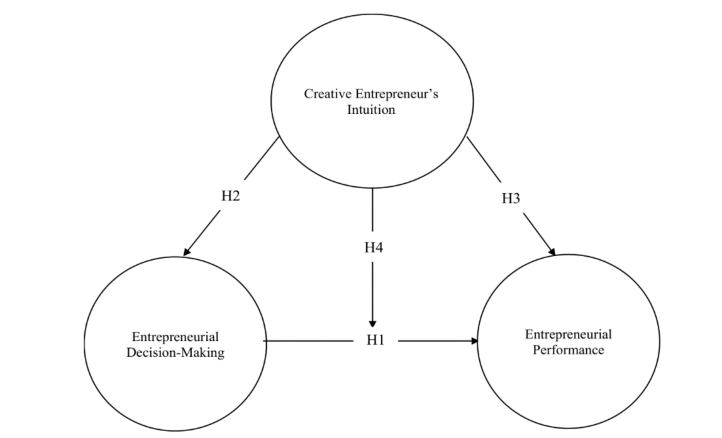
use of intuition and to other aspects of strategic decision-making. Likewise, decision motive and performance did not predict intuition. More so, envi- ronmental uncertainty moderated the relationship between decision-making and intuition. Based on these perspectives, the following hypotheses (H1 and H2) are posited.
H1: Entrepreneurs’ decision-making has a strong impact on their perfor- mance in the Ghanaian creative fashion industry. H2: Entrepreneurs’ intuition has a positive influence on their decision- making in the Ghanaian creative fashion industry.
Samadanis and Lee (2018) argued that limiting of intuition in decision- making could lead to organisational failure. By implication manifesta- tion of enhanced intuition will result in organizational success. This perspective situates with the finding by Ritchie, Kolodinsky and East- wood (2007) that a strong relationship between intuitive decision-making and financial performance. Chaston (2009) found that successful owner managers of both entrepreneurial enterprises rely heavily on intuition in their decision-making. On their part, Musso et al., (2022), found a significant negative relationship between intuition and firm perfor- mance. Based on these perspectives, the following hypothesis (H3) is posited.
H3: Entrepreneurs’ intuition will influence their entrepreneurial perfor- mance in the Ghanaian fashion industry.
In their examination of the influence of intuition on exploring new prod- ucts and new performance in SMEs, Zacca, Dayan and Elbanna (2017) found that under conditions of uncertainty, intuition drives decision-making, but does not influence SME performance. In a study to analyze the link between sensemaking and organisational failure, Weick, Sutcliffe and Obst- feld (2005), established that the process of pricing an artwork lies to a large degree on the creative entrepreneur’s intuition. Weick, Sutcliffe and Obstfeld (2005) observed that stakeholders’ decisions in art organi- sations are based on intuition. By implication, the success or failure of creatives in art organisations lies in their ability to take strategic decisions under conditions of uncertainty. On his part, Szanto (2019) found sig- nificant positive relationship between business performance and intuitive decision-making, which suggest that intuitive play a larger role in decision- making. Based on these perspectives, the following hypothesis (H4) is posited.
H4: Entrepreneurs’ intuition will moderate the relationship entrepreneurs’ decision-making and entrepreneurial performance in the Ghanaian fashion industry.
Based on the above hypotheses, the conceptual framework shown in Figure 1 below is formulated and tested in this study.
Humane Entrepreneurship in the Creative Fashion Industry 377
Figure 1: Conceptual framework the study.
METHODOLOGY
Using the quantitative philosophical approach informed by the entrepreneurs’ subjective evaluations of their intuitions in decision-making and entrepreneurial performance, data was obtained from seven hundred and twenty-eight respondents operating in the Ghanaian creative fashion indus- try, using a questionnaire. The data was analyzed descriptively and infer- entially. In the descriptive analytical approach, factor analysis, using the principal component analytical approach, was conducted to determine fac- tors that are predictive of the entrepreneurs intuitions, decision-making and entrepreneurial performances.
RESULTS AND ANALYSIS Demographic Distribution of Study Participants
All the seven hundred and twenty-eight (728) questionnaires administered were retrieved and all were found to be completes and usable for the analysis. The gender distribution of the respondents showed that 447 (61.10%) were female creative entrepreneurs and 285 (38.90%) were males.
Factor Analysis for Entrepreneurs’ Intuition, Decision-Making and Performance To assess whether the measured factors in the scales are predictive of the entrepreneurs’ intuitions, decision-making and performances, principal com- ponent analysis was conducted. The estimated Kaiser-Meyer-Olkin (KMO) value for entrepreneurs’ intuitions is 0.84. Th KMO for entrepreneurs’ decision-making is 0.83 and that for entrepreneurs’ performances is 0.85 which exceeded the recommended 0.6 value (Kaiser, 1974; Forsell et al.,
2020; Sanda, 2019). The estimated chi-square (χ2) values from the Bartlett’s test is 1501 (p = 0.000, df = 21) for entrepreneurs’ intuitions, 1949 (p = 0.000, df = 45) for entrepreneurs’ decision-making and 1405 (p = 0.000, df = 55) for entrepreneurs’ performances, all of which are very, very sig- nificant (p < 0.001). These values indicate that the correlation pattern of the respective factors are good and therefore appropriate to factor analyze their respective tested indicators. Thus, factors analysis was performed to identify and segregate the factors perceived by the study participants as predictive of creative entrepreneurs’ intuitions, decision-making and per- formances. Principal component analysis was conducted as an extraction method to characterize the various predictive indicators for each factors, as outlined in the sections that follow.
Principal Component Analysis for Entrepreneurs’ Intuitions In this analysis, varimax with Kaiser Normalization was used as the method of rotation, which converged in two (2) iterations, as shown in table 1 below. All the 2 components (i.e., C1,and C2) have individual items with factor load- ings greater than 0.50 (Forsell et al., 2020; Sanda, 2019). This implies that each component has factors with predictive strengths to informs the creative entrepreneurs intuition.
Table 1. Factor loadings for entrepreneurs’ intuitions.
Table available in the original PDF paper.
Factors Factor Loadings (r) C1 C2
0.74 0.23
My intuition come to me quickly and it drives my decisions as an entrepreneur;
0.71 0.35
I am aware my gut feelings influence your choice and decisions as an entrepreneur;
0.30 0.72
I trust my intuitions, especially in familiar situations; 0.82 −0.06 My approach to problem solving relies heavily on my intuition
0.74 0.16
My intuition shapes my decisions in uncertain contexts 0.63 0.39 My gut feelings influence my design process such as choice of style, design and fabrics My intuition affects my marketing and advertising 0.04 0.85
Based on the outcome of the factor analysis, the following fac- tors in the first component (C1), were identified as predictive of the entrepreneurs’ psycho-intuitions in decision-making: (i) intuition quickly drives entrepreneurial decisions (r = 0.74); (ii) entrepreneurial choices and decisions is influenced by gut feelings (r = 0.71); (iii) decisions in uncertain contexts shaped by intuition (r = 0.82); (iv) intuition is trusted in familiar situations (r = 0.63); (v) design process such as choice of style, design and fabrics influenced by gut feelings (r = 0.74).
The following factors in the second component (C2), were also identified as predictive of the entrepreneurs’ physio-intuitions in decision-making: (i)
Humane Entrepreneurship in the Creative Fashion Industry 379
approach to problem-solving heavily reliant on intuition (r = 0.72); and (ii) marketing and advertising decisions reliant on intuition (r = 0.85).
Principal Component Analysis for Entrepreneurs’ Decision-Making In this analysis, varimax with Kaiser Normalization was used as the method of rotation, which converged in two (2) iterations, as shown in table 2 below. All the 2 components (i.e., C1,and C2) have individual items with factor loadings greater than 0.50 (Forsell et al., 2020; Sanda, 2019). This implies that each component has factors with predictive strengths to informs the entrepreneurs decision-making.
Table 2. Principal components and factor loadings for entrepreneurs’ decision-making.
Table available in the original PDF paper.
Factors Factor Loadings (r) C1 C2
0.81 −0.11
In the past two years I have considered expanding and diversifying my business
0.76 −0.12
In the past two years I have considered relocating my business
0.68 0.12
In these past few years, I have made talent selection, hiring and recruiting decisions.
0.51 0.49
I constantly make marketing and promotional decisions 0.44 0.44 Over the last two years I have made decisions that concerns cash flow and investment −0.06 0.71 In the past two years, I have made decisions about social media strategies.
0.75 0.16
In the past two years, I considered expanding my business 0.77 0.20 In the past two years, I have decisions purchasing new machines for my machines
0.04 0.73
In the past two years, I have made decisions about collaborating with other designers
0.31 0.19
In the past few years, I have considered doing other businesses besides fashion
Based on the outcome of the factor analysis, the following factors in the first component (C1), were identified as predictive of the entrepreneurs’ decision-making on business growth: (i) In the past two years I have con- sidered expanding and diversifying my business (r = 0.81); (ii) In the past two years I have considered relocating my business (r = 0.76); (iii) In these past few years, I have made talent selection, hiring and recruiting decisions. (r = 0.68); (iv) the past two years, I have considered expanding my busi- ness (r = 0.77); (v) In the past two years, I have decisions purchasing new machines for my machines (r = 0.75); (vi) Over the last two years I have made decisions that concerns cash flow and investment (r = 0.51).
Also, the following factors in the second component (C2), were identified as predictive of the entrepreneurs’ decision-making on business marketing strategies: (i) In the past two years, I have made decisions about social media strategies (TikTok, Facebook, Instagram, WhatsApp etc) (r = 0.71); and (ii)
Equation reproduced from the original PDF.
Principal Component Analysis for Entrepreneurs’ Performances In this analysis, varimax with Kaiser Normalization was used as the method of rotation, which converged in three (3) iterations, as shown in table 3 below. All the 2 components (i.e., C1, C2 and C3) have individual items with factor loadings greater than 0.50 (Forsell et al., 2020; Sanda, 2019). This implies that each component has factors with predictive strengths to informs the creative entrepreneurs performance.
Table 3. Factor loadings for entrepreneurs’ performances.
Table available in the original PDF paper.
Factors Factor Loadings (r) C1 C2 C3
0.04 0.84 −0.08
My business sales have grown significantly over the years
0.66 0.01 −0.05
I am aware of my business in the public image 0.58 0.43 0.05 I am aware of customers compliments of my business 0.61 0.31 0.07 My brand has introduced variety of fashion products 0.09 0.52 0.43 I am focusing on improving the performance of my current business rather than entering new domains.
0.17 0.10 0.47
There is decline in sales resulting in loss of my customers
0.70 6.03 0.02
Timelines for order completion has improved 0.69 0.04 0.12 Employees/workers/apprentices are productive 0.58 0.15 0.26 Customers are satisfied with my business’ order delivery.
−0.09 −.011 0.82
Customers are satisfied with the quality of the products 0.71 −0.02 0.04 There is a high need to purchase additional equipment to improve the quality-of-service delivery and production
Based on the outcome of the factor analysis, the following factors in the first component (C1), were identified as predictive of the entrepreneurs’ performances informed by their service quality: (i) I am aware of my busi- ness in the public image (r = 0.58); (ii) I am aware of the compliments of my customers of my business (r = 0.61); (iii) I am focusing on improving the performance of my current business rather than entering new domains (r = 0.66); (iv) Timelines for order completion has improved (r = 0.58); (v) Employees/workers/apprentices are productive (r = 0.69);(vi) My customers are satisfied with the order delivery accuracy rate of the business (r = 0.76); (vii) Customers are satisfied with the quality of the products (r = 0.71). The following factors in the second component (C2), were identified as predictive of the entrepreneurs’ performances informed by the growth of their busi- ness: (i) My business sales have grown significantly over the years (r = 0.84); (ii) My brand has introduced different fashion products into the industry (r = 0.52). Furthermore, the following factors in the third component (C3),
Humane Entrepreneurship in the Creative Fashion Industry 381
were identified as predictive of the entrepreneurs’ performances informed by the quality of their service delivery: (i) There is a high need to purchase addi- tional equipment to improve the quality-of-service delivery and production (r = 0.82).
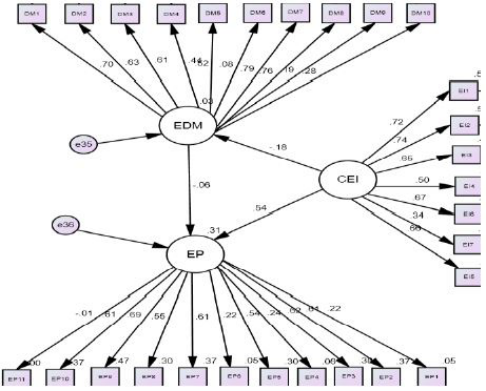
Structural Analysis of Conceptual Model The AMOS-generated structural model (standardized path diagram) show- ing the standardized factor loadings/regression weights (r) for the association between the creative entrepreneurs’ intuitions (CEI), their entrepreneurial decision-making (EDM) and entrepreneurial performances (EP) is shown in Figure 2 below.
Figure 2: AMOS graphics generated structural regression model showing standardized path and correlation coefficients.
The goodness of fit statistics for the structural model (Figure 2 above) showed that minimum was achieved, and the overall fit of the default model appears quite good with an estimated CMIN (χ2) of 26256.647 (df = 346) for the default model. Thus, the null hypothesis that the model fits the data is accepted. The path coefficient (standardized regression estimates) show- ing the relatedness of the tested in the structural model is shown in Table 4 below.
Table 4. Path coefficient estimates of the relatedness of latent variables to the exogenous variable in the structural model.
Table available in the original PDF paper.
Relatedness of Variable Standardized Regression Value (r) EDM CEI −0.18 EP EDM −0.06 EP CEI 0.54
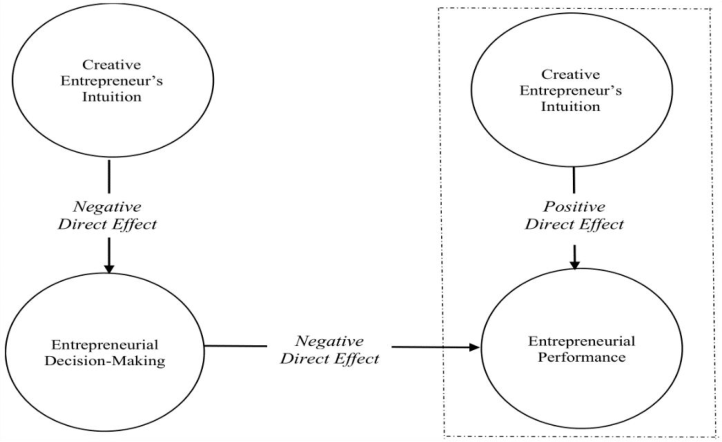
Relating the above findings to the hypotheses that informed the framing of the tested conceptual model (see Figure 1), and interpreting from the per- spectives of Kline (2023), firstly, the hypothesis (H1), that is, “entrepreneurs’ decision-making has a direct impact on their performance in the Ghana- ian creative fashion industry” holds. The implication is that when the entrepreneurs’ decision-making goes up by one standard deviation, their entrepreneur performance goes down by 0.064 standard deviations. This therefore means that the decisions taken by the creative entrepreneurs is pre- carious since it results in their under-performance rather than enhance it. Secondly, the hypothesis (H2), that is, “entrepreneurs’ intuition has a direct positive influence on their decision-making in the Ghanaian creative fash- ion industry” does not hold. The implication is that when the entrepreneurs’ intuition goes up by one standard deviation, their entrepreneurial decision- making goes down by 0.179 standard deviations. This therefore means that when the entrepreneurs overly rely on their intuition in their entrepreneurial activities, it reduces the efficacy of the entrepreneurial decisions that they make. Thirdly, the hypothesis (H3), that is “entrepreneurs’ intuition will directly influence their entrepreneurial performance in the Ghanaian fashion industry” holds. The implication is that when the entrepreneurs’ intuition goes up by one standard deviation, their entrepreneurial performance goes up by 0.544 standard deviations. This shows that the creative entrepreneurs increased reliance on their intuitions results in their increased entrepreneurial performances. Taking cognizance of the hypotheses H1, H2 and H3, it is imperative that while the creative entrepreneurs’ intuition directly con- strains their entrepreneurial decision-making, it directly enhances their entrepreneurial performances entrepreneurial performance. In this sense, the function of the creative entrepreneurs intuition in their entrepreneurial activ- ities is two-fold. Firstly, its direct effect on their performances, as established by the hypotheses H3. Secondly, it functions as a mediator on the rela- tionship between their decision-making and entrepreneurial performances (hypothesis H1) by virtue of its direct relationship with their decision-making (hypothesis H2). In this vein, the hypothesis (H4), that is, “Entrepreneurs’ intuition will moderate the relationship entrepreneurs’ decision-making and entrepreneurial performance in the Ghanaian fashion industry” did not hold”. Rather, their intuition appears to mediate the relationship between their entrepreneurial decision-making and performances. That is, when the entrepreneurs overly rely on their intuition in their entrepreneurial activities, it reduces the efficacy of the entrepreneurial decision-making process which results in their entrepreneurial under-performance.
DISCUSSION
Analytical Findings from principal components analysis identified seven (7) factors that are predictive of the Entrepreneurs’ intuitions in decision-making, eight (8) factors that are predictive of their entrepreneurial decision-making, and ten (10) factors that are predictive of their entrepreneurial performances. The influencing association between the entrepreneurs’ intuitions, decision- making and entrepreneurial is also established, as it is highlighted in Figure 3
Humane Entrepreneurship in the Creative Fashion Industry 383
below. The empirical model (i.e., Figure 3 reveals two functional models rel- ative to the influencing dynamics of the creative entrepreneurs’ intuitions on their entrepreneurial decision-making (i.e., influence of their psycho- intuitional behaviours) and entrepreneurial performances (i.e., influence of their positive physio-intuitional behaviours).
Figure 3: Effect of creative entrepreneurs psycho-intuitional and physio-intuitional behaviours on entrepreneurial decision-making and performance.
The study outcome provides an important insight on the dynamics of human-factors in creative entrepreneurship and the influencing significance of entrepreneurs’ intuition in their entrepreneurial performances. The find- ings provide humane-oriented perspectives that could enable educators asso- ciate with the neuroergonomics constraints in creative entrepreneurship development over the past years and the impact it has, and continue to have, on individuals in developing economies who desire to create business around their creativities. The study outcome provides a good understanding of the influence of creative entrepreneurs’ intuitions on their entrepreneurial performances to educators and administrators, which could be used to effec- tively design a humane-centred creative entrepreneurship skills and practices in the Ghanaian fashion industry. It also provides an important insight on the dynamics of human-factors in creative entrepreneurship and the influencing significance of entrepreneurs’ intuition in their entrepreneurial performances.
CONCLUSION
Based on the findings, it is concluded that the study has brought to the fore human-oriented perspectives that could enable educators associate with the neuroergonomics constraints in creative entrepreneurship development over the past years and the impact it has, and continue to have, on individuals in
developing economies who desire to create business around their creativities. The study outcome has provided a good understanding of the dynamics of the creative entrepreneurs’ intuitions on their entrepreneurial performances to educators and administrators, which could be used to effectively design a humane-centred creative entrepreneurship skills and practices. By implica- tion, it will also lead to the initiation of a knowledge-based platform within academic institutions for learning on how to model humane-oriented creative entrepreneurship that can lend to creative fashion entrepreneurs manifest- ing both positive physio-intuitional and psycho-intuitional behaviours to enhance their entrepreneurial activities.
ACKNOWLEDGMENT
The authors would like to acknowledge the support of DANIDA-Funded Project “Advancing Creative Industry in Ghana (ACIG)” at the University of Ghana.
REFERENCES
Bielby, W. T., and Bielby, D. D. (1994). All Hits Are Flukes: Institutionalized Decision Making and the Rhetoric of Network Prime-Time Program Development, American Journal of Sociology, Volume 99, No. 5, pp. 1287–1313. Chaston, I. (2009). Entrepreneurs, Intuition, and Small-Business Performance.
Journal of Centrum Cathedra, Volume 2, No. 1, pp. 37–45. Elbanna, S., Child, J. and Dayan, M. (2013). A Model of Antecedents and Consequences of Intuition in Strategic Decision-making: Evidence from Egypt. Long Range Planning, Volume 46, No. 1–2, pp. 149–176. Forsell, T., Tower, J., Polman, R. (2020). Development of a Scale to Measure
Social Capital in Recreation and Sport Clubs, Leisure Science, Volume 42, No. 1, pp. 106–122. Hesmondhalgh, D. and Baker, S. (2010). Creative Labour: Media Work in Three Cultural Industries. London: Routledge. Kaiser, H. F. (1974) An Index of Factorial Simplicity. Psychometrika, Volume 39,
pp. 31–36. Kline, R. B. (2023). Principles and Practice of Strucutural Equation Modelling (5th Edition). New York: Guildford Press. Musso, F., Francioni, B., Curina, I., Tramontana, F., Polidori, P.and Pediconi,
M. G. (2022). Decision-maker’s Overconfidence and International Performance: The Role of the Adoption of Intuitive Practices”, Journal of Small Business and Enterprise Development, Volume 29, No. 7, pp. 1049–1070. Ritchie, W. J., Kolodinsky, R. W. and Eastwood, K. (2007). Does Executive Intuition Matter? An Empirical Analysis of its Relationship with Nonprofit Organization Financial Performance. Nonprofit and Voluntary Sector Quarterly, Volume 36, No. 1, pp. 140–155. Saintilan, P. and Schreiber, D. (2017). Managing Organizations in the Creative
Economy: Organizational Behaviour for the Cultural Sector (1st ed.). Routledge. Sanda, M. A. (2019). The systemic-structural activity theory paradigm as a method of designing efficient human performance. In: Bedny, G. Z., Bedny, I. S. (Eds.), Applied and Systemic-Structural Activity Theory: Advances in Studies of Human Performance, 1st edition (pp. 279–300). Boca Raton: CRC Press.
Humane Entrepreneurship in the Creative Fashion Industry 385
Szanto, R. (2022). Intuitive Decision-Making and Firm Performance. Journal of Decision Systems. Volume 31 No. 1, pp. 50–59. Weick, K. E., Sutcliffe, K. M. and Obstfeld. D. (2005). Organizing and the Process of
Sensemaking. Organization Science, Volume 16, No. 4, pp. 409–421. Zacca, R., Dayan, M. and Elbanna, S. (2017). The Influence of Conflict and Intuition on Explorative New Products and Performance in SMEs. Journal of Small Business and Enterprise Development, Volume 24, No. 4, pp. 950–970. Zayadin, R., Zucchella, A., Anand, A., Jones, P. and Ameen, N. (2023).
Entrepreneurs’ Decisions in Perceived Environmental Uncertainty. Volume 34, pp. 831–848.
LISTED IN THE AHFE DIGITAL BOOKSTORE CATALOGUE
Explore the complete digital volume
Human-Centered Design and User Experience
Read this individual research paper free through the original publisher, or explore the full digital proceedings book.
ISBN 978-1-958651-90-2
Explore this ISBN in the AHFE Bookstore ↗Listed in the July 2026 bookstore catalogue; search by ISBN to confirm current availability · Digital book purchase optional