Jordan Scoliege, Jessy Barre, Philippe Cabon (2022). Integration of Human Factors in an Automated Driving Supervision System. In: Human Factors in Robots, Drones and Unmanned Systems. AHFE Open Access, vol. 57, pp. 38–45. https://doi.org/10.54941/ahfe1002308
In the field of transport, the reduction in the number of accidents caused by human error is often put forward as an argument in favor for the deployment of autonomous vehicle (Fagnant, & Kockelman, 2015). However, as long as autonomous vehicles are not capable of handling all driving situations, the human operator remains in the control loop and cooperates with the autonomous system (SAE levels 2, 3, and 4 - scale from 0 to 5 where 5 corresponding to the fully autonomous vehicle). The development of supervision systems could be a means to improve safety in these systems, as it has been the case in other transportation modes such as aviation and railways. Indeed, the supervision of autonomous vehicles (e.g.: shuttle fleet) would enable to secure the operation by anticipating incidents (e.g.: support the driver-system relationship, as an air traffic controller would do for pilots), while guaranteeing the reliability (management of system failures) and regularity of the transportation network. However, for Hoc (2000), automation is nevertheless at the origin of a certain number of deleterious effects on the human operator, such as a loss of expertise and adaptability or a lack or excess of confidence in the system, which can lead to errors. Also, human operators can misuse or abuse the automation technology. (Parasuraman and Riley, 1997). Moreover, in this human-machine cooperation, many effects have been observed such as automation bias and complacency phenomena, which can also lead to accidents (Parasuraman & Manzey, 2010).In the perspective of the literature review, we wish to bring keys elements to the designers to create a safe automated driving system. We anticipate this need through the analysis of work activity and creativity. However, autonomous vehicles not representing a mature technology or having applications in the current society. That requires a projection into a future environment and study of the resulting human factors. Prospective ergonomics (Brangier & Robert, 2014) permits to leads us to deploy that. To anticipate the major functions necessary for the future supervision activity, the approach of the “possible future activity” is applied (Daniellou, 1992). This approach studies the reference situations. We identified many sectors of activity with strong similarities with our system such as aviation, railways, bus or nuclear. Until now, four situations were integrated: the supervision of buses and tramways, the civil air traffic control, and the military air traffic control and the autonomous drone in logistics. These reference situations allowed us to identify their strength and weakness around 7 major components of the supervision (safety, infrastructure, hardware, degree of automation, software, organization of the system and human factor). This step builds prerequisites for the creation of the future supervision system. To integrate and adapt them, the next step will be the realization of creativity workshops which will revolve around expert-staff with the objective of proposing a set of specifications for the designers of the main functions to allow the integration of the human factor from the first phases of implementation in this system.
The autonomous vehicle (AV) has been a strong utopia for the evolution of mobility for the last ten years, but its deployment is constantly being post- poned. Automation, which is expected to replace physical functions, freeing up time as well as manpower, is completed through artificial intelligence by providing cognitive functions such as decision making, planning, and moni- toring. Parasuraman & Riley (1997) define automation as the performance by a machine agent (usually a computer) of a function that was previously performed by a human.
The present work is part of a PhD thesis started in September 2020 which, based on other sectors such as industry, aviation or railways, anticipates the implementation of anthropocentric centralized command centers for autono- mous vehicles. To achieve this objective, given that our solution does not exist either technologically, or in the projected uses, alternative methods of data collection of the activity is required. We will firstly present the concepts of the literature that support our topics, then secondly, the methodological elements
Integration of Human Factors in an Automated Driving Supervision System 39
that we have developed. In this paper, we focus on the process of identifying the reference situations that we have studied as well as the synthesis of the elements collected.
SUPERVISION AND IMPACTS Activity with human-machine interactions can be divided in three catego- ries: from non-automated to fully automated, including through one or more intermediate levels (e.g., SAE levels for the AV1). Automation can disrupt work activity by decreasing physical tasks and increasing cognitive tasks (e.g., knowledge-workers concept; Drucker, 1999). In industrial sectors, where human presence is important for safety, Satchell (1998) considers man and machine as complementary (task sharing, control, authority, etc.). The notion of Joint Cognitive Systems appeared in the 1980s to underline “the importance of taking into account the (joint) man-machine system to access meaningful task descriptions and this was a decisive step towards the notion of man-machine cooperation” (Hollnagel, & Woods, 1983).
Automation is often developed to resolve the human error topics (e.g., Stanton & Marsden, 1996 for automated driving). However, the human error is a theory of action (de Beaurepaire, 1996), and represents the sign of a mismatch, a lack of compatibility between the technical, organiza- tional, or functional characteristics of the work situation and the physi- cal, mental, or psychosocial characteristics of the human operator (Hadj- Mabrouk & Hadj-Mabrouk, 2004). The human error is not reducible to the incapacity or incompetence to perform a task but can come from the impossibility for the operator to execute it correctly (de Terssac and Chabaud 1990).
High levels of automation can positively impact the operator by decreasing fatigue or workload, but can also generate boredom, skill erosion, decreased situational awareness, and over- or under-trust of the system (Endsley, 2017; Hoc, 2000; Wiener & Curry, 1980). At the root of these negative effects, Parasuraman and Riley (1997) point to the fact that the design and implemen- tation of automation is typically technology centric. The cooperation human system lets appear 4 concepts emerging in the different uses: “use, misuse, disuse and abuse”. “Use” characterizes the behavior of using or not auto- mation, “Misuse” refers to over-reliance on the system while “disuse” takes shape through under-utilization of the automation. “Abuse” is “inappropri- ate application of automation by designers or managers” (p.5) because failed to consider the consequences for human performance, promoting misuse and disuse of automation.
We have identified in the literature that elements of human interaction with automation can degrade the system. In the following section, we discuss the methodology used to propose a specification to design an anthropocentric autonomous vehicle supervision center.
1In the field of autonomous vehicles, the SAE (Society of Automotive Engineers) defines 6 levels ranging from 0 to 5. 0 corresponds to no assistance and 5 to an autonomous vehicle without restrictions.
METHODOLOGY
In the context of long-term future design, where the situation or the needs are not well defined, it’s necessary to have a projection of the future environ- ment and to apprehend the human role. Prospective ergonomics (Brangier & Robert, 2014) is located upstream of design ergonomics and corrective ergonomics and deals primarily with the functional aspects of a project, while design ergonomics rather addresses the conceptual aspects and cor- rective ergonomics the operational aspects (Barré, 2015; Nelson, 2011). The “possible future activity” approach (Daniellou, 2004), permit to gets around the lack of observable situations. In this approach, Daniellou emph- asizes the need to look at existing situations through “reference situations”. These must have strong similarities with the project. The aim is to analy- zed strengths, and weaknesses of existing systems, to build a preliminary basis for the creation of the future work situation. To design our supe- rvision system applied to autonomous vehicles, we have identified several reference situations that can serve as a theoretical and practical founda- tion. This allowed us to understanding activity and more particularly to collect data on interaction between supervision operators and their system. Some of these results are presented in this manuscript. The next step: the creativity part to manage the specifications of the system, is not treated here.
Identify Reference Situations The identification of reference situations is achieved according to the context (designing a centralized supervision center applied to autonomous vehi- cles) and constraints, notably given the fact that this technology is not yet mature and there is no concrete solution yet deployed on the market. We can nevertheless anticipate some possible implementations; the supe- rvision of an autonomous public transport service (shuttles or buses), the supervision of autonomous private vehicles as well as the supervision of a car- sharing service or a robot-taxi. We also keep the possibility of still unknown applications.
Two central functions have been retained:
(1) The execution of supervision or monitoring tasks. The degree of auto- mation of the system is not discriminating in our choice, it can vary from non-existent, to average or high. The nature of the system does not have to be especially linked around mobility allowing to open the sources of data collection (industrial process, security, maintenance, etc.) .
(2) The execution of driving tasks or remote control. Potentially, supe- rvisory agents will be able to remotely take control of vehicles in case of incapacity of management by the system, we retain this function because it is associated with very specific situations.
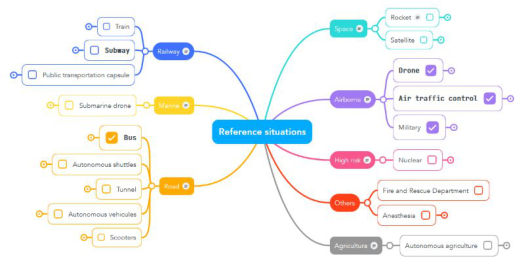
Based on these two functions, we have identified several sectors of activity that are mainly oriented towards mobility. The mind map pre- sented in Figure 1, gathers these 8 sectors of activity with their fields of application.
Integration of Human Factors in an Automated Driving Supervision System 41
Figure 1: Activity sectors and reference situations identified around the centralized supervision of autonomous vehicles based on the functions of (1) supervision/moni- toring and (2) remote driving/piloting.
Data Collection This data collection was therefore adapted to each field, which had its own human, technical and operational specificities. At least one day was devoted to data collection on site and only one of the situations was observed by two observers.
The methodology was based on several complementary methods used in ergonomics (e.g., Guérin, Laville, Daniellou, Durrafourg & Kerguelen, 2007) and particularly the “Core Task Analysis” methodology (Norros, 2004, Leplat, 2005 and Karvonen & al., 2011). The purpose of the core task analy- sis is to identify the main task of a specific job. By analyzing the objective and the demands that the work impose on the workers on their daily acti- vity but also in specific situations, it is possible to obtain the main content of the work. We structured on three main axes: observations, interviews, and critical incident analysis.
- Open observations of the activity. It is essential to understand the codes, the stakes, and the responsibilities of the different stakeholders. The obse- rvation of the real work allows to access the missions of the different actors and to understand the organization of the work including communications, cooperation as well as human-machine interactions.
- Semi-structured interviews. This method, used in addition of the obse- rvation, permits to understand the role of the human activity and to access the operators’ reasoning. From an interview grid, five themes adapted from the work of Karvonen et al. (2011) on the automated metro, were discus- sed: the nature of work and core task, professional skills, communication and co-operation, user-interfaces, and the relationship to automation. The discussion was designed to allow free exchange on the work environment. Seven operators were interviewed for an allocated time between 20 min and 80min. - Critical incident analysis. Critical incident analysis (Flanagan, 1954) offers two ways of understanding situations. It allows us to identify the undesired events that can occur in the observed context as well as the ele- ments of initiation. It also allows the possibility of apprehending the acts of recovery set up by the concerned actors allowing or not to find a stable situation.
RESULTS
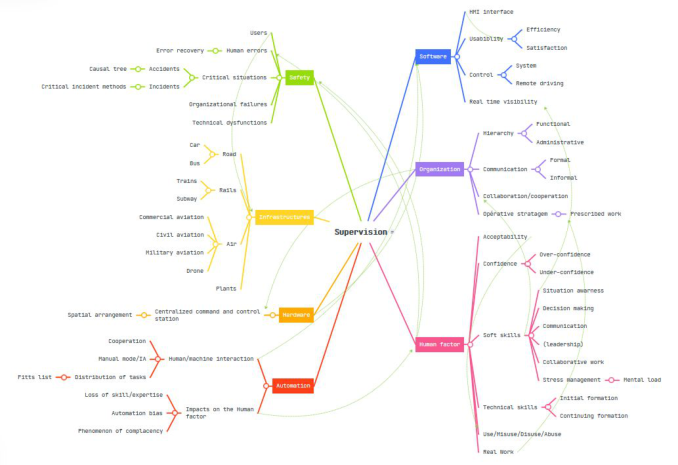
At this stage three fields (Bus & tramway supervision, Civil air control and Military air control) have been fully analyzed. A fourth exploratory field (logistics drone) is currently being studied in greater depth. Based on these elements and on a decomposition of the main functions, we were able to establish the mind map presented in Figure 2.
This representation allows us to identify 7 major components of supervi- sion, that are linked together and need to be whole considered. These links are represented by the green arrows on the Figure 2. It is impossible for us to deal with all the headings in this document, so we will discuss the most salient elements.
The institutions we met have a strong safety culture; clearly stated compo- nent of the different situations observed. We find these elements both in the operators’ communications and in the management of incidents/accidents. They are managed in such a way as to understand the complexity of situati- ons to propose adjustments in the procedures to limit their occurrence. For example, the air traffic control domain records all communications, HMI data and operator actions to allow a complete analysis after a non-common event to identify the faulty elements. The quality and safety investigation office ensures numerous communications about events requiring reinforced vigilance to allow collective appropriation. Indeed, a supervision “service” is intended to improve the system by guaranteeing the management of unfore- seen events. We noted a difference in that with the bus and tramway sectors. For one, this is done in the form of a sector breakdown (air domain) and for the other in a global form - end-to-end (road transport domain). We also recognize two categories of modality for performing the supervision task: “proactive supervision” and “reactive supervision”. We attribute the proa- ctive supervision to the aviation sector because the supervisor (also called “controller”) has a central place in the system with the role of realizing the interface of coordination and cooperation between the aircraft present in its defined area. Conversely, in the bus and tramway supervision sector, supe- rvisors (also called “regulators”) anticipate many phenomena but have the vocation to resolve conflicting situations, that is what we consider “reactive supervision”. Finally, we find a higher degree of safety, or at least a more “regulated” one, in the airline sector.
The organization of these two sectors also differs in the constitution of the workstations. The bus and tramway supervision area is organized with one agent per workstation, while the air transport area is organized by “booth” of two agents: a controller and a planner.
They have a similarity on the software. It’s centered on a real-time visuali- zation of the evolution of the traffic activity. Some specifications such as user interface or menus adapted to each sector to allow a good awareness of the situation and tend towards the best decisions.
The issue of task allocation is present in the airline sector and has been discussed in the public transportation sector. The air sector has an automatic preventive alarm of aircraft crossing. When the trajectory projection calcula- tes a penetration of the horizontal and vertical separation, the system triggers
Integration of Human Factors in an Automated Driving Supervision System 43
Figure 2: Mind map of the main functions and components of the supervision activity resulting from the analysis of the reference situations.
a first alert to request an action from the controller. In this case the system is not able to propose different maneuver choices; it only reports the ano- maly. Within the bus & tramway supervision, the supervisors underline the interest of the deployment of an aid from the software aiming at repositio- ning correctly the tramway drivers following an incident which required the implementation of an interruption of a given portion.
Supervision of systems always presents the human agent in the loop of control, so the system is vulnerable to the failures of the human factor. The notions of understanding, trust, situational awareness, but also the human’s capacities, training or even fatigue are involved in the human-system relati- onship. The human’s cognitive capacities limit him in the workload he can assume. We find an example of considering the human factor within the civil aviation field concerning the management of sectors. It has been determined, over an hour, a defined number of aircraft that a “control cabin” (2 agents) can assume in consideration of the specificities of the situation and if this is reached, then the sectors are subdivided. This action will allow a distribution of the workload with another team and will make it possible to maintain wor- king conditions which encourage a framework favorable to air safety. In the land transport sector there is no formal workload distribution strategy. This is due to the absence of variability in the quantity of vehicles to be regulated over time. The overload of the agents, caused by the simultaneous occurrence of several disruptive events, is solved informally with the support of the other agent (bus or tramway supervisor).
CONCLUSION
To understand the position of the human operator in the supervision, we tried to integrate as many reference situations as possible, from the closest
to our target system, such as the supervision of buses and tramways, to the most distant, such as the supervision of a nuclear power plant. Currently, we could analyzed the bus and tramway sector, as well as the civil and military air traffic control. Thus, out of all the reference situations identified, we were able to carry out observation and comparison of the activity of these three.
Although the macro function of the supervisor is to bring a global vision of the direct situation to the pilots/drivers, we note that the supervisor takes a different place depending on the sector of activity. This is already reflected in the names of these agents: we speak of “supervisor” or “regulator” for the bus/tramway supervisor, whereas we speak of “controllers” in the airline sector. This reflects the incident and deviation management role of the former and the proactive control role of the latter.
From these data collections, as an extension of the state of the literature review, we extract crucial information about the organization, functioning and vigilances of supervision in these different sectors. Each of them has its own specificities but presents an overlapping structuring that brings essen- tial elements to the projection of a centralized supervision center for the application to an automated driving supervision system.
This data collection needs to be adapted to the specificities of the target system. To propose a first specification for the system designer for this appli- cation, we will focus on the conversion levers of these data for our system: needs, functions, and solutions. We will proceed by setting up creativity workshops to position itself in a prospective ergonomics approach.
REFERENCES
Barré, J. (2015). Vers de nouveaux outils pour l’anticipation des besoins utilisateurs: apports méthodologiques pour l’ergonomie prospective. Thèse de Doctorat, École nationale supérieure d’arts et métiers – ENSAM. Beaurepaire, C. de, (1996) L’erreur humaine est-elle une action irrationnelle? le point
de vue de la philosophie analytique. L’erreur humaine: question de point de vue? (Cambo De Lavette, B., Et Neboit, M.). Edition Octarès. 1996, pp. 11–22. Brangier, E., Robert, J-M. (2014) L’ergonomie prospective: fondement et enjeux.
Presse universitaire de France ≪Le travail humain ≫, Vol. 77, PP. 1 à 20. Daniellou, F. (2004). L’ergonomie dans la conduite de projets de conception de systèmes de travail. In P. Falzon (Ed.), Ergonomie (pp. 359-374). Paris: PUF PP. Drucker, P. F. (1999) Knowledge-Worker Productivity: The Biggest Chal- lenge. California Management Review. Université of California Berkeley. https://doi.org/10.2307/41165987 Endsley, M. R. (2017). From here to autonomy: lessons learned from human–
automation research. Human factors, Vol. 59(1), pp. 5–27. Flanagan, J. C. (1954). The critical incident technique. Psychological bulletin, 51(4), 327–358. Guérin, F., Laville, A., Daniellou, F., Durrafourg, J., & Kerguelen, A. (2007).
Comprendre le travail pour le transformer: la pratique de l’ergonomie. Lyon: ANACT. Hadj-Mabrouk, A., & Hadj-Mabrouk, H. (2004). Approche d’intégration de l’erreur humaine dans le retour d’expérience. Application au domaine de la sécurité des transports ferroviaires, Vol. 43, pp. 102.
Integration of Human Factors in an Automated Driving Supervision System 45
Hoc, J. M. (2000). La relation homme-machine en situation dynamique. Revue d’intelligence artificielle, Vol. 14(1), pp. 55–71. Hollnagel, E., & Woods, D. D. (1983). Cognitive systems engineering: New wine in
new bottles. International journal of man-machine studies, Vol. 18(6), pp. 583– 600. https://doi.org/10.1016/S0020-7373(83)80034-0 Karvonen, H., Aaltonen, L., Wahlström, M., Salo, L., Savioja, P., & Norros, L. (2011) Hidden roles of the train driver: A challenge for metro automation. Interacting with computers, Vol. 23, Issue 4, pp. 289-298. Leplat, J. (2005) ≪Norros, L. (2004). Acting under uncertainty. The core-task analy-
sis in ecological study of work ≫, Activités [En ligne], 2–2 | octobre 2005, mis en ligne le 01 octobre 2005. URL: http://journals.openedition.org/activites/1832; DOI: https://doi.org/10.4000/activites.1832 Nelson, J. (2011). Contribution à l’analyse prospective des usages dans les projets d’innovation. Thèse de doctorat. ENSAM-ParisTech. 211 pages. Norros, L. (2004). Acting under uncertainty. The core-task analysis in ecological
study of work. VTT Industrial Systems, Techniicantie 12, P.O. Box, 1301, FIN- 02044 VTT, Finland. Parasuraman R. et Riley V. (1997), Humans and Automation: Use, Misuse,Disuse, Abuse. Human Factors: The Journal of the Human Factors and Ergonomics Society 1997 Satchell, P. (1998) Innovation and automation. Ashgate, 1998. 227 pages. Stanton, N. A., & Marsden, P. (1996). From fly-by-wire to drive-by-wire: Safety
implications of automation in vehicles. Safety science, 24(1), 35–49. Terssac, G. de, & Chabaud, C. (1990) Référentiel opératif commun et fiabilité. [In] Leplat, j. et de Terssac, G. (Eds.) Les facteurs humains de la fiabilité dans les systèmes complexes. Paris: Octarès. Wiener, E.-L., Curry, R.- E. (1980) Flight-deck automation: promises and pro-
blems. Ergonomics, Vol. 23, Issue 10, pp. 995–1011. https://doi.org/10.1080/ 00140138008924809
LISTED IN THE AHFE DIGITAL BOOKSTORE CATALOGUE
Explore the complete digital volume
Human Factors in Robots, Drones and Unmanned Systems
Read this individual research paper free through the original publisher, or explore the full digital proceedings book.
ISBN 978-1-958651-33-9
Explore this ISBN in the AHFE Bookstore ↗Listed in the July 2026 bookstore catalogue; search by ISBN to confirm current availability · Digital book purchase optional