Johan Fagerlönn, Yanqing Zhang, Lina Orrell, Hanna Rönntoft (2022). Facilitating Collaboration Between Humans and Unmanned Heavy Vehicles using Verbal Interaction and Augmented Reality. In: Human Factors in Robots, Drones and Unmanned Systems. AHFE Open Access, vol. 57, pp. 54–62. https://doi.org/10.54941/ahfe1002310
The development of unmanned self-driving vehicles appears to have great potential to increase safety and transport productivity. In industry, these vehicles are expected to be adopted first in confined contexts (hubs), such as mines. However, there is a need to better understand how to design interaction models to handle complex situations when professional operators interact with such vehicles in collaborative tasks. Research has suggested that verbal communication may facilitate interaction between automated vehicles and humans. Augmented reality (AR) has also been investigated to support operators in various work domains. Overall, research has indicated that these emerging technologies can improve operators’ productivity and safety.ObjectivesThe main study aim was to investigate the potential of verbal interaction and AR to support the user experience and facilitate collaboration between operators and unmanned self-driving heavy vehicles in hub environments. The second aim was to gain better insights into the effects of more social and natural verbal human–machine interaction. The study focused on loading scenarios in two hub types: logistic centers and underground mines.MethodsThe study had 32 participants: 16 forklift operators and 16 rock-loading operators. Two variants of concepts were designed for each hub type. The natural voice interaction (NVI) variant was designed to mimic natural and social verbal interaction between two human operators. In the basic voice interaction (BVI) variant, verbal interaction was kept to a minimum, and the operator controlled the vehicle with short verbal commands. AR was used in both variants to provide visual guidance, for instance how to distribute the load in the vehicle. The concepts were implemented in animated movies in which the operator in the movie collaborated with the unmanned vehicle to prepare and conduct a loading task. The study was conducted using online interviews in which the participants watched the movies. Subjective opinions related to acceptance, work efficiency, and other aspects of the user experience were assessed using rating scales and open-ended questions.Results and discussionOverall, the concepts generated high scores of user expereince and work efficiency in both user contexts. For instance, on a scale of 1 (inefficient) to 7 (efficient), forklift operators’ mean scores were 6.4 for the NVI and 6.4 for the BVI. The results support the use of verbal interaction and AR to facilitate collaboration between human operators and vehicles. The proposed concepts also provide promising examples of interaction models for further investigation and implementation. Interestingly, most forklift operators stated that they trusted the vehicle more in the NVI because the interaction felt, for instance, more human-like and safe. These results indicate the potential to include more natural dialogues when developing future verbal interfaces for human–vehicle collaboration. However, no difference in trust between concept variants was found among the rock loaders. Also, more rock loaders preferred the BVI, and several subjects highlighted that the extensive use of verbal interaction could become a disturbance. These results support the importance of adapting interaction design in future implementations to the needs of specific users to gain high acceptance and productivity.
There is currently a need to understand how user interfaces can be desi- gned to facilitate collaboration between human operators and unmanned self-driving trucks in confined industrial contexts (hubs), such as logistics cen- ters, terminals, and mines. An especially demanding situation is created when humans and machines work together in shared spaces to collaborate on com- mon work tasks. Considering situations when truck drivers will no longer be available, the human–system interaction must provide high levels of work efficiency, safety, and user experience (UX). The In the Hub (RISE Research Institutes of Sweden, 2022) research project aims to examine and demon- strate new models of interaction between professional human operators and self-driving heavy vehicles (SAE automation levels 4–5 (Sae International,
Facilitating Collaboration between Humans and Unmanned Heavy Vehicles 55
2018)) in hubs. The project focuses especially on exploring the potential of utilizing natural user interfaces (NUI).
Previous research suggests that verbal communication may facilitate inte- ractions between automated vehicles and humans (Kim et al. 2021; Large et al. 2019; Mahadevan et al. 2018). However, the work has mainly focu- sed on users inside cars and pedestrians near vehicles. A possible advantage of verbal interaction is that the operator can interact with the system while keeping their hands and eyes free. Also, human-like features (anthropomor- phism) may increase likeability and trust toward the system. For instance, giving the vehicle a gender, name, and voice has been shown to increase trust and likeability (Waytz et al. 2014). Furthermore, Ruijten et al. (2018) reported that conversational user interfaces resulted in higher trust compa- red to purely visual displays. According to Large et al. (2019), a more social and conversational interaction may result in higher pleasantness and trust compared to using verbal commands.
Visual information in work machines is often presented on conventional screens. But focusing on screens while manually operating a machine may pose a safety risk. The use of augmented reality (AR) has been examined to support human operators in industrial work contexts, such as mines (Jacobs et al. 2016). Research has indicated that technology can improve operators’ productivity, confidence, and safety (Sitompul and Wallmyr, 2019). For insta- nce, placing visualizations close to the line of sight may reduce operators⣙ workload compared to using ordinary visual displays (Wallmyr et al. 2019). By using AR, information can also be placed virtually in the work context, which means that the operator can easily perceive and interpret the infor- mation. AR also offers possibilities to “see through” obstacles (e.g., walls), which offers new possibilities for increasing situational awareness. However, an overall challenge with AR is that virtual content may obscure physical objects and humans in the physical world. Thus, using semi-transparent AR may be advantageous (Sarupuri et al. 2016). Previous research has explored combinations of verbal interaction and AR in interaction models. For exam- ple, the combination has been suggested for interaction with loader cranes (Majewski and Kacalak, 2016). However, little is known about how these emerging technologies can be used and combined to facilitate collaboration between humans and self-driving vehicles.
OBJECTIVES The main aim of the explorative study was to investigate the possibility of using verbal interaction and AR to support the user experience (UX) and faci- litate collaboration between professional human operators and self-driving heavy vehicles in hubs. The second aim was to gain better insights into the effects of more social and natural verbal human–machine interactions. The two main hypotheses of the study were: (1) Interaction models using verbal interaction and AR can facilitate high levels of work efficiency and UX when humans collaborate with self-driving vehicles. (2) More social verbal inte- raction can lead to higher levels of trust and acceptance compared to using short verbal commands.
The study focused on loading scenarios in two hub types: logistic centers and underground mines. A pre-study conducted within the In the Hub pro- ject showed that the loading of goods (e.g., rocks or pallets) is a situation that often requires complex interactions between truck drivers and loading operators in mines and logistic centers.
METHODS
To fulfill the aims of the study, concepts for interaction design were develo- ped, implemented in 3D animated movies, and evaluated with end users.
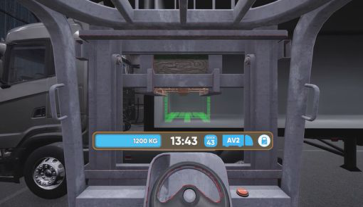
Concept Design The process of designing concepts involved a team of interaction designers, researchers, 3D animators, a forklift operator, and people from a mining company. The process resulted in two concept variants for each user context: natural voice interaction (NVI) and basic voice interaction (BVI). The two variants differed mainly in how the verbal interaction was implemented. The NVI variant aimed to mimic social verbal interaction between an operator and truck driver performing the loading task together. In the BVI variant, the operator uses short verbal commands to control the truck. AR was used in both variants to provide visual guidance and information to perform the loading (see Figure 1). The AR consisted of 2D and 3D elements. The 2D visualization showed information about remaining load capacity, remaining loading time (logistic center), and the vehicle and loading area. The lock icon shows if the truck can only be controlled by the operator in the forklift or loader. For the mine context, the 3D AR elements were used inform the ope- rator about how the load was distributed in the truck. In the logistic center context, the 3D AR was used to guide the operator to where the next pallet should be placed.
The concepts were implemented in approximately three-minute-long ani- mated movies, showing the loading being performed by the operator from a first-person perspective. More details on the design and differences between concept variants were presented by Fagerlönn et al. (2021). Videos show- ing the scenarios and the concepts are accessible online. For the mine, refer to (Self-driving vehicles, 2021a) for the NVI variant and (Self-driving vehi- cles, 2021b) for the BVI variant. For the logistic center, refer to (Self-driving vehicles, 2021c) for the NVI and for the BVI (Self-driving vehicles, 2021d).
Participants and Apparatus Thirty-two users participated in the evaluation: 16 forklift operators and 16 rock-loading operators working in different companies in Sweden. The ages of the forklift operators ranged from 22 to 60 (M = 36.8, SD = 11.0). The ages of the rock-loading operators ranged from 21 to 60 (M = 37.6, SD = 7.0). The study was conducted using online interviews. The concept movies were experienced by watching them on the video-sharing platform Vimeo. The participants used their own computers or tablets and speakers or headphones to experience the concept videos.
Facilitating Collaboration between Humans and Unmanned Heavy Vehicles 57
Figure 1: AR display in the logistic center (left) and mine (right).
Procedure and Measurements The subjects first provided demographic information and watched a short movie to allow calibration of the audio to a comfortable listening level. The subjects then watched the movies presenting the concept variants. The movies were presented in a counter-balanced order to reduce order effects. Ten items from the User Experience Questionnaire (UEQ) (Schrepp, 2015) and two items from the acceptance scale by Van der Laan et al. (1997) were used after each concept variant movie to obtain insights into the UX from different perspectives. The items consisted of seven-point rating scales between two opposite words. After watching both concept variants, the subjects answe- red statements about the perceived efficiency of the interaction technologies. Statements were answered using a scale from 1 (do not agree at all) to 7 (com- pletely agree). To assess differences in the subjects’ trust and acceptance of the different concepts, the subjects were asked to select in which concept vari- ant they would trust the truck the most and which one they would prefer to work with. Open-ended questions were used throughout the test to gain more insights into the perceived UX of the concepts and interaction technologies.
RESULTS
Table 1 shows the results of the UX ratings. Considering that the study did not use all scales in the UEQ (Schrepp, 2015) or Van der Laan et al. (1997) methods, the results of all rating items are presented.
Efficiency of Concepts and Interaction Technologies Among the forklift operators, both concept variants generated very high sco- res (above 6.0) for UEQ items related to efficiency. They also found both interaction technologies to be efficient. The statement “Communicating with the truck by talking feels efficient” generated a mean score of 5.9 (SD = 1.7), while the statement “Receiving information on the windscreen feels efficient” received a mean score of 6.1 (SD = 1.4). Analysis of the operator comments showed that the advantages in efficiency resulting from voice interaction were mainly related to the possibility of communicating/sending and recei- ving information without the need to use one’s hands; otherwise, one might be interrupted by, for example, documentation tasks. Four operators pointed out that the interaction could be made even more efficient by using shorter
Table 1. Mean UX ratings for each context and concept variant. Scales ranged between 1 (e.g., inefficient) to 7 (e.g., efficient). Standard deviations are shown in parenthesis.
voice commands. For the AR, the identified advantages were mainly related to the possibility of easily accessing information when working, and that one does not need to focus visually on something else (e.g., a separate screen) when operating the machine.
Compared to the forklift operators, the rock-loading operators genera- ted somewhat lower scores in items related to the efficiency of the concepts. However, the mean scores for the respective interaction technologies were quite high: 5.6 (SD = 1.7) for voice interaction and 5.8 (SD = 1.7) for AR. Analysis of operator comments related to efficiency indicated that the loa- ding task took too long when using the concepts compared to how long it takes in their daily work. This indicates that even though the concepts and interaction technologies scored high in terms of efficiency, the concept should be better adapted to the mine context and workflow.
User Expereince Both concept variants generated mean scores above 5.0 in the UEQ items related to perspicuity, dependability, stimulation, and attractiveness, indica- ting overall high levels of UX for the interaction. Also, the users provided high ratings for “usefulness.” In terms of “irritation,” the concepts resul- ted in somewhat lower scores for the rock-loading operators, especially in the NVI variant, with a mean score of 4.2. Comments regarding what was perceived as frustrating or stressful in the concepts revealed some insights that may explain this neutral mean score. A common theme in the comments
Facilitating Collaboration between Humans and Unmanned Heavy Vehicles 59
was concern that the extensive use of verbal interaction would be “too much speech” and feel like nagging.
Effects of Verbal Interaction on Trust and Preference Participants were asked, “In which concept would you feel that you can trust the vehicle the most?” Twelve forklift operators (75%) chose the NVI, while only two (13%) answered the BVI. Two other forklift operators did not report any difference. The reasons provided for selecting the NVI were mainly related to the fact that it felt more human-like, comforting, social, and safe. Among the rock-loading operators, five subjects (31%) chose the NVI, while six (38%) chose the BVI. Five rock-loading operators did not report any differences.
Participants were asked, “If you were given a chance to work with one of the concepts in the future, which would you prefer?” Ten (63%) of the forklift operators chose the NVI, while five (31%) chose the BVI. One for- klift operator reported no difference. An analysis of comments related to their choice of preference, as well as how they experienced the voice intera- ction in the two concept variants, was conducted. The results showed that most operators preferred the voice interaction in the NVI, and they provided the following reasons: it felt more like a real dialogue and was human-like, social, natural, and a more pleasant experience. For the rock-loading opera- tors, five subjects (31%) chose the NVI, while nine subjects (56%) selected the BVI. Two rock-loading operators reported no differences in preference. Analysis of operator comments revealed that many rock-loading operators seemed concerned about the extensive use of verbal interactions in the NVI, providing reasons such as that the BVI would be less disturbing, less irrita- ting, involve less “unnecessary talking,” be more “straight to the point,” and offer a calmer and quieter work environment.
DISCUSSION
Overall, the evaluated concepts and interaction technologies generated high efficiency and UX scores in both user contexts. The forklift operators espe- cially highlighted the advantages of these interaction technologies—that is, that voice interaction does not require them to use their hands and that AR makes it easy to access information while working. The results support the use of interaction models utilizing verbal interaction and AR to facilitate col- laboration between human operators and vehicles. Moreover, the proposed concepts combining interaction technologies provide promising examples of interaction models for further investigation and implementation. Previous research has explored the use of new interaction models to facilitate inte- raction with self-driving vehicles, for instance, by using human–machine interfaces mounted on vehicles (Mahadevan et al. 2018; Habibovic et al. 2018; Faas and Baumann, 2019). The present work provides new insights and suggestions on how voice interaction and AR can be used and combined to facilitate interaction in complex collaborative tasks, e.g., in loading tasks.
Regarding the impact of social voice interaction on preference and trust, the two contexts revealed interesting results and differences. The UX ratings
revealed no significant differences between concept variants in the two con- texts. Still, more forklift operators preferred the concept designed to offer a more extensive social verbal dialogue between the operator and the machine, providing arguments such as that it felt more human-like, comforting, social, and pleasant. Also, the results showed that more extensive social interaction made most operators trust the vehicle more. These results indicate the poten- tial for allowing more natural and social dialogues when developing future verbal interfaces for human–vehicle collaborations. These results are in line with previous research suggesting that more social and conversational inter- faces may result in higher pleasantness and trust when compared to using verbal commands (Large et al. 2019).
The rock-loading operators reacted somewhat more negatively to the more extensive use of voice interaction, and more subjects preferred the concept using simple voice commands. The results indicate that extensive use of ver- bal interaction can be perceived as unnecessary, irritating, and a potential disturbance among these users. Overall, these results highlight the importa- nce of being careful when designing and implementing verbal interactions. Considering that sound is omnidirectional and hard to ignore, it can become a distraction or annoyance. It also supports the importance of carefully adapting the design of verbal interactions to the needs and requirements of specific users and contexts to gain high acceptance and productivity. A possible reason for the rock loaders’ preference for simple voice commands could also be that the working environment in mines can include much radio communication with colleagues. Therefore, they might prefer a less verbal alternative when communicating with the system.
The analysis of operator comments also revealed differences in indivi- dual opinions and concerns within hub types. For instance, while most forklift operators liked more social verbal interaction, some also pointed out that it could become a disturbance in various situations. A possible way to handle individual preferences and contextual requirements in the design of the system could be to allow users to select the type of verbal interaction to use in different situations. However, a more enticing approach would be to enable the AI system to automatically adapt its interaction style to the human operator’s preferences, needs, work experience, and work situation (e.g., cur- rent workload). If the loading operator is performing repetitive tasks (which is common in, for example, mines), the system may need to adapt verbal interaction to avoid becoming irritating in the long run.
The results of this explorative study should be interpreted with caution. Experiencing solutions on video is not the same as experiencing and being able to interact with the solutions in a realistic context. In the next study, a refined concept will be implemented and evaluated in an interactive virtual reality (VR) environment. In future work, we hope to be able to implement and test solutions with users in real contexts over longer periods. Also, the solutions were only evaluated with Swedish users, and cultural differences may have impacted the results.
Facilitating Collaboration between Humans and Unmanned Heavy Vehicles 61
CONCLUSION
This explorative study investigated the potential for combining verbal inte- raction and AR to support UX and facilitate collaborations between profes- sional human operators and self-driving heavy vehicles. The results support the idea that emerging interaction technologies have promising potential to facilitate high levels of work efficiency and UX in collaborative tasks. Results from forklift operators also support that successful implementation of social interaction could increase the operator’s trust in the automated vehicle and acceptance of the interaction. However, rock-loading operators tended to pre- fer simple voice commands, which demonstrates the importance of adapting future implementations to the needs and desires of specific users in specific contexts. The results provide insights for use by practitioners and researchers with the intention of researching and implementing interaction design models for collaborations with self-driving vehicles.
ACKNOWLEDGEMENTS
The work was funded by the Swedish partnership program Strategic Vehicle Research and Innovation (FFI) (Grant no: 2019-05898). It was conducted in a collaboration between RISE Research Institutes of Sweden, Scania, Boliden Mineral, Icemakers and AFRY.
REFERENCES
Faas, S.M. and Baumann, M., 2019, November. Light-based external human machine interface: Color evaluation for self-driving vehicle and pedestrian interaction. In Proceedings of the human factors and ergonomics society annual meeting (Vol. 63, No. 1, pp. 1232–1236). Sage CA: Los Angeles, CA: Sage Publications. Fagerlönn, J., Sirkka, A., Orrell, L., Zhang, Y., Larsson, S., Tybring, E. and
Rönntoft, H., 2021, September. Designing Collaboration between Human Beings and Self-driving Heavy Vehicles with Emerging Interaction Technologies. In 13th International Conference on Automotive User Interfaces and Interactive Vehicular Applications (pp. 123–127). Habibovic, A., Lundgren, V.M., Andersson, J., Klingegård, M., Lagström, T., Sirkka, A., Fagerlönn, J., Edgren, C., Fredriksson, R., Krupenia, S. and Saluäär, D., 2018. Communicating intent of automated vehicles to pedestrians. Frontiers in psychology, p.1336. Jacobs, J., Webber-Youngman, R.C.W. and van Wyk, E., 2016. Potential Augmented
Reality Applications in the Mining Industry. [unpublished manuscript] Research- gate. Kim, K., Park, M. and Lim, Y.K., 2021, June. Guiding Preferred Driving Style Using Voice in Autonomous Vehicles: An On-Road Wizard-of-Oz Study. In Designing Interactive Systems Conference 2021 (pp. 352–364). Large, D.R., Harrington, K., Burnett, G., Luton, J., Thomas, P. and Bennett, P.,
2019, September. To please in a pod: employing an anthropomorphic agent- interlocutor to enhance trust and user experience in an autonomous, self-driving vehicle. In Proceedings of the 11th international conference on automotive user interfaces and interactive vehicular applications (pp. 49–59).
Mahadevan, K., Somanath, S. and Sharlin, E., 2018, April. Communicating awareness and intent in autonomous vehicle-pedestrian interaction. In Proceedings of the 2018 CHI Conference on Human Factors in Computing Systems (pp. 1–12). Majewski, M. and Kacalak, W., 2016. Conceptual design of innovative speech
interfaces with augmented reality and interactive systems for controlling loader cranes. In Artificial Intelligence Perspectives in Intelligent Systems (pp. 237–247). Springer, Cham. RISE Research Institutes of Sweden. 2022, RISE, viewed 14 February 2022, < https://www.ri.se/en/what-we-do/projects/in-the-hub > Ruijten, P.A., Terken, J. and Chandramouli, S.N., 2018. Enhancing trust in auto-
nomous vehicles through intelligent user interfaces that mimic human behavior. Multimodal Technologies and Interaction, 2(4), p. 62. Sae International, 2018. Taxonomy and definitions for terms related to driving automation systems for on-road motor vehicles. SAE. Sarupuri, B., Lee, G.A. and Billinghurst, M., 2016, November. Using augmented rea-
lity to assist forklift operation. In Proceedings of the 28th Australian Conference on Computer-Human Interaction (pp. 16–24). Schrepp, M., User experience questionnaire handbook: All you need to know to apply the ueq successfully in your projects (2015). URL http://www.ueq.online.org. Self-driving vehicles (2021a). Natural Voice Interaction (NVI) mine. [online video] Available at: https://vimeo.com/571617671 [accessed 1/2/2022] Self-driving vehicles (2021b). Basic Voice Interaction (BVI) mine. [online video]
[online video] Available at: https://vimeo.com/559904314/e3699a5e7d [accessed 1/2/2022] Self-driving vehicles (2021d). Basic Voice Interaction (BVI) logistic center. [online video] Available at: https://vimeo.com/559904431/56646ca46e [accessed 1/2/2022] Sitompul, T.A. and Wallmyr, M., 2019, November. Using augmented reality to improve productivity and safety for heavy machinery operators: State of the art. In The 17th International Conference on Virtual-Reality Continuum and Its Applications in Industry (pp. 1–9). Van Der Laan, J.D., Heino, A. and De Waard, D., 1997. A simple procedure for
the assessment of acceptance of advanced transport telematics. Transportation Research Part C: Emerging Technologies, 5(1), pp. 1–10. Wallmyr, M., Sitompul, T.A., Holstein, T. and Lindell, R., 2019, September. Evaluating mixed reality notifications to support excavator operator awareness. In IFIP Conference on Human-Computer Interaction (pp. 743–762). Springer, Cham. Waytz, A., Heafner, J. and Epley, N., 2014. The mind in the machine: Anthropomor-
phism increases trust in an autonomous vehicle. Journal of Experimental Social Psychology, 52, pp. 113–117.
LISTED IN THE AHFE DIGITAL BOOKSTORE CATALOGUE
Explore the complete digital volume
Human Factors in Robots, Drones and Unmanned Systems
Read this individual research paper free through the original publisher, or explore the full digital proceedings book.
ISBN 978-1-958651-33-9
Explore this ISBN in the AHFE Bookstore ↗Listed in the July 2026 bookstore catalogue; search by ISBN to confirm current availability · Digital book purchase optional