Biayna Bogosian, Shahin Vassigh, Eric Peterson (2023). Augmented Learning for Environmental Robotics Technologies (ALERT). In: Emerging Technologies and Future of Work. AHFE Open Access, vol. 117, pp. 76–87. https://doi.org/10.54941/ahfe1004407
The increasing environmental concerns call for more sophisticated and integrated educational methods. For sustainable outcomes, understanding and navigating complex environmental factors is essential. By imparting knowledge about environmental data and its applications, students can be better prepared to address environmental issues.The "Augmented Learning for Environmental Robotics Technologies (ALERT)" program introduces an educational method using augmented reality (AR) and artificial intelligence (AI). It provides students, particularly those in architecture, engineering, and construction (AEC), with an immersive learning experience focused on environmental data and robotics. Considering the significant environmental footprint of the AEC sector—emanating from energy-intensive buildings, roads, and infrastructures—the ALERT initiative strives to instill a comprehensive understanding of environmental data collection and visualization. This is done with the aim of promoting data-centric design and construction for a more eco-friendly built environment.In the ALERT program, AR is employed to fashion an augmented learning space where students can engage with both real-time and past environmental data. They learn to set up environmental sensors, collect data, and visualize it to unearth hidden trends and connections. Additionally, AI ensures a tailored learning journey for each student, offering optimal challenges and support. This innovative blend of AR and AI not only offers an enriching learning experience but also prepares AEC students to be at the forefront of transformative shifts, especially those influenced by advancements like robotic automation, fostering a profound understanding of environmental data.This paper outlines the preliminary stages of the ALERT project, detailing its foundational research. Topics include the educational theories guiding the creation of a groundbreaking Intelligent Learning System (ILS) and curriculum, as well as the projected impact of the program. ALERT emerges as a promising venture, potentially empowering students with the expertise to reduce the ecological footprint of infrastructure, paving the way for a greener future.
The building industry stands as one of the most energy-consuming, resource- intensive, and ecologically damaging human activities. Buildings and their infrastructure are among the largest consumers of energy, are major con- tributors to waste generation, and exert significant stress on our fragile
Augmented Learning for Environmental Robotics Technologies (ALERT) 77
ecosystems (Goldblatt, 2006). It is evident that adopting sustainable con- struction and development practices can substantially enhance the resilience and sustainability of both the built and natural environments.
Recent advancements in sensing and spatial computing technologies have significantly improved the ability to quantify buildings’ impact on the environment with high-resolution mapping techniques. These cutting-edge technologies make it increasingly feasible to collect, process, and visualize detailed spatiotemporal data sets for environmental monitoring. As a result, they play a crucial role in supporting the design and construction process for ecologically responsible built environments. In addition, innovations in robotics, big data analytics, and immersive technologies present a transfor- mative potential for the building design and construction industry. When effectively integrated into buildings and urban spaces, these technologies have the capacity to monitor and regulate various building systems to reduce environmental impacts.
However, despite these technological strides, the building industry has been slow to adapt. Furthermore, the sector is grappling with labor shortages and a global trend of limited automation (Xiao et al., 2022; Golparvar-Fard & Savarese, 2015). This underscores the pressing need to prepare the build- ing industry’s workforce with the required skills in these emerging areas, thus ensuring the industry can harness the benefits of these innovations. In addition, meeting the sustainability goals of modern construction projects cannot be achieved without the efficient application of these technologies. A workforce trained in these technologies is better positioned to achieve sustainability targets.
This paper describes a work-in-progress project titled “Augmented Learn- ing for Environmental Robotics Technologies (ALERT)” that is designed to familiarize the future workforce of the architecture, engineering, and con- struction (AEC) fields with environmental data and its application in real world scenarios. The project integrates AR technology and AI-powered Intel- ligent Learning Systems to create a personalized immersive, and data-driven learning environment. The project objectives are to 1) Develop an innova- tive environmental robotics curriculum that provides a compelling way of perceiving and interacting with information; 2) Devise a system to track learner biometrics and performance data to access engagement with an AR curriculum; 3) Develop AI algorithms to aggregate and analyze learners’ per- formance data from multiple assessment sources and converge them into meaningful information to understand the learning processes better; 4) Make assessments of learner performance to evaluate and improve the effectiveness of the ALERT platform.
LEARNING THEORIES In recent years, there’s been a resurgence in the appreciation for constructivist learning theories, especially in the realm of technology-driven educational environments. This perspective traces its roots back to the cognitive develop- ment research of Jean Piaget and Lev Vygotsky. They proposed that learners actively shape their own understanding based on their experiences. Instead of
being passive recipients of knowledge, learners need to individually construct it. As Fostnot (1996) puts it, “knowledge isn’t just handed from teacher to student; each student must construct it on their own” (p. 40).
Jonassen (1991) further clarifies this idea, explaining that constructivists focus on the process through which learners create knowledge. He notes that our understanding of reality is shaped by our experiences, cognitive processes, and cultural frameworks. In his words, “knowledge isn’t just about external reality. It’s about how the knower interprets and even constructs that reality.” Thus, an effective curriculum will encourage students to actively explore and experiment, guiding them towards the discovery of fundamental concepts.
The constructivist theory finds particular relevance in the field of envi- ronmental literacy and learning (Wright et al., 2008; Karahan et al., 2015). Nurturing environmental literacy demands an intricate, holistic grasp of environmental complexities. Traditional didactic teaching often falls short in instilling this deep understanding. The constructivist approach, with its emphasis on active participation and exploration, aligns seamlessly with the goals of environmental education – enabling learners to conceptualize the interdependence within ecosystems, the human impact, and the urgency of sustainable practices (Robertson, 1994; Stern et al., 2010).
Yannier reflects that “constructive behaviors as those in which learners generate or produce additional external fixed outputs or products beyond what was provided in the learning materials” (Yannier et al., 2020). Stem- ming from the constructivist view, pedagogical methods emphasize hands-on, interactive experiences that drive learners towards meaningful knowledge construction (Sommerauer & Müller, 2018). This can be seen in teaching approaches like Project-Based Learning, Situated Learning, Active Learning, and Experiential Learning. These methods treat students as the main actors in the learning process, crafting an environment that boosts critical thinking through practical, real-world challenges (Garzón et al., 2020).
We believe that among these approaches, Experiential Learning best fits the design goals for the ALERT platform. Rooted in John Dewey’s teach- ings in his seminal work, Experience, and Education, Experiential Learning champions the “learning by doing”philosophy. As summarized by Lewis and Williams, Dewey’s perspective sees learning as an evolving cycle involving identifying problems, hypothesizing solutions, testing those solutions, and then adapting based on the outcomes (Lewis & Williams, 1994). For the ALERT platform, the curriculum is structured around activity-based modules that simulate real-world challenges explained through environmental data. Starting with a foundational overview, each lesson then delves into practical applications of those principles. With the aid of AR visualizations, learners will actively engage in designing and executing their projects. This approach ensures a comprehensive learning experience, merging the theoretical with the hands-on, through direct interaction with the necessary technology and tools.
PROJECT INNOVATION At the core of our project lies an Intelligent Learning System (ILS) coupled with Augmented Reality (AR) to craft and deliver a personalized curriculum
Augmented Learning for Environmental Robotics Technologies (ALERT) 79
tailored for environmental robotics education. Augmented Reality, a tech- nology characterized by overlaying virtual elements on real-world visuals (Azuma, 1997), is well-documented for boosting student motivation and bol- stering academic results (Bogosian et al., 2020; Khan et al., 2019; Vassigh et al., 2016; Chaing et al., 2014).
An ILS is a student-centered approach toward learning that allows ped- agogy designers to build learner profiles, understand student performance, offer personalized assistance, and generate interpretable and actionable insights. The design and implementation of ILS has been studied over the past 40 years and there is a significant body of literature that shows their effectiveness in improving learning outcomes (Nwana, 1990; Geraesser et al., 2012; Ma et al., 2014; Chen et al., 2018). However, currently there is a research gap. Despite extensive research on ILS, its amalgamation with immersive technologies like AR has been lim- ited (Herbert et al., 2021, 2018). Our project aims to bridge this gap by amalgamating the adaptability of ILS with the immersion of AR. The com- bination is particularly crucial for environmental data comprehension. A well-informed population is better equipped to tackle environmental chal- lenges and implement sustainable solutions. We believe that this approach will foster environmental literacy, ensuring learners not only understand but can also apply this knowledge in sustainable practices.
By seamlessly fusing the adaptive capabilities of ILS with AR’s immersive environment, we envision a system that offers precise feedback and direction, fortifying student learning. Our Comprehensive ILS Development Approach includes the following components: Learner Model: This model captures detailed learner data, from back- ground to system interactions. Advanced data mining will help dissect this information, resulting in a customized learner profile. Leveraging methods like Regression and Bayesian Knowledge Tracing, we will create models predicting learner progress and tailoring assistance accordingly.
Domain Model: This model encapsulates the educational content and strategic pedagogical decisions. With predefined rules and a treasure trove of instructional methods, the Domain Model, based on learner data, will determine the ideal feedback, demonstrations, and tasks tailored to individual needs.
Object Detection: Leveraging HoloLens 2 AR HMD’s capabilities, we will identify physical components within lessons. By integrating cutting-edge object detection research, we aim to enrich the content and even consider on-device processing to streamline the experience.
User Experience (UX) Design: Tapping into HoloLens 2’s unique inter- action potential, our goal is a fluid, intuitive UX. Every interaction will be optimized for immersive learning, from hand gestures to audio commands. Unity’s Mixed Reality Toolkit will also be harnessed to introduce advanced audio features in the ALERT platform.
User Interface (UI) Design: Recognizing AR devices’ spatial constraints, our UI design prioritizes immersion without overwhelming the user. We will refine the interface iteratively, ensuring controls (audio, touch, visual) enhance, rather than hinder, the learning experience.
Our project represents a pivotal step forward in the fusion of technology and education, poised to reshape how we understand and address environ- mental challenges through hands-on interaction with realtime and historical data.
CURRICULUM The project team has developed a partially immersive environmental sens- ing and visualization curriculum under previously funded projects. The work produced by ALERT based on integrating ILS with AR will further enable the expansion and modification of the immersive environmental robotics train- ing curriculum. We will use a micro-credentialing course format to deliver the curriculum, a new pedagogical model adopted at Florida International University (FIU). Micro credentialing courses are condensed, targeted, co- curricular educational experiences designed to up-skill, re-skill, and improve critical competencies in a particular topic. The micro-credentialing system will be organized into three modules, each consisting of 5 hours of course- work, accumulating to 15 hours total. Upon completing the course, the university will issue a badge for validating the newly earned skill.
1. The Introductory Module comprises online customized lessons based on the learner’s profile. These lessons contain self-paced and follow-along deliverables in slide presentations and video formats. Each lesson will include a quiz for assessment that will be incorporated with the ILS.
In this module, we will, i) provide the critical concepts in the environmental robotics field, ii) present challenges and opportunities of collecting, visualiz- ing, and analyzing environmental data for creating sustainable and resilient built environments, iii) introduce environmental robotics types, including terrestrial, aquatic, aerial, industrial; iv) provide an overview of challenges in robotic applications such as localization of robots in GPS-denied envi- ronments, tracking, and reinforcement learning to improve navigation in complex environments; v) explain the fundamental principles of electricity, electronics components, connections, and microcontrollers; vi) present the fundamentals of programming skills for functionality testing, and debugging; vii) explore simulation capabilities of robotics for testing the code designed by students before embedding into physical mobile robots; viii) explain a standardized suite of hardware and programming components for develop- ing successful projects with sensors and actuators such as motors, ultrasonic sensors for obstacle avoidance, and sensors for environmental monitoring; ix) provide resources for integrating enhanced functionality using sensors for more individualized project objectives; x) explain the background and pri- mary concepts of Exploratory Data Analysis (EDA); xi) provide use cases of EDA for environmental research; xii) introduce the Microsoft HoloLens 2 to prepare the learners to utilize the AR HMD in subsequent modules.
2. The Applied Learning Module will be delivered in a face-to-face class- room setting during the project development and testing period. In this module, each learner will receive an AR HMD and a box of electronics, including microcontrollers, power distribution units, sensors and actuators, and other required components. Initially, students will be introduced to the
Augmented Learning for Environmental Robotics Technologies (ALERT) 81
Microsoft HoloLens 2 AR HMD with spatial quantification tutorials for the immersive environment. This module entails five applications for environ- mental robotics, each providing three use case activities to accommodate variations in learner interest, background, and performance. Using an AR HMD, each student will be guided by the ILS to follow a specific sequence of activities to assemble sensing kits for recommended use cases in each cat- egory. Depending on learner performance in the execution of these activities, additional use cases will be provided based on the ILS recommendation. The five applications include: i) Site Conditions: Monitoring and documenting existing natural and built conditions are critical for sustainable AEC construction activities. Change- able site conditions, limited access to as-built documents, and other site anomalies can create efficiency challenges for stakeholders. Thus, developing new surveying and documentation methods will facilitate new information creation and sharing modes. This application allows learners to develop a series of monitoring devices for collecting site-specific data and developing a variety of data visualizations using AR. Here, we will introduce localiza- tion and distance measuring methods in AR, which will entail connecting an ultrasonic sensor to an Arduino microcontroller to measure the distance to the room boundaries utilizing predetermined images, such as a QR code, as a marker to identify positions in space; utilizing HMD’s hand tracking capa- bilities to create spatial relations and measurements between learner’s hand position and the markers.
ii) Outdoor Air Pollution Monitoring: The 2022 UN reports show that the building industry accounts for 40 percent of global energy-related CO2 emis- sions. Poor air quality is one of construction sites’ most immediate pollution effects. Airborne contaminants and volatile compounds from construction machines, soil, cement, paint, glue, and other factors are carried by wind and influence the pollution around a construction site. Contaminants spreading around in the air can travel large distances quickly. The primary construc- tion contaminants include PM10, VOC, asbestos, and gases such as carbon monoxide, carbon dioxide, and nitrogen oxides. This makes the sector an area for immediate action, investment, and policies to promote short and long-term solutions. This application will introduce air quality sensors and use cases in AR, which will entail connecting a temperature sensor to an Arduino microcontroller, including adding a PM10 sensor to the assembly; adding a CO2 sensor to the assembly; a VOC sensor to the assembly; and adding an LCD screen to the assembly to display values on the screen.
iii) Static Water Quality Monitoring: Like air pollution, materials, and toxic chemicals influence water quality. Water pollution, based on surface water runoff, infrastructural leakage, and other ecological factors can make the water close to construction sites polluted. This application will introduce water quality sensors and applications in AR, which will entail connecting a water temperature to an Arduino microcontroller, adding a conductivity sensor to the sensor assembly; adding a turbidity sensor to the assembly; adding an underwater camera to the assembly; and adding an LCD screen to the assembly to display values on the screen.
iv) Building Comfort: Building comfort comprises a set of environmental design principles to achieve the highest comfort by maintaining healthy levels of temperature, airflow, light, and sound. This application will introduce how to compare two sensors for the same environmental parameter in AR, which will entail two sensor assemblies measuring temperature in different locations, adding one photocell sensor to each unit to measure light levels, adding the sound sensor to each unit to measure sound levels; and adding an LCD screen to the assembly for displaying the differences on the screen.
v) Building Energy Monitoring: Smart building monitoring systems make buildings more interconnected, responsive, and adaptable. This approach will require an Internet-of-Things (IoT) infrastructure to create advanced met- rics for monitoring, analyzing, and regulating multiple aspects of a building’s energy consumption. This application will introduce how to create a net- work of sensors of different kinds in AR, which will entail creating a sensing assembly composed of temperature, light, and energy monitoring, as well as accessing data collected from other participants in the course and viewing differences in reporting.
3. The Exploratory Data Analysis Module is delivered face-to-face using the AR HMD. It aims to highlight interactive and immersive methods for understanding and communicating data acquired in the previous module. This module is built on Exploratory Data Analysis (EDA) (Tukey, 1977), a statistical approach for performing initial inquiries on a dataset to under- stand what is included, identifying hidden trends, and discovering alternative ways of gathering insights from big and spatiotemporal data. In recent years, immersive and interactive media have expanded the possibilities of experi- encing EDA (Cavallo et al., 2019; Mainetti et al., 2016). This module entails five applications of data visualization and analysis, each providing three use case activities to accommodate variations in learner interest, background, and performance.
i) Understanding Dataset: Exploring and understanding a new dataset is iterative. It will require asking questions, applying standardized assessment methods, and keeping an open mind for facing new challenges and arriving at new findings. This application focuses on best practices when starting with a new dataset.
ii) Data Cleaning: Exploring and analyzing data, whether collected by the individual or using existing resources, often entails finding outliers, irregu- larities, missing values, or incorrect data types. This application will intro- duce techniques to identify and analyze these issues to create a streamlined workflow.
iii) Relationships in Data: Variables in datasets cannot be studied in isola- tion. To understand a data point, one must observe the relationship of that variable to others to identify patterns, spot errors, and conclude. This applica- tion will focus on relationships across numerical, categorical, and time-based datasets to explore the direction and strength of these relationships over time and how to represent them.
iv) From Exploration to Collaboration: Collaboration allows learners to combine their knowledge and resources to form new ideas that might
Augmented Learning for Environmental Robotics Technologies (ALERT) 83
not have been possible by working alone. The EDA approach has bene- fited significantly over the years by expanding the information visualization and exploration space to include group activities (Alcantara et al., 2022). This application overviews the affordances and challenges of viewing and analyzing data in an immersive collaborative environment.
v) From Exploration to Action: As we acquire more data from the built environment and face the challenges of working with big data with its com- plex relationships, EDA becomes a crucial step in any data science workflow. This application provides techniques to move forward with the projects after applying the EDA information representation and analysis approach.
AR LEARNING EXPERIENCE The Robotics Academy is an established web-based platform by the authors focused on advancing immersive learning for robotics and sustainability. One manifestation of this endeavor is the ALERT AR platform, crafted to engender an intricate and nuanced interaction with environmental data.
ALERT, deeply rooted in Constructivist pedagogy, encourages learners to pursue task-based, experiential learning pathways. The underlying tenet is anchored in a time-tested educational philosophy based on exploration, reflection, and adaptive action in the light of progressive feedback (Piaget, 1950). A pivotal strength of AR in the environmental educational frameworks is its unparalleled capacity for immersive data visualization, both in 2D and 3D modalities. Environmental studies, with their multifarious data sets, are made profoundly more comprehensible when visualized within a flexible and interactive three-dimensional space, complemented by 2D interpreta- tions (Billinghurst & Dünser, 2012). This capability is not just theoretical. Our team is nearing the completion of a prototype that seamlessly integrates this multifaceted visualization feature within the ALERT application.
The integration of computer vision propels the ALERT AR system into another tier of sophistication. Harnessing this technology, the platform recognizes objects, subsequently overlaying precise labels and interactable instructions (Azuma et al., 2001). This synergy between the tangible and dig- ital worlds amplifies learners’ immersion, translating abstract concepts into experiential knowledge (Klopfer et al., 2008).
Upon entering ALERT’s digital domain, learners encounter a personalized trajectory. Transitioning from the foundational lessons to the AR-infused modules, they witness their learning environment’s transformative nature. The immediacy of feedback, integral to this AR-enhanced realm, reiter- ates research emphasizing feedback’s paramount role in catalyzing optimal learning (Santos et al., 2014).
Students traverse the spatial UI within these interactive modules, decod- ing complex environmental data through 2D and 3D lenses. Such profound immersion accentuates comprehension and fosters an ability to view data through multiple perspectives (Carmigniani et al., 2011), promoting a holistic understanding.
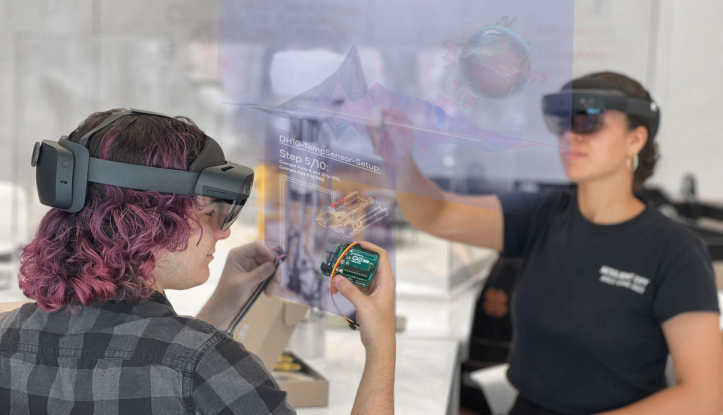
Figure 1: AEC students using an early prototype ALERT to navigate one of the Applied Learning Modules focused on outdoor air pollution monitoring. This lesson guides the students to assemble a temperature sensing kit composed of an Arduino microcon- troller with a temperature and humidity sensor. The same sensing kit is then utilized in the Exploratory Data Analysis Module for immersive data visualizations. The students are wearing HoloLens 2 headsets, which allow them to see the AR content overlaid on the real world objects.
CONCLUSION
The ALERT project, still in its developmental phase, signifies a transforma- tive trajectory in environmental robotics education within the AEC sectors. Grounded by four foundational objectives, the initiative aspires to innovate a distinctive environmental robotics curriculum that revolutionizes learner interaction and information perception. It also endeavors to construct an avant-garde system dedicated to closely tracking both learner biometrics and performance metrics. This not only deepens engagement within the AR- driven curriculum but also enriches learning experiences. Additionally, the project champions the development of AI algorithms that skillfully glean, analyze, and refine diverse learner performance data, enabling educators and learners to delve deeper into the multifaceted dimensions of the learning process. To ensure the system’s ongoing effectiveness and relevance, regular assessments of the learning outcomes will be integral to the ALERT platform’s evolution.
This harmonious marriage of AR and AI, steeped in the principles of Con- structivist pedagogy, guarantees a paradigm shift in learning—from being a passive recipient to an active participant in a rich, immersive educational tapestry. With the Intelligent Learning System (ILS) at its core, ALERT offers not just tailored learning pathways built on real-time data but also meticulous, bespoke feedback mechanisms.
While envisioned as a linchpin in the educational framework of the AEC industries, the spectrum of ALERT’s potential is vast. It reaches
Augmented Learning for Environmental Robotics Technologies (ALERT) 85
beyond redefining educational methodologies to democratizing environmen- tal robotics education. By making this field more accessible and affordable, ALERT lays the groundwork for preparing a broader spectrum of learners for a plethora of roles within the AEC realm—ranging from construction to engineering and architecture. Through its ambitious undertakings, ALERT not only propels the AEC sectors towards their sustainability goals but also stands as a testament to the future possibilities of integrating technology and education.
However, with innovation come challenges. The potential pitfalls of the ALERT platform include the issues of technological accessibility. High-end devices and stable internet, fundamental for a seamless AR experience, might remain out of reach for learners in technologically limited areas, inad- vertently widening the educational divide. Transitioning from age-old to tech-augmented teaching methodologies might also face skepticism or resis- tance from certain educational stakeholders. Moreover, while data plays an instrumental role in tailoring educational experiences, its collection and storage usher in concerns about data privacy and security. Overreliance on technology poses another challenge—there’s a genuine risk that learners might gravitate away from essential skills and critical thinking, becoming overly reliant on tech aids. Additionally, the sizable initial capital required to set up such an expansive system might be a deterrent for smaller educational institutions contemplating its adoption.
Navigating ahead, our roadmap for ALERT emphasizes user testing. Solic- iting feedback from a diverse set of learners and educators is paramount. Given the inherent complexity of environmental subjects, this feedback becomes invaluable—not only for refining the platform’s nuances but also for enhancing its educational depth and breadth. Embracing an iterative model rooted in real-world feedback ensures the continuous evolution of ALERT. By doing so, we aim to deliver a platform that resonates profoundly with its users, adeptly addressing the multifarious challenges and intricacies of environmental education.
ACKNOWLEDGMENT
This material is based upon work supported by the National Science Foun- dation (NSF) Award No. 2315647: Improving Undergraduate STEM Edu- cation program, and NSF Award No. 2202610: Research on Emerging Technologies for Teaching and Learning program. Any opinions, findings, and conclusions or rec-ommendations expressed in this material are those of the authors and do not nec-essarily reflect the views of the National Science Foundation.
REFERENCES
Alcantara, T., & Calvo, H. (2022). Exploratory Data Analysis for the Automatic Detection of Question Paraphrasing in Collaborative Environments. In the Mex- ican International Conference on Artificial Intelligence (pp. 193–211). Springer, Cham.
Azuma, R., Billinghurst, M., & Klinker, G. (2011). Special Section on Mobile Augmented Reality. Computers & Graphics, 35(4), vii–viii. Billinghurst, M., & Duenser, A. (2012). Augmented Reality in the Classroom.
Computer, 45(7), 56–63. Bogosian, B., Bobadilla, L., Alonso, M., Elias, A., Perez, G., Alhaffar, H., & Vassigh, S. (2020, March). Work in Progress: Towards an Immersive Robotics Training for the Future of Architecture, Engineering, and Construction Workforce. In 2020 IEEE World Conference on Engineering Education (EDUNINE) (pp. 1–4). IEEE. Cavallo, M., Dolakia, M., Havlena, M., Ocheltree, K., & Podlaseck, M. (2019,
November). Immersive Insights: A Hybrid Analytics System for Collaborative Exploratory Data Analysis. In 25th ACM Symposium on Virtual Reality Software and Technology (pp. 1–12). Carmigniani, J., Furht, B., Anisetti, M., Ceravolo, P., Damiani, E., & Ivkovic, M.
(2011). Augmented Reality Technologies, Systems and Applications. Multimedia tools and applications, 51, 341–377. Chiang, T. H., Yang, S. J., & Hwang, G. J. (2014). An Augmented Reality-based Mobile Learning System to Improve Students’ Learning Achievements and Moti- vations in Natural Science Inquiry Activities. Journal of Educational Technology & Society, 17(4), 352–365. Chen, J. and Hu, J., 2018. Enhancing L2 learners’ Critical Thinking Skills through a
Connectivism-based Intelligent Learning System. International Journal of English Linguistics, 8(6), pp. 12–21. Fosnot, C. T., & Perry, R. S. (1996). Constructivism: A Psychological Theory of Learning. Constructivism: Theory, Perspectives, and Practice, 2, 8–33. Garzón, J., Baldiris, S., Gutiérrez, J., & Pavón, J. (2020). How Do Pedagog-
ical Approaches Affect the Impact of Augmented Reality on Education? A Meta-analysis and Research Synthesis. Educational Research Review, 31, 100334. Goldblatt, D. L. (2006). Sustainable Energy Consumption and Society: Personal, Technological, or Social Change? (Vol. 7). Springer Science & Business Media. Golparvar-Fard, M., Pena-Mora, F., & Savarese, S. (2015). Automated Progress
Monitoring Using Unordered Daily Construction Photographs and IFC-based Building Information Models. Journal of Computing in Civil Engineering, 29(1), 04014025. Herbert, B., Baghaei, N., Billinghurst, M., & Wigley, G. (2021). A Distributed Augmented Reality Training Architecture for Distributed Cognitive Intelligent Tutoring Paradigms. Herbert, B., Ens, B., Weerasinghe, A., Billinghurst, M., & Wigley, G. (2018).
Design Considerations for Combining Augmented Reality with Intelligent Tutors. Computers & Graphics, 77, 166–182. Jonassen, D. H. (1991). Objectivism Versus Constructivism: Do We Need a New Philosophical Paradigm? Educational Technology Research and Development, 39(3), 5–14. Karahan, E., & Roehrig, G. (2015). Constructing Media Artifacts in a Social
Constructivist Environment to Enhance Students’ Environmental Awareness and Activism. Journal of Science Education and Technology, 24, 103–118. Klopfer, E., & Squire, K. (2008). Environmental Detectives—The Development of an Augmented Reality Platform for Environmental Simulations. Educational Technology Research and Development, 56, 203-228. Khan, T., Johnston, K., & Ophoff, J. (2019). The Impact of an Augmented Reality
Application on Learning Motivation of Students. Advances in Human-Computer Interaction, 2019.
Augmented Learning for Environmental Robotics Technologies (ALERT) 87
Lewis, L. H., & Williams, C. J. (1994). Experiential Learning: Past and Present. New Directions for Adult and Continuing Education, 1994(62), 5–16. Mainetti, L., Paiano, R., Pasanisi, S., & Vergallo, R. (2016, June). Modeling of
Complex Taxonomy: A Framework for Schema-Driven Exploratory Portal. In the International Conference on Augmented Reality, Virtual Reality and Computer Graphics (pp. 150–161). Springer, Cham. Ma, W., Adesope, O. O., Nesbit, J. C., & Liu, Q. (2014). Intelligent Tutoring Systems and Learning Outcomes: A Meta-Analysis. Journal of Educational Psychology, 106(4), 901. McKinsey Global Institute (2017). Reinventing Construction: A Route to Higher
Productivity. New York: McKinsey Quarterly (February). Nwana, H. S. (1990). Intelligent Tutoring Systems: An Overview. Artificial Intelligence Review, 4(4), 251–277. Piaget, J. (2003). The Psychology of Intelligence. Routledge. Robertson, A. (1994). Toward Constructivist Research in Environmental Education.
The Journal of Environmental Education, 25(2), 21–31. Stern, M. J., Powell, R. B., & Ardoin, N. M. (2010). Evaluating a Constructivist and Culturally Responsive Approach to Environmental Education for Diverse Audiences. The Journal of Environmental Education, 42(2), 109–122. Sommerauer, P., & Müller, O. (2018, June). Augmented Reality for Teaching and
Learning-a Literature Review on Theoretical and Empirical Foundations. In ECIS (p. 31). Tukey, J. W. (1977). Exploratory Data Analysis (Vol. 2, pp. 131–160). Vassigh, S., Elias, A., Ortega, F. R., Davis, D., Gallardo, G., Alhaffar, H.,... & Rishe, N. D. (2016, September). Integrating Building Information Modeling with Augmented Reality for Interdisciplinary Learning. In 2016 IEEE International Symposium on Mixed and Augmented Reality (ISMAR-Adjunct) (pp.260–261). Wright, J. M. (2008). The Comparative Effects of Constructivist versus Traditional
Teaching Methods on the Environmental Literacy of Postsecondary Non Science Majors. Bulletin of Science, Technology & Society, 28(4), 324–337. Xiao, B., Chen, C., & Yin, X. (2022). Recent Advancements of Robotics in Construction. Automation in Construction, 144, 104591. Yannier, N., Hudson, S. E., & Koedinger, K. R. (2020). Active Learning is About
More Than Hands-On: A Mixed-Reality AI System to Support STEM Education. International Journal of Artificial Intelligence in Education, 30, 74–96.
LISTED IN THE AHFE DIGITAL BOOKSTORE CATALOGUE
Explore the complete digital volume
Emerging Technologies and Future of Work
Read this individual research paper free through the original publisher, or explore the full digital proceedings book.
ISBN 978-1-958651-93-3
Explore this ISBN in the AHFE Bookstore ↗Listed in the July 2026 bookstore catalogue; search by ISBN to confirm current availability · Digital book purchase optional