Jian Liu (2022). Project-based Learning Method Applied in College English Teaching: Case Study of an Instructional Design. In: Training, Education, and Learning Sciences. AHFE Open Access, vol. 59, pp. 166–171. https://doi.org/10.54941/ahfe1002397
The development of information technology pushes forward the change of the teaching model. In general, the instructional design is becoming student-centered. In China, in college English class, more emphases are put on fostering students' language output ability. Therefore, PBL (Project-based Learning) is becoming increasingly popular, and BOPPPS (Bridge-in, Objective/Outcome, Pre-assessment, Participatory Learning, Post-assessment, Summary) mode is adopted by a growing number of English teachers. This paper tries to illustrate the application of PBL into college English class by studying an instructional design.
INTRODUCTION AND OVERVIEW College English is a basic and compulsory course of the general education curriculum in China’s universities and colleges. The overall objective of this course is to cultivate students’ comprehensive ability of using English in order to communicate effectively in the workplace. However, the reality of English teaching and learning in vocational colleges remains that it is exam-oriented and students’ English language communicative ability cannot meet the needs of their work and social life. To solve the difficulties and problems, project- based curriculum teaching reform is put forward in many vocational colleges.
Definition and Theoratical Basis According to Buck Institute for Education, project-based learning is a syste- matic method which helps students acquire knowledge and skills through supervising and urging students to research and explore complex and real problems, as well as complete well-designed tasks (Thomas, Mergendoller and Michaelson, 1999). Moursund thinks that project-based learning is a process of cognition and metacognition which requires learning by doing and doing by learning (Moursund, 1999). Duffy and Jonassen reckon that project-based learning is a teaching method of constructivism which aims to encourage students to take part in learning more actively (Duffy and Jonassen, 1992). Yan holds that project-based learning is a student-centered instructional approach that students can obtain knowledge and skills through
Project-Based Learning Method Applied in College English Teaching 167
a series of individual or cooperative tasks with the help of teachers and studying companions. Furthermore, she points out that this instructional mode is supported by both the theory of constructivism and interactionism of the sociocultural theory (Yan, 2010). To be more specific, the theory of constructivism emphasizes the internalization of learning experiences and fee- lings that students are expected to actively reconstruct their own knowledge systems instead of passively accepting knowledge. According to the sociocul- tural theory, language teaching is not only about learning a language, but also should expand students’ social potentials to let them recognize their identi- ties, beliefs and values, bring them a sense of pride and promote their social development (Yan, 2008).
To sum up, the characteristics of project-based learning are as follows: it stresses situational language teaching, cooperation, conversation and mea- ning construction; it focuses on cultivating students’ problem-solving ability; it emphasizes discovery learning; it is student-centered with the teacher pla- ying a leading and supervising role (Shao-li, 2018). It can be concluded that project-based learning can stimulate students’ learning motivation and inte- rest, cultivate students’ capacities for problem analyzing and solving, as well as critical thinking, and improve their language application ability. Therefore, it seems to be an excellent solution to the problems troubling college English teaching and learning.
APPLICATION OF PBL INTO COLLEGE ENGLISH TEACHING According to Yan, the implementation process can be divided into six steps: select a project; work out a plan; implement the project; summarize achieve- ments; communicate results; evaluate the project (Yan, 2010). In light of this process, a case study will be analyzed to illustrate the application of PBL to College English teaching.
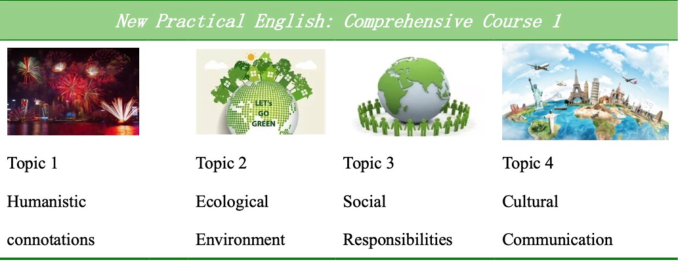
Preparation New Practical English: Comprehensive Course 1 published by Higher Edu- cation Press has been chosen as the textbook for the fall semester of the freshman year in our college. From Qiufang’s point of view, the use of teach- ing materials can be briefly concluded as selecting, reordering, revising and supplementing (Qiufang, 2017). Thus, the eight units in the textbook has been reordered and classified as four topics (see Figure 1). This paper will take the reading course of unit 5 What a Fine Day! from topic 2 as an exam- ple, and the title of the reading passage is Facing the Global Climate: We Can Make a Difference.
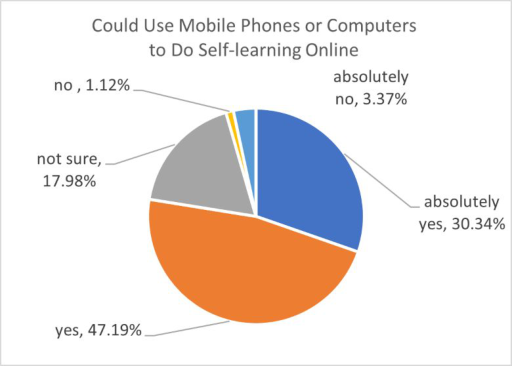
Moreover, questionnaires have been handed out to analyze students’ habits and English learning conditions and the results are as follows: grown up in the information age, students are interested in various new information tech- nology and possess fairly good IT skills and learning abilities. They could do well in the operation of mobile phones and computers that they can search for useful information through webpages, mini programs, and other teaching and learning platforms (see Figure 2). Therefore, they can quickly adapt to the instructional modes of online learning and blended learning. However,
168 Liu
Figure 1: Teaching content.Figure 2: Questionnaire result about students’ learning habits.
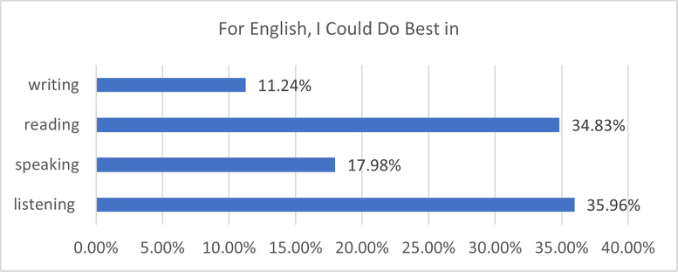
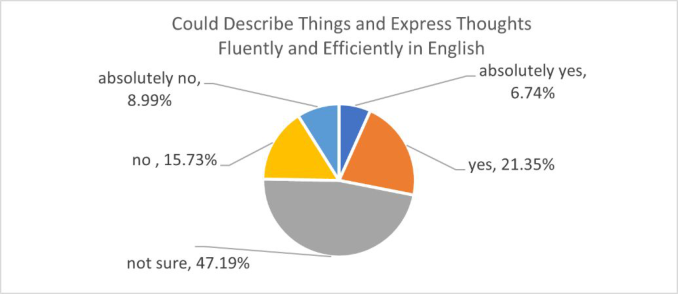
most of them can not apply what they have learned into practice. They lack confidence in writing and speaking, which further affects the quality of their “output” work (see Figure 3 and 4).
Based on the teaching content and the analysis of students, learning objecti- ves have been worked out. For knowledge objectives, students are to master the words, phrases and sentence structures to describe climate change, and learn the causes and effects of climate change and measures to cope with it. For ability objectives, students are to understand the structure and mea- ning of the reading passage and be able to retell the whole passage according to the hints of subheadings. Moreover, they are expected to use what they have learned to describe an environmental issue and its solutions. For quality objectives, students are to raise their environmental awareness and shape the thought of human community with a shared future.
Implemention The reading course is divided into three parts: pre-class, in-class and post- class. BOPPPS mode is adopted in class (90 minutes in total), emphasizing
Project-Based Learning Method Applied in College English Teaching 169
Figure 3: Questionnaire result about students’ evaluation of their English language ability.Figure 4: Questionnaire result about students’ evaluation of their English application ability.
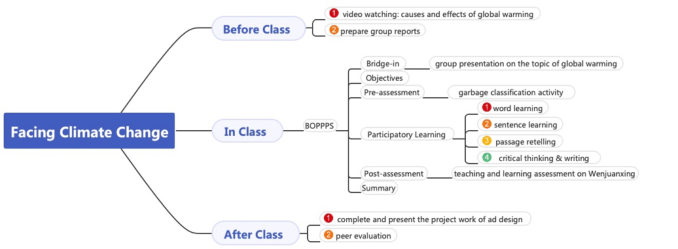
students’ participation and task output. Specifically, before class, students are required to watch two video clips from NASA about the causes and effe- cts of global warming, and prepare group reports, which will be presented in the bridge-in stage. Being the supplementary material, the video clips help students have a better and more complete understanding of the subject of the text- global warming. By converting what they have learned (input) into group reports (output), students can internalize the knowledge. The garbage classification activity in the pre-assessment step helps students warm up and get ready to learn. The most important part “participatory learning” is divi- ded into four components. Input is for the completion of output tasks, and thus input materials are the means and tools of output production (Qiufang, 2017). Therefore, a series of activities include learning from words, sente- nces and the whole passage to the writing task, constructing scaffolding of language usage, internalization and application. To illustrate in detail, in the critical thinking step, students are asked to discuss within groups about the effects that their majors or future work may bring to the environment and the according solutions. Then, by simulating the writing strategies of the text,
170 Liu
Figure 5: Mind map of the teaching process.
students write their own paragraphs and upload them to Pigai writing web- site. In the post-assessment part, students are asked to complete the teaching and learning evaluation on Wenjuanxing platform. By doing this, they can realize how much and how well they have learned. In the end, the teacher makes comments on students’ writing and summarizes the main and difficult points of this class. After class, students are expected to revise and polish their writing according the advice from Pigai web and the teacher, and then complete the group project work of designing public service advertisements based on the writing they have done. The integration of writing and ad design not only improves the beauty of practical writing, but also improves stu- dents’ enthusiasm for creation. After completing and presenting their project work, students are required to evaluate their group work mutually. Through these post-class activities, students can consolidate what they have learned. The student-centered pattern, progressive teaching and exploratory learning methods facilitate the completion of teaching objectives. The whole teaching process can be seen clearly through the mind map (see Figure 5).
In summary, the instructional design is progressive and interlocking, which can also be divided into three stages: motivating stage, enabling stage and assessing stage. The motivating stage includes bridge-in, objectives and pre- assessment. In this stage, the teacher helps students familiarize with the objectives and background information, assigns groupwork, and stimulates students’ minds and interest. The aim of the second stage is to facilitate the completion of the project work. Therefore, teaching activities begin from the input of words, sentences and structures, followed by critical thinking and writing, all of which enable students to accomplish the final project work- ad design. During the assessing stage, the evaluation methods are diversified, combining explicit and implicit assessment. In addition to the use of Pigai website, peer assessment, and teacher’s assessment, students are also asked to self-assess their assignments in order to promote reflection and personalized learning.
CONCLUSION
PBL is based on the theory of constructivism and the sociocultural theory. Through involving in teaching activities such as group discussion, problem
Project-Based Learning Method Applied in College English Teaching 171
solving, etc. students’ cognitive ability, autonomous learning ability, and cre- ative and teamwork spirit have been promoted. To some extent, this method enhances students’ language competence and improves their overall quality, solving the difficulties and problems in College English teaching. However, any PBL instructional design requires students to acquire certain knowledge and skills which would considerably influence the effect of class teaching. It also raises challenges to teachers that they have to change their roles in class. Teachers need to improve their professional quality and skills in order to design various projects and carry out effective teaching activities. By and large, PBL brings vitality to college English class and inevitably becomes the direction of English teaching reform.
REFERENCES
Duffy, T. M., Jonassen, D. H. (1992), Constructivism and the Technology of Instruction: A Conversation. New Jersey: Lawrence Erlbaum Assoc. Inc. Moursund, D. (1999), Project-based Learning Using Information Technology.
Eugene, OR: ISTE. Qiufang, Wen. (2017), “Evaluating the attainment of productive objectives through the use of POA teaching materials.” Foreign Language Education in China (Quarterly), 10(2), 17–23. Shao-li, Liu. (2018), “The Application of PBL into College English Teaching- Taking
New Framework College English as an Example.” Journal of Shaoguan University Education Science, 39(2), 38–42. Thomas, J. W., Mergendoller, J. R., Michaelson, A. (1999), Project-based learning: a handbook for middle and high school teachers. CA: The Buck Institute for Education. Yan, Gao. (2008), “Discussion of the Mediating Effect of Language Teachers in Light
of the Sociocultural Theory.” Foreign Language Learning Theory and Practice, 3, 93–96. Yan, Gao. (2010), “Research of PBL Implementation in College English Teaching.”Foreign Language World, 6, 42–48.
LISTED IN THE AHFE DIGITAL BOOKSTORE CATALOGUE
Explore the complete digital volume
Training, Education, and Learning Sciences
Read this individual research paper free through the original publisher, or explore the full digital proceedings book.
ISBN 978-1-958651-35-3
Explore this ISBN in the AHFE Bookstore ↗Listed in the July 2026 bookstore catalogue; search by ISBN to confirm current availability · Digital book purchase optional