Krystal Cachola, Kim-Phuong L. Vu (2024). Investigating the Use of Chatbots as an Educational Tool. In: Human Factors in Design, Engineering, and Computing. AHFE Open Access, vol. 159, pp. 1849–1859. https://doi.org/10.54941/ahfe1005752
With the rise of online asynchronous learning and low levels of instructor presence, students have become self-regulated learners who must monitor their performance and adapt their learning strategies as necessary. Previous studies have shown that chatbots are a promising alternative to traditional study tools such as flashcards. This study examined the effects of a chatbot’s embodiment (Humanoid, Animated) and conversational style (Formal, Informal) on learning performance and behavioral engagement. Participants were asked to watch a lecture video and interact with a chatbot to review the material. After studying with the chatbot, participants completed a quiz that was evenly split according to difficulty (easy versus hard questions), as well as study type (questions that were and were not studied with the chatbot). Participants’ ratings of usability, usefulness, ease of use, and affective engagement were obtained. Results showed that participants performed better on easy questions than hard questions. Additionally, participants performed better on studied questions than non-studied questions. However, for the informal conversational style, participants scored higher on hard questions than easy questions amongst studied questions. Embodiment and conversational style had no impact on behavioral engagement. Overall, participants rated the chatbot above average in terms of its usability, usefulness, ease of use, and affective engagement. We conclude that chatbots are an effective study tool, but they may be better suited for learning easy, surface-level knowledge. Additionally, an informal conversational style may be preferred since it matches the linguistic features used by human tutors. Limitations and future directions for research are discussed.
A conversational agent, also known as a chatbot, is an entity with some degree of intelligence in certain domains and has the capability of using natural language to engage with its users (Allouch et al., 2021). This natural language processing is commonly implemented using artificial intelligence (AI), which enables chatbots to carry anthropomorphic traits, that is, having human-like characteristics. In human-chatbot interactions, anthropomorphism is an effective approach to drive perceptions of social presence (Thomaz et al., 2019). In chatbots, design elements such as names, profile pictures, emoticons, or human-like linguistic markers are used to create social cues. Creating social presence can increase the user’s trust,
enjoyment, and perceived usefulness of the chatbot (Hassanein & Head, 2007). The present study examined the effect of a chatbot’s embodiment and conversational tone when used for educational purposes.
With the rise of online asynchronous learning, students have become autonomous and self-regulated learners (Cho & Shen, 2013). Rather than having feedback from an instructor to help guide students through the learning process, self-regulated learners must plan their study goals, monitor their performance, and reflect on their performance to guide their study behavior (i.e., if they should continue studying or if they have mastered the material). Flashcards are a common tool used during self-regulated learning in which the student visualizes the answer and checks them for correctness. However, studying with flashcards can be monotonous, making its effectiveness dependent on the student’s motivation to learn (Senzaki et al., 2017). Integrating chatbots in the e-learning environment as a self-regulated study tool is a promising alternative to flashcards. Chatbots have already been implemented in many different learning settings (see, e.g., Yildiz, 2023; Lee & Yeo, 2022). Educational chatbots commonly utilize a question-and- answer system similar to flashcards, but are designed to provide continuous feedback. This makes it easier for students to monitor and reflect on their performance since the chatbot can assess students’ study behaviors and keep track of their progress (Colace et al., 2018). Additionally, chatbots provide opportunity for students to engage cognitively during both sides of its two- way dialogue system. First, students must think about the answer they will give to the chatbot and, second, they must also analyze the chatbot’s response and evaluate their performance based on the feedback given. This increase in cognitive engagement makes the student more involved with the information presented, which can increase learning (Michelene & Wylie, 2014).
Embodiment One method that designers use to convey a sense of anthropomorphism and social presence in AI is by creating an embodiment of that agent (e.g., use an avatar) to give the agent a tangible or visual form (Cassell, 2000). The goal is to maintain a clear distinction between the human and machine while creating a sense of social presence. For example, using an avatar for online customer service increases perceptions of social presence and personality, which in turn increases customer satisfaction (Verhagen et al., 2014). In the context of education, embodied educational chatbots utilize the persona effect in which the presence of a lifelike character is used in an interactive learning environment. Even if the chatbot is not expressive, it has a strong positive effect on the student’s perception of their learning experience (Lester et al., 1997).
An embodied chatbot can pose as a peer that makes the learning experience engaging which in turn increases a student’s motivation to stay active and achieve more learning goals (Dehn & van Mulken, 2000). The two general visual styles of embodied chatbots are humanoid or animated (Cassell et al., 2000). Humanoid chatbots may be preferred because a human picture is familiar, therefore facilitating the sense of social presence. Heller et al. (2005)
Investigating the Use of Chatbots as an Educational Tool 1851
found that the use of Sigmund Freud as an embodiment made the learning experience more enjoyable as participants felt they were actually interacting with the real person. Designers of educational chatbots may prefer to use an animated embodiment, especially for younger audiences who tend to be attracted to fun and cartoonish characters. Additionally, nonhuman animated avatars may be rated as more likable and enjoyable since they create a sense of being a virtual companion rather than a virtual teacher (Gulz & Haake, 2006). Although embodiment can improve the overall experience of the learning interaction, there is debate as to whether embodiment influences task performance. Moreno et al. (2001) found that college students who learned with an embodied agent were able to transfer their knowledge to solve new problems better than those who learned without an embodied agent. The same study also found no differences in performance between a nonhuman agent and a human agent. Atkinson (2002) found that interacting with an embodied agent improved participant’s accuracy on practice problems and lowered their perceived difficulty of the task. However, the studies conducted by Moreno et al. (2001) and Atkinson (2002) implemented their agents in interactive virtual environments similar to online learning games. These virtual environments contained elements such as images and sound that could engage the user. Since chatbots are text-only interfaces, further research is needed to determine if these embodied effects are also present in less interactive interfaces.
Conversational Style The implementation of natural language processing and AI in chatbots originated from a desire to stray away from impersonal machine-like language and more towards human-like communication styles. However, there are many nuances to human language, including its tone of voice. This tone can range from being formal, which uses concise and articulate language, to being informal, which uses casual and emotive language (Sheikha & Inkpen, 2011). Determining which conversational style is better suited for chatbots is dependent upon the overall goal of the chatbot, the context in which it will be used, and the expected identity of the chatbot. For example, e-commerce brands may prefer to use an informal chatbot to improve continued chatbot use and overall brand perception (Li & Wang, 2023). However, a formal conversational style is preferred for a chatbot that requests sensitive medical history because it is perceived as more appropriate and competent (Cox & Ooi, 2022).
The purpose of the chatbot used in the present study was to assume the role of a human tutor or instructor, whose dialogue produce feedback statements to encourage their students to improve their answers (Graesser et al., 2014). This feedback is relatively informal, ranging from positive (e.g., “Very good”, a thumbs up, a smile) to negative (e.g., “Not quite”, a head shake, a frown) statements. Therefore, an informal chatbot may be appropriate for use by human tutors. Determining which conversational style is better suited for educational chatbots can also be influenced by the tradeoff between learning performance and engagement. Li and Graesser (2017) investigated
1852 Cachola and Vu
the impact of conversational formality on learning and engagement by having participants learn summarization strategies with either a formal or informal chatbot. Participants who interacted with the informal agent had higher learning performance which can be attributed to the informal language being easier to understand than the formal language. However, interacting with the informal agent also led to higher reports of mind-wandering, which was indicative of lower behavioral engagement. This implies that instructors should consider whether to prioritize performance or engagement when deciding between a formal or informal chatbot.
In general, previous research on educational chatbots has established their positive effect on the learning experience compared to traditional learning methods. The goal of the present study was to focus on two specific anthropomorphic features, embodiment and conversational style, and their influence on learning performance and engagement. The first hypothesis was that learning performance will be higher for questions that were studied with the chatbot compared to those that were not. This hypothesis is based on the fact that the chatbot’s question-and-answer format supports the retrieval of information from memory, thus demonstrating the testing effect (Roediger & Karpicke, 2006). The second hypothesis was that participants will exhibit increased behavioral and affective engagement with the animated chatbot compared to the humanoid chatbot, as the animated agent will be perceived as a companion and more preferred (Gulz & Haake, 2006). Finally, it was hypothesized that participants would perform better with the informal chatbot, according to register theory as well as Li and Graesser’s (2017) findings.
METHODS
The methods used in the current study were reviewed and approved by the Institutional Review Board (IRB) at California State University, Long Beach (CSULB).
Participants The sample of participants in this study consisted of 62 students recruited through the CSULB’s Psychology Department Subject Pool. Participants ranged from 18 to 30 years of age (M = 19.65, SE = 2.42), with forty-nine female (79%) and thirteen male (21%) participants, and over half identifying as Latino or Hispanic (58%). All but 4 participants reported taking online courses previously.
Materials
This study was conducted through the Qualtrics platform as an online survey. The survey included an instructional video, a link to the chatbot, quiz questions, and three questionnaires. The instructional video was a 16-minute clip of a lecture on theories of attention in cognitive psychology. Standard playback functions such as rewinding and pausing were available. The quiz consisted of 20 multiple-choice questions related to the video. The quiz was evenly split between easy and difficult questions, in which they were designed according to De Jong & Ferguson-Hessler’s (1996) distinction
Investigating the Use of Chatbots as an Educational Tool 1853
between surface and deep-level knowledge. For the questionnaires, a 10- item System Usability Scale (SUS) was employed to measure usability of the chatbot (Lewis, 2018). A 8-item Usefulness and Ease of Use measure adopted from Hew et al. (2023) was used to measure perceived usefulness in achieving learning goals and practicality. A 4-item Engagement measure adopted from Benotti et al. (2014) was used to assess participants’ affective engagement.
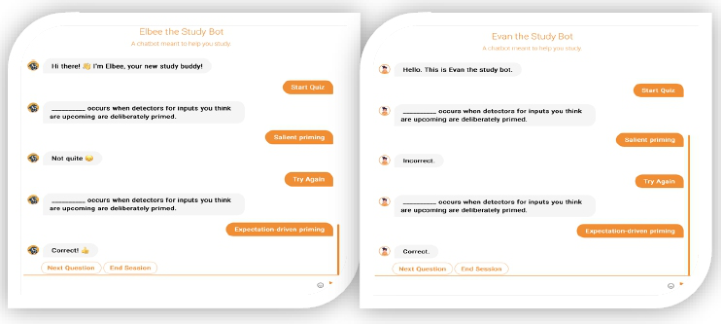
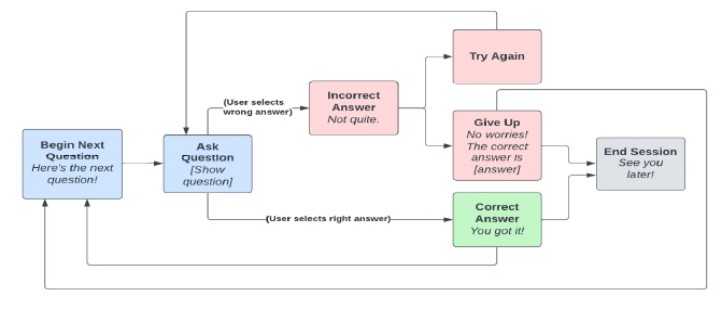
The chatbot was designed using BotPenguin (BotPenguin, n.d.). The chatbot was hosted on a standalone web page, as shown in Figure 1. Figure 2 illustrates the interaction between the user and the chatbot. The chatbot reviewed 10 (5 easy, 5 hard) quiz questions. The conversational elements proposed by Gretry et al. (2017) were used to design the informal and formal chatbot. The informal chatbot utilized first-person language that was casual and contained emotive cues such as emoticons and sound mimicking (e.g., “Woohoo”, “Hmmm”). The formal chatbot utilized third-person language that was concise and articulate. The images chosen to embody the chatbot are shown in Figure 3.
Figure 1: Depiction of the chatbot interface (Left: animated/informal; Right: humanoid/formal).Figure 2: Flowchart depicting the interaction between the user and the chatbot.
Design The present study utilized a 2 (Conversational Style: Formal/ Informal) x 2 (Embodiment: Humanoid/ Animated) x 2 (Study Type: Studied/ Not Studied) x 2 (Difficulty: Easy/Hard) mixed design, with Conversational Style and Embodiment as between-participants factors and Study Type and Difficulty as the within-participant factors. The main dependent measure was accuracy on the quiz questions. Other dependent measures included behavioral engagement based on the amount of time spent using the tool, perceived usability scores (SUS), ratings of perceived usefulness, ease of use, and affective engagement.
Procedure Participants were provided with a link to the survey on Qualtrics. The first page was the informed consent form, followed by a demographic questionnaire. Participants then watched the lecture video and were instructed to avoid taking notes on the side. After watching the video, participants clicked a link that redirected them to the chatbot. A guide on how to use the chatbot was presented. After the participants completed interactions with the chatbot, they returned to the Qualtrics survey to complete the quiz and the three subjective questionnaires. Across all conditions, participants spent an average time of 6.45 minutes using the chatbot, with no significant differences between conditions. Overall study completion time averaged 29.81 minutes.
RESULTS
Task Performance Quiz scores were calculated as the percentage of correct responses separately for easy and difficult questions and whether they were studied with the chatbot or not. Quiz scores were submitted to a 2 (Conversational Style: Formal/ Informal) x 2 (Embodiment: Humanoid/Animated) x 2 (Study Type: Studied/ Not Studied) x 2 (Difficulty: Easy/Hard) mixed ANOVA, with Conversational Style and Embodiment as between-participants factors and Study Type and Difficulty as the within-participant factors. There was a significant main effect for Study Type, F(1,58) = 67.73, p <.001,
Investigating the Use of Chatbots as an Educational Tool 1855
where participants scored significantly higher on the questions that were studied (M = 67.55, SE = 3.71) than those that were not studied (M = 39.14, SE = 2.58). The main effect for Difficulty was also significant, F(1,58) = 8.52, p = .01, where participants scored significantly higher on easy questions (M = 56.93, SE = 3.33) compared to hard questions (M = 49.77, SE = 2.53). For Conversational Style, there was a trend towards higher performance with informal (M = 58.51, SE = 3.81) than formal style (M = 48.19, SE = 3.80).
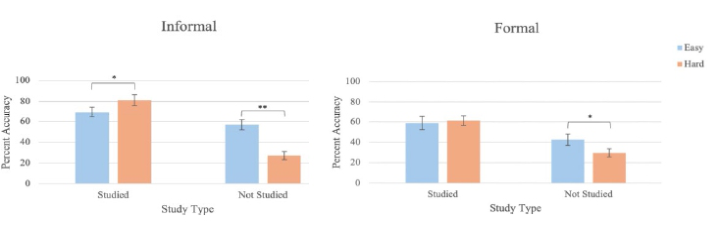
There was a significant 2-way interaction between Study Type and Difficulty, F(1,58) = 47.06, p <.001. This 2-way interaction was qualified by a significant 3-way interaction between Study Type, Difficulty, and Conversational Style, F(1,58) = 10.14, p = .002. Test of simple effects showed that the 2-way interaction of Study Type and Difficulty was present for both the informal, F(1,30) = 94.67, p <.001, and formal, F(1,30) = 4.75, p = .04, conversational style. However, for the informal conversational style, participants scored significantly higher on the hard questions (M = 81.29, SE = 4.81) than easy questions (M = 69.68, SE = 5.07) amongst studied questions, p = .002, while they scored significantly higher on the easy questions (M = 56.77, SE = 5.17) compared to the hard questions (M = 27.1, SE = 3.99) amongst non-studied questions, p <.001, see Figure 4. For the formal conversation style, participants scored similarly on hard questions (M = 61.29, SE = 5.56) and easy questions (M = 58.71, SE = 6.49) amongst studied questions, p =.55, but they scored significantly higher on easy questions (M = 42.58, SE = 4.52) than hard questions (M = 29.68, SE = 4.03) amongst non-studied questions, p = .02, see Figure 4. No other effects were significant.
Figure 4: Effect of conversation style, study type, and difficulty on performance. Note: Error bars represent standard error. * p <.05, ** p <.001.
Subjective Ratings A 2 (Conversational Style) x 2 (Embodiment) between-subjects ANOVA was conducted on SUS scores (usability), ratings of usefulness, ease of use and affective engagement. The ANOVAs yielded no significant effects. Thus, one-sample t-tests were conducted to examine whether subjective ratings were above a specific test value. SUS scores across both conditions (M = 75.89, SD = 17.11) were significantly higher than the test value of 68.0,
1856 Cachola and Vu
the acceptable usability threshold (Brooke, 2013), t(61) = 3.63, p <.001. Usefulness (M = 3.64, SD = .93) scores were significantly higher than the test value of 3.0, t(61) = 5.40, p <.001, but not higher than a test value of 3.5, t(61) = 1.31, p = .10. Ease of Use ratings (M = 4.04, SD = .87) were significantly higher than a test value of 3.5, t(61) = 4.91, p <.001. Affective Engagement ratings (M = 3.90, SD = .75) were significantly higher than a test value of 3.5, t(61) = 4.22, p <.001.
DISCUSSION
The present study sought to determine if the embodiment or conversational style of a chatbot impacted learning performance. The prediction that studying with the chatbot would have greater learning performance was supported by the finding that participants scored higher on the questions that were studied with the chatbot than non-studied questions. This implies that the chatbot was effective in helping the participants learn the material through practicing the retrieval of information. Additionally, in the instance of an incorrect answer, a majority of participants (96%) selected “Try Again” at least once. This demonstrates that immediate informative feedback from the chatbot allowed for participants to monitor their own performance and adjust their study behavior as necessary.
In terms of quiz performance, the results showed that participants scored higher on easy than hard questions. Because the chatbot had a question-and- answer format similar to flashcards, better performance on easy questions is consistent with previous research claiming that flashcards can facilitate repetitive learning, which is only a surface level of processing (Brown et al., 2014). Additionally, the chatbot utilized multiple-choice answers which only requires recognition rather than the recall of information. Multiple-choice quizzes usually show better performance for surface-level learning (Scouller, 1998). The second hypothesis was not supported. It was predicted that behavioral and affective engagement will be higher for the animated than humanoid chatbot. However, results did not show differences in chatbot usage time and perceived affective engagement scores between the animated and humanoid chatbot. This lack of an effect may be due to the fact that the use of a static image for the chatbot may have not been sufficient to create a sense of social presence. Embodiment also was shown to have no effect on learning performance, which is consistent with previous literature finding no difference in task performance when participants were exposed to nonhuman versus human-like agents (Moreno et al., 2001).
Lastly, it was predicted that participants’ learning performance would be better for the informal than formal chatbot. Although there was no significant difference in quiz scores between the formal and informal chatbot, the results showed a trend towards higher scores with the informal conversational style than formal conversational style. Additionally, participants scored higher on hard questions amongst the questions that were studied with the informal chatbot. These results are consistent with previous research showing that informal language can lead to higher learning performance (Li & Graesser, 2017).
Investigating the Use of Chatbots as an Educational Tool 1857
Limitations There were a few limitations to this study. First, a convenience sample was used and may not be representative of all online learners. Second, the use of self-report surveys to measure usability and engagement may not have reflected actual user behaviors. Finally, the short duration of the study may not have been sufficient to observe significant impacts to learning performance or engagement. To overcome these limitations, future studies should include a better representation of all online learners, collect behavioral measures of usability and engagement, such as interaction frequency and retention rate, and consider the effectiveness of chatbots for learning different topics, as well as their long-term engagement effects.
Conclusion and Implications for Design The present study showed that the chatbot improved learning performance, although this study method may be better suited for learning easy, surface- level knowledge. Moreover, an informal conversational style may be more effective in increasing learning performance since it matches the linguistic features used by human tutors. The findings from this study can be used to guide the design of conversational agents in online learning environments. Instructors wishing to incorporate chatbots into their online courses must pay special attention to the conversational formality of the chatbot. The use of expressive statements and emoticons associated with informal language can be more effective for improving learning performance. For chatbots that are only interacted with through text, rather than additional modalities such as images or sound, instructors do not need to be concerned about its visual representation as embodiment was shown to have no effect on learning performance or engagement in the present study. Finally, instructors must consider the content that will be studied with the chatbot, as chatbots are more effective for learning factual information rather than conceptual information.
REFERENCES
Allouch, M., Azaria, A., & Azoulay, R. (2021). Conversational agents: goals, technologies, vision and challenges. Sensors, 21(24), 8448.https://doi.org/10.3390/s21248448 Atkinson, R. K. (2002). Optimizing learning from examples using animated pedagogical agents. Journal of Educational Psychology, 94(2), 416–427. https: //doi.org/10.1037/0022-0663.94.2.416 Benotti, L., Martínez, M. C., & Schapachnik, F. (2014). Engaging high school
students using chatbots. Proceedings of the 2014 Conference on Innovation & Technology in Computer Science Education. https://doi.org/10.1145/2591708. 2591728 BotPenguin. (n.d.). https://app.botpenguin.com/home Brown, P. C., Roediger, H. L., & McDaniel, M. A. (2014). Make it Stick: The Science of Successful Learning. Harvard University Press. Cassell, J. (2000). Nudge nudge wink wink: Elements of Face-to-Face Conversation
for embodied conversational agents. In The MIT Press eBooks (pp. 1–27). https: //doi.org/10.7551/mitpress/2697.003.0002
1858 Cachola and Vu
Cassell, J., Bickmore, T., Campbell, L. W., Vilhjálmsson, H. H., & Yan, H.
(2000). Human Conversation as a system framework: Designing Embodied conversational agents. In The MIT Press eBooks (pp. 29–63). https://doi.org/10. 7551/mitpress/2697.003.0004 Cho, M., & Shen, D. (2013). Self-regulation in online learning. Distance Education, 34(3), 290–301. https://doi.org/10.1080/01587919.2013.835770 Colace, F., De Santo, M., Lombardi, M., Pascale, F., Pietrosanto, A., & Lemma, S.
(2018). Chatbot for E-Learning: A case of study. International Journal of Mechanical Engineering and Robotics Research, 528–533. https://doi.org/10. 18178/ijmerr.7.5.528-533 Cox, S. R., & Ooi, W. T. (2022). Does Chatbot Language Formality Affect Users’ Self- Disclosure? Proceedings of the 4th Conference on Conversational User Interfaces. https://doi.org/10.1145/3543829.3543831 De Jong, T., & Ferguson-Hessler, M. G. (1996). Types and qualities of knowledge. Educational Psychologist :/Educational Psychologist, 31(2), 105–113. https://doi.org/10.1207/s15326985ep3102_2 Dehn, D. M., & Van Mulken, S. (2000). The impact of animated interface
agents: a review of empirical research. International Journal of Human-Computer Studies, 52(1), 1–22. https://doi.org/10.1006/ijhc.1999.0325 Graesser, A. C., Li, H., & Forsyth, C. (2014). Learning by communicating in natural language with conversational agents. Current Directions in Psychological Science, 23(5), 374–380. https://doi.org/10.1177/0963721414540680 Gretry, A., Horváth, C., Belei, N., & Van Riel, A. (2017). “Don’t pretend to be
my friend!” When an informal brand communication style backfires on social media. Journal of Business Research, 74, 77–89. https://doi.org/10.1016/j.jbusre s.2017.01.012 Gulz, A., & Haake, M. (2006). Design of animated pedagogical agents—A look at their look. International Journal of Human-Computer Studies, 64(4), 322–339. https://doi.org/10.1016/j.ijhcs.2005.08.006 Hassanein, K., & Head, M. (2007). Manipulating perceived social presence
through the web interface and its impact on attitude towards online shopping. International Journal of Human-Computer Studies, 65(8), 689–708. https://doi.org/10.1016/j.ijhcs.2006.11.018 Heller, B., Proctor, M., Mah, D. Y., Jewell, L., & Cheung, B. (2005). Freudbot: An investigation of chatbot technology in distance education. EdMedia: World Conference on Educational Media and Technology, 2005(1), 3913–3918. https://www.researchgate.net/profile/Lisa_Jewell3/publication/242084006_Freu dbot_An_Investigation_of_Chatbot_Technology_in_Distance_Education/links/ 0deec5284f6311578b000000.pdf Hew, K. F., Huang, W., Du, J., & Jia, C. (2023). Using chatbots to support student
goal setting and social presence in fully online activities: learner engagement and perceptions. Journal of Computing in Higher Education, 35(1), 40–68. https://do i.org/10.1007/s12528-022-09338-x Lee, D., & Yeo, S. (2022). Developing an AI-based chatbot for practicing responsive teaching in mathematics. Computers & Education, 191, 104646. https://doi.org/ 10.1016/j.compedu.2022.104646 Lester, J. C., Converse, S. A., Kahler, S., Barlow, S., Stone, B., & Bhogal, R. S. (1997).
The persona effect: affective impact of animated pedagogical agents. Proceedings of the ACM SIGCHI Conference on Human Factors in Computing Systems. https: //doi.org/10.1145/258549.258797
Investigating the Use of Chatbots as an Educational Tool 1859
Lewis, J. R. (2018). The system usability scale: past, present, and future. International Journal of Human-Computer Interaction, 34(7), 577–590.https://doi.org/10.1080/10447318.2018.1455307 Li, H., & Graesser, A. (2017). Impact of pedagogical agents’ conversational formality on learning and engagement. In Lecture Notes in Computer Science (pp. 188–200). https://doi.org/10.1007/978-3-319-61425-0_16 Li, M., & Wang, R. (2023). Chatbots in e-commerce: The effect of chatbot
language style on customers’ continuance usage intention and attitude toward brand. Journal of Retailing and Consumer Services, 71, 103209. https://doi.org/ 10.1016/j.jretconser.2022.103209 Michelene, T. H., & Wylie, R. (2014). The ICAP Framework: Linking Cognitive engagement to active learning Outcomes. Educational Psychologist, 49(4), 219–243. https://doi.org/10.1080/00461520.2014.965823 Moreno, R., Mayer, R. E., Spires, H. A., & Lester, J. C. (2001). The case for
social Agency in Computer-Based Teaching: Do students learn more deeply when they interact with animated pedagogical agents? Cognition and Instruction, 19(2), 177–213. https://doi.org/10.1207/s1532690xci1902_02 Roediger, H. L., & Karpicke, J. D. (2006). The Power of Testing Memory: Basic Research and Implications for Educational practice. Perspectives on Psychological Science, 1(3), 181–210. https://doi.org/10.1111/j.1745--6916.2006.00012.x Scouller, K. (1998). The influence of assessment method on students’ learning
approaches: Multiple choice question examination versus assignment essay. Higher Education, 35(4), 453–472. https://doi.org/10.1023/a: 1003196224280 Senzaki, S., Hackathorn, J., Appleby, D. C., & Gurung, R. a. R. (2017).
Reinventing flashcards to increase student learning. Psychology Learning and Teaching/Psychology, Learning & Teaching, 16(3), 353–368. https://doi.org/10. 1177/1475725717719771 Sheikha, F. A., & Inkpen, D. (2011). Generation of formal and informal sentences. Natural Language Generation, 187–193. https://aclanthology.info/pa pers/W11-2826/w11-2826 Thomaz, F., Salge, C., Karahanna, E., & Hulland, J. (2019). Learning from the Dark Web: leveraging conversational agents in the era of hyper-privacy to enhance marketing. Journal of the Academy of Marketing Science, 48(1), 43–63. https: //doi.org/10.1007/s11747-019-00704-3 Verhagen, T., Van Nes, J., Feldberg, F., & Van Dolen, W. (2014). Virtual Customer
service agents: Using social presence and personalization to shape online service encounters. Journal of Computer-Mediated Communication, 19(3), 529–545. https://doi.org/10.1111/jcc4.12066 Yildiz, M. (2023). Exploring the potential of chatbots and ChatGPT in enhancing vocabulary knowledge. In Advances in educational technologies and instructional design book series (pp. 160–188). https://doi.org/10.4018/978-1- 6684-9893-4.ch010
LISTED IN THE AHFE DIGITAL BOOKSTORE CATALOGUE
Explore the complete digital volume
Human Factors in Design, Engineering, and Computing
Read this individual research paper free through the original publisher, or explore the full digital proceedings book.
ISBN 978-1-964867-35-9
Explore this ISBN in the AHFE Bookstore ↗Listed in the July 2026 bookstore catalogue; search by ISBN to confirm current availability · Digital book purchase optional