Liu Shuo-Fang, Wu Yi-Chieh (2022). Applying Service Design to Online Learning to Increase User Experience. In: Training, Education, and Learning Sciences. AHFE Open Access, vol. 59, pp. 309–315. https://doi.org/10.54941/ahfe1002415
Advanced Internet development and the impact of COVID-19 have made online learning the most convenient way for learners to acquire knowledge. Online courses enable learners to communicate directly with teachers one-on-one and achieve mutual learning and real-time interaction. However, some instructors and learners might encounter operational difficulties during online learning. For example, learners might suffer from a frustrating emotion after failing to complete a series of tasks by operating the online learning platform since they are worried about making mistakes during the class. Moreover, not every person is familiar with the online learning software; it is imperative to establish guidelines for teachers and students to realize the software operation pattern before the class starts and improve students' self-confidence during the online course. Therefore, this article aimed to understand learners' pain points while using the online communication software-Google Meet during the online course and applied design services approaches to ideate the problems and conclude the suggested operational guideline. Accordingly, this article applied service design tools, including user journey map, how might we (HMWs) method to improve user experience and ultimately achieve an obstacles-free online learning environment.
Nowadays, there are two types of online teaching patterns. The first is for learners to use computer-connected network devices to watch teach- ers’ pre-recorded courses, and the other is to participate in online real-time video courses. However, the above two methods enable learners to pas- sively receive the information through the computer screen, which differs from how teachers and students communicate in physical classrooms (Aldo- wah, Al-Samarraie, Alzahrani and Alalwan, 2019; Park and Lim, 2018) due to the lack of interaction and immersion feeling during the online course. Nevertheless, it indirectly highlighted the importance of human-computer interaction in today’s online teaching environment (Topali, Ortega-Arranz, Martínez-Monés and Villagrá-Sobrino, 2020). Therefore, exploring the human-computer interaction has become more significant in recent years, apart from applying quantitative research to analyze the online learning effe- ctiveness, cognitive and motivational variables, or learning approaches of online learning in many research papers (Zapata-Cuervo et al., 2021; Huma- yun et al., 2021; Hamilton, Heddy, Goldman and Chancey, 2021; Joshi and
Lau, 2021). Qualitative research can also be applied to observe the problems encountered by learners during the whole online learning process. Understan- ding their inner voice through the interview process will make the results of this research valuable.
Service Design Used in Online Learning Platform Shostack (1984) created the term service design, who recommended that the critical factor of realizing one company’s success was to view the whole operational process rather than leave it to individuals to make decisions. The- refore, this definition represented that the holistic experience is more crucial than focusing on a single perspective. Moreover, with the development of the economy, people are satisfied with the product itself and look forward to experiencing the process of using the product or service (Pine II and Gilmore, 1998). Brady and Cronin (2001) believed that service quality was based on consumer evaluation of the contact process of service personnel, including the service environment, facilities, and the results of service output. In the educa- tion realm, there was a kind of quality of education as service quality, learners as customers, to meet needs of learners, we need to continuously improve the quality of school education such as equipment and administrative staff performance and teacher quality. (Zhang and Lu, 2007).
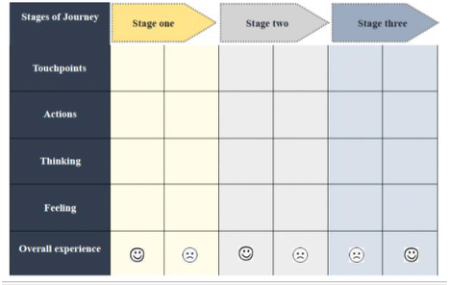
User Journey Map and How Might We (HMWs) Questions The user journey map was used in this experiment because it was necessary to use appropriate tools and methods while discovering the overall process experience and feeling of service design. The user journey map contains six elements: stages of the journey, touchpoints, actions, thinking, feeling, and overall experience (see Figure 1). The researcher can completely record and understand the user’s experience in completing one task, including what jour- neys the user went through and the user’s inner emotions. Secondly, using the HMWs question is a method that outlines the pinpoints we found in the user journey map as significant problems to assist all stakeholders to focus on essential issues. Therefore, after sorting out these issues, HMWs can be used
Figure 1: User journey map template.
Applying Service Design to Online Learning to Increase User Experience 311
as a design strategy to facilitate subsequent extension and implementation by other researchers.
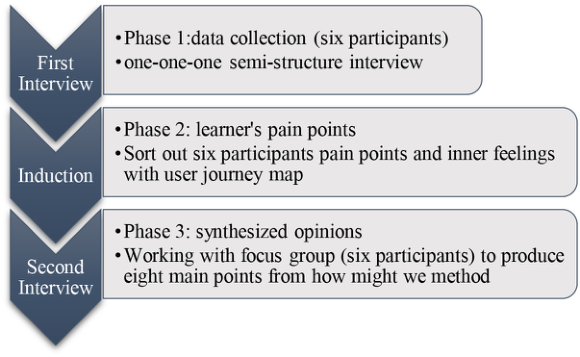
EXPERIMENTAL PROCEDURE AND PARTICIPANTS Three phases were included in this experimental procedure (see Figure 1). Phase 1 data collection process utilized one-on-one semi-structured intervi- ews to collect participants’ entire online learning process. Phase 2 consolida- ted these collected data and extracted crucial aspects from each participant’s response to produce one user journey map. Phase 3 was to form a focus group to discuss the user journey map, then come up with several main points that might be problems encountered by participants during the online course and identify them to form the suggested guidelines for using the online learning software. This research consisted of six participants, and the selection criteria were based on the table below (see Table 1).
Figure 2: Research experimental flow chart.Table 1. Sample human systems integration test parameters.
Table available in the original PDF paper.
Basic/Advanced information Choosing criteria Participants in this research
Yes
Basic information Gender 3 male and 3 female Age Age range: 18-25 Had used Google Meet to join the online courses before For over one year Advanced information Had experience of utilizing Google Meet online software
312 Shuo-Fang and Yi-Chieh
Using Google Meet Online Communication Software as this Research’s Research’s Target Platform Google meet is an online video conferencing platform that aims to pro- vide free access for corporate or individuals to stay connected securely with enterprise-grade video conferencing services. According to the statistic, the Google Meet platform seemed better than Zoom was due to its security system, superior encryption, and good user experience both on mobile and desktop (Wright, 2021). Additionally, this platform has widely been applied in universities or high schools in Taiwan for instructors to continue educating during the pandemic, while receiving lots of negative reviews from instru- ctors and learners about using this communication software in these years. Therefore, this paper aims to utilize this online communication software to discover learners’ operating processes and pain points during the course in the university.
RESULT
This paper’s result included two parts; the first was the user journey map, and the second was the eight main questions from how might we method, which was marked as an orange circle in the user journey map. Additionally, the user journey was divided into two sections since this paper had a space limitation (see Figures 2 and 3).
Eight HMWs questions are illustrated as below:
1) How might we help learners quickly enter the online teaching platform according to the account password given by the instructors before taking online courses? 2) How might we meet instructors’ pre-class requirements quickly and easily? 3) How might we inform the instructors instantly that his screen is out of sync due to network connection problems? 4) How might we allow learners to give immediate feedback to instructors during group discussions? 5) How might we have the same real feelings when we discuss online as when we communicate face-to-face with people? 6) How might we make the class atmosphere livelier and more interactive? 7) How might we allow instructors to accurately grasp each learner’s dynamics during the class? e.g., writing notes, going to the bathroom 8) How might we give learners and instructors more opportunities to interact after class?
LIMITATIONS The limitation of this research was the sample size; the overall result might be more diverse for the increased sample size in the one-on-one and focus group interviews in this experiment. Secondly, since people from all walks of life would use the online communication software of Google Meet, the rese- arch age range can expand to different age groups and make the comparison between them.
Applying Service Design to Online Learning to Increase User Experience 313
Figures 3 and 4: The first and second sections of the user journey map.
DISCUSSION AND FUTURE RESEARCH DIRECTIONS Based on the result, the researcher had found eight issues from learners during the online class. The existing eight online learning problems were presented in the form of interrogative sentences. The solutions to these problems are not limited for subsequent researchers to produce more creative ideas in the future. Solutions might come from interviewing people in the online educa- tion realm, e.g., qualified online teaching experts, online teaching platform programmers, or teachers who have used the online teaching platform, via collecting their responses and making amendments according to the models
314 Shuo-Fang and Yi-Chieh
that can be implemented. Finally, integrated the previous improvement pro- blems and solutions so that when users encounter difficulties during online learning, the solution to this problem will automatically appear in a pop- up window to guide users to complete the task. Therefore, the subsequent researcher could further brainstorm proper answers to improve the user expe- rience. The second perspective is based on this paper’s experimental process to explore other online platforms and provide corresponding solutions to platform users to follow the guidelines when encountering difficulties. Hence, the online teaching platform users can easily accomplish the task arranged by the instructor or themselves in the future.
CONCLUSION
The purpose of this article is to explore a series of problems that learners will encounter while using the online communication software - Google Meet, and the best way to discover problems in a procedure is to apply service design. Since service design plays a crucial role nowadays, a favored com- mercial product can be famous for its excellent design, high ease of use, and conscientious efforts in tangible and intangible service towards the product and their customer. Therefore, this paper’s result can serve as a design stra- tegy and guidelines for improving future online learning environments. In this case, it can reduce the difficulty of online teaching, improve ease of use, and achieve a barrier-free online learning environment.
REFERENCES
Aldowah, H., Al-Samarraie, H., Alzahrani, A. and Alalwan, N. (2019) Factors affecting student dropout in MOOCs: a cause and effect decision-making model. Jour- nal of Computing in Higher Education, 32(2), pp. 429–454. Brady, M. and Cronin, J. (2001) Some New Thoughts on Conceptualizing Percei-
ved Service Quality: A Hierarchical Approach. Journal of Marketing, 65(3), pp. 34–49. Hamilton, N., Heddy, B., Goldman, J. and Chancey, J. (2021) Transforming the Online Learning Experience. Teaching of Psychology. Humayun, M., Khalid, A., Syed, A., Elmorsy, E., Arshad, A., Humayun, M. and
Shah, S. (2021) The Effectiveness of Online Learning for the Cognitive Domain of Course Learning Outcomes from Students’ Point of View. Pakistan Journal of Medical and Health Sciences, 15(9), pp. 2186–2188. Joshi, N. and Lau, S. (2021) Effects of process-oriented guided inquiry learning on approaches to learning, long-term performance, and online learning outco- mes. Interactive Learning Environments, pp. 1–16. Park, T. and Lim, C. (2018) Design principles for improving emotional affordances in
an online learning environment. Asia Pacific Education Review, 20(1), pp. 53–67. Pine II, B. and Gilmore, J. (1998) Welcome to the Experience Economy. Harvard Business Review, [online] Available at: https://hbr.org/1998/07/welcome-to-the-e xperience-economy [Accessed 11 January 2022]. Rosala, M. (2021) Using ““How Might We”“ Questions to Ideate on the Right Pro-
blems. [online] Nielsen Norman Group. Available at: https://www.nngroup.com/ articles/how-might-we-questions/ [Accessed 21 January 2022].
Applying Service Design to Online Learning to Increase User Experience 315
Sandanayake, T., Karunanayaka, S. and Madurapperuma, A. (2021) A framework to design open educational resources-integrated online courses for undergra- duate learning: A design-based research approach. Education and Information Technologies, 26(3), pp. 3135–3154. Shostack, L. (1984) Designing Services That Deliver. Harvard Business Review,
[online] Available at: https://hbr.org/1984/01/designing-services-that-deliver [Accessed 8 January 2022]. Stickdorn, M. and Schneider, J. (2010) This is service design thinking. Amsterdam: BIS Publishers. Topali, P., Ortega-Arranz, A., Martínez-Monés, A. and Villagrá-Sobrino, S. (2020)
““Houston, we have a problem”“: Revealing MOOC practitioners’ experiences regarding feedback provision to learners facing difficulties. Computer Applicati- ons in Engineering Education. Wright, K. (2021) Google Meet vs. Zoom 2021: 5 reasons why Meet is the better enterprise video conferencing platform. [online] SADA | Cloud Technology Services | Google Cloud Premier Partner. Available at: https://sada.com/insights/blog/google-meet-vs-zoom-2021-5-reasons-why-meet -is-the-better-enterprise-videoconferencing-platform/ [Accessed 2 January 2022]. Younas, A., Faisal, C., Habib, M., Ashraf, R. and Ahmad, M. (2021) Role of Design Attributes to Determine the Intention to Use Online Learning via Cognitive Beliefs. IEEE Access, 9, pp. 94181–94202. Zapata-Cuervo, N., Montes-Guerra, M., Shin, H., Jeong, M. and Cho, M. (2021)
Students’ Psychological Perceptions Toward Online Learning Engagement and Outcomes during the COVID-19 Pandemic: A Comparative Analysis of Stu- dents in Three Different Countries. Journal of Hospitality & Tourism Education, pp. 1–15. Zhang, Xuhua. and Lu, Haowei. (2007). 整合二品模式品能展用於高等技教育服之 研究. 品質學報, 14(4), 405–421.
LISTED IN THE AHFE DIGITAL BOOKSTORE CATALOGUE
Explore the complete digital volume
Training, Education, and Learning Sciences
Read this individual research paper free through the original publisher, or explore the full digital proceedings book.
ISBN 978-1-958651-35-3
Explore this ISBN in the AHFE Bookstore ↗Listed in the July 2026 bookstore catalogue; search by ISBN to confirm current availability · Digital book purchase optional