Seung Nam Min, Jungnam Im, Murali Subramaniyam (2022). Analyzing Korean Reading course and Designing Education -A Focus on learner's eye-tracking analysis-. In: Training, Education, and Learning Sciences. AHFE Open Access, vol. 59, pp. 323–328. https://doi.org/10.54941/ahfe1002417
The purpose of this study is to propose a model for designing reading education that can improve reading ability by identifying and linguistically analyzing how the reading ability required for reading-comprehension is presented at each learner level. In this study, the eye-tracking experiment was conducted with divided into lexical and sentence levels which are the stage of comprehension corresponding to the subelement of the reading-comprehension, and the results are as follows. First, at the lexical level, it was confirmed that cognitive speed differs depending on the degree of preservation of the base form of the conjugations of the predicates with the same base form. Second, at the sentence level, we confirmed that the unstable reading-comprehension process appeared in the complex compared to the short sentence, even if the sentence length, vocabulary level, and vocabulary were similar and in the case of that the sentence has the same meaning. This paper suggests that the spelling, vocabulary, conjugation, grammar knowledge that correspond to the lower level should be included as the elements of education.
In general, from the perspective of language function, reading can play a significant role as a means of learning for a second language. Reading can be said to be a basic area of Korean language education that must be done regardless of the learner’s purpose and needs for the area. However, so far there has been a lack of research on what aspects of the learners’ difficulty in reading text, how much that step is at the level of text and learner’s lan- guage, and what aspects of it go through the process of change. We used an eye-tracker in this study to measure eye movement and flow as a scientific approach to finding the substance of the learner’s reading process. Using the data extracted from this, we would like to infer the developmental stages of the reading process by finding how the reading skills required for reading comprehension are presented at each learner level. Also, it will be analyzed
linguistically and a model for designing reading education that can improve reading skills will be proposed.
PRECEDENT RESEARCH Method of studying Korean Reading Process
The early discussion of the reading process in the Korean language field can be found in Shim (2000) and Shim’s (2009) studies, in which the direct inte- rview and the postmortem interview method were used on the premise that the learner’s strategy could show the reading process, but it is insufficient to confirm by example that specifically which factors specifically impeded the reading. In Kim’s (2014) study, the application of multiple texts was found targeting international students with Korean language skills, which can be used in the level of college mathematics, in which the method of analyzing the reading process used was to have learners individually read for five weeks and record the reading process in diary format. As such, studies to find the reading process have been tried from various angles, but it is difficult to find the objective process because it’s hard to collect all the problems that arise during the reading process and because of the intention or subjectivity of the measurer is bound to be involved. In addition, it is difficult to quantify the data in that the substance cannot be found.
Study on the Reading Process by Eye-Tracking As a method of measuring the learner’s reading process, the eye-tracking method was proposed in that reliability and objectivity can be improved based on quantified data. For example, young learners tend to fix their eyes on the vocabulary for a long time when they start to read, which is to read with a fixed gaze two or three times per vocabulary (Rayner et al. 2004). But the more proficient they become in reading and the less difficult the text becomes, the shorter the fixation time per vocabulary becomes and the longer the saccade). Park (2012a, 2012b) conducted a study to analyze the reading process for middle, high and high school students and reveal their characteristics. Frequency and time related to fixation were assumed as the measurement variables, and measuring eye movement, quantitatively finding differences in reading skills between middle school students and high school, university students. In the study of Suh et al. (2015), experiments were con- ducted by dividing into learners who are good at reading and inexperienced learners to confirm how the learners with high reading competence behave in reading and understanding the text. In Choi’s (2014) study, the differences between male and female students during the reading process of Korean text were analyzed with the subject of ten high school students. Recently, resea- rch using eye-tracking equipment, which Kim (2015a, 2015b) and Kim and Kang (2016) tried for the first time, was started also in the field of Korean education. However, microscopic research results where elements that need to be taught for reading comprehension are specifically presented are insuffi- cient. To compensate for this, finding what differs depending on the learner’s level, citing factors that influence reading comprehension, and analyzing the
Analyzing Korean Reading Course and Designing Education 325
Table 1. Experimental procedure using eye-tracking equipment.
Table available in the original PDF paper.
Contents Time (min)
10
1. Guide the order of the whole research and fill out the consent form for participation in the study
10
2. check the vocabulary and grammar awareness within the text and pre-interview
10
3. Guide the way of eye-tracking experiment 10 4. Eye-tracking experiment / Survey about subjective understanding
10
5. Solving content understanding problem relevant to the text and post-interview
factors linguistically using eye-tracking equipment as a scientific approach, will make it possible to extract reliable components in designing practical rea- ding education. In other words, based on quantified results extracted from the eye-tracking equipment, we will suggest how and what should be addres- sed in reading education, as a measure for designing reading education with a focus on a sub-element of reading comprehension.
METHOD
Subjects The eye-tracking experiment for this study was conducted with 30 students from 10 beginners, intermediate and expert Chinese learners who are stud- ying Korean at the Language Education Institute of H University in Seoul. These test subjects were selected on the premise that they can be under pri- mary control over their vocabulary and grammar knowledge because they have been studying Korean at the same educational institution from the beginner level. Also, since the experiment was only a brief time after the level test conducted in the regular course, it can be said that the objectivity to the assessment of the student’s current ability was secondarily partially premised.
Procedure The schedule of participation in experiments and interviews was orally coor- dinated met in person, and on the day of the experiments, the experiment was conducted with the consent of experiments and interviews and the use of results. The eye-tracking experiment and interview were conducted by boo- king an empty classroom in the college, and the experiment took part for about 50 minutes. The experimental procedure is shown in Table 1. The experimental equipment used in this study is Dikablis Professional from ERGONEERS, Germany. The eye movement was measured at 60Hz per second. The text contents were extracted from the Test of Proficiency in Korean (TOPIK) at each level of difficulty and before the 35th test before the reorganization. The Korean texts of two beginner difficulty levels and one intermediate difficulty used in the experiment are shown in Table 2.
Table 2. Experimental text 1.
Table available in the original PDF paper.
Test No. Material Type of text Difficulty of text
Beginner Q.59-60 in type B of 28th test
The use of rice<rice> Expository prose The number of word segments: 36 / the number of sentences: 5 Intermediate Q.57-58 in type B of 29th test
The Charm of Korean alleys<alley>
Expository prose The number of word segments: 79 / the number of sentences: 8
Table 3. Experimental text 1.
Table available in the original PDF paper.
Difficulty of text Test No. Material Language Type of text Beginner Q.57 in type B of 33rd test Gift wrapping <Gift> Korean Expository prose Translated in Chinses
Table 4. Criteria and content for reading process analysis.
Table available in the original PDF paper.
Step of reading Basic reading skill Content of
Dependent variable analysis
Comprehension Lexical Level Lexical recognition
-Allomorph -Conjugation
The number of fixations and fixation time Sentence Level Understanding sentence structure The number of the saccade and saccade time
-Word Order -Sentence Structure
The following table 3 is presented in Korean and Chinese, respectively, for sentence-level analysis In this study, the eye-tracking experiment was conducted divided into lexi- cal and sentence levels which are the stage of comprehension corresponding to the sub-element of the reading comprehension. In addition, the analysis method was changed for efficient observation of the results. Here, the lear- ner level and use type were selected as independent variables, and the fixation time and the number of fixations were selected as dependent variables to see the effect of independent variables on dependent variables. Criteria and content for reading process analysis are shown in Table 4.
SUGGESTIONS FOR DESIGNING READING EDUCATION In this study, so far, elements of reading comprehension related to lexical reco- gnition and understanding of sentence structure of Korean language learners appearing in the reading process have been examined by learners’ language level. It was confirmed that as the language level increased, the reading ability
Analyzing Korean Reading Course and Designing Education 327
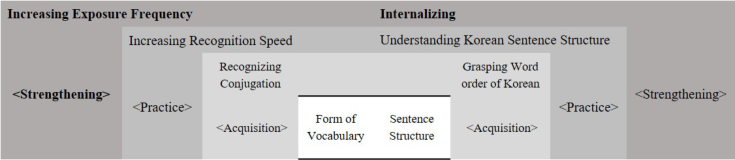
Figure 1: Model for designing Korean reading education.
improved, which was analyzed and evaluated in terms of speed and stability of reading by fixation time and the number of fixations at the lexical level, and saccade time and the number of saccades at the sentence level. At this time, the lexical or sentence level can be considered to correspond to the deco- ding, that is, the lower level in the reading process, it can be said to be the first step that requires concentration in the reading process, and it gradually becomes automatic as the language level increases. However, it is not easy to secure this automaticity for second language learners. That is, to reach the upper cognitive level, it is necessary to go through the lower level, but it is not easy to have a reading skill related to it, and if it is not properly equipped, won’t be able to proceed to the next level. Organizing based on this is as fol- lows Figure 1. Cognitive activities related to decoding cannot be automated unless the spelling, vocabulary, conjugation, and grammar knowledge corre- sponding to the lower level of reading are properly acquired and practiced as shown in Figure 1. It is necessary to lay the foundation for your reading skills focusing on the basic competencies of reading.
CONCLUSION
In this study, a way, which is based on quantifying the reading process of Korean learners through a scientific approach, and analyzing it linguistically, to improve reading skills was proposed. The reading process, which is dif- ficult to find its substance as it is a cognitive area, was measured with the eye-tracking equipment, and based on data quantified through it, the process of verifying what reading skills were needed for reading comprehension was gone through. Although the results of the above research are incomplete, it is meaningful in that the reading process was quantified by a scientific approach, and the analysis method of the reading process was proposed with dividing into learner level and language level, etc.
REFERENCES
Choi, S. (2014). Exploring Gender Difference in Reading Comprehension Process Using Eye Tracking Technology Journal of Learner-Centered Curriculum and Instruction 14: 573–597. Kim, H. (2015a). Research for Analysis of Korean Reading Process Using Eye-
tracking technology - For intermediate and advanced readers among foreign Korean learners Langugae&Culture 11(2): 131–159.
Kim, H. (2015b). Comparison of Saccade and Regression between Koreans and Advanced Non-Korean Learners during Reading Process-Utilizing Eye-tracking Technology Journal of Bilingualism (61): 67–94. Kim, H., & Kang, S. (2016). Effects of Speed-Reading Training for Korean Lear-
ners on Fixation and Saccade-Utilizing Eye-tracking Journal of Korean Language Education 27(3): 23–48. Kim, J. (2014). Reading Process of Academic Purpose Koran Learners: Based on the Application of Multiple Texts Korean Linguistics 63: 203–228. Park, Y. (2012a). The Characteristics of Eye-movements during middle school, high
school, and university students read a Korean expository text Journal of Learner- Centered Curriculum and Instruction 12: 165–189. Park, Y. (2012b). A study on the reading process characteristics of the students with reading difficulty based on eye movement Korean Language Education 139: 335–362. Rayner, K., Ashby, J., Pollatsek, A., & Reichle, E. D. (2004). The effects of frequency
and predictability on eye fixations in reading: Implications for the EZ Reader model Journal of Experimental Psychology: Human Perception and Performance 30(4): 720. Shim, S. (2000). A Study on the Reading Process of KFL (Korean as a Foreign Language) Learners [Master’s thesis, Seoul National University Graduate School]. Seoul. Shim, S. (2009). The Analysis of Research Methods and Topic Trends in KSL/KFL
Reading Research Korean Education 82: 257–277. Suh, H., Kim, J., Oh, E., & Lee, S. (2015). An Experimental Study Using the Eyetracker on Reading Characteristics of the Public Officials and the Ordinary Adults Korean Education 102: 7–44.
LISTED IN THE AHFE DIGITAL BOOKSTORE CATALOGUE
Explore the complete digital volume
Training, Education, and Learning Sciences
Read this individual research paper free through the original publisher, or explore the full digital proceedings book.
ISBN 978-1-958651-35-3
Explore this ISBN in the AHFE Bookstore ↗Listed in the July 2026 bookstore catalogue; search by ISBN to confirm current availability · Digital book purchase optional