Se Jin Park, Seung Nam Min, Murali Subramaniyam, Heeran Lee (2021). The Evaluation of Compatibility between Human and Mattress using EMG. In: Advances in Human Aspects of Healthcare. AHFE Open Access, vol. 13. https://doi.org/10.54941/ahfe100534
Sleeping environment can have a significant influence on sleep quality. Sleeping on the incorrect mattress can cause lot of health problems and affects comfort. The mattress with extra firmness or softness does not allow the sleepers muscle to rest. This study developed a methodology to evaluate compatibility between human and mattress firmness using an electromyogram (EMG). Two mattresses were considered (spring and tempur mattress) with different firmness. Ten healthy participants were tested (age: 31.70 ± 2.19 years; height: 170.90 ± 7.90 cm; weight: 70.60 ± 13.95 kg) on each mattress when lying supine and turning to their right for ten times. The EMG activities (RMS) were measured from eight different muscles (right side cervical paraspinal, right and left side upper trapezius, right and left side latissimus dorsi, right and left side lumbar erector spinae, and right side gastrocnemius lateral). Subjective rating was also collected from the participants. The RMS results showed significantly lower muscle activities when subject tossing and turning to their right on the spring mattress than tempur mattress. Spring mattress provided significantly greater relaxation on subjective rating. This methodology can be used to evaluate different mattress compatibility with various material properties.
Better quality of sleep plays a vital role in good health and well-being throughout our life. It is an important factor that helps us to reduce fatigue and to maintain regular circadian rhythm. It can help protect our mental health, physical health, quality of life, and safety (Park et al., 2014). Deficient sleep, defined as inadequate or mistimed sleep, is increasingly documented as contributing to a wide range of health problems. There are lots of environmental factors affects sleep quality including light, humidity, temperature, noise, smell, and sleeping system. We become more sensitive to the influences of sleeping environment and mattress quality (Bader and Engdal, 2000). It was highlighted that 7 % of sleep problems were related to an uncomfortable mattress (Addison et al., 1987). Few studies disclosed that the mattress could not affect sleep quality (Okamoto et al., 1997; Scharf et al., 1997; Okamoto et al., 1998; Bader and Engdal, 2000; Tonettik et al., 2011). However, a few recent studies have highlighted the fact that mattress could improve sleep quality in healthy people (Jacobson et al., 2006; Lee and Park, 2006; Jacobson et al., 2008). In the recent past, the mattress industry has created different technological solutions in production of mattress. Considering that few, and often different, data are available regarding the effect of mattress on sleep quality. The mattress has the possibility either to boost or rob you of sleep. We spend approximately one-third of our life in bed, and a synergy of psychological, physiological, and physical conditions affects the quality of sleep. Due to an insufficiently adapted sleep system including mattress, support structure, head cushion and/or incorrect sleeping posture, the human body, especially the vertebral column, is often insufficiently supported (Lee and Park, 2006). Few studies have investigated the sleep-improving quality of various mattresses. It was reported that the comfort of a mattress was more heavily influenced by spinal curvature and distribution of body pressure in human- mattress system than the material of the mattress itself (Park et al., 2001). The insufficient back support could cause low-back pain, which is one of the most compelling problems in the industrial world. The mattress with extra firmness does not evenly support the sleeper’s body, and the mattress with extra softness sags and prevents the spine from maintaining proper alignment. Neither situation does not allow the sleepers muscle to rest, as they must work throughout the night to find a comfortable position and maintain correct posture.
There are lot sleep related problem, sleep apnea is a very common problem. There have been several types of apnea problems recognized, but by far the most common is obstructive sleep apnea. It accounts for over 95 % of the individuals who have problems with sleep apnea (Valham et al., 2012). The symptoms of obstructive sleep apnea include frequency movements (tossing and turning), awaking frequently, morning tiredness, etc. (Valham et al., 2012). Tossing and turning while trying to sleep has made the mattress a signal for wakefulness rather than sleep. And also tossing and turning is the one of the causes for the disturbed sleep. The tossing and turning does not allow the sleepers muscle to rest. However, tossing and turning are necessary to avoid a pressure overloading to soft tissues and to prevent muscle stiffness. Different types of mattress are manufactured today, using vertical or horizontal springs, or other materials (latex, viscoelastic or other flexible polyurethane foams). The firmness of the mattress is an important factor in the sleeping system and it affects the sleepers muscle during tossing and turning. The firmness of the mattress should provide a low load to the muscles. To the authors’ knowledge there was only one study evaluated mattress firmness and loads on the muscles. Sasaki and Kaku (2011) developed the next generation PU form of High Resilience (HR) and Viscoelastic (VE) foam for mattresses. They also evaluated the comfort of the mattress with body pressure distribution performance and the ease of rollover with two subjects. Their result suggested that the next generation foam mattress produced least load in the abdomen muscles comparing to VE or HR foams. However, during tossing and turning requires a lot of activity from upper back, lower back and leg muscles. The aim of this study was to develop a methodology to evaluate the compatibility between sleepers and mattress firmness using an electromyogram (EMG) and subjective evaluation also performed to test usability evaluation.
METHODS
Participants Ten healthy subjects were recruited and their anthropometric details are: mean (SD) age 31.7 (2.19) years; height 170.9 (7.9) cm; weight 70.6 (13.95) kg. Subjects had no history of back, neck, and leg pain for the last one year. Participants were instructed to wear short sleeve pajamas (100 % cotton).
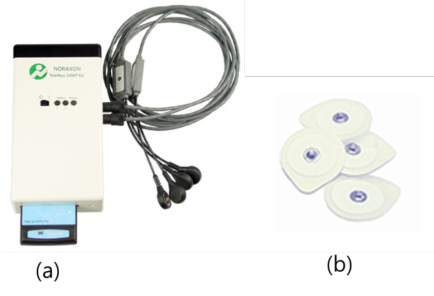
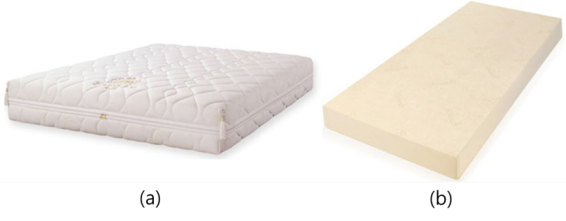
Apparatus and Mattress Considered The muscle activity during tossing and turning were measured using a wireless type surface EMG system (Telemyo 2400T G2 Telemetry EMG system, Noraxon, USA) (see Figure 1). To measure EMG signals, a pair of disposable Ag/AgCl surface electrodes with 2 cm inter-electrode distance was affixed to the skin over the selected muscles. Two mattresses (spring and Tempur) with different firmness were considered in this study (see Figure 2).
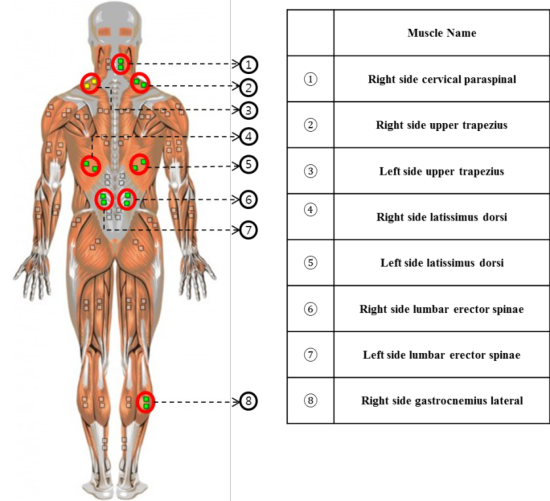
Muscle Selection and Location Eight muscles (including neck, shoulder, upper back, lower back, and leg) were considered to completely understand the muscle behavior during tossing and turning on the mattress. The muscles considered to be: right side cervical paraspinal, right and left side upper trapezius, right and left side latissimus dorsi, right and left side lumbar erector spinae, and right side gastrocnemius lateral. The muscles location and electrode location is shown (see Figure 3). The skin was abraded and cleansed with alcohol before the electrodes were placed using standard placement procedures (Konrad, 2005; Shewman and Konrad, 2008).
Figure 1. Muscle activity measurement system (a) Wireless type surface system; (b) Surface electrodesFigure 2. Mattress considered for the test (a) Spring mattress; (b) Tempur mattressFigure 3. Muscles considered for the EMG measurement
Objective Evaluation The evaluation begins with EMG muscle activity measurements’. All the participants were tested on both Human Aspects of Healthcare (2021) mattresses. The EMG muscle activities were continuously measured from the selected eight muscles, when participants performing tossing and turning on the mattresses. The tossing and turning was repeated for 10 times (with 10 - 15 Sec interval between each toss and turn) on each mattress. To avoid the carry-over effect the Latin squared design was adopted. To avoid muscle fatigue 10 min break was given between tests. The EMG signals were acquired at 1024 Hz. The raw EMG muscle activities were further analyzed using MyoResearch XP Master Edition software (Noraxon Inc., USA) and RMS muscle activities were estimated. The average RMS muscle activities were calculated and compared between the mattresses.
Subjective Usability Evaluation The usability evaluation was performed using subjective method. The evaluation contains eight questions about mattress and their feeling in terms of mattress hardness, back support, overall comfort and so on. Participants rated their feeling using seven point scale for each question. The average of the scores was calculated and compared. This subjective evaluation was performed after participants completed the objective measurement.
RESULTS
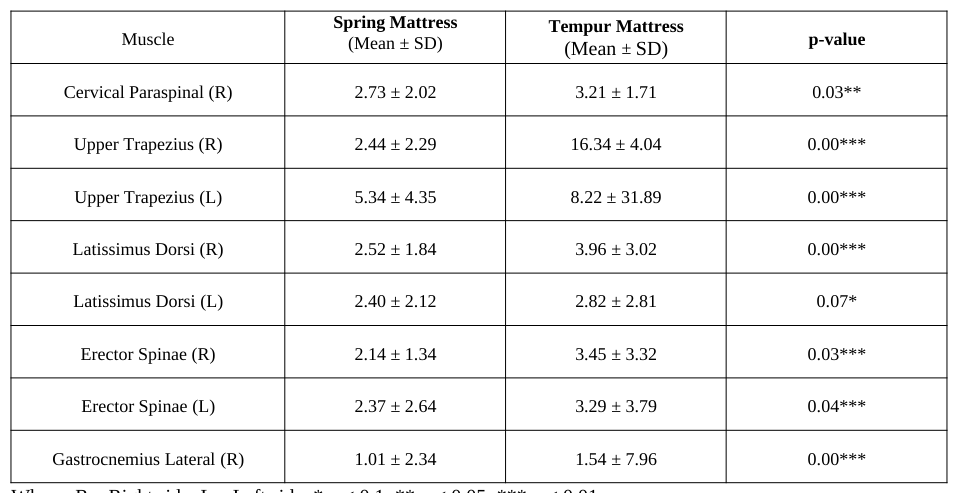
Objective Evaluation The T-test results of the average RMS muscle activity for the mattresses are shown in Table 1. Comparatively higher RMS muscle activity recorded when participants performing the tasks (tossing and turning) on the tempur mattress compared with the spring mattress. Statistically significant differences (p < 0.05) were found on the RMS muscle activities between mattresses. These results suggest that higher muscle load generated when performing the tasks on the tempur mattress compared with spring mattress. If subjects using tempur mattress for the extended period and doing frequent movements (tossing and turning), it could generate higher muscle load and probably leads to muscle fatigue, back pain and related disorders.
Table 1: Average RMS muscle activity of selected muscles during tossing and turning Spring Mattress Tempur Mattress
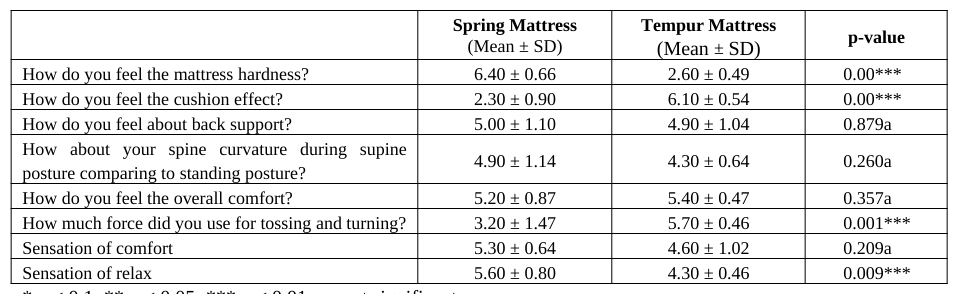
Subjective Usability Evaluation The subjective usability evaluation results are shown in Table 2. Participants rated comparatively (p < 0.05) higher scores for spring mattress in terms of hardness and sensation of relaxation. Also the subjects rated lesser score for tossing and turning, which showed that better assistance to the body during tossing and turning provided by the spring mattress. With higher hardness, the spring mattress can support the sleepers back. If someone has back pain using the spring mattress could be better. The participants felt significantly (p < 0.05) greater cushion effect when laid on the tempur mattress; however participants gave significantly (p < 0.05) greater force for tossing and turning to their right.
Table 2: Average subjective rating score for the mattresses Tempur Mattress Spring Mattress
CONCLUSIONS
This study developed a methodology to evaluate the compatibility between sleepers and mattress firmness using an electromyogram (EMG) and subjective evaluation. The result that spring mattress was better than a tempur mattress in terms of muscle activities. Also subjective rating confirmed that spring mattress was better than a tempur mattress on tossing and turning. This methodology can be used to evaluate different mattress compatibility with various material properties.
REFERENCES
Addison, R. G., Thorpy, M. J., Roth, T. (1986). “A survey of the United States public concerning the quality of sleep”, J Sleep Res, 16, 244. Bader, G. G., Engdal, S. (2000). “The influence of bed firmness on sleep quality”, Applied ergonomics, Volume 31
No 5, pp. 487-497. Jacobson, B. H., Wallace, T., Gemmell, H. (2007). “Subjective rating of perceived back pain, stiffness and sleep quality following introduction of medium-firm bedding systems”, Journal of chiropractic medicine, Volume 5 No 4, pp. 128-134. Konrad, P. (2005), “The ABC of EMG”, A practical introduction to kinesiological electromyography, 1. Lee, H., Park, S. (2006). “Quantitative effects of mattress types (comfortable vs. uncomfortable) on sleep quality
through polysomnography and skin temperature”, International journal of industrial ergonomics, Volume 36 No 11, pp. 943-949. Okamoto, K., Mizuno, K., Okudaira, N. (1997). “The effects of a newly designed air mattress upon sleep and bed climate”, Applied human science: journal of physiological anthropology, Volume 16 No 4, pp. 161-166. Okamoto, K., Nakabayashi, K., Mizuno, K., Okudaira, N. (1998). “Effects of truss mattress upon sleep and bed
climate”, Applied human science: journal of physiological anthropology, Volume 17 No 6, pp. 233-237.
Park, S. J., Lee, H. J., Hong, K. H., Kim, J. T. (2001), “Evaluation of Mattress for the Koreans”, in: Proceedings of the Human Factors and Ergonomics Society Annual Meeting (Volume 45 No 7, pp. 727-730). SAGE Publications. Park, S. J., Subramaniyam, M., Moon, M. K., Jeon, B. B., Lee, E. J., Han, S. H., Woo, C. S. (2014), “Sleep Quality
and Skin-Lightening Effects of White Mother Chrysanthemum Aroma”, in: Handbook of Industrial Applications of Affective Engineering, Springer International Publishing Switzerland, pp. 241-252. Sasaki, T., Kaku, D. (2011), “Next Generation PU Foams for Mattresses benign to Human Body”, Res. Reports Asahi Glass Co., Ltd., 61. Scharf, M. B., Stover, R., McDannold, M., Kaye, H., Berkowitz, D. V. (1997). “Comparative effects of sleep on a
standard mattress to an experimental foam surface on sleep architecture and CAP rates”, Sleep, Volume 20 No 12, pp. 1197-1200. Shewman, T., Konrad, P. (2008), “Clinical sEMG Electrode Sites - SEMG Muscle Chart [online], Available from: http://www.noraxon.com/products/educational/index.php3 [Accessed 5 July 2011]. Tonetti, L., Martoni, M., Natale, V. (2011). “Effects of different mattresses on sleep quality in healthy subjects: an
actigraphic study”, Biological Rhythm Research, Volume 42 No 2, pp. 89-97. Valham, F., Sahlin, C., Stenlund, H., Franklin, K. A. (2012). “Ambient temperature and obstructive sleep apnea: effects on sleep, sleep apnea, and morning alertness”, Sleep, Volume 35 No 4, pp. 513.
LISTED IN THE AHFE DIGITAL BOOKSTORE CATALOGUE
Explore the complete digital volume
Advances in Human Aspects of Healthcare
Read this individual research paper free through the original publisher, or explore the full digital proceedings book.
ISBN 978-1-4951-2093-0
Explore this ISBN in the AHFE Bookstore ↗Listed in the July 2026 bookstore catalogue; search by ISBN to confirm current availability · Digital book purchase optional