Nigar Tuğbagül Altan, Oğuzkaan Sarıkaya (2022). COVID- 19 Pandemic State: Teaching Children Colors With Mobile Application Based On Augmented Reality. In: Training, Education, and Learning Sciences. AHFE Open Access, vol. 59, pp. 360–366. https://doi.org/10.54941/ahfe1002422
The spread of, COVID- 19 from Wuhan, China in December 2019 enforced Draconian measures in form of social barriers to control the COVID- 19 pandemic. Many governments replaced face-to-face education in schools with remote education through the internet. Efficient and effective teaching techniques are still being sought. Especially, lessons practical training exercises need environmental platforms to enhance teaching yet physical platforms could have Pandemic related risks for humans. The risks are even higher, for children in primary education and for children with neurodevelopmental disorders who need to learn with repeated exercises. This study proposes a color learning mobile application for children that is based on augmented reality. The application is supposed to teach colors to young pupils in an enjoyable way. In this paper, three primary colors: red, yellow, blue, and three secondary colors: orange, green, and purple are taught with 3-D ball animation based on the augmented reality technique. This animation introduces how the secondary colors originate from the combination of primary colors. This is an enjoyable, teaching-learning, and self- repeatable activity for children in a COVID-19 pandemic state.
Currently, the World population is witnessing several new strains of viru- ses that have global health threats. For instance, Severe Acute Respiratory Syndrome Coronavirus (SARS-CoV) killed 774 people from 2002 to 2004 (NHS, 2022). In 2012, the Middle East Respiratory Syndrome Coronavirus (MERS-CoV) emerged in the Kingdom of Saudi Arabia), originating from animals, especially camels, (Zaki AM, 2012) caused people to die. In total, 27 countries have reported 858 known deaths since 2012 (WHO, 2022). However, today we are witnessing a pandemic that has caused a worl- dwide urgency. This time a novel strain of SARS-CoV called the novel Coronavirus (SARS-CoV-2). In late December 2019, COVID-19 rooted in SARS-CoV-2 infection started in Wuhan, China (Tang, Xiaolu, 2020). Many people suffered and still suffering from this disease and die all around the world. According to a WHO report, until 1 April 2022, there have
COVID-19 Pandemic State: Teaching Children Colors with Mobile Application 361
been 486.761.597 confirmed cases of COVID-19, including 6.142.735 dea- ths (WHO, 2012/). These viral numbers forced countries to take precautions to protect human health. WHO has recommended “social distancing” and “self-quarantine”to slow down the pandemic. As a result, many governments have closed down various facilities and canceled unessential social gatherings. The closing of private and public schools has shifted the educational system from an in-person to a learn-from-home model. In education, many countries continue their education online. Hence, the importance of computer-based education that can provide learn-from-home opportunities has taken a new urgency.
In this study, we suggest a mobile application for color learning based on augmented reality for young children. We aim to highlight the advantages of Augmented Reality systems and how they could help in learning in the target population for a pandemic situation such as Covid-19.
AUGMENTED REALITY (AR) IN EDUCATION Augmented Reality (AR) provides a more immersive and engaging environ- ment without hugely decreasing the authenticity of the real world. Behavioral self-regulation skills of the children are related to school contexts to fol- low classroom rules, pay attention to instructions and engage them in learning opportunities (Suchodoletz et al., 2013). There are various resea- rches about enjoyable, engaging AR-education issues sharing the benefits of AR (Dinnebeil et al. 2012; Oranc and Kuntay, 2019; Dalim et al., 2020; Nincarean et al. 2013; Ibáñez et al., 2014; Alhumaidan et al. 2018; Tomi et al. 2013; Lpez-Faican and Jane, 2020; Altan N. T. A., Gokturk M., 2019; Akçayır, Murat, Akçayır, 2017).
Children with different levels of mental development could respond with heightened attention to AR applications. In this study, our application is developed for young children.
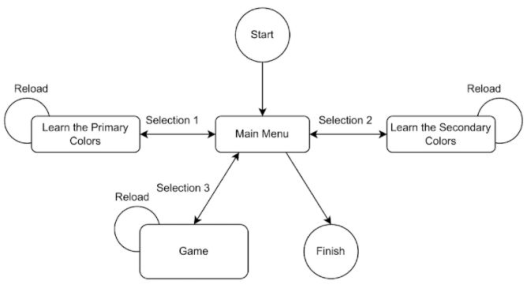
COLOR LEARNING MOBILE APPLICATIONS BASED ON AUGMENTED REALITY FOR CHILDREN The application is coded with C# and the Unity Game Engine using Vuforia SDK and Database. Figure 1 displays the flow chart of the application.
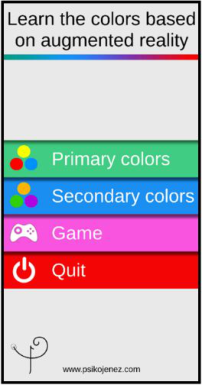
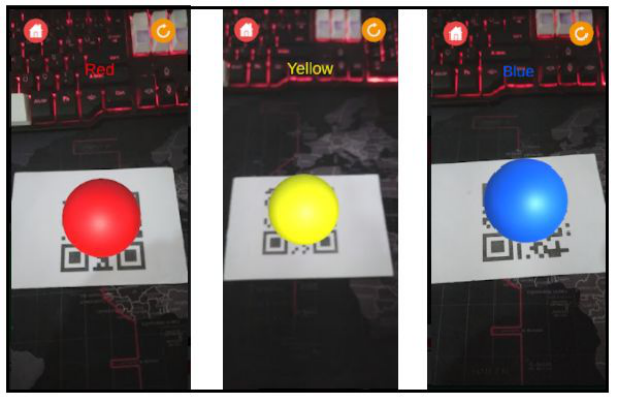
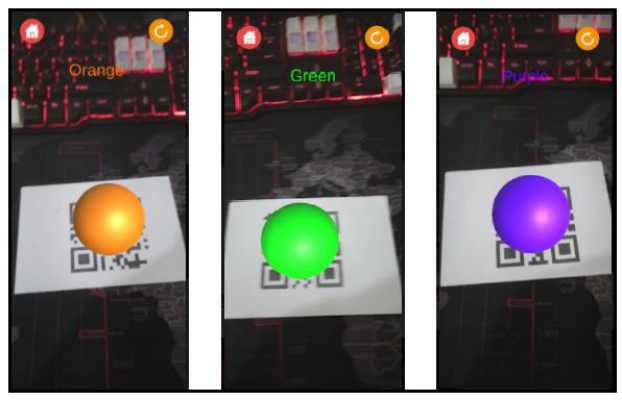
The main page of the application is shown in Figure 2. Four options are available to choose from the application. The first and the second buttons are designed to teach the primary or the secondary colors, respectively. AR includes the text (name of a color) with its pronunciation. When the user pushes the button called “Primary colors”, the text (name of a color) with its pronunciation occurs (Figure 3). A button called “Secondary colors” is designed for teaching the origin of the secondary colors. It functions like the button called “Primary colors” (Figure 4). The “Quit” button is to exit the application (Figure 2).
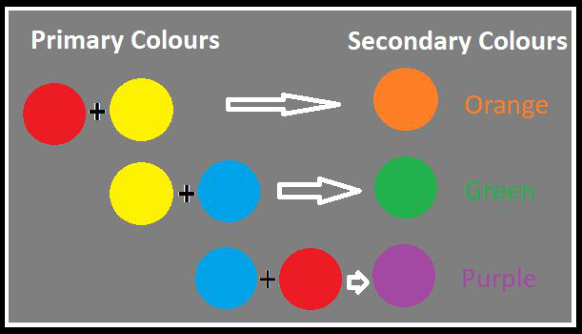
The primary colors are red, yellow, and blue. These colors are the only three colors that cannot be produced by any combination of other colors. Secondary colors are orange, green, and purple are made of a combination of
362 Sarıkaya and Altan
Figure 1: Flow chart of the program.Figure 2: The main page of the application.
primary colors. Figure 5 shows how the “secondary colors” originate from the mixing of the two primary colors. All other secondary colors could be generated from these three “primary” colors.
A button called “Game” initiates the combination of the two primary colors to produce the secondary colors with an animation effect based on Marker based AR.
In this study, three primary colors: red, yellow, blue, and three secondary colors: orange, green, and purple are taught with 3-D ball animation, using a marker-based augmented technique. We animated all primary and secondary colors which are in Figure 5.
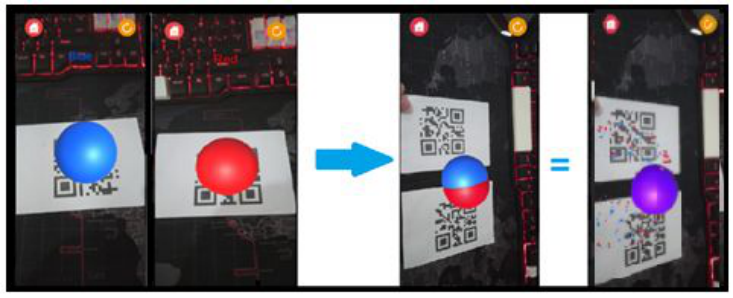
This animation based on augmented reality includes how secondary colors are made up from the combination of primary ones. Figure 6 displays an example animation that purple is made by red and blue colors in this application.
COVID-19 Pandemic State: Teaching Children Colors with Mobile Application 363
This paper presents the application to teach primary and secondary colors with animation techniques to young children using augmented reality.
AR has some basic properties that could provide answers we are looking for in the era of Pandemic: supporting a safe experimental environment for teaching serious topics to the children such as fire, a thunderstorm with the help of simulations close to reality, building enjoyable, and funny, engaging, and entertaining learning platforms. Depending on the requirements, it can support teamwork and social interactions in an isolated environment.
It can be used everywhere with mobile devices which have a camera and AR software.
364 Sarıkaya and Altan
Figure 5: Primary colors and secondary colors.Figure 6: An example animation shows that purple is made by combining red and blue colors in this application.
This application is suggested for children who are suffering from isolation due to epidemic risks, especially in the current world problem: COVID-19.
In future work, we will develop applications with many learning topics for young children supporting self-repeatable and isolated learning in times of social isolation.
ACKNOWLEDGMENT
We acknowledge the financial support from, the www.psikojenezteknoloji.com company and thank Dr. Mehmet Ali Gulgun for editing help.
REFERENCES
Akçayır, Murat, Akçayır, (2017), “Advantages and challenges associated with augmented reality for education: A systematic review of the literature”, Educational Research Review, Volume 20, Pages 1-11, ISSN 1747-938X, https://doi.org/10.1016/j.edurev.2016.11.002.).
COVID-19 Pandemic State: Teaching Children Colors with Mobile Application 365
Alhumaidan, Haifa, Lo, Kathy Pui Ying, Selby, Andrew (2018). Co-designing with children a collaborative augmented reality book based on a primary school text- book, International Journal of Child-Computer Interaction, Volume 15, 2018, Pages 24-36, ISSN 2212-8689, https://doi.org/10.1016/j.ijcci.2017.11.005. Altan N. T., Gokturk M., (2019), “Comparison of the Theory of Mind Tests on the
Paper, 2D Touch Screen and Augmented Reality Environments on the Students With Neurodevelopmental Disorders”, in IEEE Access, 7, 52390-52404, 2019. DOI: 10.1109/ACCESS.2019.290283. Behzadan, Amir H., Kamat, Vineet R. (2013). Enabling discovery-based learning in construction using telepresent augmented reality, Automation in Construction, Volume 33, 2013, Pages 3-10, ISSN 0926-5805, https://doi.org/10.1016/j.autcon .2012.09.003. Che, Dalim, Che Samihah et al. (2020). Using augmented reality with speech input for
non-native children’s language learning.Int. J. Hum. Comput. Stud. 134 (2020): 44–64. Dinnebeil, L., Sawyer, Brook, Logan, Jessica, Dynia, Jaclyn, Edward, Cancio, Justice, Laura. (2012). Influences on the congruence between parents’ and teachers’ ratings of young children’s social skills and problem behaviors. Early Childhood Research Quarterly. 10.1016/j.ecresq.2012.03.001. Friedenthal, S. Moore, A. Steiner, R. (2008) A Practical Guide to SysML: The Systems
Modeling Language, Morgan Kaufmann; Elsevier Science. Folds, Dennis. Gardner, Douglas and Deal, Steve. (2008). Building Up to the Human Systems Integration Demonstration, INCOSE INSIGHT Volume 11 No. 2. López-Faican, Lissette & Jaen, Javier. (2020). EmoFindAR: Evaluation of a mobile
multiplayer augmented reality game for primary school children. Computers & Education. 149. 103814. 10.1016/j.compedu.2020.103814. Memish ZA, Cotten M, Meyer B, Watson S, Asahafi AJ, Al Rabeeah AA, et al. Human infection with mers coronavirus after exposure to infected camels, Saudi Arabia, 2013. Emerging Infectious Disease journal 2014; 20(6):1012–5. NHS, (April 03, 2022) SARS (severe acute respiratory syndrome); NHS Website:
https://www.nhs.uk/conditions/sars/ Nincarean, Danakorn, Alia, Mohamad Bilal, Halim, Noor Dayana Abdul, Rahman, Mohd Hishamuddin Abdul (2013). “Mobile Augmented Reality: The Potential for Education”, Procedia - Social and Behavioral Sciences, Volume 103, 2013, Pages 657-664, ISSN 1877-0428, https://doi.org/10.1016/j.sbspro.2013.10.385. Oranc, Cansu, Küntay Aylin C. (2019). Learning from the real and the virtual worlds: Educational use of augmented reality in early childhood, International Journal of Child-Computer Interaction, Volume 21, 2019, Pages 104-111, ISSN 2212-8689, https://doi.org/10.1016/j.ijcci.2019.06.002. (https://www.sciencedirect.com/science/article/pii/S221286891830028X). Suchodoletz, Antje & Gestsdottir, Steinunn & Wanless, Shannon & Mcclelland,
Megan & Birgisdóttir, Freyja & Gunzenhauser, Catherine & Ragnarsdóttir, Hrafnhildur. (2013). Behavioral self-regulation and relations to emergent acade- mic skills among children in Germany and Iceland. Early Childhood Research Quarterly. 28. 62–73. 10.1016/j.ecresq.2012.05.003. Tang, Xiaolu, Wu, Changcheng, Li, Xiang, Song, Yuhe, Yao, Xinmin, Wu, Xinkai, Duan, Yuange, Zhang, Hong, Wang, Yirong, Qian, Zhaohui, Cui, Jie, Lu, Jian (2020). On the origin and continuing evolution of SARS-CoV-2, National Science Review, Volume 7, Issue 6, June 2020, Pages 1012–1023.
366 Sarıkaya and Altan
Tomi, Azfar Bin, Rohaya Awang Rambli, Dayang. (2013). An Interactive Mobile Augmented Reality Magical Playbook: Learning Number with the Thirsty Crow, Procedia Computer Science, Volume 25, 2013, Pages 123-130, ISSN 1877-0509, https://doi.org/10.1016/j.procs.2013.11.015 WHO (April 03, 2022) Middle East respiratory syndrome coronavirus (MERS-CoV),
World Health Organization, https://www.who.int/health-topics/middle-east-resp iratory-syndrome-coronavirus-mers#tab=tab_1 Zaki AM, van Boheemen S, Bestebroer TM, Osterhaus AD, Fouchier RA. Isolation of a novel coronavirus from a man with pneumonia in Saudi Arabia. N Engl J Med 2012; 367:1814–20.
LISTED IN THE AHFE DIGITAL BOOKSTORE CATALOGUE
Explore the complete digital volume
Training, Education, and Learning Sciences
Read this individual research paper free through the original publisher, or explore the full digital proceedings book.
ISBN 978-1-958651-35-3
Explore this ISBN in the AHFE Bookstore ↗Listed in the July 2026 bookstore catalogue; search by ISBN to confirm current availability · Digital book purchase optional