Jing Xu, Duoduo Zhang (2022). From disembodied to embodied: the embodied transformation of children's architectural education learning situation design. In: Training, Education, and Learning Sciences. AHFE Open Access, vol. 59, pp. 74–80. https://doi.org/10.54941/ahfe1002386
The current traditional teaching mode of children's architectural education makes children's bodies detached from the situation, and there are problems such as abstract knowledge, single perception, and lack of practice. Based on the concept of embodied learning, this paper proposes a design strategy for embodied learning situations, and on this theoretical basis, designs and implements children's educational practice services based on Huayao's traditional architectural culture. Firstly, through literature research, based on situational learning and embodied cognition theory, analyze the characteristics of children's cognition, explore the internal connection between situation and children's architectural education, discuss the significance of embodied theory in the design of learning situations, and draw the conclusion of the learning process of embodied situations. Three stages, namely perception, engagement, and reflection on the situation. On this basis, it proposes the design strategy of embodied learning situation, and discusses four aspects: daily cultural situation, embodied resource situation, role task situation, and evaluation generation situation. Provide an effective reference for the design of architectural education activities for children, and design learning situations through embodied concepts to help children in architectural education activities to explore interaction, knowledge transfer, and cultural generation, and improve creativity and innovative thinking.
As an interdisciplinary comprehensive education, children’s architecture has attracted much attention at present, but there are still problems such as abstract knowledge, single perception, and lack of practice. Therefore, this study will explore the situational design in children’s architectural educa- tion from the perspective of embodied cognition. Combined with the laws of embodied cognition, situational learning is summarized into three sta- ges: perception, participation and reflection. According to each stage, four elements of embodied situation design are further proposed: daily cultural situation, embodied resource situation, role task situation and evaluation
From Disembodied to Embodied: The Embodied Transformation 75
generation situation. Under the guidance of this design strategy, the “Lit- tle Huayao Architectural Designer” architectural aesthetic education course service was carried out, and the proposed strategy was verified in practice.
EMBODIED COGNITION AND CHILDREN’S ARCHITECTURAL EDUCATION Embodied cognition emphasizes that cognition is generated through the inte- raction between the body and the world (Merleau-Ponty, Smith, 1962). At the same time, cognition occurs in real situations. (Wilson, 2002). So body, mind, and environment are inseparable. In embodied teaching, it is believed that learners realize the transformation of knowledge through body perception and embodied activities (Black et al. 2002). China’s children’s architectural education is currently dominated by participatory architectural design pro- jects and popular science activities. Looking at it from the perspective of embodied cognition, we will find that it tends to “leave the body”. First of all, the teaching method focusing on symbols is not conducive to the interna- lization and transfer of abstract knowledge. And a single sensory experience marginalizes the participation of the body. Secondly, although students expe- rience the manual process, they only stay at the rational operation level, lacking application and reflection.
Embodied cognitive theory can provide new thinking for children’s arch- itectural education. According to Piaget’s theory of children’s cognition, children are in the concrete operational stage, they begin to have logical thin- king, and they also begin to form their first identities (Ehteshami, 2018). Therefore, children’s architectural education can start from the daily cultu- ral situation, cultivate children’s logical thinking and problem-solving ability, and enhance their cultural identity. Secondly, architectural knowledge inclu- des not only intuitive and explicit perception experience knowledge such as colors and materials, but also tacit and situational implicit movement experi- ence knowledge in the construction process. Therefore, in teaching activities, the perception and motor experience should be unified, to realize the con- tinuous interaction with the environment and let the learning happen truly and naturally.
THE EMBODIED TURN OF LEARNING SITUATION Situation refers to the physical environment in which things occur and the coexisting background events (Thomas, 1992). Situational teaching refers to integrating knowledge into a situation, allowing students to interact with it naturally (Dewey, 1930), thereby generating knowledge. The instructi- onal design of learning situations is based on problem situations, which guide learners to solve real problems with knowledge (Choi and Hannafin, 1995). Situational design types can be based on problems, tasks, projects, etc. (Jonassen et al. 1998). Contextual learning can integrate architectural know- ledge into cultural contexts and then apply them to problem-solving contexts. While enabling children to have embodied cognition, they also completed the
exploration of the origin of identity and the establishment of cultural identity (Spencer and Woolley, 2000).
The core of situational learning is how to effectively interact with the situa- tion. According to embodied cognition, the interaction process can be divided into three stages: perception situation, participation situation, and reflection situation. In the stage of perception situation, students refine, summarize and consolidate the learned experience through sensory perception and behavio- ral operation experience to complete knowledge perception. In the situational engagement stage, students achieve knowledge transfer by taking roles to complete tasks. Roles can weaken the boundaries of situations and allow students to think from multiple perspectives; tasks can generate problems and stimulate students to think independently. In the reflective situational stage, learners conduct self-descriptive reflection and collective communica- tion evaluation and reflection to form individualized cognition and complete internalized knowledge (Ji et al. 2019).
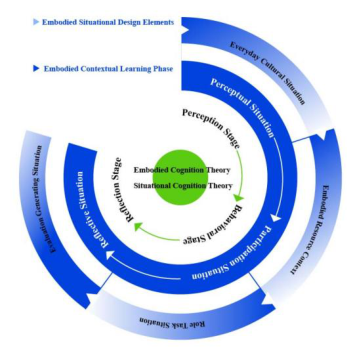
DESIGN STRATEGIES FOR EMBODIED LEARNING SITUATIONS Learning context design needs to consider four core elements: contextual con- text, content knowledge, motivational tools and evaluation systems (Choi and Hannafin, 1995). According to the three stages of embodied contex- tual learning discussed above, this paper summarizes four design elements for the construction of embodied learning contexts: daily cultural situation, embodied resource situation, role task situation, and evaluation generation situation (see Figure 1). The daily cultural situation is to select learning mate- rials from daily life, so that students can mobilize their existing experience to actively explore. Embodied resource situations guide students to observe the environment with multiple senses, experience the process of hands-on pra- ctice, and complete the learning of knowledge and skills. Role-task scenarios are the creation of roles and problem-based design tasks, so that learners can use previous experience to understand new knowledge and apply it to
From Disembodied to Embodied: The Embodied Transformation 77
new situations. The evaluation generation context allows learners to share and communicate in the whole learning process, which is conducive to the reconstruction of knowledge.
“LITTLE HUAYAO ARCHITECTURAL DESIGNER” CHILDREN’S ARCHITECTURAL EDUCATION DESIGN AND PRACTICE Based on the design strategy proposed above, the research team designed and carried out a series of architectural aesthetic education courses for the third and fourth-grade pupils in Baishuidong Village Primary School, Lon- ghui County, Hunan Province. First of all, we conducted on-the-spot research and determined that the theme of Huayao architectural culture is the theme of the course, and the course takes Huayao ancient village as the daily cultural situation, creating a specific resource situation to guide students to observe the environment and experience the construction process of Huayao buil- dings. Let students complete architectural design creation through role task scenarios. And the display and evaluation of the works are completed through the evaluation generation situation. The design service of this course is mainly practiced in the following four stages.
Determine the Learning Content and Goals The service target of this teaching activity is the third and fourth-grade students of Baishuidong Village Primary School, Huayao County, Hunan Province. Combined with Bloom’s classification of learning objectives, the teaching objectives of this study are developed from four aspects: skills, thin- king, values, and responsibilities (Bloom, 1994). Skills require students to understand and learn the fundamentals of architecture. Thinking cultiva- tes students’ practical ability and creative abilities. Values cultivate students’ ability to appreciate and respect the local architectural culture. The responsi- bility aspect is to inspire children to take the initiative to inherit architectural culture. The content of this study is mainly to learn the construction, layout, decoration, and other knowledge of Huayao architecture, and to understand the harmonious interaction between architectural culture and nature.
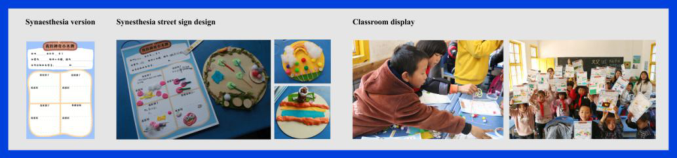
Synaesthesia Training and Building Model Making In this part of the teaching, students first through field observation, mobilize multi-sensory channels to perceive nature and describe and record personal feelings. Then carry out synaesthesia exercises, such as expressing the feelings brought by hearing through visual colors, etc., so that the senses can pene- trate and merge and cause associations (Ward, 2008). Provide students with a variety of handmade materials, as well as emotional boards, match different materials with sensory descriptions, and record synaesthesia experiences in emotional boards (see Figure 2). Students then use the handmade materials in the emotional version to design street signs, describe their design process and ideas, and strengthen their embodied perception experience.
The second part is the construction experience of Huayao buildings. This part allows students to watch traditional buildings first, and then learn basic
78 Xu and Zhang
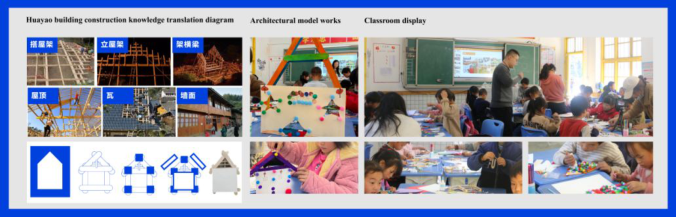
Figure 2: Synaesthesia street sign design course tools and classroom presentations.Figure 3: Huayao architecture building course tools and classroom display.
architectural knowledge through audio-visual resources. Translate the con- struction process of Huayao buildings into a hands-on process of designing sketches, building structures, and drawing decorative elements (see Figure 3). Students use handmade materials such as wooden strips to complete the model created by hand. Students must first consider the size and proportion, design sketches, and then select wooden strips to complete the construction, training logic, and spatial thinking ability (Arin, 2014). In the process of decoration and drawing, it is necessary to recall the architectural decoration elements seen in daily life, to complete the aesthetic creation and expression.
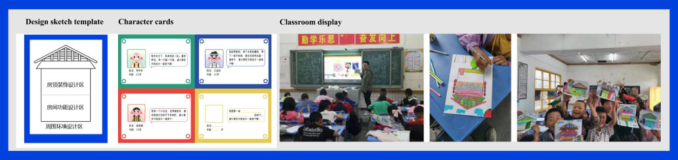
Choose a Character to Complete the Architectural Design Task In this stage, it is mainly to guide students to actively discover, explore and solve problems. Each student plays the role of Huayao Architectural Desi- gner and completes the task of designing Huayao buildings for the villagers (see Figure 4). Students first select a role card, which contains the iden- tity information and living needs of Huayao villagers. Analyze the villagers’ living problems in specific situations according to the role cards, think about solutions, and express them by drawing sketches. After the sketch design is completed, students use handmade materials and template tools to complete the space planning, functional design, decorative design, and environmental layout of the architectural model, so that students can form a personalized cognition in the creation and cultivate creative thinking.
Display and Evaluate Design Works This process mainly encourages students to evaluate their own and oth- ers’ design works, and realize multi-dimensional thinking in the process of sharing and communication (see Table 1). After the learning, the learning
From Disembodied to Embodied: The Embodied Transformation 79
Figure 4: Huayao architectural design course tools and classroom display.Table 1. Student representative works showcase.
Table available in the original PDF paper.
Student work Student description Teacher evaluation Course content
Synaesthesia exercises
She applies her own fee- lings to the design of street signs.
The street signs I desi- gned represent blue sky and white clouds and birds.
He solved problems with measurements
Building model making
I made a big house out of a lot of wood slats; I made windows out of stars.
Architectural design creation
The children solved the grandma’s problems in the creative process.
I designed for my the elderly, who was in poor health and needed a bed.
effect is analyzed through interviews, questionnaires, and evaluation, and the teaching strategies are adjusted in time according to the specific situation. The results of the after-class questionnaire showed that 75% of the students were interested in the Huayao architectural culture, 73.33% of the students expressed their pride in the Huayao culture, and 75% of the students liked the course and wished to continue their studies.
CONCLUSION
Aiming at the problems of abstraction of knowledge, single perception, and lack of practice in the current children’s architectural education, this paper summarizes four design elements of the embodied learning situation, namely the daily cultural situation, the embodied resource situation, and the role task situation and evaluations generate situation. Taking this as a theoretical guide, the architectural aesthetic education course of “Little Huayao Archite- ctural Designer” is designed, which strengthens the perception of knowledge through synaesthesia experience and manual practice realizes the internali- zation of knowledge through participation in tasks and realizes personalized cognition through evaluation and reflection. cognition. Let local children complete their learning in embodied situations, cultivate their ability to solve problems and create, deepen their understanding of architectural culture, and build cultural confidence (Çiftçi, 2020). Provide an effective reference
80 Xu and Zhang
for children’s architectural education design, and explore feasible localized children’s architectural education.
ACKNOWLEDGMENTS
The project is funded by Hunan province educational science foundation project, under project No. ND229962.
REFERENCES
Arin, S. (2014). Built environment education for children through architectural workshops. Procedia-Social and Behavioral Sciences, 143, 35–39. Black, J. B., Segal, A., Vitale, J., & Fadjo, C. L. (2012). Embodied cognition and
learning environment design. Theoretical foundations of learning environments, 2, 198–223. Bloom, B. S. (1994). Reflections on the development and use of the taxonomy. Yearbook: National Society for the Study of Education, 92(2), 1–8. Choi, J. I., & Hannafin, M. (1995). Situated cognition and learning environments:
Roles, structures, and implications for design. Educational technology research and development, 43(2), 53–69. Choi, J. I., & Hannafin, M. (1995). Situated cognition and learning environments: Roles, structures, and implications for design. Educational technology research and development, 43(2), 53–69. Çiftçi, A. (2020). Impact of historic environments on child’s cultural identity and
architectural heritage awareness: CATCH (children-architects to create homes), Erasmus+ project experience. The Historic Environment: Policy & Practice, 11(2- 3), 127–157. Dewey, J. (1930). The quest for certainty: A study of the relation of knowledge and action. The Journal of Philosophy, 27(1), 14–25. Ehteshami, A. (2018). Children and the History of Architecture. Ji, Y., Liu, Y., Sun, X., Tan, P., Fu, T., & Feng, K. (2019, July). Research on Chinese
traditional handicraft education expansion model based on STEAM. In Inter- national Conference on Human-Computer Interaction (pp. 413–427). Springer, Cham. Jonassen, D. H., Tessmer, M., & Hannum, W. H. (1998). Task analysis methods for instructional design. Routledge. Merleau-Ponty, M., & Smith, C. (1962). Phenomenology of perception (Vol. 26).
London: Routledge. Spencer, C., & Woolley, H. (2000). Children and the city: a summary of recent environmental psychology research. Child: care, health and development, 26(3), 181–198. Thomas, R. (1992). Teaching for Transfer of Learning. Ward, J., Thompson-Lake, D., Ely, R., & Kaminski, F. (2008). Synaesthesia, creativity
and art: What is the link?. British Journal of Psychology, 99(1), 127–141. Wilson, M. (2002). Six views of embodied cognition. Psychonomic bulletin & review, 9(4), 625–636.
LISTED IN THE AHFE DIGITAL BOOKSTORE CATALOGUE
Explore the complete digital volume
Training, Education, and Learning Sciences
Read this individual research paper free through the original publisher, or explore the full digital proceedings book.
ISBN 978-1-958651-35-3
Explore this ISBN in the AHFE Bookstore ↗Listed in the July 2026 bookstore catalogue; search by ISBN to confirm current availability · Digital book purchase optional