Yi Sin Wu, Chun Yen Chen, Chang Teng-, Yee Pay Wuang (2024). Cool Guy's Adventure: A Sensory Integration Game Designed for Children with Attention Deficit Hyperactivity Disorder (ADHD). In: Human Factors in Aging and Special Needs. AHFE Open Access, vol. 133, pp. 157–167. https://doi.org/10.54941/ahfe1004904
This paper offers an interactive scenario of Cool Guy's Adventure for children with Attention Deficit Hyperactivity Disorder (ADHD) based on sensory integration (SIT). We present a design framework that allows occupational therapists to arrange and combine game units and difficulty levels. ADHD is one of the most common neurodevelopmental disorders of childhood. Many studies have utilized HCI technology to assist and treat patients with various mental conditions, helping them lead healthier lives. However, there has been limited attention given to the development of HCI technologies to support children with ADHD. The game was developed using the Unity3D game engine and Microsoft Kinect®, each game design focuses on sensory integration training and enhances the child's intrinsic motivation: Throw the perfect ball, Play hopscotch, and Capture treasure. We present assessments and results after testing a sample of children (n=4), aged 8, with or without ADHD.■ References[1]Fage C., Pommereau L., Consel C., Balland E. and Sauzéon H. 2014. The 16th International ACM SIGACCESS Conference on Computers and Accessibility Tablet-based Activity Schedule for Children with Autism in Mainstream Environment. Rochester, USA, 145-152. DOI: https://doi.org/10.1145/2858036.2858245[2]Sonne T. and Jensen M. M. 2016. Evaluating the ChillFish Biofeedback Game with Children with ADHD. In Proceedings of the 2016 ACM Interaction Design and Children (IDC), Manchester, United Kingdom, 529-534. DOI: https://doi.org/10.1145/2930674.2935981[3]American Psychiatric Association. 2013. Diagnostic and Statistical Manual of Mental Disorders. Fifth edition: DSM-5, Washington, p.991.[4]Liao M.-N. 2016. Co-creation - Exploration and Research on The Joint Decision-making Mode of Interdisciplinary Cooperation. Master’s thesis. National Yunlin University of Science and Technology.
In recent years, many studies have utilized HCI (Human-Computer Inter- action) technology to assist and treat patients with various mental disorders, enabling them to lead healthier lives (Gürbüzsel et al., 2022; Sonne & Jensen, 2016). However, there has been limited focus on developing technologies to support children with ADHD (Attention Deficit Hyperactivity Disorder), despite it being one of the most common neurodevelopmental disorders of childhood. According to the Diagnostic and Statistical Manual of Mental Disorders (DSM-5), population surveys suggest that ADHD occurs world- wide in approximately 7.2% of children (American Psychiatric Association, 2022). One of the primary treatments for ADHD involves SIT (Sensory Integra- tion Therapy) in functional therapy to enhance the intrinsic motivation of children with ADHD. Nowadays, an increasing number of complex social
and design issues cannot be resolved solely within a single field of exper- tise (MacCaull et al., 2010). This study proposes a design framework, developed through collaboration between digital media experts and sensory integration therapists in interdisciplinary workshops, aimed at integrating sensory integration therapy with context-based interactive gaming. This allows occupational therapists to arrange game units and difficulty levels.
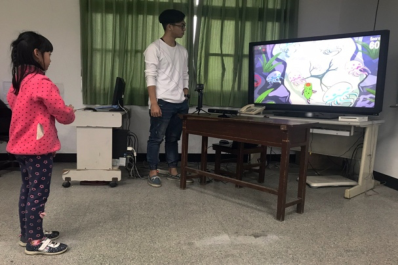
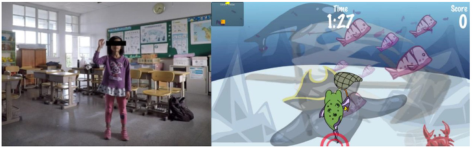
The interactive scenario of the game involves children navigating an adven- ture as a fish. Developed using the Unity3D game engine and Microsoft Kinect®, the engine utilizes sensing devices to capture, track, and inter- pret body movements and gestures, eliminating the need for users to wear additional aids. We present assessments and results after informally tested children (n = 4) ages 8 (with or without ADHD) (see Figure 1).
Figure 1: At the stage one: throw the perfect ball.
BACKGROUND
To explore these issues, we have conducted a survey of existing literature, presented in the first part of this paper. In the background, we introduce some basic concepts of children with ADHD. We review the most relevant game-based approaches that employ non-conventional forms of interaction for children with ADHD, and provide a more detailed presentation of existing studies on motion-based gaming for ADHD children. In the second part of the paper, we present the empirical study that we conducted to investigate the appropriateness and educational potential of motion-based touchless gaming for children with ADHD.
Challenges for Children With ADHD ADHD is a persistent neurodevelopmental disorder, recognized as the most prevalent mental health and behavioural disorder among children and ado- lescents aged 3-17. Its impact extends into adulthood for both males and females, highlighting its significance as a public health concern (Perou et al., 2013). Clinical observations suggest that ADHD is a neuropsychological disor- der, with attentional and executive dysfunctions playing a central role. These include disinhibition, impulse control (Barkley et al., 1997; Pennington &
Cool Guy’s Adventure: A Sensory Integration Game Designed for Children 159
Ozonoff, 1996), working memory, cognitive flexibility, planning, organiza- tion (Denckla, 1989), and delay aversion—where individuals seek to escape discomfort caused by delayed gratification (Hanisch et al., 2004).
In addition to symptoms like distractibility, restlessness, and impulse con- trol issues, children with ADHD often require occupational therapy and rehabilitation due to motor function problems (Udal et al., 2009). They may also struggle with visual and/or auditory tasks (Dalen et al., 2004). In the fol- lowing section, we will discuss motor function and visual processing issues in ADHD children.
Motor Function Problems Although ADHD children are often restless, they exhibit lower levels of phys- ical coordination, power control, and visual integration perception compared to children of the same age (Harvey et al., 2007). These motor-related pro- cessing dysfunctions may stem from an inability to modulate behavioural states, primarily involving the brain’s motor control and coordinating struc- tures (Sergeant & Meere, 1988). Furthermore, motor function weaknesses may arise from delays in cognitive processes preceding overt motor actions (Banaschewski et al., 2001).
Many studies suggest that children with ADHD are not entirely devoid of motor function abilities, but they perform worse than their typically devel- oping peers in terms of static balance (Mao et al., 2014), dynamic balance (Goetz et al., 2017), fine motor skills (Fenollar-Cortés et al., 2017), and motor speed (Rommelse et al., 2007). Notably, the majority of these studies have found impaired balance functions in ADHD individuals. To maintain balance across various environmental conditions, sensory information from somatosensory, visual, and vestibular origins must be integrated by the cen- tral nervous system (Takagi et al., 2022). These balance impairments can hinder activity or participation and increase the risk of injury for children with ADHD.
Visual Function Problems Comparing the standing balance ability and sensory organization of stand- ing balance control between school-aged children with ADHD and typically developing children, the study revealed an overall significant difference in bal- ance performance between the two groups (Shum & Pang, 2009). Sensory organization is associated with the processing of visual perception systems and sensory signal interruptions, including visual attention and visual spatial attention (Chen et al., 2002).
The aforementioned issues encompass attention deficit, movement, and visual perception, causing children with ADHD to often struggle to meet envi- ronmental demands in daily life situations, including school, family, and com- munity settings. Compared to typically developing children aged 6-12, those with ADHD demonstrate weaker performance in abstract thinking, concept formation and transformation, sequential planning ability, organizational ability, and reaction inhibition (Lawrence et al., 2004).
Motor function problems and visual function problems can impact various aspects of daily activities for children with ADHD, particularly their perfor- mance in school. It is essential to consider how sensory processing issues influence motor function problems and visual function problems in children with ADHD. Therefore, training in motor control and behaviour manage- ment techniques plays a crucial role within the framework of a multimodal treatment approach to ADHD (Barkley, 2015).
OCCUPATIONAL THERAPY Occupational Therapy aims to assist individuals with physical, psychological, developmental disabilities, or social dysfunction through purposeful activi- ties to achieve maximum independence in daily life (American Occupational Therapy Association, 2024). Sensory Integration therapy, first described by occupational therapist Dr. Ayres, is based on sensory integration theory and utilizes therapeutic activities to address sensory processing issues (AYRES, 1995). Dr. Wuang emphasized that sensory integration is a function of a normal brain, wherein various learning abilities are developed through the selective intake and organization of sensory stimuli (Wuang, 2009).
Sensory-based therapies involve activities believed to organize the sen- sory system through fun and play-based approaches (Section On Comple- mentary And Integrative Medicine et al., 2012). Occupational Therapists use specially designed equipment such as balls, swings, and trampolines to provide sensory inputs and modify how the brain reacts to touch, sound, sight, and movement. The therapist adjusts the sensory environ- ment to promote self-direction, play, and adaptive responses in various areas, creating suitable challenges and tapping into the child’s inner drive (Schaaf & Roley, 2006).
Sensory integration encompasses a variety of sensory messages in the envi- ronment, including vestibular, proprioception, touch, sight, hearing, smell, and taste. The vestibular system, responsible for balance and spatial orienta- tion, consists of otolith organs and semi-circular canals, which detect linear acceleration and position relative to gravity (Wiener-Vacher et al., 2013). Pro- prioception involves sensing the position and movement of body parts and the effort being employed in movement (Proske & Gandevia, 2012). The brain integrates information from the vestibular system and proprioception to determine body position, movement, and acceleration, while also integrat- ing external sensory input to generate appropriate responses. Sensorimotor training is an essential component of treatment programs for ADHD children (Gillberg & Kadesjö, 2003).
RELATED WORK
A well-designed game with clear and achievable goals, challenging activities requiring skill, and immediate feedback on performance enables the player to achieve what Csikszentmihalyi terms as the Flow state of mind (Chen, 2007). It’s can offer assistance in non-intrusive ways, and foster children’s
Cool Guy’s Adventure: A Sensory Integration Game Designed for Children 161
inner drive. However, it depends on whether the game incorporates user- oriented design, through relevant cases, we explore interactive feedback from interactive devices to children.
Design and Games for Children With ADHD Lands of Fog and Adventurous Dreaming Highflying Dragon are both exam- ple of assistive technologies for ADHD children. Lands of Fog designed a full-body interaction experience for children with Autism Spectrum Disorder (ASD) (Mora-Guiard et al., 2016). This virtual world is a unique place where different biomes meet, inhabited by strange and unique insects and creatures. Each zone is populated by unique objects and creatures, revealed as the child moves through the space, gradually understanding the structure of the virtual environments (see Figure 2).
Figure 2: Fog is a full-body virtual environment.
Adventurous Dreaming Highflying Dragon is a game prototype for ADHD children (Hashemian & Gotsis, 2013). The player role-plays a young dragon to complete the tasks. The physical activity tasks are integrated with cogni- tively challenging tasks that can help improve ADHD-related symptoms.
Motion-Based Touchless Games The study on motion-based touchless games expands the current empir- ical evidence of the potential benefits of touchless motion-based gaming (Bartoli et al., 2013). Children with ADHD are often described as inatten- tive, frequently failing to listen, having difficulty focusing on any one thing, and displaying an inability to finish tasks. They have unique training needs, including patience, reinforcement, and encouragement, which Kinect games can help address. Occupational therapists analyse a variety of games and set selection criteria by choosing conventional ones in therapeutic centres. These criteria include:
1. Task simplicity: All games must comprise only one game rule to help children focus their attention and emotions on play. 2. Short duration: Game sessions should be completed in a few minutes to favour concentration and keep physical fatigue at an affordable level. 3. Ordering: Games should be ordered in terms of complexity to engage chil- dren in progressively more demanding experiences based on their motor and cognitive skills.
4. Balanced diversity: Games must have heterogeneous content and design characteristics to avoid boredom, while not being too different to reduce the risk of creating anxiety.
METHODOLOGY
This project is part of an ongoing research initiative conducted in collabo- ration with the Department of Occupational Therapy at Kaohsiung Medical University. We collaborate with various stakeholders to develop, implement, and assess design interventions aimed at enhancing interactive situational play for children with ADHD. The project draws primarily on literature and theories related to sensory integration. Additionally, we have organized cross- disciplinary workshops involving digital media designers and occupational therapists.
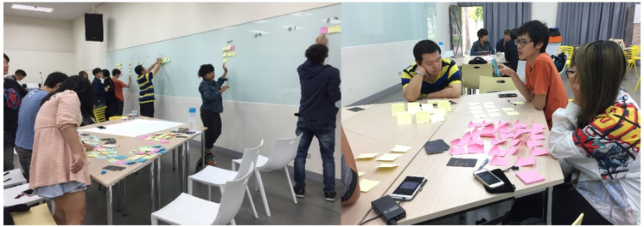
The Cross-Disciplinary Workshop During the initial stage of the workshop, OTs shared their clinical treatment experiences, providing designers with first hand insights into the reactions of ADHD children. This enabled designers to determine appropriate levels of game feedback. Given that OTs may lack experience and training in creative thinking, the second stage involved engaging them in simple creative exer- cises. Using guided creative thinking cards, OTs were encouraged to explore their imaginations and practice critical thinking, with the aim of articulating their ideas. In the third stage, ideas from both digital media designers and functional therapists were combined. Facilitated by digital media designers and facilitators, each group was tasked with consolidating their ideas into a cohesive narrative (see Figure 3).
Figure 3: Designers and OTs creative ideas for situational games.
Origins of Game Concept OTs share their experiences in creating assistive devices for clinical treat- ments, such as using Microsoft PowerPoint to develop animated car games. They noted that most toys or games available in the market are not suit- able for children with ADHD. Additionally, the condition of each child under the care of functional therapists varies. According to characteristic symptoms, ADHD is categorized into three types: (1) combined subtype,
Cool Guy’s Adventure: A Sensory Integration Game Designed for Children 163
which includes symptoms of attention deficit, hyperactivity, and impulsive- ness; (2) inattentive subtype, characterized by symptoms of inattention only; and (3) hyperactive/impulsive subtype, with symptoms of hyperactivity and impulsiveness only (Rommelse et al., 2007). Consequently, OTs must tailor the design of assistive devices according to the specific needs of each case.
In response to the challenges faced by OTs, designers propose solutions and methods that enable functional therapists to adjust the game’s diffi- culty level freely and integrate it with a narrative. This game comprises three mini-games, with a modular play structure that allows children to engage in repetitive tasks and attain mastery. It is hoped that these skills will gener- alize to real-life scenarios, enabling children to accomplish tasks they were previously unable to perform.
Style of Cool Guy’s Adventure The narrative of the game involves the story of a young fish’s (cool guy) adventure, aiming to engage children to play and repeat it until the end. The game story takes place between Asia, Africa and Europe’s’ vast waters – the Mediterranean. Children play as a very young fish – cool guy, who is naughty, is also a small adventurer who is adventurous. The cool guy’s mother is the most beautiful fish in the Mediterranean, because she is so beautiful that she is quietly stared by the evil eel. The evil eel takes away the mother when the cool guy went out, he must strain every nerve to go to eel’s lair to save his mother.
There are many tasks on the way to stop the player, for instance the thrilling seagrasses, the unfathomable trenches and large stones that block the road. Each mini-game has its own scenario and takes place at different locations in the sea world for variety and mitigation of boredom. The game was developed through iterative design with the Unity3D game engine and Microsoft Kinect®, and informally tested children (n = 4) ages 8 (with or without ADHD).
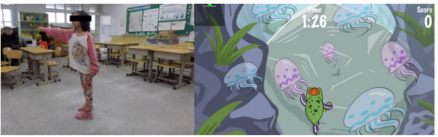
Throw the Perfect Ball: Cool Guy finds himself blocked by large stones within the cave, but notices some cracks on the surface.
Players can use stones to strike these cracks and break through the obstruc- tion. ADHD children must aim accurately at the target to successfully dislodge the stone and progress forward (see Figure 4). Each target changes position, enhancing hand-eye coordination, spatial judgment, and strength control. The system records the deviation of each missed throw, learns from the hit rate via game scores, and monitors the emotional responses of ADHD children.
Figure 4: Players hit those cracks to break the stone and move forward.
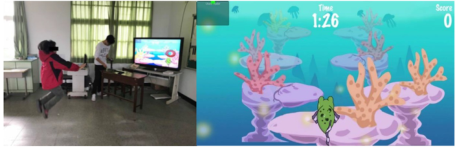
Play Hopscotch: Cool Guy ventures into a deep valley where the only path forward requires using intermittent stone pillars as footholds, proceeding cautiously and steadily.
Players must execute small jumps to step onto each stone pillar, navigat- ing uneven distances between them (see Figure 5). The system records the deviation value of each failed jump and determines success rates based on the score. This activity enhances coordination between eye movements and lower limb actions, aiding in body posture control, balance response, and motion planning.
Figure 5: Players must make a small jump and move to step on the stone pillar.
Capture Treasure: In this area, many ships have sunk, leaving behind wreckage and valuable treasures. The terrain is complex, so the captain of the squid, the owner of this territory, will guide the player through it.
Players needs to assist the captain in navigating left or right while using the net to catch any treasures that may pose a collision risk, thus ensuring the captain’s movement remains unhindered (see Figure 6). ADHD children wave their arms to block passing treasures, with the speed of treasure appearances varying. The system records deviations from the target and the overall success rate when fishing fails. This activity helps improve posture control, object movement speed judgment, and enhances the movement planning abilities of ADHD children.
Figure 6: Players wave their arms to intercept the passing treasures.
RESULTS AND DISCUSSION
The study presents a situational game that integrates sensory integration with digital media. The primary objectives are to (1) enhance the inner drive of children with ADHD, (2) collect data on possible activities for ADHD chil- dren, (3) reduce repetitive activities among children, and lessen the burden on occupational therapists who create assistive devices.
Cool Guy’s Adventure: A Sensory Integration Game Designed for Children 165
Following the experiment, it was observed that in the interactive situa- tional design of Cool Guy’s Adventure, children interacted well with Kinect sensing games. Experimental data revealed improvements in children’s hand movements and the stability of their upper and lower trunk postures. How- ever, during the observational phase of this project, conducted weekly for four weeks with the children, it became evident that by the third week, there were expressions of “again” and “why.” Developing different situational stories should significantly enhance the inner drive of ADHD children.
In terms of game design, the project utilizes Kinect for its hardware com- ponent. However, if it could integrate specialized equipment commonly used by occupational therapists, such as balls and dolls, to enrich sensory informa- tion, and combine different situational stories, it could help children adapt their responses within the game, create appropriate challenges, and stimulate their inner drive.
ACKNOWLEDGMENT
We would like to express our gratitude to the National Science and Tech- nology Council in Taiwan for providing research funding. In this study, four 8-year-old children from Shuidui Elementary School were recruited. We extend our thanks to the children and their parents for their participation.
REFERENCES
American Occupational Therapy Association. (2024). About Occupational Therapy.
Retrieved Feburary 17 from https://www.aota.org/About-Occupational-Therapy American Psychiatric Association. (2022). Diagnostic and Statistical Manual of Mental Disorders. Fifth edition: DSM-5. AYRES, A. J. (1995). Proprioceptive facilitation elicited through the upper extremi-
ties: I. Background. The American journal of occupational therapy, 9(2, Part 1), 1–9. Banaschewski, T., Besmens, F., Zieger, H., & Rothenberger, A. (2001). Evaluation of sensorimotor training in children with ADHD. Perceptual and Motor Skills, 92(1), 137–149. https://doi.org/10.2466/pms.2001.92.1.137 Barkley, R. A. (2015). Attention-deficit hyperactivity disorder: A handbook for
diagnosis and treatment, 4th ed. The Guilford Press. Barkley, R. A., Koplowitz, S., Anderson, T., & McMurray, M. B. (1997). Sense of time in children with ADHD: effects of duration, distraction, and stimulant medication. The International Neuropsychological Society, 3(4), 359–369. Bartoli, L., Corradi, C., Garzotto, F., & Valoriani, M. (2013). Exploring Motion-
based Touchless Games for Autistic Children’s Learning. The 12th International Conference on Interaction Design and Children, New York, New York, USA. Chen, C.-Y., Chen, C.-L., Wu, C.-Y., Chen, H.-C., Tang, F.-T., & Wong, M.-K.(2002).
Visual spatial attention in children with attention deficit hyperactivity disorder. Journal of Chang Gung Medicine, 25(8), 514–521. Chen, J. (2007). Flow in Games (and Everything Else). Communications of the ACM, 50(4), 31–34. Dalen, L., Sonuga-Barke, E. J. S., & Martin Hall, B. R. (2004). Inhibitory deficits,
delay aversion and preschool AD/HD: implications for the dual pathway model. Neural Plasticity, 11(1–2), 1–11. https://doi.org/10.1186/1744-9081-5-47
Denckla, M. B. (1989). Executive function, the overlap zone between attention deficit hyperactivity disorder and learning disabilities. International Pediatrics, 4(2), 155–160. Fenollar-Cortés, J., Gallego-Martínez, A., & Fuentes, L. J. (2017). The role of inat-
tention and hyperactivity/impulsivity in the fine motor coordination in children with ADHD. Research in Developmental Disabilities, 69, 77–84. Gillberg, C., & Kadesjö, B. (2003). Why Bother About Clumsiness? The Implications of Having Developmental Coordination Disorder (DCD). Neural Plasticity, 10(1–2), 59–68. Goetz, M., Schwabova, J. P., Hlavka, Z., Ptacek, R., & Surman, C. B. (2017).
Dynamic balance in children with attention-deficit hyperactivity disorder and its relationship with cognitive functions and cerebellum. Neuropsychiatric Disease and Treatment, 13, 873–880. https://doi.org/10.2147/ndt.s125169 Gürbüzsel, ˙I., Göksun, T., & Co¸skun, A. (2022). Eliciting parents’ insights into products for supporting and tracking children’s fine motor development. The 21st Annual ACM Interaction Design and Children Conference, Braga Portugal. Hanisch, C., Konrad, K., Günther, T., & Herpertz-Dahlmann, B. (2004). Age-
dependent neuropsychological deficits and effects of methylphenidate in children with attention-deficit/hyperactivity disorder: a comparison of pre-and grade- school children. Journal of Neural Transmission, 111(7), 865–881. Harvey, W. J., Reid, G., Grizenko, N., Mbekou, V., Ter-Stepanian, M., & Joober, R. (2007). Fundamental Movement Skills and Children with Attention-Deficit Hyperactivity Disorder: Peer Comparisons and Stimulant Effects. Journal of Abnormal Child Psychology, 35(5), 871–882. https://doi.org/10.1007/s10802- 007-9140-5 Hashemian, Y., & Gotsis, M. (2013). Adventurous Dreaming Highflying Dragon: a
full body game for children with attention deficit hyperactivity disorder (ADHD). The 4th Conference on Wireless Health, Baltimore, Maryland. Lawrence, Houghton, V., Douglas, S., Durkin, G., Whiting, K., & Ken Tannock, R.
(2004). Executive function and ADHD; A comparison of children’s performance during neuropsychological testing and real-world activities. Journal of Attention Disorders, 7(3), 137–149. https://doi.org/10.1177/108705470400700302 MacCaull, W., Jewers, H., & Latzel, M. (2010). Using an interdisciplinary approach to develop a knowledge-driven careflow management system for collaborative patient-centred palliative care. The 1st ACM International Health Informatics Symposium, New York. Mao, H.-Y., Kuo, L.-C., Yang, A.-L., & Su, C.-T. (2014). Balance in children with
attention deficit hyperactivity disorder-combined type. Research in Developmen- tal Disabilities, 35(6), 1252–1258. Mora-Guiard, J., Crowell, C., Pares, N., & Heaton, P. (2016). Lands of Fog: Helping Children with Autism in Social Interaction through a Full-Body Interactive Expe- rience. The 15th International Conference on Interaction Design and Children, Manchester, United Kingdom. Pennington, B. F., & Ozonoff, S. (1996). Executive functions and developmental
psychopathology. Journal of Child Psychology and Psychiatry, 37(1), 51–87. Perou, R., Bitsko, R. H., Blumberg, S. J., Pastor, P., Ghandour, R. M., Gfroerer, J.
C., Hedden, S. L., Crosby, A. E., Visser, S. N., Schieve, L. A., Parks, S. E., Hall, J. E., Brody, D., Simile, C. M., Thompson, W. W., Baio, J., Avenevoli, S., Kogan, M. D., & Huang, L. N. (2013). Mental health surveillance among children—United States 2005–2011.
Cool Guy’s Adventure: A Sensory Integration Game Designed for Children 167
Proske, U., & Gandevia, S. C. (2012). The proprioceptive senses: their roles in signaling body shape, body position and movement, and muscle force. American Physiological Society, 92(4), 1651–1697. Rommelse, N. N. J., Altink, M. E., Oosterlaan, J., Beem, L., Buschgens, C. J. M.,
Buitelaar, J., & Sergeant, J. A. (2007). Speed, Variability, and Timing of Motor Output in ADHD: Which Measures are Useful for Endophenotypic Research? Behavior Genetics, 38(2), 121–132. https://doi.org/10.1007/s10519-007-9186-8 Schaaf, R. C., & Roley, S. S. (2006). SI: Applying Clinical Reasoning To Practice with Diverse Populations. TX: Psychological Corporation. Section On Complementary And Integrative Medicine, Council on Children with
Disabilities, American Academy of Pediatrics, Michelle Zimmer, & Desch, L. (2012). Sensory integration therapies for children with developmental and behav- ioral disorders. Pediatrics, 129(6), 1186–1189. Sergeant, J. A., & Meere, J. v. d. (1988). What happens after a hyperactive child commits an error? Psychiatry Research, 24(2), 157–164. Shum, S. B. M., & Pang, M. Y. C. (2009). Children with Attention Deficit Hyperac-
tivity Disorder Have Impaired Balance Function: Involvement of Somatosensory, Visual, and Vestibular Systems. The Journal of Pediatrics, 155(2), 245–249. Sonne, T., & Jensen, M. M. (2016). Evaluating the ChillFish Biofeedback Game with Children with ADHD. The 15th International Conference on Interaction Design and Children, Manchester United Kingdom. Takagi, S., Hori, H., Yamaguchi, T., Ochi, S., Nishida, M., Maruo, T., & Takahashi, H. (2022). Motor Functional Characteristics in Attention- Deficit/Hyperactivity Disorder and Autism Spectrum Disorders: A Systematic Review. Neuropsychiatric Disease and Treatment, 18, 1679–1695. Udal, A. H., Malt, U. F., Lövdahl, H., Gjaerum, B., Pripp, A. H., & Groholt, B.
(2009). Motor function may differentiate attention deficit hyperactivity disorder from early onset bipolar disorder. Behavioral and Brain Functions, 5, 47. Wiener-Vacher, S. R., Hamilton, D. A., & Wiener, S. I. (2013). Vestibular activity and cognitive development in children: perspectives. Frontiers in Integrative Neuroscience, 7(92). https://doi.org/10.1145/2930674.2935981 Wuang, Y.-P. (2009). Sensory Integration. Wu-Nan Book.
LISTED IN THE AHFE DIGITAL BOOKSTORE CATALOGUE
Explore the complete digital volume
Human Factors in Aging and Special Needs
Read this individual research paper free through the original publisher, or explore the full digital proceedings book.
ISBN 978-1-964867-09-0
Explore this ISBN in the AHFE Bookstore ↗Listed in the July 2026 bookstore catalogue; search by ISBN to confirm current availability · Digital book purchase optional