Yana Korneeva, Mariya Tunkina, Natalia Simonova, Anna Trofimova (2022). Working capacity and general functional state during a 20-day Arctic expedition (on the example of the Arctic Floating University). In: Social and Occupational Ergonomics. AHFE Open Access, vol. 65, pp. 221–227. https://doi.org/10.54941/ahfe1002679
The climatic and geographical conditions of the Arctic region and social and living conditions of the expeditionary form of work can have a negative impact on the activities and well-being of people carrying out their professional activities in these conditions. The person functional state reflects the main activity level of the main physiological systems (autonomic nervous system, etc.) in a certain period of time. Daily monitoring of human’s functioning cardiovascular and nervous systems indicators is an effective technology for the prevention of psychological maladjustment, deterioration of health, and undesirable situations under the influence of unfavorable factors. The study purpose is to describe the working capacity and general functional states dynamics of expedition members during the expedition period in the Arctic. Research methods are instrumental psychophysiological methods, psychological questionnaires and multivariate statistical analysis methods. This study was conducted on research vessel within 20 days in the morning and in the evening. The study involved 39 people (average age – 33,6 ± 2 years). The majority of employees experience an increase in their working capacity against the background of a decrease in the level of their general functional state at the beginning of the expedition period. The middle of the expeditionary period is characterized by the instability of the working capacity level. With the end of the active research work period, the general functional state of many participants is associated with a period of rest and recovery. In the dynamics of the autonomic nervous system and the sympathetic nervous system states prevails over the parasympathetic according to the data of objective (instrumental psychophysiological diagnostics) and subjective methods (psychological methods). Some of the results correlate with our previous studies, which were devoted to the study of the shift workers' human functional state.
The Arctic climatic and geographical conditions can have a negative impact on the activities and well-being of people who live and work in these areas (Nagornev et al., 2019; Moran, 2020; Korneeva, 2022). An additional impact is exerted by social factors of professional activity in expeditionary conditions, for example, group isolation, limitation of personal space, unifor- mity of the situation, and others (Rothblum, 1990; Palinkas, Suedfeld, 2008; Moraes et al, 2020). The influence of these factors and conditions is refle- cted in nervous, endocrine and cardiovascular systems reactions (Khasnulin, Khasnulin, 2012). Work in extreme conditions places increased demands on the workers’ adaptation and necessitates high energy costs and the ability to quickly mobilize the functional reserves of the body (Yusupov, Ovchin- nikov, 2016; Popova et al., 2018). The concept of human functional states is used for the analysis of various human states relevant to work conditi- ons: fatigue, monotony, job stress reactions, physical and emotional strain, states of optimal workability, and so on (Leonova, 2009). Dynamic monito- ring of the cardiovascular system and the human nervous system functioning is an effective technology for the prevention of psychological maladjustment, deterioration in health and emergency situations under the influence of unfa- vorable Arctic climatic and geographical conditions and social conditions of the expeditionary fly-in-fly-out work method. In favor of the need to con- duct studies using the daily monitoring technology of human conditions is also indicated by the fact that scientific studies with a similar design are insuf- ficient. The study purpose is to describe the functional states of expedition members during the expedition period in the Arctic.
MATERIALS AND RESEARCH METHODS The study by means of a scientific expedition was carried out on the research vessel “Mikhail Somov” (Russia) from June 11 to June 30, 2021 (20 days) as part of the project “Arctic Floating University - 2021”. Expedition route is Arkhangelsk - Novaya Zemlya - archipelago Franz Josef Land - Arkhangelsk. The study started on the second day of the expedition and involved 39 people (19 men and 20 women aged 20 to 72 years, average age – 33,6 ± 2,12 years).
Dynamic monitoring of the participants’ general functional state and wor- king capacity was carried out daily in the morning and in the evening during the entire expedition period in the Arctic using the following research methods: 1. Psychophysiological method involving the use of the device UPFT-1/30- “Psychophysiologist”: a. method of variational cardiointervalometry (VCM) for assessing the general functional state of body based on an analysis of the cardiova- scular system parameters; b. method of complex visual-motor reaction (CVMR-35) for assessing the speed and quality characteristics of the reaction with switching (to a light stimulus of two different colors). Based on these parameters, the operator (mental) working capacity level is determined.
Working Capacity and General Functional State During a 20-Day Arctic Expedition 223
2. Psychological methods:
c. the questionnaire for the state self-assessment “Well-being. Activity. Mood” (WAM), developed by V.A. Doskin, N.A. Lavrentieva, V.B. Sha- ray and M.P. Miroshnikov (Doskin et al., 1978). WAM is a table containing 30 pairs of words reflecting the studied features of the psycho-emotional state (well-being, mood, activity), expressed in polar ratings; d. color test by M. Luscher (Luscher, Scott, 1969), using interpretation coef- ficients developed by G.A. Aminev based on factor analysis for this test (Aminev, 2010). Coefficients (“vegetative balance”, “operability” and others) are calculated using formulas that reflect a certain combination of colors. They are considered by us as projective indicators that reflect the psycho-emotional characteristics of a person’s state at the time of the study.
The rationale for this scientific design of the study and the application of the objective and subjective methods complexes for assessing the state of employees is presented in our previous study (Korneeva, Simonova, 2020).
For statistical data processing, descriptive statistics and frequency analysis were used by applying the “IBM SPSS Statistics 23.00” package.
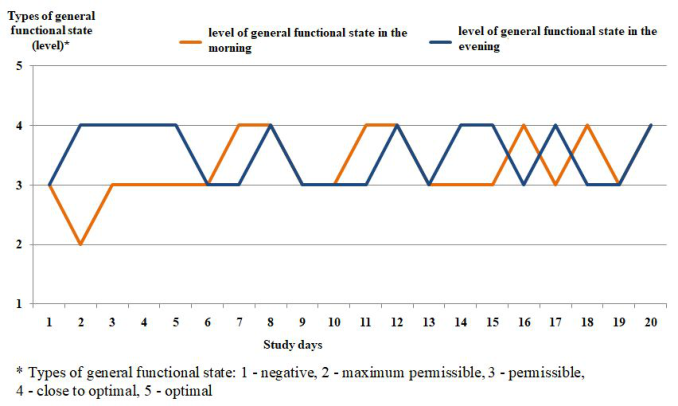
RESEARCH RESULTS According to the results of the frequency analysis by the general functio- nal states of the body (VCM method) during the expedition and the median values of the participants’ individual dynamics, it was found that the general functional state of the participants’ majority during the expedition period was characterized mainly by acceptable and close to optimal values (see Figure 1). This means that the psychophysiological capabilities and reserves level of cardiovascular and autonomic nervous systems as a whole was sufficient to adapt to the conditions of the expedition and the Arctic environment. The key points can be considered the 2nd and 20th days of study (3rd and 21st days of the expedition), when the number of participants increased, both with a negative functional state level and with a state close to optimal.
The dynamics of the autonomic nervous system state was assessed accor- ding to an objective indicator (using VCM) and a subjective indicator (“vege- tative balance” coefficient for the M. Luscher’ test). The data are consistent and indicate the predominance of a tendency to increase the sympathetic nervous system during the expedition. This is the mobilization state of body functions. At the same time, the parasympathetic nervous system prevalence of the participants was observed at the end of the expedition period, when the stage of collecting materials for their study was completed.
According to the subjective assessments of the participants (WAM method), the improvement in health and increased activity was on the 8th and 11th day of the expedition after landing on the islands. This was clari- fied using the median of measurements for the parameters “well-being” and “activity”.
Figure 1: The participants’ general functional state of body during entire expedition period in the arctic.
The median values for the objective parameter of operator working capa- city (CVMR-35) and for the projective indicator of working capacity (M. Luscher’ method) during the expedition period indicate its optimal level. The first increase in working capacity (using CVMR-35) was recorded at the beginning of the expedition (morning of the 2nd and evening of the 3rd days of the study). The second peak falls on the evening of the 9th and 10th days of the study. These were periods of scientific research (with landing on the island). At the end of the expedition, the working capacity dynamics was characterized by ups and downs (not below average values).
A generalized description of the general functional states of body and wor- king capacity dynamics of the participants during the entire expedition period to the Arctic is presented in Table 1.
CONCLUSION
The dynamic monitoring technology of human functional states based on the consideration of objective and subjective (self-report of participants) data helps to identify key changes in the human states dynamics in the Arctic. At the beginning of the expeditionary period we observe an increase in working capacity indicators against the background of a decrease in the participants’ general functional state level of body in the Arctic scientific expedition. This is a state of moderate tension of regulatory systems in the presence of a suffi- cient psychophysiological reserves level and their optimal use. The middle of the expeditionary period is characterized by instability of the working capa- city level (an increase with a further decrease). With the end of the period of active research work associated with landings on islands and work at oce- anographic stations, the general functional state of many participants was characterized by a period of rest and restoration of homeostatic balance. It
Working Capacity and General Functional State During a 20-Day Arctic Expedition 225
Table 1. The general functional states of body and working capacity dynamics of the participants during entire expedition period to the arctic.
Table available in the original PDF paper.
Characteristics of the functional state and working capacity
Expedition period stage The beginning of the expedition period (trip to the islands) The dynamics of the state in the morning is characterized by a reduced participants’ general functional state of body on the 3rd day of the expedition, followed by normalization of the state (the predominance of acceptable values and those close to optimal). In the evening, the participants are dominated by the close to optimal general functional state of body. The activation of the sympathetic department of the nervous system in the morning prevails. In the evening the balanced influence of the sympathetic and parasympathetic divisions in the regulation of the autonomic nervous system prevails. Increasing efficiency on the 3rd and 4th days of the expedition. The middle of the expeditionary period (the period of active research work)
An increase in the general functional state level in the morning before landings, and, mainly, an acceptable state in the evening on the days after landings. The tendency to increase the working capacity of the majority of participants on the 10th and 11th day of the expedition. The rest of the time, average working capacity values prevail. End of the expedition period (return trip to the city)
More participants with a predominance of acceptable and close to optimal general functional states of body. There were statistically fewer participants with the negative general functional state level. After completion of the island landing phase, the participants are dominated by the activation of the parasympathetic division of the nervous system and the balanced influence of the sympathetic and parasympathetic systems. In the last days of the expedition there is an increase in the influence of the sympathetic department in the morning and evening hours. Efficiency is characterized by a change in high and medium values of the indicator.
was established that the general functional state of the majority of partici- pants during the expedition period was characterized mainly by acceptable and close to optimal values. In the dynamics of the autonomic nervous system and the sympathetic nervous system state prevailed over the parasympathetic one (according to the data of objective and subjective methods). This means that the psycho-physiological capabilities and reserves level of the cardiova- scular and autonomic nervous systems as a whole was sufficient to adapt to the conditions of the expedition and the environment of the Arctic (at the same time, moderate tension of regulatory systems was frequent).
This study results are consistent with the data of previous expeditions “Arctic Floating University” in 2013 (Porokhina, Voytekhovich, Simonova,
2015) and in 2015 (Fedotov, Melkova, Podoplekin, 2017). In 2013 partici- pants showed the predominance of the sympathetic nervous system through- out the entire sea voyage. The authors (Porokhina, Voytekhovich, Simonova, 2015) have also pointed out that the team mood rises occur during peri- ods of high social activity (the largest rise of the indicator coincides with the landing). The study results of the expedition members in 2015 (Fedotov, Mel- kova, Podoplekin, 2017) indicate the absence of a significant negative impact effects of a short-term sea voyage in high latitudes on the participants’ gene- ral functional state of the body. It was found that participants under the age of 35 showed an increase in the activity of parasympathetic influences by the end of the expedition. Conversely, the activity of the sympathetic-adrenal system with a contribution to the humoral component of regulation increases in people over 35 years of age.
In the study (Pankova et al., 2020) participants in short-term expeditions to the North differ from residents of Central Russia and polar regions by the spectral characteristics of heart rate variability. These differences can be con- sidered as correlates of positive and adequate in terms of the physiological value, adaptive changes in the autonomic regulation of the cardiovascular system. According to a study by Palinkas Suedfeld (2008) about 5% of peo- ple on expeditions meet DSM-IV criteria for psychiatric disorders. However, they also experience positive resulting from successfully coping with stress, improved health and personal growth.
We continue to analyze the data obtained during the expedition curren- tly. The results suggest that due to the sufficient adaptive capabilities of the cardiovascular and autonomic nervous systems participants maintain normal indicators of well-being and working capacity.
ACKNOWLEDGMENT
The authors would like to acknowledge scientific and educational project “Arctic floating university - 2021” on the R/V “Mikhail Somov”. The study was carried out as part of the Russian implementation of the state task for conducting fundamental scientific research on the topic “Assessment of psychological risks in the professional activities of specialists in extreme profiles” (project FSRU-2020-006, 2020 - 2022).
REFERENCES
Aminev, G.A. (1982) Mathematical Methods in Engineering Psychology; Bashkir State University: Ufa, Russia. Doskin, V.A.; Lavrent’eva, N.A.; Miroshnikov, M.P.; Sharay, V.B. (1973) Test of
differentiated self-assessment of the functional state. Quest. Psychol. No 6. pp 141–145. Fedotov, D.M., Melkova, L.A., Podoplekin, A.N. (2017) Functional state of the body human during maritime translatitudinal voyages in the Arctic. Journal of Biomedical Research. Vol. 5, No 1, pp. 37–47. DOI: 10.17238/issn2542- 1298.2017.5.1.37
Working Capacity and General Functional State During a 20-Day Arctic Expedition 227
Khasnulin, V.I., Khasnulin, P.V. (2012) Modern ideas about the mechanisms of formation of northern stress in humans at high latitudes. Human Ecology. No 1. pp. 3–11 Korneeva Ya., Simonova N. (2020) Job Stress and Working Capacity among Fly-
In-Fly-Out Workers in the Oil and Gas Extraction Industries in the Arctic. International Journal of Environmental Research and Public Health Volume 17, No 21: 7759. DOI:10.3390/ijerph17217759 Korneeva, Y. (2022) The Adverse Environmental Impact Factors Analysis on Fly- In-Fly-Out Personnel at Industrial Enterprises. Int. J. Environ. Res. Public Health Vol. 19, No 997. DOI: 10.3390/ijerph19020997 Luscher, M., Scott, I. (1969) The Luscher Color Test. Random House: New York,
NY, USA. Leonova, A.B. (2009) The concept of human functional state in Russian applied Psychology. Psychology in Russia: State of the Art. pp. 517-538. DOI: 10.11621/pir.2009.0026 Moraes, M.M., Bruzzi, R. S., Martins, Yg. A.T., Mendes, T.T., Maluf, C. B., Ladeira,
R.V.P., Núñez-Espinosa, C., Soares, D. D., Wanner, S.P., Arantesac, R. M.E. (2020) Hormonal, autonomic cardiac and mood states changes during an Antarctic expe- dition: From ship travel to camping in Snow Island. Physiology & Behavior. Vol. 224. DOI: 10.1016/j.physbeh.2020.113069 Moran, E.F. (2022) Human Adaptability: An Introduction to Ecological Anthropology. Taylor & Francis. 460 p. Nagornev, S. N., Bobrovnitsky, I. P., Yudin, S. M., Khudov, V. V., Yakovlev, M. Yu.
(2019) Impact of climate and geographic factors of the Arctic on human health: metabolic and pathophysiological aspects. Russian Journal of Rehabilitation Medicine. No 2, pp. 4–30 (In Russian). Palinkas, L.A., Suedfeld, P. (2008) Psychological effects of polar expeditions. Lancet.
(2020) Cardiovascular system parameters in participants of Arctic expeditions. International Journal of Occupational Medicine and Environmental Health. No 33(6). pp. 819–828. DOI: 10.13075/ijomeh.1896.01628 Popova, T., Kulganov, V., Lobanov, A., Andronov, S. (2018) Neuro-psychological adaptation of patients with chronic bronchitis in Arctic conditions. European Respiratory Journal. No 52: PA801. Porokhina, I.A., Voytekhovich, T.S., Simonova, N.N. Changes in Socio-Psychological
Climate, Team’s Mood and Expedition Member’s Status in the Dynamics of an Arctic Voyage. Ekologiya cheloveka [Human Ecology]. 2015, 10, pp. 37–46. DOI: 10.33396/1728-0869-2015-10-37-46 Rothblum, E.D. (1990) Psychological factors in the Antarctic. The Jour- nal of Psychology: Interdisciplinary and Applied. No 124(3). pp. 253–273. 10.1080/00223980.1990.10543221 Yusupov, V.V., Ovchinnikov, B.V. (2016) “Influence of extreme conditions of professional activity on the functional state of military personnel”, in: Psychological health of the individual: theory and practice: a collection of scientific papers based on the materials of the III All-Russian Scientific and Practical Conference. Belasheva (Ed.). pp. 9–12.
LISTED IN THE AHFE DIGITAL BOOKSTORE CATALOGUE
Explore the complete digital volume
Social and Occupational Ergonomics
Read this individual research paper free through the original publisher, or explore the full digital proceedings book.
ISBN 978-1-958651-41-4
Explore this ISBN in the AHFE Bookstore ↗Listed in the July 2026 bookstore catalogue; search by ISBN to confirm current availability · Digital book purchase optional