Mexhid Ferati, Arianit Kurti (2024). Hybridization possibilities of two approaches: Participatory Design and User-Centered Design. In: Human Interaction and Emerging Technologies (IHIET-AI 2024): Artificial Intelligence and Future Applications. AHFE Open Access, vol. 120, pp. 237–242. https://doi.org/10.54941/ahfe1004573
Participatory Design and User-Centered Design are two approaches commonly used when designing solutions. Both approaches involve users, albeit to a different degree across different phases of the design process. The recent shift enforced by COVID-19, brought the need that more activities are expected to be conducted online. In these circumstances, there are adaptation challenges in both approaches, especially for the Participatory Design. Technology mediation in the activities in both approaches brings overhead that makes the changes between them less obvious. Thus, in this paper we bring up for discussion a discourse of hybridization of these approaches as a way forward for online and distributed design processes. Furthermore, we present our initial thoughts regarding the possibilities that this might bring.
INTRODUCTION AND BACKGROUND Two very well-known approaches in the design process that emphasize user involvement are Participatory Design (PD) and User-Centered Design (UCD). In terms of the degree of user involvement, however, these approaches differ. PD involves users throughout the entire process and aims for their maximum participation to tease out the tacit knowledge from participants (Spinuzzi, 2005). Thus, their participation in each step from the beginning until the end of the design process is essential and crucial. On the other hand, UCD focuses on understanding user needs and providing an outcome design that meets those needs (Norman, 1986). The user involvement in this approach is not expected at each stage and it is the designers who lead and make decisions based on the data they gather from participants. Briefly, the UCD prioritizes efficiency in understanding the user needs and meeting those needs, whereas PD emphasizes user collaboration and participation (François et al., 2021).
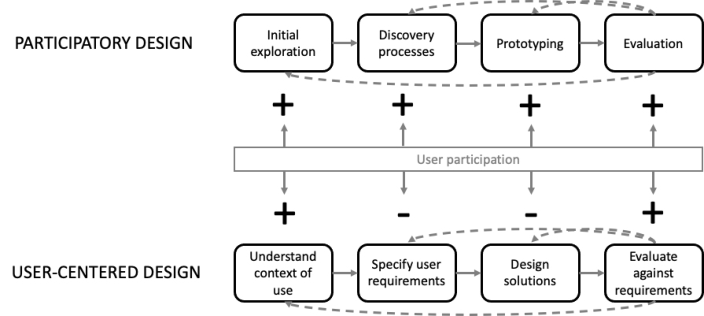
To further elaborate these differences, in Figure 1, we show both approaches along with their respective phases. The PD approach starts with the initial exploration phase which is characterized by activities such as obser- vations, interviews, and surveys by which designers aim to understand the problem being investigated. In the next phase, discovery processes, design- ers aim to define better the problem being investigated through conducting
workshops, mappings, as well as using existing artifacts and probes to stimulate and guide user participation.
Figure 1: Participatory design and user-centered design approach with their respective phases and user participation.
Once the problem is well defined, the designers engage in initial prototype development (or if it is a consequent iteration, typically, an advanced pro- totype) together with participants to directly influence the outcome (Kujala, 2003). The developed prototype is then evaluated using user testing which is the last phase of the PD approach. Similarly, we also show the four phases of the UCD approach. In the initial phase, understanding the context, the designer aims to understand the user needs by analyzing user tasks and the context where those tasks are conducted. Typical activities include observa- tions, surveys, and interviews. Once the user activities and the context of use are understood, the designer continues to the second phase, which is to spec- ify user requirements. In this phase, modelling of the requirements is done, and the typical way is to develop personas and scenarios that embody those requirements. The third step is to design solutions starting from sketches and paper prototypes to advanced prototypes. Finally, these prototypes are evalu- ated to validate the initial requirements through usability testing or heuristic evaluation.
In Figure 1, we also indicate with the plus or minus sign the inclusion or exclusion of users for each phase. In the PD approach, user participation is required and is essential at each phase, which contributes to higher accep- tance of the final product by the end users (Sanders, 2002). In the UCD approach, on the other hand, participant involvement happens only in the first and the last phase, whereas in the second and third phase, designers carry out activities without user participation.
Traditionally, these approaches have been conducted in face-to-face set- tings and especially the PD approach offers the best results in such arrange- ments, considering that it aims for equal participation by all actors that relate to the problem being investigated or the design being implemented (Kensing and Blomberg, 1998). Studies by Vines et al. (2012) and Joshi and Bratteteig
Hybridization Possibilities of Two Approaches 239
(2016), however, show that user participation is challenged and not possible in all phases conducted throughout the design process. These studies show that continual user participation has been a challenge for some time, but this is further exacerbated as more work is being done online (Cerna and Müller, 2021). This was especially true during the COVID-19 pandemic, which made it impossible for users and designers to meet in person. Conducting these work- shops online was seen as a solution, however, as shown by Cerna and Müller (2021) for effective online participation, familiarity with the technology is a condition for active involvement. The tools for online participation could be complex and participants may lack such skills, hence they might need addi- tional support to be able to provide their input (Cerna and Müller, 2021). Although, many studies indicate that participation in online sessions is chal- lenging for the older adult users (Kope´c et al., 2017; Wirth et al., 2016), study by Cerna and Müller (2021) claims that struggling with digital tools is not necessarily because of participant’s age, but just that different partici- pants have different skills, needs, and even physical forbearance. For instance, Mallam et al. (2021) point that when conducting workshops and data gath- ering sessions online, the length of sessions and involvement is impacted as participants get tired and bored, thus the sessions need to be shorter, and the activities need to contain variety of different topics. These studies raise the need for the adaptation of PD for distance participation.
PD FOR DISTANCE PARTICIPATION We have several years of experience of teaching a course in which students are required to design Internet of Things solutions for the home environ- ment. In the course, students are required to use PD methods to gather data from users by meeting them in person to the largest extent possible. Before the pandemic, this was typically not an issue, as students could meet par- ticipants in person. When the pandemic hit, the university switched entirely to distance education and with that students could not involve participants in person, but only via online communication tools, such as Zoom, Skype, etc. Participant involvement via distance proved to be difficult in many group projects, and as a result, input from participants would decrease as the project progressed, which threatened the validity of the PD approach. Participation suffered mainly from the fact that not all participants had the same level of technical proficiency for using different tools to be used in these settings, such as Jamboard, Mural, Miro etc. Being familiar with and inspired by the UCD approach, students requested to switch to it later in the project to avoid the technical overhead, particularly during the prototype design phase, which was affected by participant attrition.
After some reflection, we approved such a switch primarily because it was a necessary adaptation to make. Additionally, since the switch was done when students were working on the prototype design phase, there existed another motivation in favor of it. A study comparing the PD and UCD approaches showed that the prototypes designed during the UCD, compared to the PD approach, were more acceptable and usable by the end users
240 Ferati and Kurti
(François et al., 2021). The study further explains that the concepts developed in the UCD approach were designed by experts who incorporated the require- ments gathered from the participants, whereas the concepts designed in the PD workshops were developed by designers and participants together. Thus, the evaluation revealed that the concepts designed using the UCD approach were more efficient, with less errors, and easier to use. Our interpretation of this study is that to create usable interfaces, the involvement of participants in the design workshop is not essential or it could even be detrimental.
Table 1. Comparison of methods used in PD and UCD when performed online.
Table available in the original PDF paper.
Challenges and opportunities
Participatory Design Tools Difficulty when performing online
Interviews Easy Surveys Easy
Discovery processes Workshops Medium Mappings Medium
Probes/Cards Hard Prototyping Paper prototype Hard
Advanced prototype Hard Evaluation User testing Medium
Initial Explorations Observations Hard Having in mind that participatory design is primarily conducted on face-to-face settings, moving it to hybrid and online mode brings certain challenges. Participation becomes more challenging for different user groups (like children and seniors) due to a lack of proficiency with the digital tools (Lee et al., 2021; Rogers et al., 2022). Anyhow, the introduction of the digital tools can also bring serendipity development of PD approaches as online therapy for young mental health (Wadley et al., 2013).
Challenges and opportunities
User-centered Design
Tools Difficulty when performing online Understand context of use
Interviews Easy Surveys Easy
Interaction logs Easy Personas Easy Specify user requirements
Scenarios Easy Design Solutions Paper prototype Medium
Advanced prototype Easy Usability testing Medium Evaluate against requirements
Heuristic evaluation Easy
Observations Hard UCD methods over years have developed a lot, although the center part of them has been focusing on product/service development with higher usability (Mao et al., 2001). The core of these efforts was not necessary on the user participation in the design process, but finding the best way to have a good understanding of the users’ needs and requirements. In this aspect the change to the hybrid approaches for user involvement has been less costly to UCD.
The study by François et al. (2021), however, compared the PD and UCD approaches when sessions were conducted on-site. This, however, should not affect the outcome even when such comparison would happen for sessions conducted online. On the contrary, we posit that when prototype design ses- sions are conducted online, the UCD concepts should be better than PD concepts. Our argument is summarized in Table 1, proposed based on our subjective experience with the PD and UCD approach. On the third column we summarize our subjective assessment while using diverse technological
Hybridization Possibilities of Two Approaches 241
tools across design phases of PD and UCD. Based on our assessment, we iden- tified that moving activities in online settings within PD are more difficult to use compared to UCD. Involvement of the users of diverse technological pro- ficiency levels directly impacts the quality of the inputs in the design process across PD phases. Whereas within the second and third phase of UCD design process that mainly involves design practitioners, the technical overhead is far less present. Furthermore, in the last column of the table, we highlight some challenges and opportunities that shift to online settings brings based on existing research.
CONCLUSION AND THE WAY FORWARD One of the differences between PD and UCD is the fact that PD is very much focused on the process (i.e., involvement of the users throughout all the steps) whereas at UCD the focus is more on the end product/service to be devel- oped. Having in mind this, the move to online/hybrid mode, consequently, brings more “overhead” to the PD approaches compared to UCD. Conse- quently, through this process of “hybridization”, the borders between PD and UCD get blurred and these approaches get closer to each other. In this process, interesting from the research point of view will be the discussion of the possibilities that this hybridization brings. Will it make the end results of the PD much more usable, or will it increase the sense of ownership of the end product/service of UCD through more “democratic” process? Or this could be the initiation of a necessity driven innovation toward a new hybrid design process that seamlessly integrates and interchanges PD and UCD design phases.
REFERENCES
Cerna, K. and Müller, C., 2021. Making online participatory design work: Understanding the digital ecologies of older adults. In Proceedings of 19th European Conference on Computer-Supported Cooperative Work. European Society for Socially Embedded Technologies (EUSSET). François, M., Osiurak, F., Fort, A., Crave, P. and Navarro, J., 2021. Usability and
acceptance of truck dashboards designed by drivers: two participatory design approaches compared to a user-centered design. International Journal of Industrial Ergonomics, 81, p. 103073. Joshi, S. G. and Bratteteig, T., 2016. Designing for prolonged mastery. On involving old people in participatory design. Scandinavian Journal of Information Systems, 28(1), p. 1. Kensing, F. and Blomberg, J., 1998. Participatory design: Issues and concerns.
Computer supported cooperative work (CSCW), 7, pp. 167–185. Kope´c, W., Skorupska, K., Jaskulska, A., Abramczuk, K., Nielek, R. and Wierzbicki, A., 2017, August. Livinglab pjait: Towards better urban participation of seniors. In Proceedings of the International Conference on Web Intelligence (pp. 1085–1092). Kujala, S., 2003. User involvement: a review of the benefits and challenges. Behaviour
& information technology, 22(1), pp. 1–16. Lee, K. J., Roldan, W., Zhu, T. Q., Kaur Saluja, H., Na, S., Chin, B., Zeng, Y., Lee, J. H. and Yip, J., 2021, May. The show must go on: A conceptual model of
242 Ferati and Kurti
conducting synchronous participatory design with children online. In Proceedings of the 2021 CHI conference on human factors in computing systems (pp. 1–16). Mallam, S. C., Nordby, K., Haavardtun, P., Nordland, H. and Viveka Westerberg, T., 2021. Shifting participatory design approaches for increased resilience. IISE Transactions on Occupational Ergonomics and Human Factors, 9(2), pp. 78–85. Mao, J. Y., Vredenburg, K., Smith, P. W. and Carey, T., 2001, November. User-
centered design methods in practice: a survey of the state of the art. In Proceedings of the 2001 conference of the Centre for Advanced Studies on Collaborative research (p. 12). Norman, D., 1986. User centered system design. New perspectives on humancomputer interaction. Rogers, W. A., Kadylak, T. and Bayles, M. A., 2022. Maximizing the benefits of par-
ticipatory design for human–robot interaction research with older adults. Human Factors, 64(3), pp. 441–450. Sanders, E. B. N., 2002. From user-centered to participatory design approaches. In Design and the social sciences (pp. 18–25). CRC Press. Spinuzzi, C., 2005. The methodology of participatory design. Technical communica-
tion, 52(2), pp. 163–174. Vines, J., Blythe, M., Dunphy, P., Vlachokyriakos, V., Teece, I., Monk, A. and Olivier, P., 2012, May. Cheque mates: participatory design of digital payments with eighty somethings. In Proceedings of the SIGCHI Conference on Human Factors in Computing Systems (pp. 1189–1198). Wadley, G., Lederman, R., Gleeson, J. and Alvarez-Jimenez, M., 2013, November.
Participatory design of an online therapy for youth mental health. In Proceedings of the 25th Australian Computer-Human Interaction Conference: Augmentation, Application, Innovation, Collaboration (pp. 517–526). Wirth, R. J., Yuan, C. W., Hanrahan, B. V., Carroll, J. M., Rosson, M. B., and Bindá, J., 2016, November. Exploring interactive surface designs for eliciting social activity from elderly adults. In Proceedings of the 2016 ACM International Conference on Interactive Surfaces and Spaces (pp. 403–408).
LISTED IN THE AHFE DIGITAL BOOKSTORE CATALOGUE
Explore the complete digital volume
Human Interaction and Emerging Technologies (IHIET-AI 2024): Artificial Intelligence and Future Applications
Read this individual research paper free through the original publisher, or explore the full digital proceedings book.
ISBN 978-1-958651-96-4
Explore this ISBN in the AHFE Bookstore ↗Listed in the July 2026 bookstore catalogue; search by ISBN to confirm current availability · Digital book purchase optional