Hongjia Lin (2026). From Memory to Medium: Investigating How Generative AI–Based Dream Recreation Supports Emotional Restoration and Self-Continuity. In: Affective and Pleasurable Design. AHFE Open Access, vol. 204, pp. 154–166. https://doi.org/10.54941/ahfe1007341
In the digital age, young individuals face both emotional stress and fragmented self-narratives. Positive dreams may contain clues for repairing self-identity and enhancing life continuity, yet their fleeting nature makes them difficult to integrate. Current technological solutions fail to effectively support users in visually reconstructing meaning from dreams.This study proposes the Narrative Self-Integration (NSI) framework, using generative AI to guide users from passive recorders to active self-narrative editors. Developed through qualitative interviews (N=16) and validated through an experimental study (N=17), the framework demonstrates significant enhancement of positive emotions and sense of self-continuity.Theoretically, this work repositions generative AI as a constructive tool for self-narrative coherence. Practically, it provides a concrete pathway for next-generation digital mental health interventions.
Research Background and Motivation In the contemporary context where digital technologies profoundly reshape social structures and human experiences, the mental health of younger generations faces unprecedented complex challenges. On one hand, the proliferation of social media, information overload, and performance- oriented societal pressures have led to widespread “emotional exhaustion, chronic loneliness, and existential anxiety” (Twenge et al., 2018). On the other hand, the fragmentation and hyper-mobility of modern life—manifested in career transitions, residential relocations, and the constant switching between multiple virtual identities—is quietly eroding individuals’ holistic perception of their life narratives, triggering a profound “crisis of self-continuity” (Sani, 2008). Self-continuity, defined as an individual’s subjective perception of self-consistency and stability across time, serves as the cornerstone of psychological security and identity stability. Its weakening not only intensifies identity confusion but also diminishes psychological resilience in coping with adversity. Consequently, exploring innovative psychological interventions
From Memory to Medium: Investigating How Generative AI–Based Dream Recreation 155 that simultaneously support emotional regulation and self-integration has become an urgent priority in mental health research and digital health design.
Dreams, as a universal yet unique subconscious experience, offer a technical entry point to address these challenges. They often contain highly condensed emotional cues and symbolic imagery. Positive dreams can evoke valuable inner experiences such as comfort, reassurance, nostalgia, and a sense of self- continuity. These experiences serve as effective emotional repair resources and building blocks for self-identity. However, these positive dream experiences are often fleeting, difficult to consciously capture, preserve, or re-experience, rendering their potential psychological value underutilized. Against this backdrop, dreams—this universally shared yet still mysterious nocturnal mental activity—reveal unique potential. As the subconscious “private cinema,” dreams not only process daytime emotions but also contain rich “symbolic imagery and unconsciously perceived emotional cues” (Hartmann, 2010). Among these, positive dreams that evoke comfort, connection, nostalgia, or empowerment hold particular clinical and psychological value. They function as an internal reservoir of psychological resources, offering emotional solace, facilitating cognitive restructuring, and serving as narrative material that reinforces “self-identity continuity and a sense of life’s meaning” (Hong et al., 2022). However, due to dreams’ illogicality, ephemerality, and expressive challenges, these valuable experiences are often swiftly forgotten or retained only as vague impressions upon waking, rendering their inherent healing and growth potential difficult for individuals to consciously access and utilize.
Fortunately, the paradigm shift in generative AI offers a revolutionary solution to this dilemma. Represented by “diffusion models and large language models,” GAI technologies demonstrate near-human creativity in text-to-image generation, content creation, and narrative coherence construction (Rombach et al., 2022). Its key characteristics—the ability to generate initial visual content based on vague, unstructured natural language descriptions, coupled with support for “dynamic refinement through multi- round, iterative dialogue”—render it an unprecedented “ideal medium.”GAI can function as a highly responsive “mirror of the mind” or a “co-creative partner,” assisting users in gradually transforming fleeting dream impressions into “concrete, stable, repeatedly viewable, and interactive visual narratives.” This opens a highly promising pathway toward a novel form of digital self- care grounded in inner experience.
Problem Statement and Research Gap Current digital tools for dream and mental health exploration have significant limitations. Mainstream journaling apps rely on text-based, static symbolic interpretations, suffering from three fundamental flaws: single-modal input fails to capture visual dream essence; passive interaction lacks emotional engagement mechanisms; rigid interpretations ignore users’ personal contexts, risking inappropriate applications. Consequently, existing tools cannot help users genuinely “revisit” dream emotions or support the therapeutic leap from recording to reconstruction.While GAI mental
156 Lin health research has emerged, dream-focused interventions remain nascent with critical gaps: GAI is treated as isolated content generators rather than integrated into comprehensive user-centered frameworks; literature lacks qualitative inquiry into users’ micro-behaviors, evolving interpretations, and emotional responses during AI-mediated creation; and no studies track long-term psychosocial benefits—particularly neglecting “self-continuity” as an outcome variable despite its developmental importance, nor exploring impacts on self-efficacy and creative expression.This study proposes a “narrative self-integration” framework, arguing that structured collaborative co-creation with GAI enables individuals to externalize ambiguous dreams into personally meaningful visual narratives. This re-authoring process facilitates emotional processing and enhances temporal self-continuity. Following design science, we investigate:
RQ1: Core user needs, interaction patterns, and design principles for balancing emotional fidelity, creative control, and guidance in narrative integration. RQ2: Subjective experiences (emotional arousal, self-reflection depth) and
psychological mechanisms through which GAI-mediated creation influences emotional states and self-perception. RQ3: Comparative efficacy against text methods—immediate effects on positive emotion and state self-continuity, and longitudinal improvements in trait self-continuity and well-being.
The study advances HCI-positive psychology dialogue by reconceptualizing GAI as active medium for self-narrative construction, providing empirically validated frameworks for next-generation digital mental health tools.
LITERATURE REVIEW
This research integrates foundational insights from three converging domains to address a critical gap in digital mental health intervention.
From psychology and dream science, extensive work confirms that dreams function as a continuity mechanism, reflecting waking cognitive and emotional concerns while offering a unique repository of autobiographical fragments (Schredl & Hofmann, 2003; Kahn, 2019). Positive dreams, in particular, are recognized for their potential to evoke comfort, reinforce identity, and provide symbolic material for self-reflection (Fosshage, 1983). Crucially, theories such as Hill’s (2004) Dream Work model and Ullman’s (1996) group appreciation approach emphasize that this therapeutic value is not automatic but requires structured, supportive processes of active exploration, insight, and narrative integration—a resource-intensive practice seldom accessible outside clinical settings (Giovanardi & Spangler, 2021). The construct of self-continuity—the subjective sense of connection across temporal selves—emerges as a vital psychological outcome supported by such integrative narrative processes (Bluck & Alea, 2008; Vignoles, 2011).
Parallel developments in digital mental health illustrate a paradigm shift from early affective computing systems focused on passive emotion
From Memory to Medium: Investigating How Generative AI–Based Dream Recreation 157 recognition (Picard, 1997), towards more participatory, user-centered designs that facilitate expressive writing, reflective storytelling, and meaning-making (e.g., narrative therapy principles, reflective design). However, existing dream engagement tools predominantly rely on text-based recording, emphasizing linear narratives and retrospective interpretation, and framing dreams as personal information objects to be organized and reflected upon (Hoefer et al., 2022). However, such text-oriented approaches struggle to represent the highly visual, affect-driven, and non-linear nature of dream experiences. Addressing this limitation, Wan et al. (2024) introduced Metamorpheus, which explores the re-narration of dreams through metaphorical visual storytelling and affect-driven interaction in a dynamic human–AI co-creative process, thereby highlighting the expressive constraints of traditional text- centric paradigms.
Concurrently, advancements in generative AI—particularly large language and diffusion models—present a transformative opportunity (Yazdani et al., 2025). Demonstrated as effective “scaffolds” and “collaborative partners” in creative and educational contexts, GenAI excels at translating ambiguous natural language into evocative visuals and supporting iterative refinement through dialogue (Long & Peng, 2023; Zhang et al., 2024). This capability aligns profoundly w ith the needs of dream processing. Yet, within mental health, GenAI applications have largely been confined to static content generation or conversational agents, lacking a comprehensive framework that guides users through an end-to-end, psychologically-grounded journey from memory to meaning. Thus, a significant interdisciplinary gap persists: while dreams hold latent value for emotional restoration and self-continuity, and while GenAI offers unprecedented technical means to unlock this value, there remains a lack of empirically-grounded, user-centered design frameworks that systematically bridge subconscious dream material, interactive co-creation, and conscious self-narrative construction. This study directly addresses this gap by proposing and evaluating the “Narrative Self- Integration” framework, positioning GenAI not as a mere image generator, but as an active medium for collaborative self-storying and psychological integration.
RESEARCH METHODOLOGY This study follows a design-based research paradigm, employing a multi- stage mixed-methods design to construct and validate the “narrative self- integration” framework and its technological implementation pathways. The research process strictly adheres to the logic of design science, systematically exploring the effectiveness and mechanisms of generative AI as a psychological intervention mediator through an iterative cycle of “problem exploration- theory construction-prototype development-effect evaluation.”
This study adopts a design-based research paradigm, which views design practice as a form of knowledge production, emphasizing the resolution of complex real-world problems through iterative design processes.The research design rests upon three core methodological premises: (1) Dream processing involves highly subjective psychological processes requiring in-depth qualitative understanding; (2) The efficacy of technological interventions depends on accurately addressing users’ psychological needs; (3) The
The overall research adopts an interpretive sequential mixed-methods design comprising three logically coherent phases. Phase One is exploratory qualitative research, collecting data through in-depth interviews and conducting thematic analysis to understand the psychological mechanisms of dream processing and user needs. Phase Two is the design development phase, building a theoretical framework based on qualitative findings and developing a technical prototype. Phase Three is the evaluation phase, quantitatively assessing system effectiveness through experimental research and gaining deeper insights into user experience via qualitative interviews.
Phase One: Qualitative Research Phase To establish an empirical foundation, the research team recruited 16 participants (8 males, 8 females) aged 21–25 (M = 23.1, SD = 1.4) through purposive sampling. Selection criteria included: (1) regular dream experiences and recall ability; (2) interest in self-exploration and dream reflection; (3) willingness to deeply share personal experiences; (4) no history of severe psychological disorders. Participants’ professional backgrounds spanned psychology, computer science, design studies, humanities, and social sciences, ensuring diverse perspectives. Semi-structured in-depth interviews averaged 85 minutes in duration (range: 75–95 minutes). Interview questions spanned four dimensions: (1) dream memory and narrative characteristics; (2) dream interpretation and meaning-making patterns; (3) the relationship between dreams and self-perception; (4) expectations and concerns regarding technology-assisted tools. All interviews were audio-recorded and verbatim transcribed, yielding approximately 200,000 words of textual data. This study employed reflective thematic analysis to examine interview data. The analysis followed Braun and Clarke’s six-stage framework: familiarization with data, initial coding, search for themes, review of themes, definition and naming of themes, and report writing. Through three rounds of coding, the research team identified three core themes:
Theme 1: Emotional Dominance of Dream Memories and Their Cognitive Representation Characteristics. Analysis revealed that dream memories exhibit a distinct emotional-centric feature. Participants consistently reported emotional experiences within dreams (e.g., anxiety M = 4.3, SD = 0.8; joy M = 3.9, SD = 0.7) in waking life were significantly more persistent and intense than visual detail recall. This emotional primacy indicates that any dream intervention design must prioritize the emotional dimension over pursuing visual fidelity.
Theme 2: The need for reality anchoring and narrative integration in dream interpretation.Research revealed a strong reality-oriented tendency in participants’ dream interpretations, with over 87.5% of respondents (14/16) preferring to connect dream content to real-life events, interpersonal relationships, or personal growth themes. This association manifested not only at the content level but also in the meaning-making process— participants used dream narratives to fill gaps in self-understanding and establish continuity across different life stages.
From Memory to Medium: Investigating How Generative AI–Based Dream Recreation 159 Theme 3: The Paradoxical and Mediating Role of Visual Representation. When examining preferences for dream visualization, the study uncovered a significant dual tension. On one hand, participants yearned to capture the “emotional essence” of dreams through visual forms; on the other, they strongly resisted overly concrete representations, believing these would undermine the dream’s “interpretive potential.” This contradiction reveals visualization’s dual role in dream processing: both as a medium for emotional expression and as a catalyst for reflective engagement.
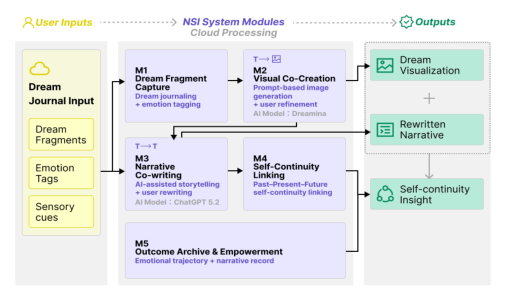
Phase Two: Proposing the “Narrative Self-Integration” Framework Building on insights from the preliminary qualitative research, this study proposes the “Narrative Self-Integration” (NSI) framework. This framework aims to guide users, through the mediation of generative AI, in transforming fragmented, ambiguous, and emotionally impactful dream experiences into structured, comprehensible psychological resources that carry self-connecting meaning. The NSI framework comprises five interconnected modules, forming a complete closed-loop process from “emotional deconstruction” to “meaning reconstruction.”
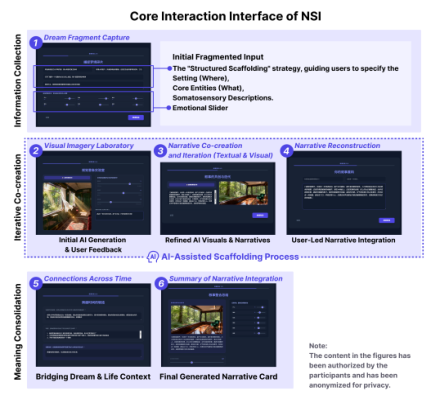
Figure 1: Flowchart of the NSI system.Figure 2: User experience flow of the NSI system.
The first phase of the NSI framework requires users to conduct a multidimensional quantitative assessment of their dream’s initial emotional state. The system provides emotional sliders (Likert Scale-like Sliders) across six dimensions, including “Anxiety,” “Confusion,” and “Joy.”
Design Logic: Unlike traditional textual logging, parametric interaction compels users to engage in metacognitive reflection. By translating abstract sensory experiences into concrete numerical values, users establish an “emotional anchor.” This not only provides stylistic constraints for subsequent AI-generated imagery but, more crucially, helps users objectively recognize their subjective emotional state before entering the narrative.
Phase Three: Empirical Evaluation and Mixed-Methods Validation The third phase employed a pre-post within-subjects design, integrating psychometric tests and follow-up interviews within a mixed-methods framework. Seventeen participants (7 male, 10 female; mean age = 23.2 years, SD = 1.8) were recruited. All were current/recent students who recalled a recent positive/neutral dream, reported mild-to-moderate stress (VAS ≥ 4), and had no mental disorder history or ongoing treatment. The 75-minute procedure included four stages. First, pre-tests: participants completed the PANAS and provided demographic data. Second, the core intervention: under guidance, they used the NSI prototype for a 45-minute four-stage process from emotional anchoring to narrative integration. Due to technical limitations, a modified “Wizard of Oz” method was used—participants interacted with the interface while researchers executed generation tasks via an optimized API, ensuring logic validation without technological confounding. Third, immediate post-tests: participants re-took the PANAS and the adapted State Self-Continuity Scale (4-item, α = 0.86). Fourth, one-week follow-up: semi- structured interviews explored long-term effects and mechanisms. Interviews were transcribed for qualitative analysis.
Quantitative analysis used SPSS 26.0 for paired-sample t-tests (PANAS) and descriptive statistics (self-continuity). Qualitative analysis employed reflective thematic analysis with two researchers independently coding transcripts and notes, focusing on emotional experience, control perception, and narrative integration. Regular discussions resolved coding discrepancies, ensuring reliability.
FINDINGS Significant Improvement in Emotional State
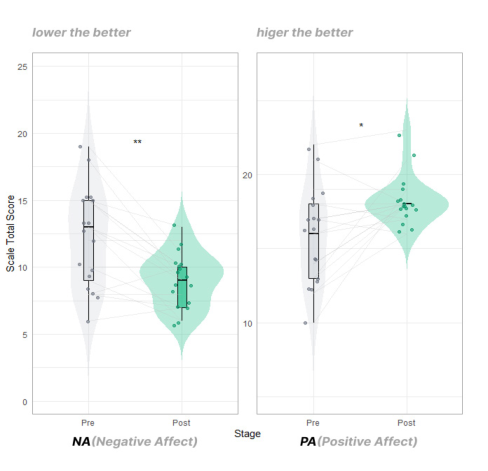
The Positive and Negative Affect Schedule (PANAS) was used to quantitatively assess the emotional states of 17 participants through pre- and post-tests. Paired-sample t-tests revealed a significant increase in positive emotion scores post-NSI intervention, rising from a pretest mean of 15.82 (SD = 3.30) to 18.24 (SD = 1.68) at posttest. Statistical analysis confirmed this elevation as statistically significant (t(16) = −3.01, p = 0.008 < 0.01). Concurrently, scores on the negative emotion dimension exhibited a significant downward trend, decreasing from a mean of 12.18 (SD = 3.75) to 9.06 (SD = 2.01), with the difference also being statistically significant (t(16) = 3.97, p = 0.001 < 0.01).
From Memory to Medium: Investigating How Generative AI–Based Dream Recreation 161 Effect size calculations revealed a Cohen’s d of 0.73 for the increase in positive emotion and 0.96 for the decrease in negative emotion. This indicates that the NSI intervention produced not only statistically significant but also practically meaningful effects on emotional states, representing a medium to large effect size.
Figure 3: Comparison of quantitative emotional scores. (Gray indicates the pre-NSI condition, and green indicates the post-NSI condition)Table 1: Pre- and post-intervention emotional state scores and difference tests (N = 17).
Further analysis revealed that the enhancement of positive emotions was most pronounced in the items “Inspired” (M difference = 1.41), “Excited” (M difference = 1.29), and “Interested” (M difference = 1.23), indicating that the NSI intervention particularly stimulated participants’ psychological vitality and exploratory motivation.The reduction in negative emotions was primarily observed in the “anxious” (M difference = −1.64) and “irritable” (M difference = −1.18) items, reflecting the intervention’s positive role in alleviating psychological stress and negative emotions. This “bidirectional improvement” pattern in emotional states indicates that the NSI intervention
162 Lin not only increases positive emotional resources but also effectively alleviates negative emotional states, demonstrating significant emotion regulation functions.
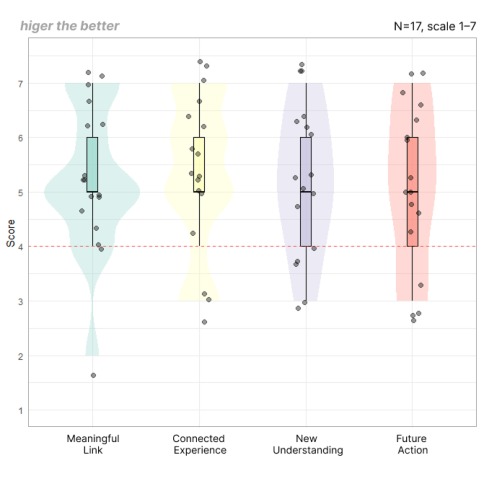
Significant Enhancement of Self-Continuity Following the intervention, participants completed the State Self-Continuity Scale, comprising four dimensions measured on a 7-point Likert scale (1 = strongly disagree, 7 = strongly agree). Overall analysis revealed a mean self-continuity endorsement of 5.21 (SD = 1.20), indicating that the NSI intervention effectively enhanced participants’ sense of self-continuity. Scores across dimensions exhibited distinct patterns.
Figure 4: Distribution of post-NSI scores across four self-integration dimensions.Table 2: Scores for dimensions of self-continuity (N = 17).
Table available in the original PDF paper.
Ranking
Dimension Description Mean
Standard Deviation (SD)
5.47 0.94 1
Meaningful Connection
My dream experiences have formed meaningful connections with my life
5.29 0.99 2
Clear Connections
Through this activity, I gained clearer insight into how my diverse experiences are interconnected
(Continued)
Table 2: Continued.
Table available in the original PDF paper.
Ranking
Dimension Description Mean
Standard Deviation (SD)
5.12 1.22 3
Time Continuity
This experience made me feel a stronger sense of continuity between my past, present, and future.
4.94 1.25 4
Complete Understanding
I feel I have gained a more complete understanding of my life story.
Table 2 shows that the “Meaningful Connections” dimension scored highest (M = 5.47), indicating that the NSI intervention was most effective in helping participants establish concrete links between their dreams and real life. This was followed by the “Clear Connections” dimension (M = 5.29), suggesting that participants gained clearer recognition and understanding of the intrinsic connections between their diverse personal experiences through the NSI process.Relatively lower scores were observed for the “Temporal Continuity” (M = 5.12) and “Comprehensive Understanding” (M = 4.94) dimensions, suggesting room for improvement in promoting broader temporal continuity and life story integrity through a single intervention. Nevertheless, internal consistency testing across all four dimensions yielded a Cronbach’s α coefficient of 0.86, indicating good reliability for the scale.
Psychological Mechanisms of Qualitative Findings Through reflective thematic analysis of in-depth interview transcripts, the study identified three interrelated core themes revealing the underlying psychological mechanisms of the NSI intervention. Participants consistently reported that while AI-generated visual images might not be entirely accurate in detail, the overall atmosphere and emotional tone they evoked effectively reawakened and consolidated emotional memories from dreams. This nonverbal visual representation was described by participants as an “emotional container,” aiding them in transforming vague inner experiences into observable, actionable psychological objects. During the iterative refinement phase of the NSI framework, participants gradually transitioned from passive dream experiencers to active narrative creators through operations like fine-tuning generation parameters and modifying prompts. This shift from description to creation significantly enhanced participants’ sense of self-agency.During the narrative integration phase of the NSI framework, participants, guided by the system, forged profound connections between isolated dream imagery and distinct periods of their personal life journey. These connections transcended simple association, representing a process of deep meaning construction.
Cross-Validation Across Data Cross-analysis of quantitative and qualitative data reveals that participants exhibiting the most pronounced emotional improvement were often those
164 Lin demonstrating the deepest reflection and highest levels of self-insight in qualitative interviews. Concurrently, individuals scoring higher on the Sense of Self Continuity scale more frequently mentioned experiences of cross- temporal connections and discoveries of life meaning during interviews. This cross-validation between datasets not only enhances the reliability and persuasiveness of the findings but also suggests that NSI interventions may simultaneously influence emotional states and self-continuity by promoting deep reflection and meaning-making.
Furthermore, the study identified subgroup differences. Participants with an arts background placed greater emphasis on the aesthetic quality of visual presentation and creative expression, while those with a psychology background prioritized narrative coherence and psychological insight. Although these differences do not undermine the core conclusions, they suggest that future applications of the NSI framework may need to consider user background characteristics to provide more personalized guidance and support.
Comprehensive Discussion The findings demonstrate that the NSI framework promotes emotional repair and enhances self-continuity through three interrelated mechanisms: emotional anchoring via visual representations, self-agency through human- machine collaboration, and narrative integration across time. Quantitative data confirmed the intervention’s statistical and practical efficacy, while qualitative analysis revealed the underlying psychological mechanisms and user experience characteristics. These findings not only validate the theoretical value of the NSI framework but also provide a robust empirical foundation and practical guidance for future development of generative AI-based psychological intervention tools. Notably, the differentiated enhancement patterns across dimensions of self-continuity suggest that future intervention designs could more specifically target the construction of temporal coherence and life story integrity to achieve more comprehensive psychological growth outcomes.
DISCUSSION
This study demonstrates that the “Narrative Self-Integration” framework, mediated by generative AI, effectively enhances emotional states and self- continuity through a tripartite mechanism of emotional anchoring, agency enhancement, and narrative integration. Quantitative results confirmed significant improvements in positive affect and state self-continuity post- intervention, while qualitative findings revealed AI-generated visuals served dual roles as emotional anchors reifying fleeting experiences and catalysts for reflective engagement. The primary theoretical contribution reconceptualizes generative AI beyond passive content generation toward an active medium for self-narrative construction, positioning it as a responsive co-creator that externalizes ambiguous internal experiences for conscious reinterpretation— the first empirical evidence that GenAI-mediated narrative intervention
From Memory to Medium: Investigating How Generative AI–Based Dream Recreation 165 directly enhances self-continuity. Four practical design guidelines emerge: prioritize emotional fidelity over visual realism, foster collaborative loops rather than automation, provide gentle narrative scaffolding, and ensure transparency with ethical safety. Limitations include small homogeneous samples, single-session lab settings, and Wizard-of-Oz prototyping, necessitating future longitudinal field studies with diverse populations, clinical adaptations, and advanced multimodal AI integration alongside ethical governance frameworks.
CONCLUSION AND OUTLOOK In an age where digital experiences can contribute to fragmentation, this research demonstrates a path for technology to instead foster integration. The “Narrative Self-Integration” framework showcases the unique potential of generative AI to serve not merely as a tool for efficiency or entertainment, but as a mediating medium for psychological growth. By enabling individuals to actively visualize, reinterpret, and narratively weave their subjective experiences, it supports both immediate emotional repair and the longer- term project of constructing a coherent, continuous self. This work ultimately points toward a future for HCI and digital health where technology is designed with deep sensitivity to human psychology, empowering individuals to become more conscious authors of their own life stories.
REFERENCE Bluck, S., & Alea, N. (2008). Remembering being me: The self continuity function of autobiographical memory in younger and older adults. In F. Sani (Ed.), Self continuity: Individual and collective perspectives (pp. 55–70). Psychology Press. Fosshage, J. L. (1983). The psychological function of dreams: A revised psychoanalytic
perspective. Psychoanalysis & Contemporary Thought, 6(4), 641–669. Giovanardi, G., & Spangler, P. (2021). Introduction to the Special Section on Working on dreams, from psychotherapy to neuroscience. Research in psychotherapy (Milano), 24(2), 578. https://doi.org/10.4081/ripppo.2021.578 Hartmann, E. (2010). Emotion guides the dream: The central image of the dream
pictures and measures the emotion. In The nature and functions of dreaming. Oxford University Press. https://doi.org/10.1093/acprof:oso/9780199751778.003.0003 Hill, C. E. (Ed.). (2004). Dream work in therapy: Facilitating exploration, insight, and action. American Psychological Association. https://doi.org/10.1037/10624- 000 Hoefer, M. J. D., Schumacher, B. E., & Voida, S. (2022). Personal dream informatics:
A self-information systems model of dream engagement. In Proceedings of the 2022 CHI Conference on Human Factors in Computing Systems (CHI ’22) (Article 281, pp. 1–16). Association for Computing Machinery. https://doi. org/10.1145/3491102.3517 669 Hong, E. K., Sedikides, C., & Wildschut, T. (2022). How Does Nostalgia Conduce to Global Self-Continuity? The Roles of Identity Narrative, Associative Links, and Stability. Personality & Social Psychology Bulletin, 48(5), 735–749. https://doi. org/ 10.1177/01461672211024889
Frontiers in psychology, 10, 2676. https://doi.org/10.3389/fpsyg.2019.02676 Long, T., & Peng, W. (2023). PortfolioMentor: Multimodal generative AI companion for learning and crafting interactive digital art portfolios. arXiv. https://arxiv.org/ abs/23 11.14091 Picard, R. W. (1997). Affective computing. The MIT Press. Rombach, R., Blattmann, A., Lorenz, D., Esser, P., & Ommer, B. (2022). High-
resolution image synthesis with latent diffusion models. In Proceedings of the IEEE/ CVF conference on computer vision and pattern recognition (pp. 10684-10695). Sani, F. (Ed.). (2008). Self Continuity: Individual and Collective Perspectives (1st ed.). Psychology Press. https://doi.org/10.4324/9780203888513 Schredl, M., & Hofmann, F. (2003). Continuity between waking activities and dream
activities. Consciousness and cognition, 12(2), 298–308. https://doi.org/10.1016/ s10 53-8100(02)00072-7 Twenge JM, Campbell WK. Associations between screen time and lower psychological well-being among children and adolescents: Evidence from a population-based study. Prev Med Rep. 2018 Oct 18;12:271-283. doi: 10.1016/j. pmedr.2018.10.003. PMID: 30406005; PMCID: PMC6214874. Ullman, M. (1996). Appreciating dreams: A group approach. Sage Publications, Inc. Vignoles, V. L. (2011). Identity motives. In S. J. Schwartz, K. Luyckx, & V. L. Vignoles
(Eds.), Handbook of identity theory and research (pp. 403–432). Springer Science + Business Media. https://doi.org/10.1007/978-1-4419-7988-9_18 Wan, Q., Feng, X., Bei, Y., Gao, Z., & Lu, Z. (2024). Metamorpheus: Interactive, affective, and creative dream narration through metaphorical visual storytelling. In Proceedings of the 2024 CHI Conference on Human Factors in Computing Systems (CHI ’24) (Article 166, pp. 1–16). Association for Computing Machinery. https://doi.org/10.1145/3613904.3642410 Yazdani, S., Singh, A., Saxena, N., Wang, Z., Palikhe, A., Pan, D., Pal, U., Yang, J.,
& Zhang, W. (2025). Generative AI in depth: A survey of recent advances, model variants, and real-world applications. arXiv. https://arxiv.org/abs/2510.21887 Zhang, L., Pan, J., Gettig, J., Oney, S., & Guo, A. (2024, October). VRCopilot: Authoring 3D layouts with generative AI models in VR. In Proceedings of the 37th Annual ACM Symposium on User Interface Software and Technology (pp. 1–13). Association for Computing Machinery. https://doi.org/10.1145/3654777.3676451
LISTED IN THE AHFE DIGITAL BOOKSTORE CATALOGUE
Explore the complete digital volume
Affective and Pleasurable Design
Read this individual research paper free through the original publisher, or explore the full digital proceedings book.
ISBN 978-1-964867-80-9
Explore this ISBN in the AHFE Bookstore ↗Listed in the July 2026 bookstore catalogue; search by ISBN to confirm current availability · Digital book purchase optional