Fisnik Dalipi, Arianit Kurti, Mexhid Ferati (2024). APPEND: A Blockchain-Based Model of Digital Product Passport for Furniture Industry. In: Human Interaction and Emerging Technologies (IHIET-AI 2024): Artificial Intelligence and Future Applications. AHFE Open Access, vol. 120, pp. 95–103. https://doi.org/10.54941/ahfe1004559
The digital product passport has been introduced as a policy instrument to enable traceability throughout the product life cycle and to support a circular economy. Anyhow, as a relatively new concept, there are a lot of uncertainties throughout the industrial landscape regarding the challenges and opportunities it brings. One such branch of industry is the furniture sector. In this paper, we present a DPP solution for furniture sector based on blockchain technology and inspired by a design thinking mindset. Through a prototype implementation, we highlight the key aspects such as data governance, stakeholder constellation, data interoperability, and data integrity that have significant research potential. Furthermore, we discuss these key concepts of DPP through the lens of eco-design principles in order to promote sustainability, improve energy efficiency, and protect the environment.
INTRODUCTION AND BACKGROUND In the current business landscape, organizations are actively striving to enhance competitiveness via the adoption of two transformational strategies: circular transformation and digital transformation (Ingemarsdotter et al., 2020). Despite exhibiting unique value potentials, there is a growing body of research that establishes a connection between the two goals (Chauhan et al., 2022), sometimes referred to as the notion of a smart circular economy. The emerging concept of the circular economy is increasingly receiving attention and prominence among policymakers and business stakeholders. The signifi- cance of the circular economy for companies is supported by several sources, such as the recent Circular Economy Action Plan of the European Union (EU, 2020) and an expanding corpus of research (Korhonen et al., 2018; Hohmrich et al., 2018). Nevertheless, it is important to acknowledge that the global economy does not currently exhibit circular characteristics. This may be attributed to several factors, such as inadequate levels of transparency, standardisation, and data exchange (Kirchherr et al., 2023).
Emerging digital technologies possess the primary capability of effectively monitoring and tracing items over their entire life cycle. As a result, these technologies contribute significantly to the improvement of supply-chain
transparency and the collection of data, thereby enhancing the adoption of a circular economy (Neligan et al., 2022). In this context, in order to make sustainable products the norm in a more resilient single market (EU, 2022), Digital Product Passport (DPP) has emerged as a next step. Digital product passports primarily have been proposed as policy instruments to enable decision-making throughout product life cycles in favour of a circu- lar economy (Jansen et al. 2023). Anyhow, despite the great idea, the lack of conceptualization, and the relatively weak connection towards industries, the DPP brings uncertainties and challenges across the industrial landscape. One such industry that is facing uncertainties regarding the development and implementation of DPP is also the furniture sector.
The implementation of a product passport for furniture has significant promise in facilitating the advancement of circular production, fostering more resource-efficient value chains, and enhancing global competitiveness (King et al., 2023). This aligns with some of the global objectives outlined in Agenda 2030. Primarily, the aforementioned statement pertains to the achievement of Sustainable Development Goal 12, which focuses on sustain- able consumption and production, as well as Goal 13, which aims to combat climate change. The achievement of these objectives is heavily reliant on the incorporation of sustainable new production methods, enhanced resource efficiency, and the establishment of circular flows.
The EU aims to make it mandatory that DPP be implemented in the fur- niture sector, which implies an advanced digitalization of the sector. The furniture sector represents a typical manufacturing industry characterized by a standardized value chain, and all manufacturing branches could benefit from the knowledge of the DPP. Although we concentrate on the furniture industry in this work, the knowledge and expertise gained from it will be use- ful for any other manufacturing value chain that the aforementioned figure can represent.
The rest of the paper is structured as follows, in the next section, we position our work within the scope of the current state of the art of DPP. After, we present our prototype depicted through a design thinking mindset. This is followed by discussions and analysis of the key concepts of DPP, and then we conclude with a critical discussion regarding these concepts from the eco-design lens.
PROPOSED APPROACH We consider the design thinking mindset as a methodology in the develop- ment of the digital product passport prototype. Design thinking resides in the intersection and balancing between desirability, feasibility, and viability (Menold et al., 2016). In this respect, desirability is defined as needs and requirements from a human point of view; feasibility is what is possible using existing or within-reach technology; and viability considers the economic sustainability within the ecosystem.
Design thinking is also characterized by concrete phases that facilitate the innovation process, from early inception, when the issue at hand is poorly defined, until a solution is proposed and evaluated. These four phases
APPEND: A Blockchain-Based Model of Digital Product Passport 97
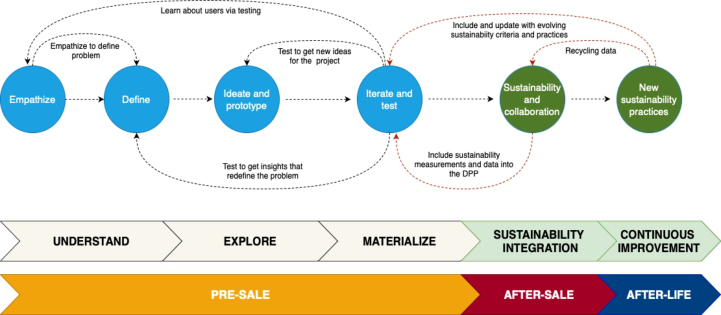
(Empathize, Define, Ideate and Prototype, and Iterate and Test) are fur- ther combined with two more phases (Sustainability and Collaboration, and New Sustainability Practices) as depicted in Figure 1. Inspired by the work of Lewrick et al. (2018), we describe each phase below:
Figure 1: Design thinking and the DPP lifecycle.
Empathizing with users: The aim of this initial phase is to develop a comprehensive understanding of needs and anticipations of individuals who will engage with DPP, which will contribute to the development of a user-friendly interface.
Problem definition: Based on users’ needs, the problem is defined, which is aimed to be solved through the implementation of the DPP. Additionally, this phase aims to identify the environmental and sustainability challenges it should address by means of merging practical empirical data with research-based evidence.
Ideation and Prototyping: Once we understand the problem, the next phase is to generate innovative ideas for the features and functionalities that should be embedded into the DPP. Initially, by brainstorming several ideas as potential solutions and then prototyping a selection of such ideas into a prototype, we will aim to create a tangible outcome to be tested for a proof of concept validation. Following the principle of software independence, by utilizing XML, we can represent structured informa- tion, documents, and data in a format that can be used independently of a particular software. This ensures that the data identifiers of a product and DPP information are transferable from one software system to another. The use of verified data would function as a sort of certification, ensuring the reliability and credibility of information on its source and the circum- stances under which it was produced. In relation to intellectual property (IP) protection, in accordance with (Berg et al. 2022), we will consider that data providers should maintain direct control over the data they provide, ensuring data sovereignty, and take measures to securely preserve the data to prevent illegal access.
Testing and iteration: By means of various testing methods, we will gain user feedback to ensure that the passport provides accurate and real- time information about a product’s environmental impact. Adopting an iterative approach in this phase, but also on the entire cycle, the aim is to continuously improve the solution. Additionally, aspects of ensur- ing the usability of DPP and compliance with national and international regulations, will be central to this phase.
Collaboration: Collaboration is crucial in ensuring the success of the passport in promoting sustainability. This involves engaging with many stakeholders across the supply chain, such as producers, consumers, and regulators.
Sustainability Integration: The objective of this phase is to conduct sus- tainability integration by incorporating measurements and data related to sustainability into the DPP, aligning it with the principles of the circular economy (Westerlund, 2023).
Continuous Improvement: Continuous improvement is a crucial aspect that should be maintained in order to foster development and enhance and refine various processes and practices. It is essential to continually update the passport in order to include evolving sustainability criteria and practices.
The pre-sale phase in Figure 1 corresponds with data entry and the cre- ation of the DPP. Relevant actors in this phase include authorities, product producers, and parts producers. The after-sale phase is related to sustainabil- ity integration and collaboration, where a change of owner and repairs can also take place. Actors relevant to this phase include resellers, owners, repair- ers, etc. Lastly, the after-life phase deals with life-cycle data, such as the sales volume of a product, which can be used to anticipate how much waste to expect at any given time and the amount of resources that could be recycled. Actors relevant to this phase include authorities, owners, and recyclers.
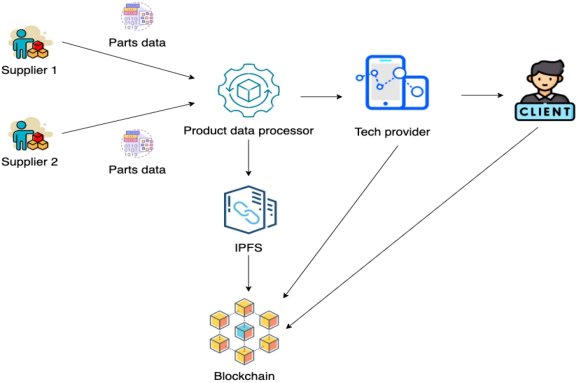
Figure 2: Blockchain as an enabler for DPP.
APPEND: A Blockchain-Based Model of Digital Product Passport 99
As presented in Figure 2, a model incorporating blockchain technology and related principles has been proposed with the aim of enhancing the sup- ply chain ecosystem within the furniture sector. Blockchain technology is characterised by its decentralised nature. Decentralisation signifies that the entire supply chain ecosystem will not be under the authority of a single entity (Xia et al., 2023). Without the need for intermediaries, any entity on the network is capable of communicating with any other entity. Each piece of information will be decentralised for storage. Even if a portion of the systems are offline, the network’s efficacy will not be impacted. Every transaction is readily observable by all relevant parties. Additionally, historical data is pre- served within the blockchain, enabling the client to readily authenticate the product’s origin. Our proposed model, APPEND, employs blockchain tech- nology to ensure the security of digital documents uploaded by supply chain stakeholders, including parts data and more. This is achieved through the use of the Ethereum blockchain and the interplanetary file system (IPFS).
In Figure 2, we present a typical value chain depiction across all the stages. The figures identify both stakeholders and their involvement across differ- ent stages of the value chain. Furthermore, it also represents the data stream needed for increased interoperability between different providers in the value chain. The main components of the proposed model comprise (1) digital doc- uments, (2) the Ethereum blockchain, (3) an IPFS, and (4) system users as its primary components. Every component is incorporated in order to facilitate the exchange of information between them. IPFS facilitates the storage and retrieval of data, including documents, websites, and applications. By means of a content addressing scheme, the address of a specific file is determined by its content. When a file is saved on IPFS, it generates a unique cryptographic hash. This hash serves as the file’s identifier or address (Saurabh and Dey, 2021). In the proposed model, digital documents would be securely saved in an encrypted format on the IPFS.
The proposed solution is seen as a socio-technical system, as it includes both the human and the technical sides. Therefore, a values-based systems engineering requirements process is adopted that prioritises a design for systemic change (IEEE, 2021).
DISCUSSION AND IMPLICATIONS The DPP system comprises multiple actors, organisations, processes, and technical systems that need to interoperate to achieve the overarching capa- bility. Thus, data interoperability in the DPP system is required for cross- company information exchange between stakeholders. The European Com- mission seems to propose a decentralized approach to data governance for DPPs (Ducuing and Reich, 2023). However, there is a lack of clarity over how the many stakeholders would coordinate their efforts, including updates on diversity and inclusion, quality assurance, and interoperability. In our case, the European Interoperability Framework (EIF) principles of the European Commission are followed (National Interoperability Framework Observa- tory, 2022), which cover legal, organizational, semantic, and technical aspects of interoperability. Regarding the technical requirements for interoperability,
data formats and schemes describing the product will be standardized (Berg et al., 2022) so that data from a particular DPP system can be processed by different DPPs.
Data governance is an integral aspect of DPPs, primarily aimed at address- ing the challenges related to ownership, trust, stakeholder coordination, and competing interests. Although recognition of the importance of data gov- ernance is widespread, there has not been a comprehensive examination of the specific goals and limitations that influence the alignment between DPPs and the many governance alternatives that are now accessible (Ducuing and Reich, 2023). Governance of data flow on the input side of DPPs is crucial, particularly due to the lack of alignment between the data life cycles (cre- ation, integration, and consumption) and the underlying product life cycle. The generation of data is a prerequisite for the assembly of the product, and it is possible that the information may need to persist even after the product has been destroyed. The governance of the DPP, including many components like systems, databases, and registries, can be seen as a purposeful infrastructure facilitating the transition to the circular economy.
Nowadays, there are a range of technological approaches and solutions that enable the traceability and consistency of data. When it comes to trace- ability, blockchain is considered a promising solution to improve certain data quality dimensions, including data consistency, traceability, and avail- ability. We aim to use blockchain for data storage and also for tracing the origin of the product components, along with the ownership of the prod- uct. Secure data immutability will be ensured with e-signatures. Traceability and immutability will enable supplier verification, product history, owner history, and data protection. Having in mind the challenges identified in blockchain and data compliance (Agrawal et al., 2021), through this work we intend to demonstrate some examples of data traceability and ownership and investigate these potentials for improving overall sustainability.
Increased traceability of the entire value chain within the furniture sec- tor brings the possibility of innovating data-driven business models within a traditional branch such as the furniture sector. Through new data-driven business models, we’ll be investigating the transformation potential of the existing products to be offered as services as well as improving the main- tenance, circularity, and sustainability of products within the furniture sector.
CONCLUSION AND FUTURE WORK Recently, the EU has placed significant emphasis on the adoption of eco- design principles in order to promote sustainability, improve energy effi- ciency, and protect the environment. The principal aim of the eco-design legislation is to address and minimize the negative environmental impacts that are linked to products throughout their entire life cycle (EU, 2022). In this context, the concept of the DPP is becoming a requirement for manufac- turers and is now receiving significant interest as a transformational concept within the framework of a green and circular economy. For this purpose, we propose the idea of developing a DPP system in the furniture industry.
APPEND: A Blockchain-Based Model of Digital Product Passport 101
We consider the design thinking mindset as a methodology in the devel- opment of the blockchain-enabled digital product passport prototype in the furniture sector. The use of blockchain technology is considered due to its potential to greatly facilitate the creation of secure digital product passports. The use of blockchain technology in digital product passports is advantageous due to its fundamental characteristics, including immutabil- ity, transparency, and decentralisation. These aspects contribute to increased levels of security and dependability, enhanced authenticity, and circularity. Thus, organisations can improve trust and transparency by using public blockchain technology to construct passports that facilitate the establish- ment of immutable records pertaining to ownership, origin, and use, thereby increasing trust and transparency. The integration of a digital product passport and the transparency offered by blockchain technology present crucial information on the life cycle of a product, hence providing a safe and transparent solution. The potential that DPP holds to revolutionise supply chains and enhance consumer trust in the furniture industry is undeniable. It has recently catalysed positive change and empowered the research community to explore innovative approaches that elevate the entire industry.
As a future work, our target is to provide a demonstratible solution to the DPP while validating the data traceability, integrity, ownership, and governance as underlying concepts for a successful and sustainable imple- mentation of the DPP. Therefore, the novelties that this work aims to bring are the following: 1) novel implementation of the DPP system within the furniture sector; 2) harnessing state-of-the-art research related to data trace- ability, ownership, and governance and their adoption in the design process; 3) testing and validation of DPP implementation across the full value chain in the furniture sector, from pre-sale until after life
ACKNOWLEDGMENT
The authors would like to acknowledge VINNOVA – Sweden’s Innovation Agency for partly supporting this research work through the grant number 2023-03318.
REFERENCES
Agrawal, T. K., Kumar, V., Pal, R., Wang, L. and Chen, Y. (2021). Blockchain-based framework for supply chain traceability: A case example of textile and clothing industry. Computers & industrial engineering, 154, p. 107130. Berg, H., Kulinna, R., Stöcker, C., Guth-Orlowski, S., Thiermann, R. and Porepp,
N. (2022). Overcoming information asymmetry in the plastics value chain with digital product passports: how decentralised identifiers and verifiable credentials can enable a circular economy for plastics (Vol. 197). Wuppertal Institut für Klima, Umwelt, Energie. Chauhan, C., Parida, V. and Dhir, A. (2022). Linking circular economy and digitalisation technologies: A systematic literature review of past achievements and future promises. Technological Forecasting and Social Change, 177, p. 121508.
Ducuing, C. and Reich, R. H. (2023). Data governance: Digital product passports as a case study. Competition and Regulation in Network Industries, 24(1), pp. 3–23. Chapanis, A. (1996). Human factors in systems engineering. Wiley Series in Systems
Engineering and Management. Andrew Sage, series editor. Hoboken, NJ: Wiley. EU (2022). Directorate for Energy. Ecodesign and Energy Labeling Working Plan 2022–2024. Available at: https://energy.ec.europa.eu/publications/ecodesign-and -energy-labelling-working-plan-2022-2024_en (Accessed: 21 November 2023). EU (2020) European Commission 2020. A New Circular Economy Plan for a
Cleaner and More Competitive Europe. Available at: https://eur-lex.europa.eu/le gal-content/EN/TXT/HTML/?uri=CELEX:52020DC0098 (Accessed: 18 Novem- ber 2023). Homrich, A. S., Galvão, G., Abadia, L. G., and Carvalho, M. M. (2018). The circular economy umbrella: Trends and gaps on integrating pathways. Journal of Cleaner Production, 175, pp. 525–543. IEEE (2021). Systems and Software Engineering Standards Committee, & Olszewska, J. I. IEEE Standard Model Process for Addressing Ethical Concerns During System Design: IEEE Standard 7000–2021. IEEE. https://doi.org/10.1109/ IEEESTD.2021.9536679 Ingemarsdotter, E., Jamsin, E. and Balkenende, R. (2020). Opportunities and
challenges in IoT-enabled circular business model implementation–A case study. Resources, Conservation and Recycling, 162, p. 105047. Jensen, S. F., Kristensen, J. H., Adamsen, S., Christensen, A. and Waehrens, B. V.
(2023). Digital product passports for a circular economy: Data needs for prod- uct life cycle decision-making. Sustainable Production and Consumption, 37, pp. 242–255. King, M. R., Timms, P. D. and Mountney, S. (2023). A proposed universal definition of a Digital Product Passport Ecosystem (DPPE): Worldviews, discrete capabili- ties, stakeholder requirements and concerns. Journal of Cleaner Production, 384, p.135538. Kirchherr, J., Yang, N. H. N., Schulze-Spüntrup, F., Heerink, M. J. and Hartley, K.
(2023). Conceptualizing the Circular Economy (Revisited): An Analysis of 221 Definitions. Resources, Conservation and Recycling, 194, p. 107001. Korhonen, J., Honkasalo, A. and Seppälä, J. (2018). Circular economy: the concept and its limitations. Ecological economics, 143, pp. 37–46. Lewrick, M., Link, P. and Leifer, L. (2018). The design thinking playbook: Mindful
digital transformation of teams, products, services, businesses and ecosystems. John Wiley & Sons. Menold, J., Simpson, T. W. and Jablokow, K. W. (2016). The Prototype for X (PFX) framework: assessing the impact of PFX on desirability, feasibility, and viability of end Designs. In International Design Engineering Technical Confer- ences and Computers and Information in Engineering Conference (Vol. 50190, p. V007T06A040). American Society of Mechanical Engineers. National Interoperability Framework Observatory (2022). The European Interop-
erability Framework in detail. Available at: https://joinup.ec.europa.eu/collection /nifo-national-interoperability-framework-observatory/european-interoperabilit y-framework-detail (Accessed: 19 November 2023). Neligan, A., Baumgartner, R. J., Geissdoerfer, M. and Schöggl, J. P. (2023). Circular disruption: Digitalisation as a driver of circular economy business models. Busi- ness Strategy and the Environment, 32(3), pp. 1175–1188.
APPEND: A Blockchain-Based Model of Digital Product Passport 103
Saurabh, S. and Dey, K. (2021). Blockchain technology adoption, architecture, and sustainable agri-food supply chains. Journal of Cleaner Production, 284, p.124731. Westerlund, L. (2023). Enabling a Circular Economy with Digital Product Passports:
Information Requirements and Data Collection Practices. Master thesis, Royal Institute of Technology, Sweden. Xia, J., Li, H., and He, Z. (2023). The Effect of Blockchain Technology on Supply Chain Collaboration: A Case Study of Lenovo. Systems, 11(6), p.299.
LISTED IN THE AHFE DIGITAL BOOKSTORE CATALOGUE
Explore the complete digital volume
Human Interaction and Emerging Technologies (IHIET-AI 2024): Artificial Intelligence and Future Applications
Read this individual research paper free through the original publisher, or explore the full digital proceedings book.
ISBN 978-1-958651-96-4
Explore this ISBN in the AHFE Bookstore ↗Listed in the July 2026 bookstore catalogue; search by ISBN to confirm current availability · Digital book purchase optional