Cesar Corrales, Dennis Romero (2022). Methodology of ergonomic evaluation in construction and building works. In: Social and Occupational Ergonomics. AHFE Open Access, vol. 65, pp. 65–73. https://doi.org/10.54941/ahfe1002660
This work proposes a practical methodology for the evaluation and control of ergonomic risks in construction and building works. The methodology starts with the Analysis of Working Conditions for Risk Identification, and then selects the critical positions using techniques such as the hierarchical analytical method or the criteria comparison matrix. The next step is to determine the ergonomic tools to be used per workstation, and once the evaluations are completed, the results of the risk level and the recommended actions are considered as a basis for improvement proposals. Of particular importance at this stage is the use of the Ruler tool for angle measurement. The improved positions are re-evaluated to verify the favorable changes from an ergonomic point of view and, in addition, risk level values are compared before and after the implementation of proposals. Finally, the methodology includes an implementation plan and an economic evaluation, to decide whether it is appropriate to invest in ergonomic improvements. Improvements are observed in accident indicators related to the presence of ergonomic risks, while evaluating the opportunity cost related to potential savings for the organization related to absenteeism, staff turnover, costs related to medical breaks and potential fines for non-compliance with legal regulations. Finally, it is concluded that there is a potential profitability and feasibility of the ergonomic interventions applied and proposed.
Ergonomics is the science of designing work to fit the worker, rather than physically forcing the worker’s body to fit the job, considering the phy- sical requirements, capabilities, and limitations of the employee to ensure their health and well-being, and may eliminate many potential ergonomic disorders (trigger finger, tendinitis, bursitis) (Mohana et al., 2019). Likewise, ergonomics studies people in relation to their working conditions, especi- ally in the design of tools, equipment and furniture, for more efficient work (Oviawe, 2020) With the application of Ergonomics, the physical discomfort of employees, especially in the neck and shoulder area, was reduced and productivity was improved, especially through a more transparent and efficient process (Vink
and Kompier, 1997). For company performance, employees must optimally increase between overload and underload (Vink et al., 2006) Musculoskeletal disorders (MSDs) are the most common health problems for people around the world (Osborne et al., 2012) Musculoskeletal injuries develop slowly over time, weakening nerves, tendons, ligaments, and joints, and are caused by physical stress on workers, leading to tissue breakdown, which, at an early stage, presents as fatigue, discomfort and pain (Delin et al., 2020). Work-Related Musculoskeletal Disorders (WMSDs) are very serious pro- blems that arise from workers’ health and productivity. These WMSDs involve the muscles, nerves, and tissues of the neck, shoulders, back, and upper and lower extremities due to repetitive motion, lifting, working in con- fined areas, poor work posture, overexertion, physical contact with edges sharp, vibration and temperature and reductions the productivity of wor- kers due to muscle pain and fatigue (Francis and Deepanm, 2019; Lop et al., 2019). However, the construction industry is one of the most dangerous and accident-prone work environments and one of the highest risk businesses in terms of its activities, as they can cause injuries or even death (Kim, 2017). Working in the construction industry seems difficult due to its diversity, com- plexity and dynamic characteristics, but it also implies more physical tasks for workers compared to other sectors that must be developed continuously and regularly, which causes musculoskeletal disorders, and as already stated, injury or even death (Delin et al., 2020).
Work-related musculoskeletal disorders (WMSDs) are the leading cause of nonfatal injuries in construction workers, and overexertion by a worker is a major source of WMSD tales. Pushing, pulling, and carrying movements, which are all activities largely associated with physical loads, account for 35% of WMSDs (Yang et al., 2020). By occupation, construction workers had the highest number of WMSD cases (Wang et al., 2017) In general, construction activities are very varied and include painting, pla- stering, concreting, paving and masonry, each with different risk factors, and which are usual, demanding tasks, such as cleaning and preparing construction sites, digging trenches, operating power tools, bending mach- ines, loading and unloading construction materials, and mixing and placing concrete, all of which expose workers to ergonomic risk factors such as awkward postures, static force, environmental hazard, repetitive motion, heavy lifting with frequency and vibrations in the hands, arms and the whole body that ultimately weaken the muscles of the body and cause lower back, knee, shoulder and wrist pain (Lop et al., 2019; Inyang et al., 2012; Alghadir and Anwer, 2015; Umer et al., 2018).
The diversity of tasks and the dynamics of the construction site makes it difficult to collect worker posture data for ergonomic evaluation, in addition, the aging of the workforce, the increase in labor wages and labor shortages have been become new challenges for the construction industry so ergono- mics can help improve productivity and alleviate labor problems (Yu et al., 2019; Anwer et al., 2021). It is therefore necessary to find ways to effecti- vely identify and assess the risks of WMSD, which is the key to alleviating
Methodology of Ergonomic Evaluation in Construction and Building Works 67
this problem. So far, a plethora of methods have been developed to uncover WMSD risk factors in ergonomic and epidemiological studies. Among them, self-report and observation methods are often used. However, these methods can only detect easily identifiable risk factors such as repetition and awkward posture, leaving other risk factors (eg high stress and vibration) unresolved in the workplace (Wang et al., 2015) Musculoskeletal disorders in construction result in costly delays and disa- bility claims, lost productivity, increased insurance premiums, time off from work, numerous claims, project delays, unexpected schedule changes, and hiring and contracting costs. training, which become accumulated and unex- pected costs are added to the indirect costs of the project and can affect the competitiveness of the company (Kim, 2017). The costs of MSDs are also important to industries, and industries with the highest prevalence of MSDs are most affected in terms of lost productivity due to employee days away from work due to MSDs, and whether they cause permanent disabilities, new hiring costs, compensation and training generate more costs (Bhattacharya, 2014). In this way, musculoskeletal disorders acquired by construction work, lead this important sector of the economy to a series of losses and decrease of productivity (Wang et al., 2015) and poses challenges to the productivity and occupational health of the construction industry, so construction mana- gers need to deepen their understanding of the physical and biomechanical demands of various construction tasks so that policies can be implemented. and adequate preventive measures (Umer et al., 2017).
In this way Occupational safety and health is traditionally a challenging area in the labor-intensive construction industry since occupational safety and well-being is a global priority (Häikiö et al., 2020). This is why to reduce the risk of developing WMSD among construction workers, general ergono- mic practices have been promoted by safety and health organizations such as the Occupational Safety and Health Administration (OSHA) and the Nati- onal Institute for Safety and Health. Occupational (NIOSH) (Antwi-Afari et al., 2017).
Given this complex and global scenario, ergonomics in the context of occu- pational health and safety becomes a requirement to improve the health, safety and comfort of people beyond human productivity and the production system. This paper proposes a methodology to assess and control ergono- mic risks in the construction industry that will allow the improvement of the health of construction workers.
THE METHODOLOGY AND ITS APPLICATION In this section we present the both the methodology and examples of the application of this proposed methodology. The steps involved in implemen- ting this methodology were piloted in a constrution company. The following methodology has been established.
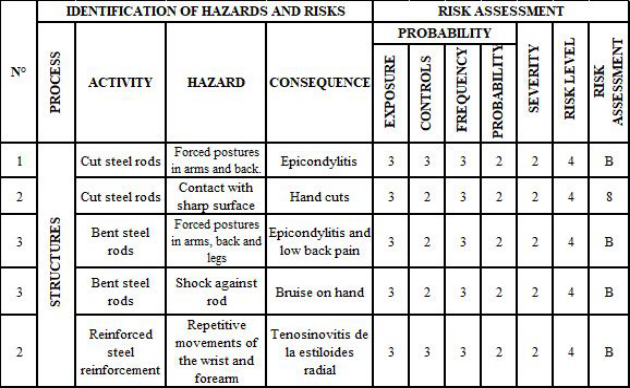
Develop the Hazard Identification and Risk Assessment Matrix The first stage consists of applying the hazard identification and risk asses- sment matrix, identifying safety and ergonomic biomechanical hazards,
68 Corrales and Romero
Figure 1: Identification of hazards and risks.
considering the different postures and movements of workers during the development of their daily activities. Figure 1.
Determine the Critical Activities to Evaluate There are the following steps:
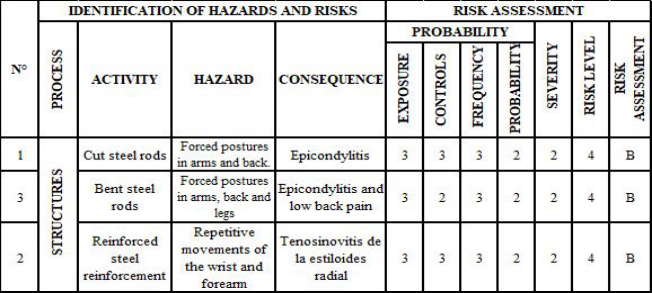
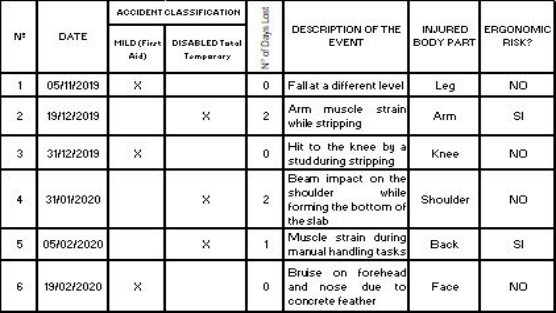
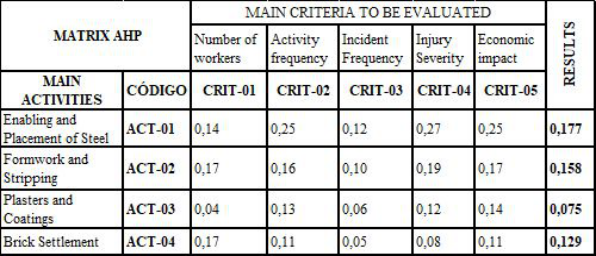
a. Identification of activities with ergonomic hazards. Identification of acti- vities with ergonomic hazards of the musculoskeletal type based on the hazard identification matrix and risk assessment based on the risk assessment matrix, Figure 2. b. Accident Rate. Use of Worksite Accident Rate Indicators, to validate that ergonomic risk activities are really important, Figure 3. c. Determine the critical activities Determine the critical activities using the Analytical Hierarchy Method (AHP) in order to prioritize and define those activities of the project in execution that will be studied, Figure 4.
As can be seen in this extract of results, the priority activity is Installation and Placement of Steel, followed by formwork and stripping, and so on. In this way, the priority of the activities to be evaluated is determined.
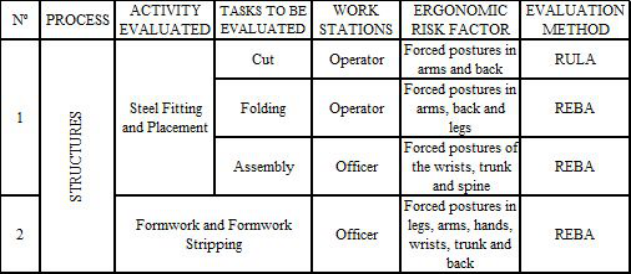
Determination of the Ergonomic Evaluation Methods to be Applied In each of the critical activities and based on the identified hazards, evaluation methods are proposed according to the characteristics of the activities.
Application of Evaluation Methods As the case may be, REBA, RULA, OCRA, NIOSH INDEX or simi- lar will apply. The particularity of this stage is the use of the RULER tool or Angle Measurement Tool between body segments from
Methodology of Ergonomic Evaluation in Construction and Building Works 69
Figure 2: Identification of ergonomic hazards and risks.Figure 3: Ergonomic risks and accident.Figure 4: AHP matrix.
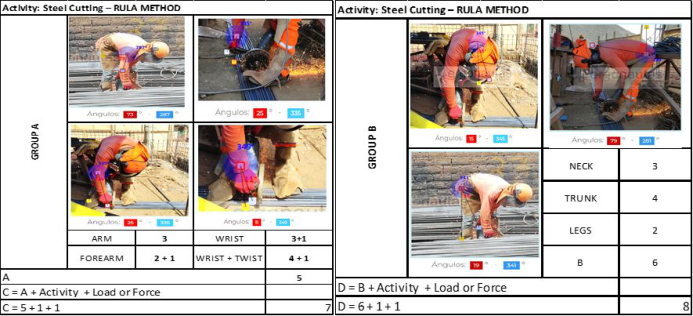
Photographs, an instrument created by the Polytechnic University of Vale- ncia, for this it is necessary to take a sufficient number of photogra- phic shots from different points of view and ensuring that the plane where the angle to be measured is located is parallel to the plane of the camera. (https://www.ergonautas.upv.es/herramientas/ruler/ruler.php), A
70 Corrales and Romero
Figure 5: Ergonomic methods vs risk factors.Figure 6: RULA Method: C and D.Figure 7: RULA methods – FINAL SCORE.
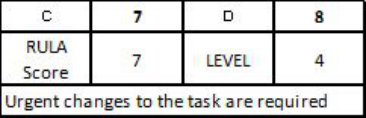
case of those analyzed will be shown. The value obtained after applying the RULA method is 7, which implies a level 4 risk and the recommendation that Urgent changes to the task are required. This is applied to all the sele- cted tasks and a risk profile will be obtained and therefore improvements should be proposed for the activities that have a high level of risk. In the images you can see the angles found with the RULER tool.
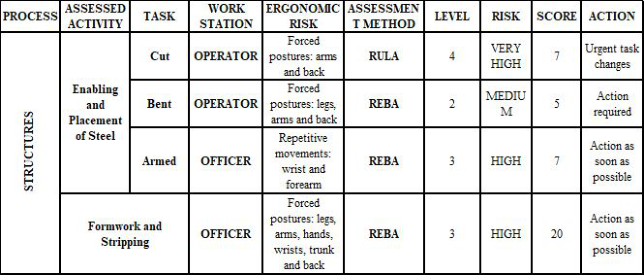
Once the different evaluation methods have been applied, they are sum- marized as can be seen in Figure 9, which is an extract of said summary.
Methodology of Ergonomic Evaluation in Construction and Building Works 71
Improvement proposals For each of the tasks, improvement actions have been determined, which include improvement of postures, use of protective equipment, use of mech- anical equipment, redesign of positions. As an example, the improvement of the Steel Cutting activity is presented. Some of the proposals for improvement are:
Prepare supports to place the steel rods to lift them more easily and work platforms, so that the steel is worked at the same level.
72 Corrales and Romero
Padded safety shoulder pads for moving the steel rods between 02 people, changing shoulders to avoid fatigue and keeping the area completely clean and clear. - Use platforms for the assembly and tying of the steel at height.
Use Electric Steel Ties (battery-powered), also using a coupling-type handle to prevent bending of the trunk.
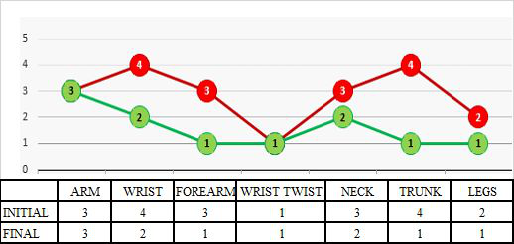
Use electro-hydraulic shears. - Use electric winches for the transfer of Steel Stirrups It is very important to apply the evaluation methods, to check that the level of risk has been reduced. If the level of risk is reduced and is acceptable, the next stage is stopped, which is the economic evaluation of each proposal, and its implementation is scheduled. Simulation of cutting workstation was made using DAZ Studio 4.15 Pro Software and using the RULER tool to measure the angles.
CONCLUSION
Ergonomic analysis is a procedure that relies on methods of Industrial Engineering to identify the current status of individual and overall factory environments to propose improvements in enviornmental designs. This paper shows the evaluation and control of ergonomic risks in the construction works. We’ve shown that if these evaluations are carried out in detail, reliable recommendations for improvement may be obtained. The application of the RULER tool to measure angles from photos and the use of simulators for the evaluation of the improvement proposal is also shown.
REFERENCES
Alghadir, A.; Anwer, S. (2015). Prevalence of Musculoskeletal Pain in Construction Workers in Saudi Arabia. Sci. World J. 529873 Antwi-Afari, M. F.; Li, H.; Edwards, D. J.; Pärn, E. A.; Seo, J.; Wong, A. Y. L (). Bio-
mechanical Analysis of Risk Factors for Work-Related Musculoskeletal Disorders during Repetitive Lifting Task in Construction Workers. Autom. Constr. 2017, 83, 41–47. Anwer, S.; Li, H.; Antwi-Afari, M. F.; Wong, A. Y. L. (2021). Associations between physical or psychosocial risk factors and work-related musculoskeletal disorders in construction workers based on literature in the last 20 years: A systematic review. Int. J. Ind. Ergon., 83, 103113. Bhattacharya, A. (2014). Costs of Occupational Musculoskeletal Disorders (MSDs)
in the United States. Int. J. Ind. Ergon., 44 (3), 448–454. Delin, P. V.; Yamini Roja, S.; Karthika, S. (2020). Analysis of occupational risk factors for ergonomic design of construction work systems, India, Int. Res. J. Eng. Technol. 7 (8), 3577–3581 Francis, J. R.; Deepan, G. A. (2019). Study of Plausible Ergonomic Risk Factors in
Construction Industries and its Effective Remedial Measures, India, Int. Res. J. Eng. Technol., 6 (3), 7106–7111. Häikiö, J.; Kallio, J.; Mäkelä, S.; Keränen, J. (2020). View of IoT-based safety monitoring from the perspective of construction site workers. Int. J. Occup. Environ. Health., 4(1), 1–14.
Methodology of Ergonomic Evaluation in Construction and Building Works 73
Inyang, N.; Al-Hussein, M.; El-Rich, M.; Al-Jibouri, S. (2012). Ergonomic Analysis and the Need for Its Integration for Planning and Assessing Construction Tasks. J. Constr. Eng. Manag., 138(12), 1370–1376. Kim, I. (2017). The Role of Ergonomics for Construction Industry Safety and Health
Improvements, J. Ergon., 7 (2), 1269–1282. Lop, N. S. B.; Salleh, N. M.; Zain, F. M. Y.; Saidin, M. T. (2019). Ergonomic Risk Factors (ERF) and their Association with Musculoskeletal Disorders (MSDs) among Malaysian Construction Trade Workers: Concreters, Pakistan, Int. J. Acad. Res. Bus. Soc. Sci., 9 (9), 1269–1282. Mohana, M.; Mukesh, T. S.; Vettri Indhujha, S. (2019). Ergonomic risk manipula-
tions in construction sphere-A literature review, India, Int. J. Eng. Sci. Invention Res. Dev., 8 (7), 33–39. Osborne, A.; Blake, C.; Fullen, B. M.; Meredith, D.; Phelan, J.; McNamara, J.; Cunningham, C. (2012). Prevalence of Musculoskeletal Disorders among Farmers: A Systematic Review. Am. J. Ind. Med., 55 (2), 143–158 Oviawe, J. I. (2020). Ergonomics Principles as Strategy for Promoting Students’
Acquisition of Psycho-Productive Skills in Building Construction Trade in Tech- nical Colleges in Edo State, Nigeria. Eur. J. Educ., 7 (5), 359–374. Prado, J.; Orlei, A.; de Paula, A.; Colombini, D. (2020). Comparison of RULA and Checklist OCRA Ergonomic Risk Methods for Civil. Ind. Eng. Manag., 19 (4), 790–802. Umer, W.; Li, H.; Szeto, G. P. Y.; Wong, A. Y. L. (2017). Identification of Biomecha-
nical Risk Factors for the Development of Lower-Back Disorders during Manual Rebar Tying. J. Constr. Eng. Manag., 143 (1), 04016080 Umer, W.; Antwi-Afari, M. F.; Li, H.; Szeto, G. P. Y.; Wong, A. Y. L. (2018). The Prevalence of Musculoskeletal Symptoms in the Construction Industry: A Systematic Review and Meta-Analysis. Int. Arch. Occup. Environ. Health, 91 (2), 125–144 Vink, P.; Kompier, M.A.J. (1997). Improving office work: a participatory ergonomic
experiment in a naturalistic setting. Ergon. 40 (4), 435-449. Vink, P.; Koningsveld, E. A. P.; Molenbroek, J. F. (2006). Positive outcomes of participatory ergonomics in terms of greater comfort and higher productivity. Appl. Ergon., 37 (4), 537–546. Wang, D.; Dai, F.; Ning, X. (2015). Risk Assessment of Work-Related Musculoske-
letal Disorders in Construction: State-of-the-Art Review. J. Constr. Eng. Manag., 141 (6), 04015008. Wang, X.; Dong, X.S.; Choi, S. D.; Dement, J. (2017). Work-Related Musculoskeletal Disorders among Construction Workers in the United States from 1992 to 2014. Occup. Environ. Med., 74 (5), 374–380. Yang, K.; Ahn, C. R.; Kim, H. (2020). Deep Learning-Based Classification of Work-
Related Physical Load Levels in Construction. Adv. Eng. Inform., 45 (101104), 101104. Yu, Y.; Yang, X.; Li, H.; Luo, X.; Guo, H.; Fang, Q. (2019). Joint-Level Vision-Based Ergonomic Assessment Tool for Construction Workers. J. Constr. Eng. Manag., 145 (5), 04019025.
LISTED IN THE AHFE DIGITAL BOOKSTORE CATALOGUE
Explore the complete digital volume
Social and Occupational Ergonomics
Read this individual research paper free through the original publisher, or explore the full digital proceedings book.
ISBN 978-1-958651-41-4
Explore this ISBN in the AHFE Bookstore ↗Listed in the July 2026 bookstore catalogue; search by ISBN to confirm current availability · Digital book purchase optional