Ian Barros Guimaraes, Nektarios Karanikas (2022). Insights into human factors at a truck manufacturing company. In: Human Aspects of Advanced Manufacturing. AHFE Open Access, vol. 66, pp. 21–29. https://doi.org/10.54941/ahfe1002684
This study was performed at a truck manufacturing company with three production lines. It employed a paper-based survey with two demographic questions, 16 Likert-type questions covering physical, cognitive and organisational human factors, and three qualitative questions to invite workers to state improvement ideas and current challenges and strengths. The response rate was 35%. The median across the 70 completed surveys for all human factors areas investigated was M=3 out of 4 maximum, except for the quality of instructions (M=2), physical load demands (M=2) and job variety (M=4). Statistically significant differences amongst the three production lines were observed for four human factors aspects. The years of work experience in the company were found significantly and negatively correlated with three human factors aspects. Most of the improvements suggested by the workers were related to organisational and procedural aspects. A similar focus was revealed for the challenges met, whereas collegial relationships were appreciated as the strongest area.
Human factors typically refer to three major areas: physical, organisational, and cognitive. Physical human factors include anthropometric and physi- ological aspects and relate to activities with physical effort, including the interactions between workers and equipment (e.g., physical load, work postu- res and repetitive movements). Cognitive human factors regard areas such as information processing, decision making and perceptions. Organisational human factors focus on the interactions and processes within an organisa- tion, including the work system and its stakeholders (e.g., work pressure, management interactions and job pressure) (Salvendy and Karwowski, 2021).
Examining physical ergonomics can support manufacturing organisations with increasing quality and productivity while ensuring worker wellbeing (Zare et al. 2016). Moreover, considering human factors during the design of new process flows, product concepts can generally benefit the production environment and its workers (Village et al. 2015). Ogbeyemi et al. (2020) verified the relationship between human factors and workers’ performance in a small manufacturing company by evaluating correlations between job rotation, fatigue, satisfaction, and skills with worker performance. Also, cor- relations between work design and performance of employees in the assembly process of a car wire harnessing revealed that poor human factors such as
work monotony negatively impacted products’ quality (Hamrol et al. 2011). Guimaraes et al. (2012) investigated the benefits of improving the workplace by reducing noise levels. The results suggested that investing in workplace organisation is justified from a cost-benefit perspective and involving workers in the changes significantly impacts the health and safety of staff.
Similarly, Ahmadzadeh and Bengtsson (2016) studied the waste generated on production maintenance and revealed its association with human-related factors. Moreover, Fritzsche et al. (2014) examined the effects of team diver- sity and physical workload on the assembly process of a car manufacturing company and showed that effective management of these two factors contri- buted to better work performance and improved productivity. Kolus et al. (2018) reviewed several studies to investigate the impacts of design and management of human factors on system and quality performance. Poorly managed human factors were connected with failures in the processes, low manufacturing performance and quality defects. On the other hand, impro- vements were noticed in manufacturing and quality performance where there were efforts to enhance human factors (Kolus et al. 2018).
STUDY CONTEXT AND OBJECTIVES Australia has high numbers of road freight activity, mainly because of its broad population spread. Therefore, trucks play a crucial role in Australia as the primary connection between different economic sectors and their custo- mers (TIC, 2022). The Australian truck sector generates over 200,000 direct and indirect jobs. It moves more than AUD200 billion worth of products annually, rendering it one of the most crucial Australian economy sectors (Introinto, 2021). To meet the high demands of the sector, the truck manufa- cturing company studied in this research operates with increased flexibility and continual adaptations of the production processes, supported by wor- kers trained in different tasks. However, the company had never studied human factors in its work environment to identify necessary improvements by understanding weaknesses and strengths.
Therefore, this first exploratory research was conducted to investigate how workers perceive various human factors in their work environment that could affect their safety, health, wellbeing, and performance. The overall aim of this study was to support the company in comprehending the state of various human factors in their manufacturing process. Also, the company expres- sed an interest in understanding any differences across its three production lines of how workers perceive these human factors. Thus, apart from the ove- rall strengths and weaknesses, the results would be used to exchange good practices amongst the production lines.
Line 1 prepares both models of trucks the company manufactures, and its main tasks include the fitment of brackets, axles and rails, with an average production of 15 trucks/shift and a cycle time of 33 min/truck. Therefore, it is considered a line with heavy operations and a high production volume. Line 2 produces the customised truck model, with highly varying require- ments from each client and a production volume of five trucks/shift and 99 min/truck cycle time. This production line under-takes the assembly of
Insights into Human Factors at a Truck Manufacturing Company 23
the cabinet, engine, muffler, fuel tanks, tyres and all other main components. Line 3 produces the standard truck model, with a volume of ten trucks/shift and a cycle time of 50 min/truck. Although Line 3 has a lower volume than Line 1 and follows the same assembly sequence as Line 2, it is also considered a high-volume production line with less variability.
METHODOLOGY
A paper-based questionnaire survey was designed by including major human factors areas covered in relevant authoritative books (Kroemer, 2017; Salvendy and Karwowski, 2021) and the articles specific to human factors in manufacturing mentioned in the introduction section above. The questi- onnaire, available to the reader upon request, included two demographic questions (production line and work experience), 16 Likert-type questions about human factors and three open-ended questions. The human factors areas targeted were Encouragement/manager support; Communication; Tea- mwork support; Time pressure; Workload; Job stress; Physical load; Work postures; Workstation layout; Training; Instructions/Standard operation procedures; Tool suitability/adequacy; Job variety; Job rotation; Situation awareness; and Decision making.
Ten company staff from the production, engineering, safety and human resources departments reviewed the survey instrument to ensure its final ver- sion was contextualised to the specific company and comprehensible to its workers. An information sheet explained the research aims and voluntary and confidential participation. For the Likert-type questions, we used a 1-4 scale to avoid the usage of neutral responses and force the participants to choose one trend (Jamieson, 2013; Chyung et al. 2017). The three open questions encouraged workers to state suggestions, challenges and strengths regarding their work environment. The research and survey were approved by the eth- ics committee of the Queensland University of Technology (approval number 4515). The questionnaire was administered in November 2021 to 200 workers of both morning and evening shifts and across the three production lines of the company. The participants were given a week to complete the survey and return it to the secure boxes provided. Afterwards, the data from the answ- ered questionnaires were transferred into an electronic format to allow for their analysis. For the quantitative data, we calculated the median values per question, examined their correlations with work experience and per- formed Kruskal-Wallis tests to investigate statistically significant differences amongst the production lines. The statistical significance level was set to α=0.05.
The qualitative data from the open questions were initially coded and then classified based on the SHELLO framework (Chang and Wang, 2010) per question and production line. This model is used to group interactions betw- een humans (L), software (S) (e.g., rules, procedures), hardware (H) (e.g., tools and equipment), environment (E) (e.g., infrastructure and natural con- ditions), the organisation (O) (e.g., management and leadership) and other persons (L) (e.g., colleagues and other workers). The coding and classification
24 Guimaraes and Karanikas
were cross-checked by the authors of this paper. Following two iterations, we achieved a satisfactory agreement level of 92% (Gwet, 2008). The quan- titative and qualitative analysis results were informally discussed with the company staff who participated in the questionnaire review to offer some first contextual explanations.
RESULTS
Seventy questionnaires were filled and analysed, with n = 11 questionnaires (15.7%) from Line 1, n = 30 (42.9%) from Line 2 and n = 29 (41.4%) from Line 3 and a response rate of 35%. The distribution of the answered sheets across the production lines corresponded to their relative workforce population. The years of work experience in the company ranged from one to 30 years, with an average of 5.5 years.
The overall results showed that the quality of instructions and physical load demands were the weakest areas (M = 2), whereas job variety was highly appreciated by the workers (M = 4). The rest of the areas assessed attracted a median of M = 3. Nonetheless, all human factors areas assessed gathered scores from the whole scale 1-4. The four human factors aspects that pre- sented significant differences amongst the three production lines were time pressure (Line 1 & 3: M = 3, Line 2: M = 2; p = 0.030), stress (Line 1: M = 2, Lines 2 & 3: M = 3; p = 0.032), work postures (Line 1 & 3: M = 2, Line 2: M = 3; p = 0.016) and training (Lines 1 & 2: M = 3, Line 3: M = 2; p = 0.003).
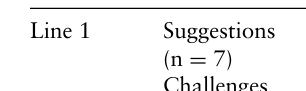
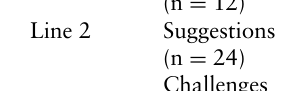
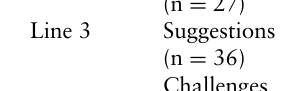
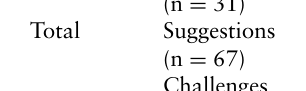
Spearman’s correlations for the records with non-missing values pair- wise (N = 50) revealed significant and negative associations between work experience and the factors of encouragement (r= −0.392, p = 0.005), communication (r= −0.394, p = 0.005) and workstation layout (r= −0.287, p = 0.043). The results from the coding and classification of the qualitative responses are presented in Table 1. Overall, the respon- dents made 67 suggestions, expressed 79 challenges and appreciated 70 strengths of their work environment across all SHELLO interaction categories.
Across the whole sample, Table 1 reveals that suggestions and challenges regarded more frequently the interactions of L-O (i.e., worker–organisation, including aspects such as structure, strategies, vision, management and lea- dership) and L-S (i.e., worker–software, meaning artefacts such as policies, standards and procedures). On the other hand, strengths were mainly linked to L-L interactions (e.g., collegial relationships), followed, nonetheless, by organisational areas (L-O).
The distribution of the frequencies of the SHELLO categories across the production lines indicates that Line 1 made more L-O suggestions, whe- reas Lines 2 and 3 focused more on L-S recommendations. Regarding challenges, Lines 1 and 3 emphasised L-O interactions more often, with Line 2 experiencing challenges more in L-S interactions. In the question about strengths, all production lines appreciated more frequently the L-L interactions.
Insights into Human Factors at a Truck Manufacturing Company 25
Table 1. Results from qualitative analysis.
Table available in the original PDF paper.
Topic Frequencies (N, % across rows) of SHELLO interactions Production line L-L L-O L-E L-H L-S
As the particular factory manufactures multiple truck models with heavy parts and a high level of customisation to the client needs, frontline employees perform their works in a highly variable, “multi-tasking” environment. This, on the one hand, could explain that workers appreciated job variety, but, on the other hand, could also generate difficulties with the quality of instructi- ons, which workers rated low. The results align with Michalos et al. (2010), who revealed challenges related to work instructions and the necessity for multi-skilled labour in highly flexible manufacturing processes. By exten- sion, the unfavourable rate of physical load demands can also be linked to the high variability of tasks that might not allow workers to condition over time and increase their physical work capacity in particular tasks (Armstrong et al. 2019; Wills et al. 2019). Nonetheless, other influential factors related to physical work are worth investigating further in the company (e.g., weight, shape and handles/grips of components, required force to lift, pull, push, etc., supportive equipment for physical work, individual differences and policies for worker-task matching).
The significant differences presented for some of the human factors amongst the production lines can be connected to their different and varying work volume, and pace and accord with the findings by Sakthi Nagaraj and
26 Guimaraes and Karanikas
Jeyapaul (2020) and Hasle et al. (2012), who identified that lean manufactu- ring practices and high-paced lines could influence stress, time pressure and fatigue. Line 2 might experience more time pressures because of the require- ment to maintain its production volume under highly variable client demands for customisation. Line 1 probably has increased stress levels as its produ- ction pace affects both Lines 2 and 3; low productivity in Line 1 could be a bottleneck for the other two lines.
Similarly, the differences in work posture ratings could be connected with the high production volume and pace in Lines 1 and 3. In a similar European company, it was found that the higher the manufacturing pace and volume, the more the workers adapted poor body postures (Nachiappan and Anan- tharaman, 2006). Moreover, differences in the perceptions about the quality and adequacy of training could be attributed to the fact that during the period this study was conducted, the company hired several workers to increase its production volumes, which created additional pressure to provide training. While noting that further examination of this is warranted, it could mean that the company accelerated training and compromised its quality and effe- ctiveness (e.g., novice staff needed more time to assimilate knowledge and develop skills through practice). Nevertheless, this is an area the organisation should seriously consider as poor training can lead to errors, while proper training can improve reliability and reduce product failures (Yeow and Nath Sen, 2003).
While the essential role of effective communication and organisational support has been acknowledged in various work environments (De Nobile, 2017; Gutierrez et al. 2012; Hochwarter et al. 2003), Worley and Doolen (2006) specifically discussed it in lean manufacturing practices. They stated that failing in these aspects could lead to insufficient team development, poor understanding of processes and lack of shop floor involvement in impro- vements. Possibly, the negative correlations between work experience and communication, management support and workstation layouts in the com- pany indicate higher expectations of more experienced workers. This is an area the organisation could investigate further by engaging this worker coh- ort to improve its communication strategies (e.g., frequency, forms, content) and understand what kind of management support is necessary to better the work environment and increase satisfaction and retainment.
The results of the qualitative analysis highlight that the interactions of employees with organisational and procedural parameters are critical areas and deserve attention. During the data coding, the authors observed that the challenges and suggestions regarding the specific interactions mostly referred to communication, training, instructions, and parts delivery. These findings align with the results of the quantitative analysis and could be explained by the status of the Australian market at the time of this study. Massive demand for trucks created pressure on the company to increase its production volumes through more recruitment and requirements for extra work hours and days. Also, the results might associate with the impacts of the Covid-19 pandemic on the global supply chain. The factory faced shortages in semiconductors and different components on all trucks models. This shortage hit the heavy truck industry globally (Cooban, 2021).
Insights into Human Factors at a Truck Manufacturing Company 27
However, the company should further examine whether the results above reflect temporary issues or systemic problems that existed before the adverse conditions above. Furthermore, the different areas the employees of the three production lines focused on when stating challenges and suggestions show opportunities for cross-learning. For instance, Line 2 would share with Lines 1 & 3 practices regarding organisational aspects (e.g., responses to time pres- sure), while the former could support Line 3 in improving local procedures, processes, etc. Similarly, the suggestions made by all production lines can be combined and discussed before they are considered by senior management. Indeed, the appreciation of L-L interactions by the study participants sugge- sts there is a fertile ground to adopt a bottom-up approach and investigate further the findings of this research.
CONCLUSION
This study focused on investigating the operators’ perceptions of 16 human factors in a truck manufacturing company and collecting their views about challenges, strengths, and recommendations related to their work environ- ment. Thirteen out of the 16 human factors we rated as satisfactory by the participants. The lower-than-average rates for work instructions and workload were attributed to the highly variable and demanding production requirements, which, nonetheless, offered job variety that the staff apprecia- ted. The results also suggested that more experienced workers expected from management better communication and more encouragement to participate in improving their work environment.
The statistically significant differences between the three production lines regarding four human factors were attributed to their different manufactu- ring pace and variability of requirements. Moreover, the qualitative analysis showed that, while employees greatly appreciated collegial relationships, they experienced challenges and expressed recommendations for organisational and procedural aspects. Some results could have been shaped by the distur- bances caused during the COVID-19 pandemic and global shortages in the supply chain. Nonetheless, the findings of this first exploratory study in this company could function as opportunities for more profound research and implementing interventions to improve workers’ health, safety, wellbeing, and performance, including sharing best practices and strengths across its production lines. Also, the results of this research could be a comparison basis the company could use to evaluate the effects of its improvement initiatives through a follow-up study.
REFERENCES
Ahmadzadeh, F., Bengtsson, M. (2016). Using evidential reasoning approach for prioritisation of maintenance-related waste caused by human factors—a case study. The International Journal of Advanced Manufacturing Technology, 90(9-12), 2761–2775. https://doi.org/10.1007/s00170-016-9377-7 Armstrong, D. P., Sinden, K. E., Sendsen, J., Macphee, R. S., Fischer, S. L. (2019).
Evaluating the effect of a strength and conditioning program to improve para- medic candidates’ physical readiness for duty. Work, 63(4), 623–633. https: //doi.org/10.3233/WOR-192953
28 Guimaraes and Karanikas
Chang, Y.-H., Wang, Y.-C. (2010). Significant human risk factors in aircraft maintenance technicians. Safety Science, 48(1), 54–62. https://doi.org/10.1016/j.ssci .2009.05.004 Chyung, S. Y., Roberts, K., Swanson, I., Hankinson, A. (2017). Evidence-Based
Survey Design: The Use of a Midpoint on the Likert Scale. Performance Improve- ment, 56(10), 15–23. https://doi.org/10.1002/pfi.21727 Cooban, A. (2021). A global shortage of semiconductor chips has hit the production of heavy-duty trucks, a report says. Accessed 20 October 2021 from https: //www.businessinsider.com.au/global-semiconductor-chip-shortage-hits-heavy-d uty-truck-production-report-2021-9https://www.businessinsider.com.au/global- semiconductor-chip-shortage-hits-heavy-duty-truck-production-report-2021-9 De Nobile, J. (2017). Organisational communication and its relationships with job
satisfaction and organisational commitment of primary school staff in Western Australia. Educational Psychology, 37(3), 380–398. https://doi.org/10.1080/ 01443410.2016.1165797 Fritzsche, L., Wegge, J., Schmauder, M., Kliegel, M., Schmidt, K. H. (2014). Good ergnomics and team diversity reduce absenteeism and errors in car manufacturing. Ergonom-ics, 57(2), 148–161. https://doi.org/10.1080/00140139.2013.875597 Guimaraes, L. B., Ribeiro, J. L., Renner, J. S. (2012). Cost-benefit analysis of a socio-
technical intervention in a Brazilian footwear company. Applied Ergonomics, 43(5), 948–957. https://doi.org/10.1016/j.apergo.2012.01.003 Gutierrez, A. P., Candela, L. L., Carver, L. (2012). The structural relationships between organisational commitment, global job satisfaction, developmental experiences, work values, organisational support, and person-organisation fit among nursing faculty. Journal of Advanced Nursing, 68(7), 1601–1614. https:// doi.org/10.1111/j. 1365–2648.2012.05990.x Gwet, K. L. (2008). Computing inter-rater reliability and its variance in the presence
of high agreement. British Journal of Mathematical and Statistical Psychology, 61(1), 29–48. https://doi.org/https://doi.org/10.1348/000711006X126600 Hamrol, A., Kowalik, D., Kujawi´nsk, A. (2011). Impact of selected work condition factors on quality of manual assembly process. Human Factors and Ergonomics in Manufacturing & Service Industries, 21(2), 156–163. https://doi.org/10.1002/hfm.20233 Hasle, P., Bojesen, A., Langaa Jensen, P., Bramming, P. (2012). Lean and the
working environment: a review of the literature. International Journal of Ope- rations & Production Management, 32(7), 829–849. https://doi.org/10.1108/ 01443571211250103 Hochwarter, W. A., Kacmar, C., Perrewé, P. L., Johnson, D. (2003). Perceived organisational support as a mediator of the relationship between politics perce- ptions and work outcomes. Journal of Vocational Behavior, 63(3), 438–456. https://doi.org/10.1016/S0001-8791(02)00048-9 Introinto. (2021). Introduction To Australia’s Trucking Industry Sector. Accessed 31
August 2021 from https://www.introinto.com.au/trucks/ Jamieson, S. (2013). Likert scale. Encyclopedia Britannica, Accessed 5 September 2021 from https://www.britannica.com/topic/Likert-Scale Kolus, A., Wells, R., Neumann, P. (2018). Production quality and human factors
engineering: A systematic review and theoretical framework. Applied Ergonomics, 73, 55–89. https://doi.org/10.1016/j.apergo.2018.05.010 Kroemer, K. H. E. (2017). Fitting the Human: Introduction to Ergonomics / Human Factors Engineering (7th ed.). CRC Press, Boca Raton.
Insights into Human Factors at a Truck Manufacturing Company 29
Michalos, G., Makris, S., Papakostas, N., Mourtzis, D., Chryssolouris, G. (2010).
Auto-motive assembly technologies review: challenges and outlook for a flexible and adaptive approach. CIRP Journal of Manufacturing Science and Technology, 2(2), 81–91. https: //doi.org/10.1016/j.cirpj.2009.12.001 Nachiappan, R. M., Anantharaman, N. (2006). Evaluation of overall line effectiveness (OLE) in a continuous product line manufacturing system: IMS. Journal of Manufacturing Technology Management, 17(7), 987–1008. https://doi.org/10.1108/17410380610688278 Ogbeyemi, A., Lin, W., Zhang, F., Zhang, W. (2020). Human factors among workers in a small manufacturing enterprise: a case study. Enterprise Information Systems, 1–21. https://doi.org/10.1080/17517575.2020.1829076 Sakthi Nagaraj, T., Jeyapaul, R. (2020). An empirical investigation on association
between human factors, ergonomics and lean manufacturing. Production Planning & Control, 1–15. https://doi.org/10.1080/09537287.2020.1810815 Salvendy, G., Karwowski, W. (2021). Handbook of Human Factors and Ergonomics (5th ed.), John Wiley & Sons, New Jersey. TIC. (2022). Today’s Trucks. Truck Industry Council. Accessed 31 January 2022
from https://www.truck-industry-council.org/todays-trucks Village, J., Searcy, C., Salustri, F., Patrick Neumann, W. (2015). Design for human factors (DfHF): a grounded theory for integrating human factors into produ- ction design processes. Ergonomics, 58(9), 1529–1546. https://doi.org/10.1080/ 00140139.2015.1022232 Wills, J. A., Saxby, D. J., Glassbrook, D. J., Doyle, T. L. A. (2019). Load-Carriage
Conditioning Elicits Task-Specific Physical and Psychophysical Improvements in Males. The Journal of Strength & Conditioning Research, 33(9), 2338–2343. https://doi.org/10.1519/jsc.0000000000003243 Worley, J. M., Doolen, T. L. (2006). The role of communication and management support in a lean manufacturing implementation. Management Decision, 44(2), 228–245. https://doi.org/10.1108/00251740610650210 Yeow, P. H. P., Nath Sen, R. (2003). Quality, productivity, occupational health and
safety and cost-effectiveness of ergonomic improvements in the test workstations of an electronic factory. International Journal of Industrial Ergonomics, 32(3), 147–163. https://doi.org/10.1016/s0169-8141(03)00051-9 Zare, M., Croq, M., Hossein-Arabi, F., Brunet, R., Roquelaure, Y. (2016). Does Ergonomics Improve Product Quality and Reduce Costs? A Review Article. Human Factors and Ergonomics in Manufacturing & Service Industries, 26(2), 205–223. https://doi.org/10.1002/hfm.20623
LISTED IN THE AHFE DIGITAL BOOKSTORE CATALOGUE
Explore the complete digital volume
Human Aspects of Advanced Manufacturing
Read this individual research paper free through the original publisher, or explore the full digital proceedings book.
ISBN 978-1-958651-42-1
Explore this ISBN in the AHFE Bookstore ↗Listed in the July 2026 bookstore catalogue; search by ISBN to confirm current availability · Digital book purchase optional